Ask someone from Da Nang to name the dish that belongs to them — not to Hue, not to Hoi An, not to Hanoi — and most will say banh trang cuon thit heo. It is the city’s contribution to Vietnamese food, and it is almost entirely unknown to visitors who arrive with a list of noodle soups.
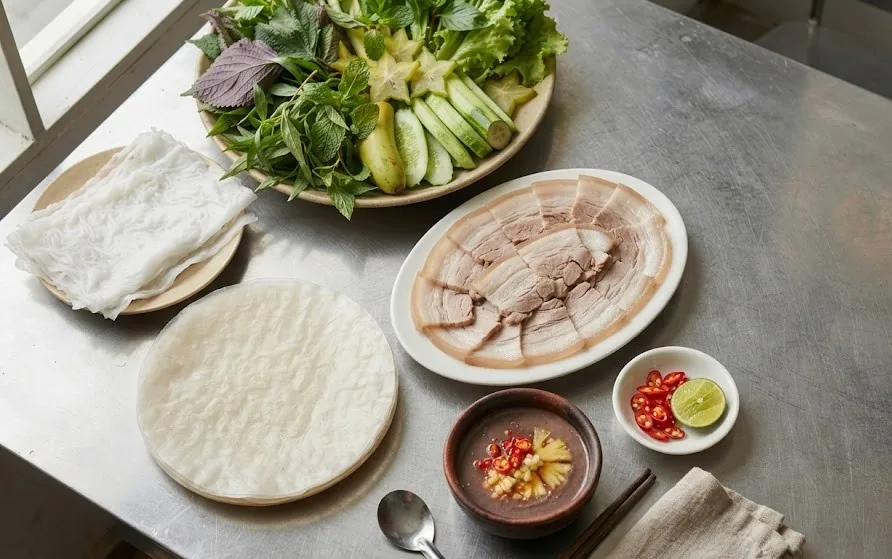
The reason it gets missed is that it doesn’t photograph as a single bowl. What arrives is a table full of components: a plate of boiled pork, a mound of herbs, two kinds of rice paper, and a bowl of fermented anchovy sauce that will divide your table. You assemble it yourself, badly at first, and by the fourth roll you understand why people here eat it once a week.
Quick Summary: Banh trang cuon thit heo is Da Nang’s signature dish — boiled two-skin pork belly rolled at the table with herbs, soft rice paper and a crisp toasted rice sheet, dipped in mam nem. Expect 60,000–160,000 VND for a shared portion. Two Michelin Bib Gourmand shops serve it: Que Xua on Nui Thanh and Phu Hong in Hai Chau. The pork should show a rim of skin on both edges of each slice — that’s the mark of the real thing.
Updated August 2026 · 9 min read · Local writer, Da Nang
What Makes It Different from Other Vietnamese Rolls
Vietnam has hundreds of rolled dishes. This one has three things the others don’t.
The Two-Skin Pork
The defining detail, and the one worth knowing before you order. Proper banh trang cuon thit heo uses thit heo hai dau da — pork cut so that each slice shows a thin rim of skin on both edges, with a band of fat and lean meat between them.
Getting that cut requires a specific piece of the belly and a butcher who knows what they’re doing. Slices with skin on only one side, or no skin at all, mean the shop is cutting corners. It is the single fastest way to judge a place before you taste anything.
The pork is boiled, not grilled or roasted, and served warm rather than hot.
The Double Rice Paper
You get two kinds: banh trang deo, soft and pliable, and banh trang nuong or banh da, a large sheet of toasted rice paper studded with sesame that shatters when you break it.
The crisp sheet goes inside the soft one. That texture contrast — yielding outside, shattering inside — is the entire architecture of the dish, and it’s why the roll doesn’t taste like a spring roll despite containing similar things.
Mam Nem
Not nuoc cham, the diluted sweet fish sauce you get everywhere else. Mam nem is fermented anchovy sauce, thinned with pineapple, garlic, chilli and lime — thick, murky purple-brown, and genuinely pungent.
This is the component visitors either love or refuse. There is no middle position and no polite version. Some shops will bring nuoc cham if you ask, and the dish is noticeably duller for it.
Important note: If you have a shellfish or fish allergy, mam nem is not negotiable — it is the dish. Ask for nuoc mam pha as a substitute, or order banh xeo instead.
The Herbs
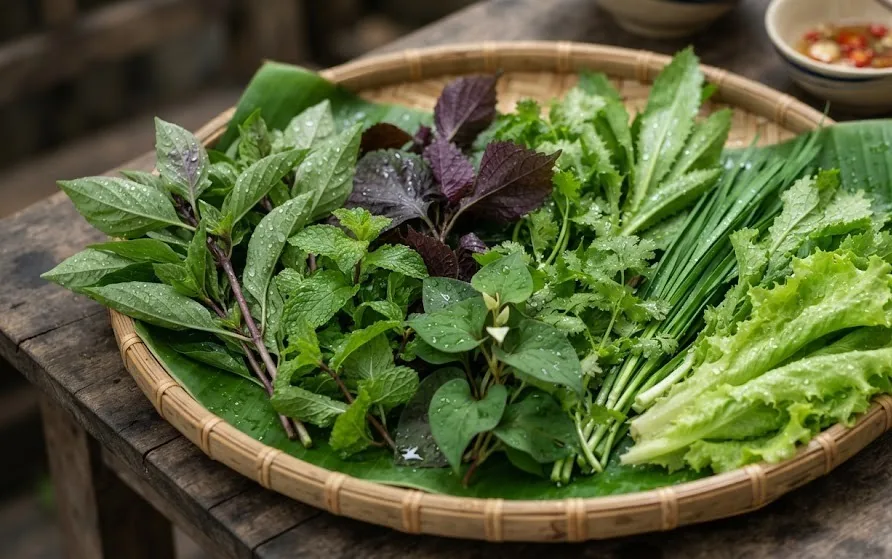
A proper plate carries fifteen to twenty different greens, and they aren’t decoration — they’re most of the volume of each roll.
You’ll typically get lettuce, perilla, Vietnamese coriander, mint, banana flower, cucumber, green mango or unripe banana slices, bean sprouts, and chives. Some shops add boiled rice vermicelli sheets.
One to approach carefully: giap ca, fish mint. Broad heart-shaped leaves with a pungent, faintly metallic flavour that a lot of first-timers dislike. Try a small piece before committing a whole leaf to a roll. Setting it aside is completely normal — locals do it too.
How to Roll It: Four Steps
Nobody will show you, and every table of visitors gets this wrong the same way.
Step 1 — Lay the soft sheet flat. One sheet of banh trang deo on your plate, not in your hand. Working on the plate is the difference between a roll and a mess.
Step 2 — Break the crisp sheet. Snap off a piece of the toasted rice paper roughly a third the size of the soft sheet and lay it in the lower half. Don’t use the whole thing — it will tear its way out.
Step 3 — Build low and long. Two or three slices of pork, then herbs on top, laid lengthwise rather than piled. The most common mistake is overfilling: a roll the thickness of your thumb holds together, a roll the thickness of your wrist does not.
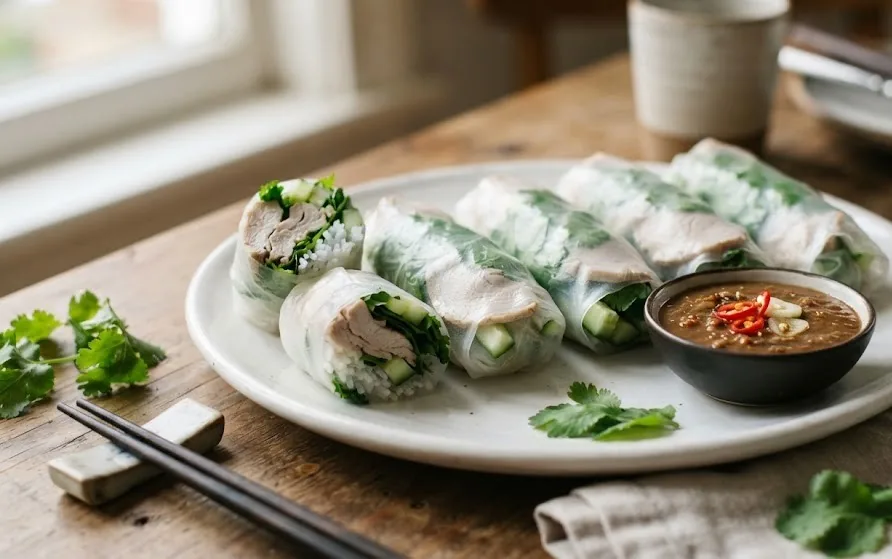
Step 4 — Fold the sides in, then roll away from you. Tight but not crushed. Dip one end in the mam nem — dip, don’t drown — and eat it in two or three bites while it’s still warm.
Common mistake: Waiting to build a stack of finished rolls before eating. The crisp sheet starts softening the moment it meets the herbs. Roll one, eat one.
Where to Eat It in Da Nang
The Michelin Bib Gourmand Options
Que Xua
165–167 Nui Thanh, Hai Chau · Open 06:00–22:30 · 35,000–80,000 VND
Holds a MICHELIN Bib Gourmand and serves essentially two dishes — this and mi Quang. The narrow focus shows: the pork is sliced by hand with even two-skin rims, and the plate arrives fast because the kitchen isn’t doing anything else. The most reliable introduction to the dish in the city, and the easiest for visitors, since the menu is short enough to be self-explanatory.
Phu Hong
Hai Chau · 30,000–100,000 VND per dish
Another Bib Gourmand, in a plain room in the centre. Serves banh trang cuon thit heo alongside mi Quang and bun bo, which makes it a good stop if your group can’t agree.
The Long-Standing Local Names
Quan Mau
35 Do Thuc Tinh, Cam Le · 60,000–160,000 VND per portion
Widely regarded as the benchmark among people who live here, and the shop most often named when you ask a Da Nang local rather than a guidebook. The mam nem is the reason — thicker and more assertive than most.
The trade-off is distance: Cam Le is a fair way from the beach and the centre, and you’ll need a Grab. Portions are large and built for sharing.
Ba Muа
19–21 Tran Binh Trong, Hai Chau
The best-known name in the city and the most set up for visitors — larger, air-conditioned, with a menu that explains itself. Some shops here let you choose between standard two-skin pork and Dai Loc pork, the variety from the Quang Nam district the dish originally comes from.
Convenience costs a little in atmosphere. If you want the version your hotel concierge will recommend, this is it.
Ba Huong
460 Duong 2 Thang 9, Hoa Cuong Bac, Hai Chau · Open around 09:00–22:00
A family recipe for the mam nem is what people come back for. There are additional branches around the city, including on Ngo Gia Tu — quality is reported as consistent across them, which is unusual.
Dai Loc Nho
148 Trung Nu Vuong, Hai Chau · Open 06:30–20:30 · 30,000–79,000 VND
Down an alley, small, and named for Dai Loc — the inland district the dish comes from. The cheapest of the sit-down options and the one that feels least like a restaurant.
The Budget Version
Con Market Food Court
Ong Ich Khiem · Most dishes 20,000–50,000 VND
A plate here costs a fraction of the sit-down shops and the difference is in the room, not the food. The pork is sliced the same way and the herbs come from the market fifty metres away. No English, no menu — point at what the next table is eating.
Read our guide to what to eat in Da Nang for the rest of the market’s food.
What It Costs
| Where | Price per portion |
|---|---|
| Con Market and small alley shops | 30,000–60,000 VND |
| Michelin Bib Gourmand shops | 35,000–100,000 VND |
| Larger sit-down restaurants | 60,000–160,000 VND |
A portion is built for two people. Order one plate between two and add a second if you’re still going — that’s how it’s eaten locally, and it stops the herbs wilting on the table.
Insight: The price gap between a 40,000 VND plate and a 150,000 VND plate is mostly the room, the air conditioning and the portion size. The pork itself doesn’t vary as much as the bill suggests. If you want the dish rather than the dining experience, the cheaper shops are not a compromise.
When to Eat It
Unlike most Da Nang dishes, this one is not a breakfast. Shops open through the day, but it’s eaten at lunch and dinner, and it works best as a shared evening meal with beer.
It’s also one of the few local dishes that doesn’t require an early start — the good shops don’t sell out by 10am the way the noodle places do.
Related on this site
- Banh Bao in Da Nang: 13 Best Steamed Bun Spots (2026)
- Savoring Da Nang’s Suon Nuong: Grilled Pork Ribs
- Da Nang’s Best Goi Cuon: Fresh Spring Rolls for a Healthy Bite
- nem lui in Da Nang
Frequently Asked Questions
What does banh trang cuon thit heo taste like?
Clean and layered rather than rich. The boiled pork is mild, so the flavour comes from the herbs — bright, bitter, sour and aromatic depending on which you pick up — and from the mam nem, which brings salt and a deep fermented funk. The crisp rice paper adds a shatter that keeps the whole thing from being soft. It’s much lighter than it looks.
Is mam nem too strong for first-timers?
It’s the most divisive component in Da Nang’s food. It smells considerably stronger than it tastes, and most people who dislike it are reacting to the smell rather than the flavour. Start with a shallow dip rather than a full coat. If it’s genuinely not working, ask for nuoc mam pha — the sweeter, diluted fish sauce — and you’ll still enjoy the dish, just less than you could.
How much does banh trang cuon thit heo cost in Da Nang?
Between 30,000 VND at a market stall and 160,000 VND at a large sit-down restaurant, for a portion that feeds two. Michelin Bib Gourmand shops like Que Xua sit in the middle at 35,000–80,000 VND. It’s one of the best value-per-person meals in the city because a single portion genuinely stretches.
Where does the dish come from?
Dai Loc, an inland district of the former Quang Nam province, roughly forty kilometres south-west of the city. Since Da Nang merged with Quang Nam on 1 July 2025, the dish’s home district and the city where it’s most famous are formally the same place. Several Da Nang shops still advertise “Dai Loc pork” as a mark of authenticity.
Can vegetarians eat this?
Not in its standard form — the pork and the mam nem are both central. Some chay restaurants make a vegetarian version using tofu skin or mushroom in place of the pork and a fermented soybean sauce instead of mam nem. It’s a different dish that borrows the format, but it’s good.
Is it safe to eat the raw herbs?
At a busy shop, yes. The herbs are the only raw component, and shops that turn over quickly buy them daily and wash them properly. The same rule applies as with all street food here: choose by how full the room is, not by how clean the tablecloth looks.
The Verdict
If you eat one thing in Da Nang that you can’t easily get elsewhere in Vietnam, make it this. Mi Quang travels; banh trang cuon thit heo, done properly with two-skin pork and real mam nem, mostly doesn’t. It’s the dish that tells you which part of the country you’re in.
Start at Que Xua if you want the easy version, or Quan Mau if you’d rather eat where the argument about the best mam nem actually happens. Either way, order one plate between two, roll them thin, and eat each one before you build the next.