While most visitors to Da Nang work through bánh mì and mì Quảng, banh bao — the steamed bun sold from glass-fronted carts and small shopfronts across the city — remains almost entirely off the tourist trail. That is a shame, because it is one of the easiest and cheapest windows into how the city actually eats. A pork-and-quail-egg bun costs less than a bottle of water, and the good ones are made by hand every morning.
This guide covers what banh bao actually is in Vietnam, the fillings you will realistically encounter in Da Nang, and thirteen verified places to buy it — from long-established neighbourhood steamers to the Taiwanese-style bao restaurants that have opened in the last few years. It also covers a name collision that trips up a lot of visitors, and the two-hour rule that separates a great bun from a disappointing one.
Quick Summary: Banh bao in Da Nang costs roughly 12,000–20,000 VND for a standard bun from a street shop, and 35,000–45,000 VND at Taiwanese-style bao restaurants. The core fillings are pork with quail or chicken egg, char siu, salted egg custard (kim sa), vegetarian, and sweet. Buy between 6–8 AM or 3–6 PM when fresh batches come out, avoid buns that have sat in the steamer for hours, and carry small notes — nearly every vendor on this list is cash only.
Earlier editorial update: 22 August 2026 · Reading time: 13 min · Expertise: Vietnamese Street Food & Da Nang Dining
What Banh Bao Actually Is
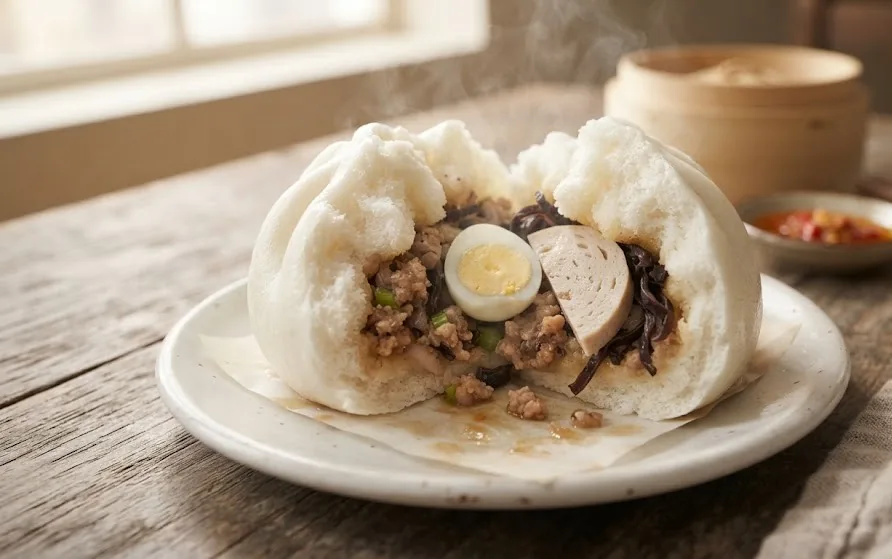
Banh bao is the Vietnamese adaptation of the Chinese bāozi, and the name is a direct phonetic borrowing. The Chinese original traces back to a legend involving the strategist Zhuge Liang, who is said to have devised a filled bun shaped like a human head as a substitute for a ritual sacrifice — the source of the older name mántóu, which entered Vietnamese as màn thầu and now refers specifically to the plain unfilled version.
The Vietnamese version diverged. Vietnamese banh bao is generally smaller than its Chinese counterpart, and the standard savoury filling is a distinct composition: minced pork, wood ear mushroom, shiitake, glass noodles, Chinese sausage, and a quail or chicken egg — sometimes with salted egg added. Regional variation across Vietnam exists but is often overstated in food writing; what you’ll notice more is variation between individual makers.
The Fillings You’ll Actually Find in Da Nang
Important note: Some guides list six or seven distinct Da Nang banh bao “types” with regional names. In practice, vendors here organise their steamers by filling, not by named variety, and you order by pointing and naming the filling. These are the ones you’ll see.
-
Nhân thịt trứng (pork and egg): The default. Minced pork with wood ear mushroom and glass noodles, wrapped around a whole quail egg or half a chicken egg. If you order nothing else, order this.
-
Xá xíu (char siu): Cantonese-style barbecued pork, sweeter and more strongly seasoned than the standard filling. Widely available and often the best thing a given shop makes.
-
Kim sa (salted egg custard): Salted duck egg yolk blended with butter and sugar into a filling that turns molten when steamed. “Kim sa” means golden sand, describing the grainy texture. Sweet with a savoury edge, and the closest thing Vietnam has to a dessert bao.
-
Chay (vegetarian): Mushrooms, tofu and glass noodles. Genuinely good rather than a consolation prize — several Da Nang shops season the vegetarian version with black pepper in a way that makes it the more interesting bun.
-
Phô mai (cheese): A recent addition that has spread fast, usually paired with char siu or with the standard pork filling.
-
Bánh bao chiên (fried): The whole bun deep-fried rather than steamed, giving a crisp shell. Sold alongside bánh tiêu, the hollow sesame doughnut, at the same stalls.
A Name Collision Worth Knowing
Common mistake: Searching for banh bao around Hoi An and ending up with something entirely different. Bánh bao bánh vạc — known in English as White Rose — is a famous Hoi An speciality, but it is not a steamed bun at all. It is a delicate translucent rice-flour dumpling filled with shrimp, pinched into a flower shape and topped with fried shallots.
The two dishes share a word and nothing else. Since the July 2025 merger brought Hoi An inside Da Nang’s city limits, both now appear in searches for Da Nang food, so it is worth knowing which one you are looking for.
Where to Buy Banh Bao in Da Nang
All addresses and hours below were verified in August 2026. Street food hours in Vietnam are aspirational rather than binding — several of these shops close when they sell out.
Neighbourhood Steamers and Specialists
Bánh bao Đức Đại Phát
The most consistently recommended banh bao in central Da Nang, and the one visitors write about most. A small takeaway counter on Lê Duẩn with a genuinely wide range: the standard pork with quail egg, char siu, char siu with cheese, a wholegrain bun, and a vegetarian version that regulars rate as highly as the meat.
Seating is minimal — essentially a stool if the owner brings one out — but the buns come out hot and the operation is friendly enough that people go out of their way to return.
Common mistake: Trusting the posted hours. Multiple visitors have arrived to find the shop closed, most likely because the day’s batch sold out. Go in the morning or early evening rather than mid-afternoon.
Address: 35 Lê Duẩn, Hải Châu · Hours: ~6:00 AM – 10:00 PM (closes when sold out) · Cash only
Bánh Bao Phùng Hoa
A newer handmade operation on Huỳnh Thúc Kháng, and the best-value bun on this list — a standard meat-and-egg banh bao runs around 14,000 VND. The two fillings worth ordering here are the egg custard and the cheese, both of which people single out. Buns are made daily rather than bought in, and the shop also does its own yogurt, which is unexpectedly good and costs very little.
Under the radar on review count, which is exactly why it’s worth including.
Address: 148 Huỳnh Thúc Kháng, Hải Châu · Type: Handmade daily · Cash only
Tiệm bánh bao Nhà Hiền
A home kitchen in Hòa Khánh making buns with fresh yeast rather than commercial baking powder — a distinction you can taste in the crumb, which is softer and less chemically sharp. The char siu is the standout, and the owners will accommodate requests like leaving out cheese without fuss.
They deliver across Da Nang, which makes this the practical choice if you’re staying somewhere central and don’t want to travel out to Hòa Khánh.
Insight: Finding it is genuinely difficult — it’s the last house in a row down a narrow alley off Tô Hiệu. Use the pin, not the street number, and expect to walk the final stretch.
Address: 248/8 Tô Hiệu, Hòa Khánh · Hours: ~7:00 AM – 8:00 PM · Delivery available
Bánh Bao Thọ Phát Chu Văn An
A small food counter running the Thọ Phát product line — one of Vietnam’s best-known industrial banh bao brands — alongside drinks. Reliable rather than artisanal, open long hours, and a reasonable default if you’re in the Chu Văn An area and want something predictable.
Address: 36 Chu Văn An, Hải Châu · Hours: ~6:00 AM – 10:00 PM
Bánh bao Thọ Phát Đà Nẵng (Ích Khiêm)
The larger Thọ Phát outlet on Ích Khiêm, notable mainly for reliably stocking kim sa — the salted egg custard bun — which smaller shops often run out of. The vegetarian version here also draws specific praise for its black pepper and mushroom balance.
Important note: Feedback on this branch is genuinely mixed. Alongside strong reviews for the kim sa and vegetarian buns, at least one customer has raised a serious complaint about the texture and composition of the meat filling. If you’re buying here, the custard and vegetarian options are the safer picks.
Address: Ích Khiêm, Hải Châu · Hours: ~7:00 AM – 9:00 PM
Bánh bao Ba Cu
A long-established local name with more than one location — the Phan Đăng Lưu branch operates on a classic split schedule, opening early for the breakfast trade and again in the afternoon for the evening one. There is a second outlet on Điện Biên Phủ in Thanh Khê run under the Cô Liên name.
Small operations with few reviews between them, but the brand carries weight locally, which in Vietnamese street food is usually a better signal than a review count.
Address: 160 Phan Đăng Lưu, Hòa Cường · Hours: ~6:30–10:00 AM, ~3:00–9:30 PM · Cash only
Address: 476 Điện Biên Phủ, Thanh Khê · Cash only
Bánh Bao Phan Châu Trinh
An evening-only banh bao shop in the centre, priced around 15,000 VND per bun, with a well-seasoned meat and egg filling. Recently dropped the “Ba Cu” element from its signage and now trades under the street name.
Important note: Include this one with a caveat. While some customers rate it among the best they’ve had, others have complained specifically about the dough — too much leavening agent in one account, an off smell in another. Reports are inconsistent enough that it’s worth buying one before buying six.
Address: 53 Phan Châu Trinh, Hải Châu · Hours: ~3:00 – 10:00 PM
Bánh bao mẹ Sam
A very small fresh-bun operation out on Trường Chinh, west of the centre. Praised for a soft, fragrant crumb and a well-balanced filling. Not worth a special trip across town, but a good stop if you’re in An Khê.
Address: 620 Trường Chinh, An Khê
Fried Banh Bao
Bánh Bao Chiên Cao Thắng
A Hà Huy Tập institution that has been frying banh bao and rolling bánh tiêu on the same corner for well over a decade — long enough that regulars remember when the buns cost a fraction of today’s price. The owner fries the sesame doughnuts to order, so they arrive genuinely hot and crisp, and the steamed buns here come with a whole quail egg and a generous mushroom-heavy filling.
Common mistake: Assuming an orderly queue. Service here runs on the owner’s own logic rather than arrival order, and customers regularly report being served after people who came later. Stand close, be visible, and don’t expect a numbered system.
Address: 145 Hà Huy Tập, Thanh Khê · Type: Fried banh bao and bánh tiêu · Cash only
Taiwanese-Style Bao Restaurants
Insight: These are a different dish under a related name. Gua bao — the Taiwanese folded bun — is an open, clamshell-shaped steamed bun that you fill rather than a sealed ball with filling inside. Da Nang has developed a small but strong cluster of these, and they are the only places in the city doing genuinely creative bao work.
Bao.G – Bánh bao kẹp Đài Loan
The most interesting bao restaurant in Da Nang, tucked down an alley off Nguyễn Tri Phương in a space full of deliberately mismatched vintage furniture and old stereo equipment. The menu runs Hong Kong and Taiwanese dishes with Vietnamese inflections.
Order several bao and share. The smoked duck is the reliable pick, the soft-shell crab draws consistent praise, and there is a fried bao filled with vanilla ice cream that works far better than it sounds — the hot-cold contrast is the whole point. Even the plain unfilled bun is worth trying here, which is a fair test of how good the dough is.
Address: 432 Nguyễn Tri Phương, Hòa Cường · Hours: ~10:30 AM – 10:30 PM
BAO FAM
A Taiwanese-style bao and rice restaurant on Trưng Nữ Vương with a broad menu covering both meat and vegetarian bao, braised pork belly with sticky rice, and a spicy noodle soup that regulars rate highly. Bao run around 35,000 VND each and each has a distinctly different texture and flavour rather than being variations on one base.
The room is small and gets warm, and it works well for takeaway or delivery. Split-shift hours, so check before making the trip.
Address: 562–564 Trưng Nữ Vương, Hòa Cường · Hours: ~10:00 AM – 2:00 PM, ~4:30 – 9:30 PM
Where to Find Banh Bao Chay
Vegetarian banh bao is available year-round at most of the shops above — Đức Đại Phát and the Thọ Phát outlets both carry it — but demand spikes on the first and fifteenth days of each lunar month, when a significant portion of Da Nang eats vegetarian.
Important note: On those two days, arrive early and expect queues at vegetarian establishments city-wide. Several of the city’s best-regarded vegetarian restaurants — Quán Thế Âm on Võ Nguyên Giáp and at Đầm Rong, Shanti Vegan on Lê Đình Lý, Vạn Bảo on Vân Đồn, and Bảo Long on Lê Độ — become significantly busier and slower on the 1st and 15th. If your visit falls on one of those dates and you want vegetarian food without the wait, buy banh bao chay from a regular bun shop in the morning instead.
How to Buy and Eat Banh Bao Like a Local
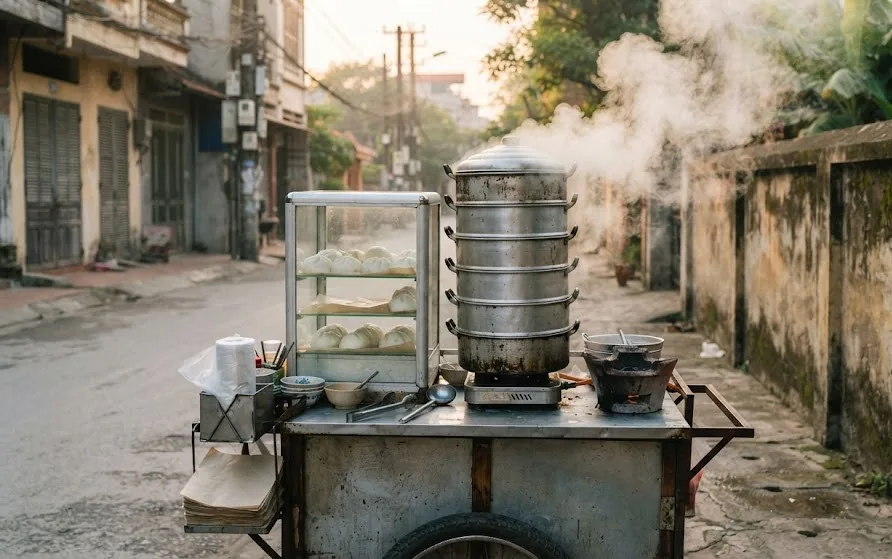
Step 1 – Timing: Two windows matter. The first batch of the day comes out between 6 and 8 AM, and a second batch goes into the steamer in the late afternoon, roughly 3 to 6 PM. Buns that have sat in a warm steamer for hours go dense and the filling dries out — this is the single biggest difference between a great banh bao and a mediocre one, and it has nothing to do with the vendor’s skill.
Step 2 – Ordering: Point and name the filling. Nhân thịt for pork, xá xíu for char siu, kim sa for salted egg custard, chay for vegetarian, phô mai for cheese. Hold up fingers for quantity. Nobody expects tonal accuracy and the transaction takes ten seconds.
Step 3 – Payment: QR bank transfer is now standard for Vietnamese customers, and most stalls display a VietQR code. Without a Vietnamese bank account you need cash, and small notes matter — a vendor selling 14,000 VND buns will struggle with a 500,000 note first thing in the morning.
Step 4 – Eating: Peel the paper base away rather than unwrapping from the top. Bite a small opening first and let the steam escape before committing, particularly with kim sa, where the molten filling can genuinely burn. Eat standing up, near the cart, within about a minute of purchase. It does not improve in a bag.
Common mistake: Buying six buns for later. Banh bao is at its best in the first few minutes and declines steadily after that. If you do need to keep some, they re-steam acceptably for five to seven minutes but never quite recover.
Data: Da Nang’s accommodation establishments served over 17.6 million. Following the July 2025 merger with Quang Nam province, the city now covers approximately 11,859 km² and includes Hoi An — bringing bánh bao bánh vạc, the White Rose dumpling, inside Da Nang’s boundaries alongside the city’s steamed bun scene. Figures per Da Nang Department of Culture, Sports and Tourism reporting and National Assembly Resolution 202/2025/QH15.
What to Drink With It
Banh bao is a breakfast and snack food, and the pairings follow accordingly. Cà phê sữa đá — iced coffee with condensed milk — is the standard morning combination, and the coffee’s bitterness genuinely does cut the richness of a pork-and-egg bun. Sữa đậu nành (soy milk), sold hot from the same carts in the early morning, is the more traditional pairing and the one you’ll see locals choose.
For an afternoon kim sa bun, unsweetened tea works better than anything sweet, because the filling is already carrying substantial sugar. Skip sugarcane juice with the sweet fillings unless you have a high tolerance.
How to Choose
|
If you want… |
Order… |
Typical price |
Best window |
|---|---|---|---|
|
The default experience |
Nhân thịt trứng |
12,000–15,000 VND |
6–8 AM |
|
Something sweeter and richer |
Xá xíu |
15,000–20,000 VND |
Any |
|
A molten, dessert-like bun |
Kim sa |
15,000–20,000 VND |
Afternoon |
|
Lighter, pepper-forward |
Chay (vegetarian) |
12,000–15,000 VND |
Morning |
|
Crisp rather than soft |
Bánh bao chiên |
10,000–15,000 VND |
Afternoon |
|
A proper sit-down meal |
Taiwanese gua bao |
35,000–45,000 VND each |
Lunch or dinner |
Future Trends in Da Nang’s Banh Bao Scene
Insight: The interesting movement is at the two ends — small home kitchens using fresh yeast and selling by delivery, and Taiwanese-style bao restaurants treating the bun as a restaurant dish. The middle, dominated by industrial brands, is where the least is happening.
-
Home Kitchens with Delivery: Operations like Nhà Hiền point to where the quality end is heading — small batches, fresh yeast, and a delivery radius rather than a shopfront. Lower overhead, better product.
-
Cheese as a Standard Filling: Cheese banh bao has moved from novelty to menu staple in a few years, and is now offered at shops that otherwise stick to tradition.
-
Gua Bao Growth: Taiwanese folded bao are still a small category in Da Nang but growing, and they carry much better margins than 14,000 VND street buns. Expect more openings.
-
Hoi An Integration: Post-merger, expect food guides to increasingly present the city’s steamed buns and Hoi An’s White Rose dumplings together, despite them being unrelated dishes.
Frequently Asked Questions
What is the difference between banh bao and Chinese baozi?
Banh bao is the Vietnamese adaptation of bāozi. Vietnamese versions are generally smaller, and the standard savoury filling is distinctly Vietnamese: minced pork with wood ear mushroom, shiitake, glass noodles, Chinese sausage, and a quail or chicken egg. Chinese baozi covers a far broader range of fillings, from red bean paste to vegetables.
How much should banh bao cost in Da Nang?
Roughly 12,000–20,000 VND for a standard bun from a street shop or takeaway counter, with the cheapest handmade options around 14,000 VND. Taiwanese-style gua bao at sit-down restaurants run 35,000–45,000 VND each, which reflects a different dish rather than a markup.
What is bánh bao kim sa?
A steamed bun filled with salted duck egg yolk blended with butter and sugar, which turns molten during steaming. The name means “golden sand,” describing the texture. It is sweet with a savoury undertone and should be eaten immediately, carefully — the filling gets extremely hot.
Is bánh bao bánh vạc the same thing?
No. Bánh bao bánh vạc, or White Rose, is a Hoi An shrimp dumpling made from translucent rice flour and shaped like a flower. It shares the word “bánh bao” and nothing else. Since the 2025 merger, both appear in Da Nang searches.
Can I find vegetarian banh bao?
Yes, widely — most shops carry a chay version, and several season it well enough that it competes with the meat filling. Availability is highest on the 1st and 15th of each lunar month, when much of the city eats vegetarian, though queues are longer on those days.
Is banh bao gluten-free?
No. The dough is wheat flour based. Rice-flour alternatives exist in Vietnamese cuisine but they are different dishes, not gluten-free banh bao.
What time should I buy it?
Between 6 and 8 AM for the first batch, or 3 to 6 PM for the second. Avoid buying from a steamer that has clearly been sitting — the dough goes dense and the filling dries out within about two hours.
Do vendors take cards?
Almost never. QR bank transfer is what Vietnamese customers use, and it isn’t accessible to most foreign visitors. Carry cash in small denominations.
Is Hoi An part of Da Nang now?
Yes. The July 2025 merger of Da Nang City and Quang Nam province brought Hoi An inside Da Nang’s city limits.
Conclusion
Banh bao rewards a small amount of attention out of proportion to what it costs. The difference between an excellent bun and a forgettable one comes down to two things: whether it was made with fresh yeast that morning, and how long it has been sitting in the steamer since. Neither is complicated to check — go early, look for a shop where the batch is visibly moving, and buy one before you buy several.
The practical route through this list is simple. Start at Đức Đại Phát on Lê Duẩn for the standard pork-and-quail-egg bun, which is the reference point everything else gets measured against. Try a kim sa in the afternoon when the custard is freshly made. Then, if the dish has caught your interest, go to Bao.G in the evening and see what happens when the same basic technique gets treated as restaurant cooking. Three stops, well under 200,000 VND, and a much clearer picture of Da Nang than another bowl of mì Quảng would have given you.
Vendors, addresses and hours were verified in August 2026. Street food operating hours in Vietnam are approximate — many shops close early when the day’s batch sells out, and several on this list are reported to do so regularly. Prices reflect typical ranges observed and shift with ingredient costs. Where customer feedback on a vendor is inconsistent, this has been noted rather than omitted. Administrative changes are per National Assembly Resolution 202/2025/QH15 and Standing Committee Resolution 1659/NQ-UBTVQH15.
Part of our guide to what to eat in Da Nang.