Da Nang’s Best Vietnamese Pancakes: Banh Xeo and Banh Khot 2026 is a guide to two of central Vietnam’s most beloved street foods — the large, crispy banh xeo and its bite-sized cousin, banh khot. Da Nang sits right in the middle of Vietnam’s culinary heartland, where rice flour, turmeric, and fresh herbs come together in sizzling cast-iron pans. This guide covers seven highly-rated spots locals frequent, how to eat both dishes properly, and a full-day food tour route that pairs pancakes with the city’s top sights.
Banh xeo and banh khot share the same rice-flour batter but diverge in size, texture, and eating style — one is a shareable crepe you wrap in rice paper, the other a single-bite cup you pop straight into your mouth. Da Nang’s version leans extra crispy thanks to the central region’s preference for thin batter and high heat. The average cost per person lands between 50,000 and 100,000 VND, making this one of the most affordable ways to eat like a local in 2026.
Da Nang’s Vietnamese Pancake Scene: Banh Xeo vs. Banh Khot
Why Da Nang is the epicenter for crispy Vietnamese pancakes
Da Nang’s location in central Vietnam puts it at the crossroads of three distinct culinary traditions: the salty, bold flavors of the north, the sweet and spicy notes of the south, and the herb-heavy, refined style of Hue to the north. This geographic sweet spot means the city’s banh xeo and banh khot inherit the best of all worlds. The central region’s climate — hot and dry for much of the year — also plays a role.
High ambient heat means batter crisps up faster, and locals have perfected the technique of using less oil and higher flame to achieve that signature shatter-crisp texture.
The city’s culinary reputation has grown steadily over the past decade, with food-focused travelers now planning entire itineraries around Da Nang’s street food scene. Unlike Hanoi’s cha ca or Ho Chi Minh City’s broken rice, Da Nang’s claim to fame has always been its pancakes. The dish appears on nearly every local menu, from humble sidewalk stalls to riverside restaurants, and the competition keeps quality consistently high.
The 2026 foodie landscape: what’s changed and what’s trending
The 2026 food scene in Da Nang looks noticeably different from five years ago. Social media food content — particularly short-form video — has pushed once-hidden local stalls into the spotlight. Ba Duong, the city’s most famous banh xeo spot, now draws queues that stretch around the block during peak hours, a phenomenon that barely existed in 2026. This visibility cuts both ways: popular spots get more attention, but quality sometimes dips as vendors scale up to meet demand.
Another shift is the rise of upscale interpretations. Restaurants like Apsara and Madame Lan have elevated the humble pancake into a sit-down dining experience, complete with air conditioning, proper table service, and refined plating. Meanwhile, the 2026 travel trend toward “authenticity” has pushed visitors toward markets and family-run stalls rather than generic tourist restaurants. The result is a two-tier system: street-level authenticity for the purists, and polished versions for those who want comfort alongside their crispy batter.
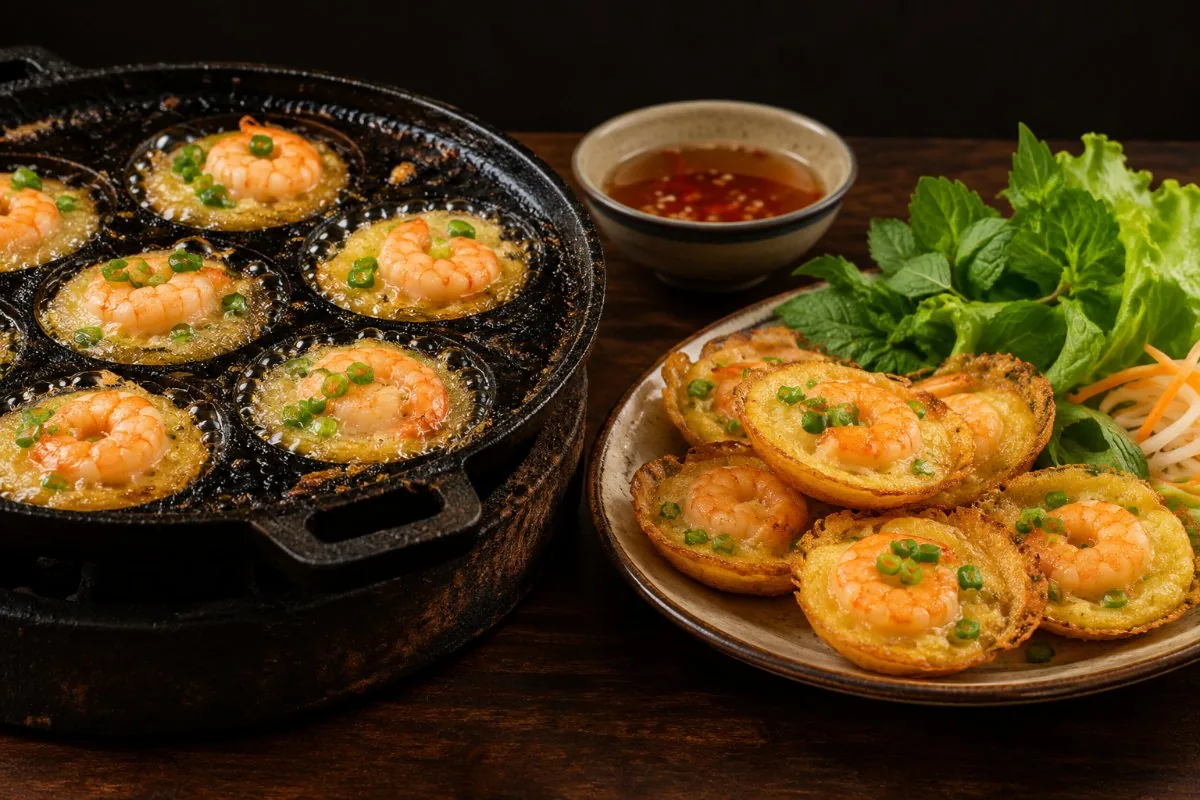
Banh Xeo and Banh Khot: What Sets Them Apart?
The anatomy of a Banh Xeo: size, batter, and fillings
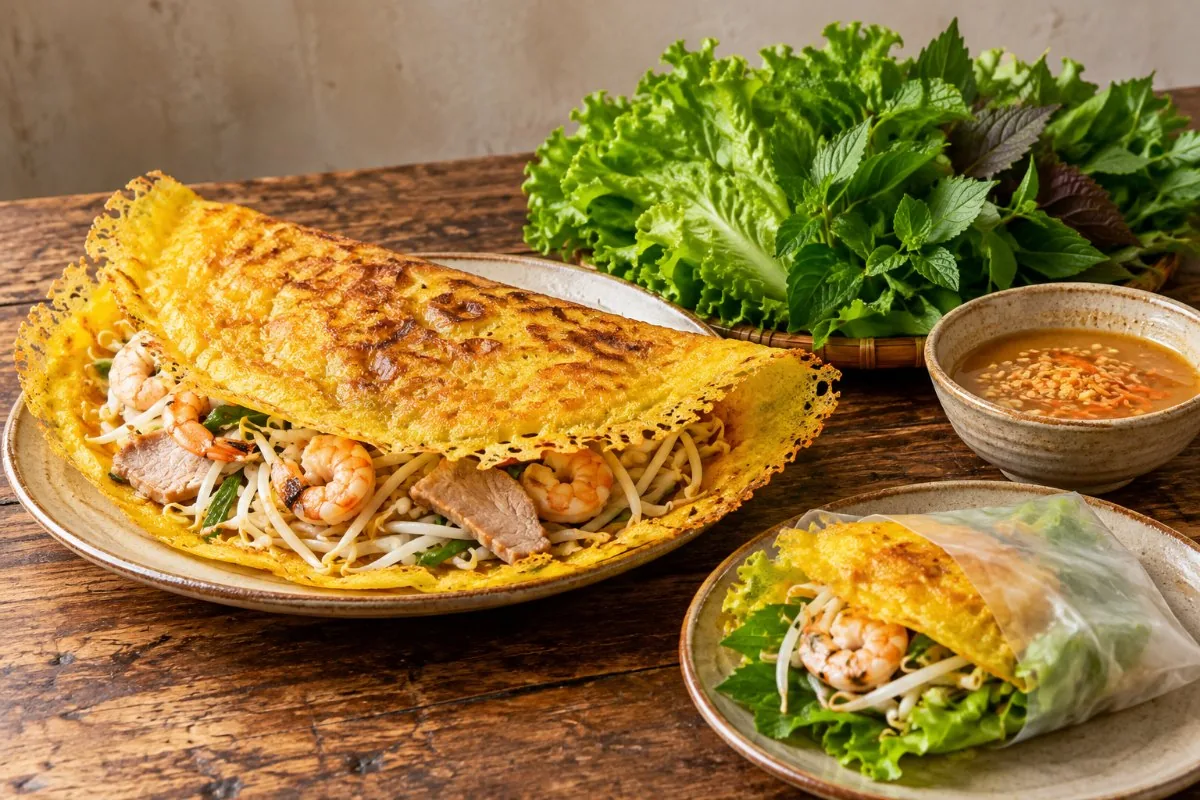
Banh xeo translates roughly to “sizzling cake,” named for the loud hiss when batter hits the hot pan. The classic Da Nang version is a large, thin crepe — typically 25 to 30 centimeters across — folded in half like an omelet. The batter combines rice flour, turmeric powder, and coconut milk or coconut soda, which gives the pancake its signature golden-yellow color and a hint of sweetness. The filling stays simple: pork belly, whole shrimp, and fresh bean sprouts, all cooked together so the sprouts soften while the edges of the crepe turn deep golden and crisp.
What makes Da Nang’s banh xeo distinct from southern versions is the crispness. In Ho Chi Minh City, the crepe tends to be thicker and softer. In Da Nang, vendors use a thinner batter and a hotter pan, producing a pancake that shatters when you bite into it. The filling ratio also leans heavier on the bean sprouts, which add a juicy crunch that contrasts with the crispy shell. You eat banh xeo by tearing off a piece, wrapping it in rice paper with fresh herbs, and dipping it in nuoc cham.
The anatomy of a Banh Khot: miniature, savory, and topped
Banh khot is essentially banh xeo’s smaller, more refined sibling. The batter is nearly identical — rice flour, turmeric, coconut milk — but instead of one large crepe, vendors pour the batter into a special pan with round indentations, creating dozens of small, cup-shaped pancakes about the size of a silver dollar. Each one gets topped with a whole shrimp, sometimes a bit of green onion, and occasionally a quail egg. The edges crisp up against the hot pan while the center stays slightly soft, creating a texture contrast in every single bite.
The eating style differs too. Banh khot doesn’t require wrapping in rice paper — you pick one up with chopsticks, add a few herbs and a slice of pickled carrot, then dip the whole thing in nuoc cham. This makes banh khot the more convenient option for casual snacking or for travelers who want to try multiple dishes in one sitting. In Da Nang, banh khot is often served as a platter with a basket of herbs, a bowl of dipping sauce, and a small plate of pickled vegetables on the side.
Which one should you order first? A quick decision guide
If you can only try one, start with banh xeo at Ba Duong — it’s the city’s signature dish and the version that put Da Nang on the food map. Order banh khot when you want something lighter, easier to eat, or when you’re planning to sample other street foods afterward. The table below breaks down the key differences to help you decide.
| Feature | Banh Xeo | Banh Khot |
|---|---|---|
| Size | Large crepe, 25-30 cm across | Bite-sized, ~4 cm diameter |
| Batter | Rice flour, turmeric, coconut milk | Rice flour, turmeric, coconut milk |
| Fillings | Pork belly, whole shrimp, bean sprouts | Shrimp on top, sometimes quail egg |
| Texture | Thin, shatter-crisp edges | Crispy edges, soft center |
| Eating style | Wrap in rice paper with herbs | Pick up directly, dip in sauce |
| Portion | 1-2 pieces per person | 10-15 pieces per plate |
| Best for | Main meal, sharing | Snack, appetizer, grazing |
The 7 Best Places for Banh Xeo and Banh Khot in Da Nang
1. Ba Duong: The legendary Banh Xeo institution
Ba Duong, located at 12 Trung Nu Vuong Street in the Hai Chau district, is the most famous banh xeo spot in Da Nang — and for good reason. This family-run operation has been serving the same recipe for decades, and the quality has never wavered. The signature dish is a large, extra-crispy banh xeo loaded with whole shrimp and fatty pork belly. Expect to pay around 60,000 VND per person. Go early (before 11 AM) or late (after 6 PM) to avoid the worst of the queue.
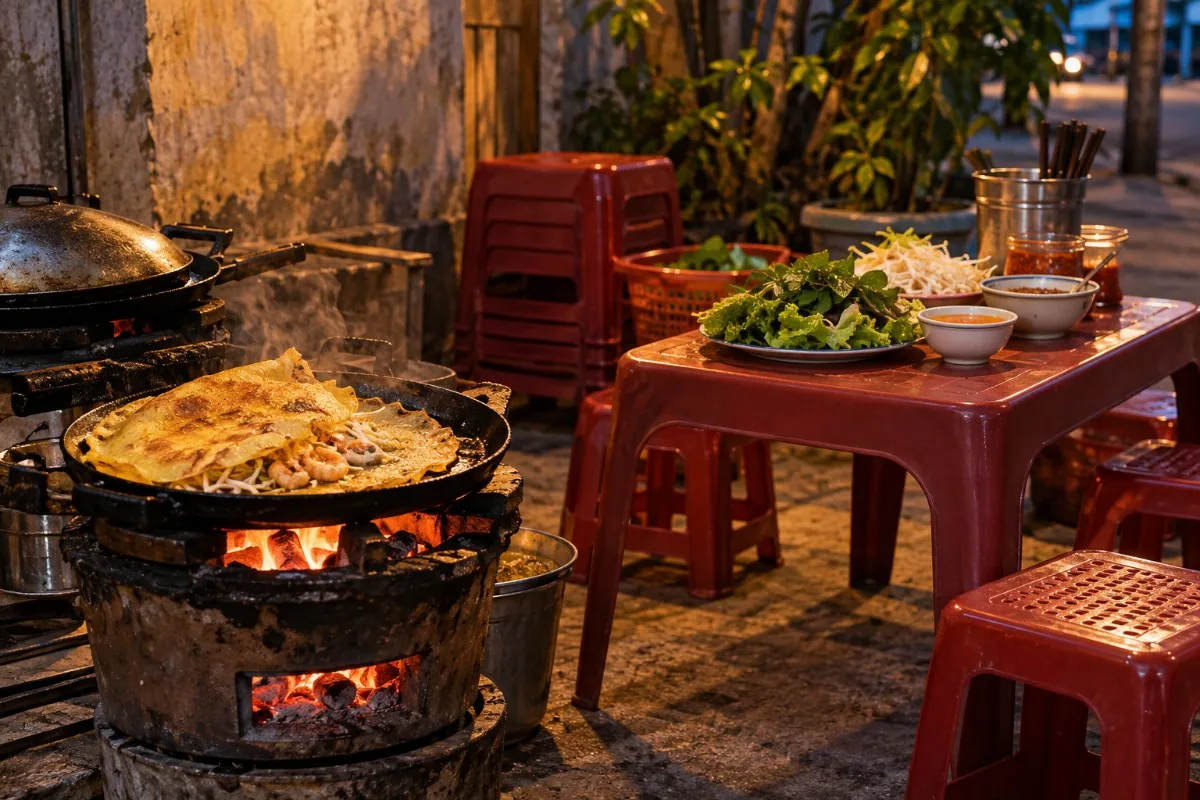
The seating is plastic stools on the sidewalk, so dress casually and come hungry.
2. Banh Xeo Tom Nhay: Where the shrimp still dance
Banh Xeo Tom Nhay, which translates to “dancing shrimp pancakes,” sits at 34 Lo 12 Dien Bien Phu Street. The name comes from the live shrimp that are thrown onto the hot pan — they literally jump before cooking. This spot is less touristy than Ba Duong and offers a slightly thicker, more substantial crepe. The shrimp are sweeter and fresher here, and the portion size is generous. A full meal for two with drinks runs about 150,000 VND. The restaurant has both indoor seating and a small outdoor area, making it a good option on rainy days.
3. Hai San Be Man: A local favorite for both dishes
Hai San Be Man, at 59 Nguyen Chi Thanh Street, is the place locals recommend when they want both banh xeo and banh khot at the same table. The menu covers both dishes, plus a range of seafood options that pair well with the pancakes. The banh khot here comes with a generous shrimp topping and a slightly sweeter batter than average. Prices are reasonable — around 50,000 VND per dish — and the staff is used to guiding first-timers through the menu. The restaurant fills up fast during dinner hours, so arrive before 6:30 PM to secure a seat.
4. Quan Com Hue Ngon: A Central Vietnamese twist
Quan Com Hue Ngon, located at 47 Nguyen Chi Thanh Street, brings a Hue-style interpretation to Da Nang’s pancake scene. The banh xeo here is smaller and thinner than the Da Nang standard, with a more delicate crispness and a lighter hand with the turmeric. The accompanying herbs are more varied — expect perilla, mint, and even shredded banana flower. This is the spot to visit if you want to taste how the dish evolves across central Vietnam. Prices sit around 55,000 VND per person, and the restaurant offers both indoor and outdoor seating.
5. Banh Khot Co Ba: The queen of crispy mini-pancakes
Banh Khot Co Ba, at 14 Lo 12 Dien Bien Phu Street, is Da Nang’s most celebrated banh khot specialist. The restaurant uses a traditional cast-iron pan with deep indentations, which produces an exceptionally crispy edge on every single mini-pancake. The topping is a whole fresh shrimp, and the batter is mixed with coconut cream for extra richness. A plate of 15 pieces costs 70,000 VND and comes with a generous basket of herbs and a bowl of nuoc cham.
This is a sit-down restaurant with proper tables and fans, making it comfortable even during the hottest hours of the day.
6. Apsara: An upscale dining experience
Apsara, located at 222 Tran Phu Street along the Han River, offers a refined take on traditional Vietnamese cuisine, including both banh xeo and banh khot. The portions are smaller and the presentation is elegant — the pancakes arrive on banana leaves with artistically arranged herbs. This is the place to bring someone who wants the authentic flavors without the plastic-stool experience. Prices are higher, around 120,000-150,000 VND per dish, but the riverside setting and air conditioning justify the premium. Book a table on the terrace for sunset views over the Han River.
7. Madame Lan: A reliable choice for first-timers
Madame Lan, at 4 Bach Dang Street, is a sprawling restaurant that serves a little bit of everything Vietnamese, including solid versions of both pancakes. The banh xeo here is textbook-correct: crispy, golden, and loaded with shrimp and bean sprouts. The restaurant is huge, with multiple dining rooms and a garden area, so you rarely wait for a table. Prices are mid-range at 80,000-100,000 VND per person. This is the safest bet for travelers who want a comfortable, predictable meal with English-speaking staff and a menu full of photos.
How to Eat Banh Xeo and Banh Khot Like a Local
The proper wrapping technique with rice paper and greens
Eating banh xeo correctly takes a bit of practice, but the technique is easy to master. Start by taking a piece of rice paper and laying it flat on your plate. Add a leaf of lettuce, a few mint leaves, and a slice of perilla if available. Tear off a chunk of the banh xeo — about the size of two fingers — and place it on top of the greens. Add a slice of pickled carrot and a piece of cucumber if your plate includes them.
Now fold the bottom edge of the rice paper over the filling, fold in the sides, and roll it up tightly like a spring roll. The goal is a neat, compact bundle that you can dip without falling apart.
The key is to not overstuff. A banh xeo wrap that’s too thick won’t fit in your mouth comfortably, and the filling will spill out when you bite. Start with a smaller piece of pancake than you think you need — you can always add more. Dip the entire bundle into the nuoc cham, letting the sauce soak into the rice paper for a second before eating. The combination of crispy pancake, crunchy vegetables, and tangy-sweet sauce is the full banh xeo experience.
Mastering the dipping sauce: nuoc cham and its variations
Nuoc cham is the soul of the banh xeo experience. The standard version combines fish sauce, lime juice, sugar, water, minced garlic, and sliced chili. The proportions vary by region and by vendor. Da Nang’s version tends to be slightly sweeter and less salty than the north’s, with a more prominent lime flavor. Some restaurants add shredded green papaya or carrot to the sauce, turning it into a light pickle that adds crunch to every dip.
When you sit down at a pancake spot, taste the nuoc cham first. If it’s too salty, add a squeeze of lime. If it’s too sweet, ask for extra chili or a splash of fish sauce. The perfect nuoc cham should hit all four tastes: salty from the fish sauce, sweet from the sugar, sour from the lime, and spicy from the chili. Banh khot often comes with a slightly thicker, richer version of the sauce, sometimes with a bit of coconut milk mixed in for extra body.
What to drink alongside your pancakes
The classic accompaniment to banh xeo and banh khot is a cold, refreshing drink that cuts through the richness of the fried batter. The most popular choice is tra da, or iced tea, which is served free at most street stalls. The slightly bitter, unsweetened tea cleanses your palate between bites and helps cool you down in Da Nang’s heat. For something sweeter, try nuoc mia (fresh sugarcane juice) or a young coconut. Both are widely available at stalls near the pancake restaurants.
If you’re eating at a sit-down restaurant like Apsara or Madame Lan, consider a fresh fruit smoothie or a Vietnamese iced coffee (ca phe sua da) to round out the meal. Beer drinkers should try a local Bia Da Nang or Bia Hoi, the fresh draft beer that’s poured daily across the city. The light, crisp beer pairs surprisingly well with the savory, slightly sweet pancakes — a combination that locals have enjoyed for generations.
The 2026 Food Tour Route: Combining Pancakes with Da Nang’s Highlights
A morning market visit and a Banh Xeo breakfast
Start your day at Han Market (Cho Han) in the city center, where vendors set up by 6 AM. Wander the stalls to see the day’s catch — whole shrimp, live crabs, and buckets of fish — and grab a strong Vietnamese coffee from one of the market’s small cafes. By 8 AM, walk the five minutes to Ba Duong for a classic banh xeo breakfast. The queue is shorter in the morning, and the pancakes are freshly cooked in batches.
Order one banh xeo and a plate of herbs, and eat it the local way: wrapped, dipped, and washed down with iced tea.
An afternoon exploring Son Tra Peninsula and a Banh Khot snack
After your breakfast, rent a motorbike or hire a Grab car for the drive to Son Tra Peninsula, the lush forested headland that juts into the East Sea. Spend the morning hiking to the Linh Ung Pagoda, home to a 67-meter-tall statue of the Goddess of Mercy, or take a scenic drive along the peninsula’s coastal roads. By early afternoon, head back toward the city and stop at Banh Khot Co Ba for a mid-afternoon snack.
Order a plate of banh khot and share it with your travel companions — the bite-sized pancakes are perfect for a light lunch before an evening of more eating.
An evening food tour around My Khe Beach
As the sun starts to set, make your way to My Khe Beach, the long stretch of golden sand that made Da Nang famous. Take a walk along the shore, then head inland to the streets behind the beachfront hotels, where a cluster of seafood restaurants and street stalls set up for the evening. This is the time to try Hai San Be Man, which serves both banh xeo and banh khot alongside fresh seafood. Order a plate of each, plus a grilled fish or a bowl of clams if you’re hungry.
End the night with a walk along the beach promenade, listening to the waves and digesting one of the best meals of your trip.
Key Considerations for a Memorable Pancake Experience
Navigating the crowds: peak hours and seating arrangements
Da Nang’s most popular pancake spots get genuinely crowded, especially during dinner hours between 6 PM and 8 PM. Ba Duong, in particular, can have queues of 30 minutes or more during peak season. To minimize waiting, aim for off-peak hours: before 11 AM for breakfast, or between 2 PM and 4 PM for a late lunch. Most street-level spots use plastic stools and low tables, which can be uncomfortable for taller travelers or those with back issues. If that’s a concern, opt for sit-down restaurants like Banh Khot Co Ba or Madame Lan, which offer proper tables and chairs.
Dietary adaptations: vegetarian options and allergy concerns
Vegetarians will find banh xeo and banh khot challenging but not impossible. The traditional versions are built around pork and shrimp, but several Da Nang restaurants now offer vegetarian adaptations using mushrooms and tofu instead. Ask for “banh xeo chay” or “banh khot chay” — the word “chay” means vegetarian. The batter itself is naturally gluten-free (rice flour and turmeric), but cross-contamination is common in street kitchens, so those with celiac disease should exercise caution. Shellfish allergies are a bigger concern, as shrimp is a core ingredient in both dishes.
If you have a shrimp allergy, skip the pancakes entirely and explore Da Nang’s other culinary offerings.
Budgeting for your pancake feast
Eating banh xeo and banh khot in Da Nang is remarkably affordable. At street-level spots, expect to pay 50,000-70,000 VND per person for a filling meal with drinks. Sit-down restaurants run 100,000-150,000 VND per person. The most expensive option, Apsara, will set you back around 200,000 VND per person if you order multiple dishes. For a full day of pancake-eating across three different venues, budget around 300,000-400,000 VND (roughly $12-16 USD). That includes breakfast, a snack, dinner, and drinks — one of the best value food experiences in Southeast Asia.
Related on this site
- Banh Bao in Da Nang: 13 Best Steamed Bun Spots (2026)
- Da Nang’s Best Banh Trot: Savory Rice Dumplings Explored
- Discover Da Nang’s Top Quan Nhau for Authentic Bites 2026
Frequently Asked Questions
What is the difference between banh xeo and banh khot?
Banh xeo is a large, thin crepe filled with pork, shrimp, and bean sprouts, served folded and meant to be wrapped in rice paper. Banh khot is a small, round mini-pancake topped with a whole shrimp, eaten directly with herbs and dipping sauce. The batter is nearly identical, but the size, shape, and eating style differ completely.
Is banh xeo gluten-free?
Yes, the traditional batter is made from rice flour and turmeric, both naturally gluten-free. However, some restaurants may add wheat flour to adjust texture, so confirm with the staff if you have celiac disease. Cross-contamination is also possible in busy street kitchens.
What is the average price for banh xeo in Da Nang?
At street-level stalls, a banh xeo meal costs between 50,000 and 70,000 VND per person. Sit-down restaurants charge 100,000-150,000 VND per person. The most upscale option, Apsara, runs around 200,000 VND per person for a full meal.
When is the best time to visit Ba Duong to avoid the crowd?
Go before 11 AM for breakfast or between 2 PM and 4 PM for a late lunch. Dinner hours between 6 PM and 8 PM are the busiest, with queues of 30 minutes or more during peak tourist season.
Are there vegetarian options for banh xeo and banh khot?
Yes, several restaurants in Da Nang offer vegetarian versions using mushrooms and tofu instead of pork and shrimp. Ask for “banh xeo chay” or “banh khot chay” at the restaurant. The batter itself is vegetarian-friendly, but the filling and cooking oil may vary.
Do I need to wrap banh khot in rice paper?
No, banh khot is eaten directly. Pick one up with chopsticks, add a few herbs and pickled vegetables, then dip the whole thing in nuoc cham. The small size means no wrapping is required.
Next Steps
- Start your pancake journey at Ba Duong for the city’s most iconic banh xeo — go before 11 AM to beat the queue.
- Pair your first meal with a visit to Han Market and a walk along the Han River to understand Da Nang’s food culture in context.
- Round out your experience with a plate of banh khot at Banh Khot Co Ba, then explore the city’s other culinary highlights like the noodle soups featured in our Da Nang noodle guide.
Part of our guide to what to eat in Da Nang.