Da Nang is a fishing city with a working port, which means the seafood here is genuinely excellent and genuinely cheap — right up until the moment somebody hands you a bill for four million dong.
That gap between what seafood costs and what visitors pay for it is almost entirely down to one thing, and it isn’t dishonesty. It’s a pricing convention that nobody explains. Understand it in the next two minutes and you’ll eat better here than most people who stay a week. Seafood is one part of what to eat in Da Nang it’s also the part where the bill goes wrong.
Quick Summary: Da Nang seafood is sold by weight, and most restaurants price per 100g, not per kilo — so 290,000 VND on the board means 2.9 million per kilo. Always confirm the unit before anything goes on the scale. The local seafood district is Tho Quang, on the Son Tra side; the beachfront strip on Vo Nguyen Giap charges more for the same fish. Budget 150,000–300,000 VND per person for a good meal at a local restaurant.
Updated August 2026 · 10 min read · Local writer, Da Nang
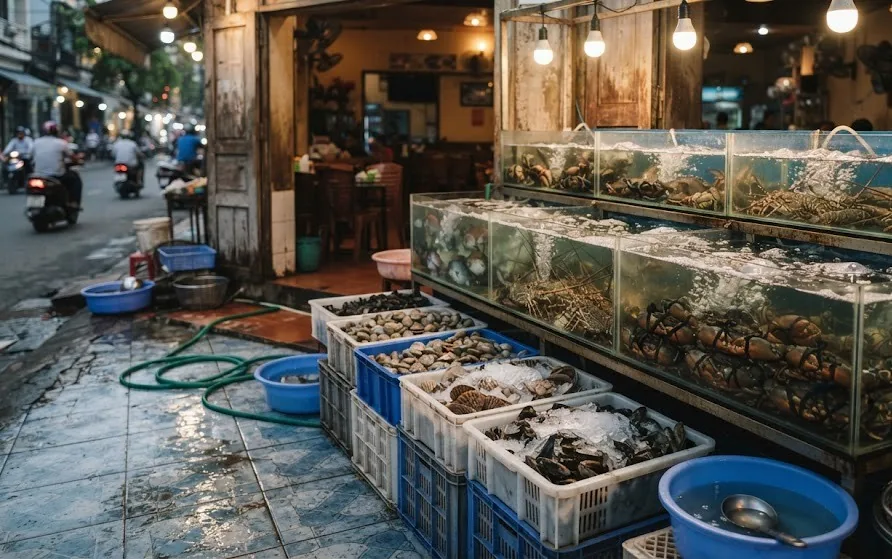
The One Thing to Know Before You Order
Seafood in Vietnam is sold by weight. In Da Nang, the price on the tank label or the menu is very often per 100 grams, not per kilogram.
Real figures from a well-known Da Nang restaurant give a sense of scale:
| Item | Listed price | Actual price per kg |
|---|---|---|
| King crab | 290,000 VND / 100g | 2,900,000 VND |
| Lobster | 240,000 VND / 100g | 2,400,000 VND |
| Mantis shrimp | 290,000 VND / 100g | 2,900,000 VND |
| Scallops | 120,000 VND / 100g | 1,200,000 VND |
| Razor clams | 98,000 VND / 100g | 980,000 VND |
| Mud crab | 89,000 VND / 100g | 890,000 VND |
| Blood cockles | 59,000 VND / 100g | 590,000 VND |
None of this is a scam — the unit is usually printed on the board. But a single crab weighing 800g at 89,000 per 100g comes to over 700,000 VND, and a table that ordered “a couple of crabs” without doing the arithmetic gets a shock.
Important note: Ask “Giá này một ký hay một lạng?” — is this price per kilo or per 100g? Một lạng means 100g. Ask before anything is weighed, not after.
Four Rules That Solve the Rest
Step 1 — Confirm the unit and the price before it touches the scale. Point at what you want, ask the price, and get the number for that specific piece.
Step 2 — Watch the weighing. This is normal behaviour here, not an insult. Stand at the tank while they weigh it. Most restaurants expect it.
Step 3 — Order by the piece where you can. “Two crabs,” not “some crab.” “This one,” pointing, not “a kilo of prawns.” It removes the ambiguity entirely.
Step 4 — Ask for the bill itemised by weight. A legitimate restaurant will produce it without hesitation. If the bill is a single round number with no weights on it, that’s the moment to ask questions.
Common mistake: Assuming a restaurant with a posted price board can’t overcharge. The board is honest; the arithmetic is where people lose. Restaurants that post prices per 100g clearly and weigh in front of you are the safe ones — the risk is at places with no board at all.
Where Locals Eat: Tho Quang
The seafood district is on the Son Tra side, around Tran Quang Khai and the streets near the fishing port at Tho Quang. This is where the boats land and where Da Nang families go for a seafood dinner.
It is not scenic. There is no sea view, the rooms are plastic chairs under fluorescent light, and the menus are in Vietnamese. The seafood is better and roughly a third cheaper than the beachfront.
Nam Danh
Tran Quang Khai, Tho Quang · Many dishes around 60,000 VND
Plain, busy, and a long-standing local favourite. Much of the menu is priced per plate rather than by weight, which sidesteps the whole weighing problem. If you want to eat seafood without doing maths, start here.
Be Anh
139/59/38 Tran Quang Khai, Tho Quang
Larger and more comfortable than most in the district, with a menu that runs from everyday grilled fish up to abalone and lobster. Set up for groups and family gatherings.
A Ty
6 Le Duc Tho, Tho Quang
Cheap, local, and reliable. The kind of place where the bill for four people with beer surprises you in the good direction.
Where Visitors Eat: The My Khe Side
More comfortable, more English, higher prices for the same fish. Sometimes worth it.
Be Man
96–98–100 Le Dinh Duong, Hai Chau · and Lot A19-2 Vo Van Kiet, An Hai
The best-known seafood restaurant in the city and the one most visitors end up at. Live tanks out front, seats around 500 people, and — importantly — prices clearly posted per 100g with weighing done in front of you. Stock runs from blood cockles at the cheap end up to king crab and lobster, roughly 130,000 to 3,000,000 VND per kilo depending on what you pick.
It’s busy, it’s loud, and the service is fast rather than attentive. But the pricing is transparent, which is the main thing.
Be Ni 2 Seafood
Near My Khe Beach · MICHELIN Guide listed
Appears in the MICHELIN Guide for Da Nang, and it’s the easiest recommendation for visitors who want a proper menu, English service and no ambiguity about the bill. Live tanks with lobster, crab, prawn, scallop and clam, cooked in traditional preparations that let the ingredient carry the dish.
More expensive than Tho Quang. Considerably less stressful.
Bien Man
Lot 9 Vo Nguyen Giap, Phuoc My, Son Tra · around 150,000–200,000 VND per person
Riverside setting, local crowd, and a price point that sits between the Tho Quang shops and the tourist strip.
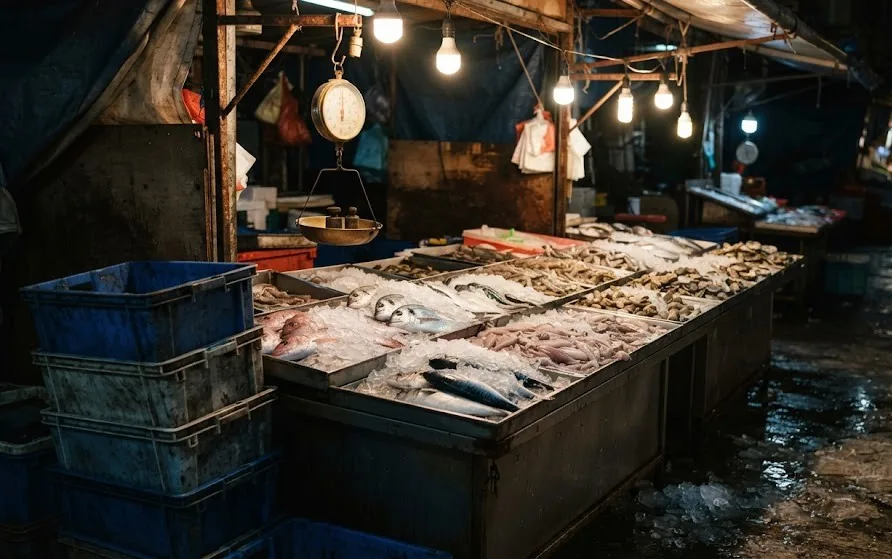
The Son Tra Night Seafood Market
Evenings only, on the Son Tra side
Not a restaurant — an evening market where you choose from live tanks and the vendor cooks what you pick, on the spot. Prices land well below the beachfront restaurants for the same seafood.
This is the most enjoyable way to eat seafood in Da Nang if you’re comfortable with a bit of friction: no menu, limited English, and you’ll be negotiating by pointing. Bring cash in small notes. For more markets in this vein, see our guide to Da Nang’s hidden island markets.
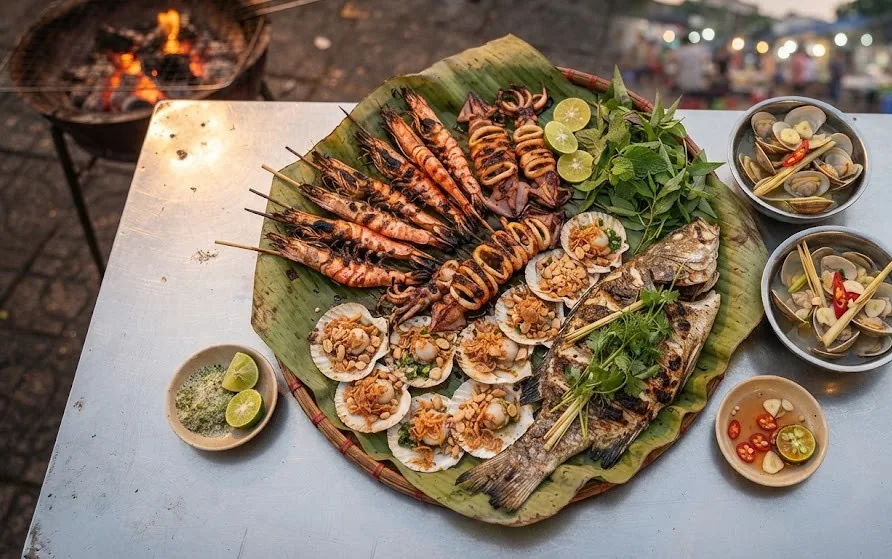
What to Order
Da Nang cooks seafood simply, and that’s the right approach. The best preparations are the ones that let you taste what you paid for.
The Three to Get First
Nghêu nướng mỡ hành — clams grilled with spring onion oil and peanuts, sometimes with butter and chilli. Cheap, fast, and the standard opener at any table.
Tôm hấp bia — prawns steamed in beer with lemongrass. The most direct way to judge how fresh a restaurant’s stock is.
Cá nướng muối ớt — whole fish grilled with salt and chilli. Ask what came in that morning rather than picking from the menu. The same day-boat fish gets pounded into the cake in bun cha ca, the city’s default breakfast.
Also Worth It
Ốc hút — small snails stir-fried with lemongrass and chilli, sucked from the shell. Technically street food rather than restaurant seafood, and the most local thing on this list. Best at Con Market’s evening stalls with beer — see our guide to Da Nang’s unique street eats.
Mực nướng sa tế — grilled squid with satay. Cua rang me — crab in tamarind, sweet and heavy, popular but it buries the crab.
What to Skip
Anything drowned in cheese, anything described as “special sauce,” and lobster. Lobster in Da Nang is priced for the tourist market and is not what this coast does best — the crab, clams and prawns are where the value is.
Insight: The single best indicator of a good seafood restaurant here is not the tank, the view or the price. It’s whether local families are eating there on a weekday evening. Da Nang residents eat seafood regularly and they don’t overpay for it.
How Much to Budget
| Where | Per person |
|---|---|
| Con Market snail and shellfish stalls | 80,000–150,000 VND |
| Tho Quang local restaurants | 150,000–250,000 VND |
| Be Man / mid-tier with tanks | 250,000–400,000 VND |
| Beachfront restaurants and MICHELIN-listed | 400,000–800,000 VND |
Those figures assume clams, prawns, squid and fish. Add crab or lobster and the number moves fast — a single mud crab can double a table’s bill on its own.
Seasonality
Seafood here is good year-round, but the sea isn’t always workable. Through October and November the swell is heavy, boats stay in, and restaurants lean more on farmed and held stock. Quality is still fine; variety narrows.
March to August is the best window, which is also when boat trips and diving run. See our guide to where to stay in Da Nang for how the seasons affect the rest of a trip.
Related on this site
- Da Nang’s Best Nem Lui: Lemongrass Pork Skewers to Try 2026
- Da Nang’s Best Hot Pot Experiences for Group Dinners 2026
- Where to Find Da Nang’s Best Grilled Skewers and BBQ
Frequently Asked Questions
How much does seafood cost in Da Nang?
Budget 150,000–250,000 VND per person at a local restaurant in Tho Quang, or 250,000–400,000 VND at a mid-tier place with live tanks. Individual items are usually priced per 100g: blood cockles around 59,000 VND, mud crab around 89,000 VND, scallops around 120,000 VND, lobster around 240,000 VND — which works out to 590,000, 890,000, 1,200,000 and 2,400,000 VND per kilo respectively.
How do I avoid being overcharged for seafood in Da Nang?
Confirm whether the posted price is per kilo or per 100 grams before anything is weighed — this single question prevents most bill shocks. Then watch the weighing, order by the piece rather than by quantity, and ask for an itemised bill showing weights. Restaurants with clearly posted price boards and visible scales are the safer choice, not the riskier one.
Where do locals eat seafood in Da Nang?
Tho Quang, on the Son Tra side near the fishing port, particularly along Tran Quang Khai. The rooms are plain and the menus are in Vietnamese, but the seafood is fresher and roughly a third cheaper than the beachfront restaurants on Vo Nguyen Giap. Nam Danh, Be Anh and A Ty are all in this area.
What is the best seafood dish to order in Da Nang?
Grilled clams with spring onion oil (nghêu nướng mỡ hành) and prawns steamed in beer (tôm hấp bia) are the two that best show off what this coast does. Both are inexpensive, both are cooked simply, and both are how local tables usually start. Skip lobster — it’s priced for visitors and isn’t the region’s strength.
Is seafood in Da Nang safe to eat?
Yes, at any restaurant with live tanks and reasonable turnover. Seafood is chosen alive and cooked to order, which removes most of the risk. The usual caution applies: avoid places where stock is sitting out unrefrigerated, and be more careful in the wet season when boats are running less often and stock may be held longer.
Do I need to book a seafood restaurant in Da Nang?
Not usually on a weekday. Weekend evenings at the larger places like Be Man fill up, particularly during Vietnamese domestic holiday periods, so a call ahead helps. The Tho Quang restaurants are mostly walk-in.
The Verdict
Da Nang’s seafood is one of the best-value things about the city, and the only real barrier is a pricing convention that takes thirty seconds to understand. Ask whether the number is per kilo or per 100 grams, watch the scale, and the whole problem disappears.
Once it does, go to Tho Quang rather than the beach. The room will be worse, the lighting will be fluorescent, and the fish will be better and cheaper. That trade is the entire argument for eating where locals eat.