Discovering Da Nang’s unique street eats means trading the predictable banh mi queue for a bowl of pungent nam o that locals have slurped for decades. While every guidebook points you to the same tourist-friendly stalls, the city’s real character hides in plain sight: in the alleys off Le Duan, in the steam rising from Con Market’s back corners, and in the late-night carts that flicker to life after 9 PM. This guide maps the dishes, the neighborhoods, and the unwritten rules that separate a casual visitor from someone who genuinely eats like a local.
Da Nang’s street food rewards the curious. Skip the crowded banh xeo joints near the river and head instead for banh trang cuon thit heo — fresh rice paper rolls with grilled pork and a fermented fish dipping sauce that defines central Vietnamese cooking. The city’s compact size means most hidden stalls sit within a 15-minute motorbike ride of the beach, and the best time to find them is between 6-8 AM or after 5 PM, when locals actually eat. Budget around 200,000-300,000 VND ($8-12 USD) for a serious tasting session across five or six different stalls.
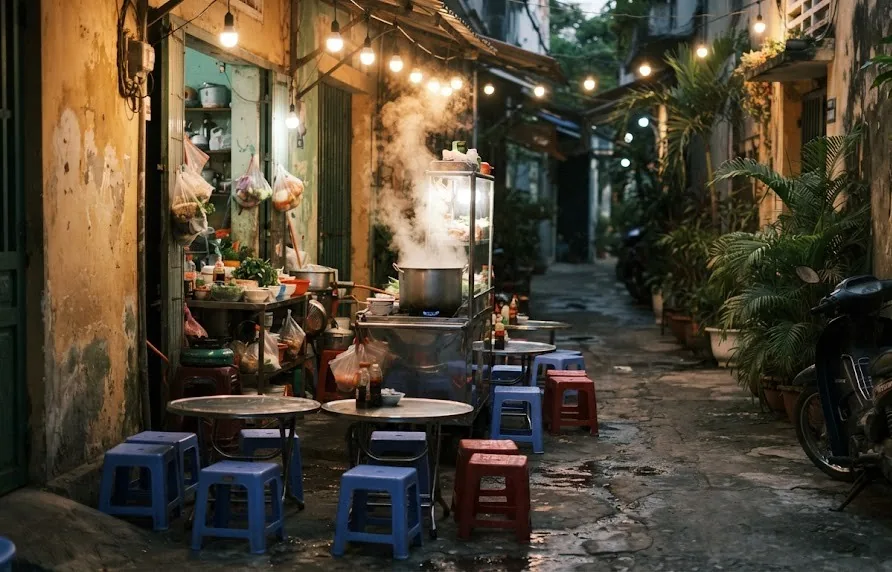
The Hidden Gems of Da Nang Street Food: A Local’s Guide
Da Nang’s culinary identity lives in dishes you won’t see on most tourist menus — and that’s exactly why you should seek them out. Walk past the Instagram-famous mi quang stalls near the Han River bridge and you’ll find a different world: grandmothers fanning charcoal grills, plastic stools barely a foot off the ground, and bowls of food that taste like nothing you’ve had before. The city’s street food scene isn’t about spectacle — it’s about generations of families perfecting a single recipe.
Tourist staples like banh xeo (crispy pancakes) and mi quang dominate the guidebooks, but locals rotate through a wider repertoire. On any given morning, you’ll spot office workers hunched over bowls of banh canh — thick, chewy noodles in a rich broth — or banh beo, delicate steamed rice cakes topped with dried shrimp and crispy shallots. These dishes rarely make it onto English menus because they’re harder to explain and even harder to eat gracefully. That’s precisely why they’re worth chasing.
Why Da Nang’s Street Food Scene Differs from Hanoi and Ho Chi Minh City
Geography, history, and climate have conspired to make Da Nang’s food distinctly spicier, saltier, and more herb-forward than anywhere else in Vietnam. This is the culinary heart of central Vietnam, where the imperial city of Hue’s refined cooking meets the fishing villages of the coast. The result is a street food culture that prizes intensity over subtlety — and that’s a good thing.
The central Vietnamese flavor profile: spicy, salty, and fresh herbs
Central Vietnamese cooking doesn’t shy away from heat. Dishes arrive with fresh chilies, peppery broths, and a heavy hand with salt — a legacy of the region’s fishing heritage, where preserving food with salt and fermentation was survival. Fresh herbs play a starring role too: mint, perilla, basil, and the sharp, citrusy note of rau ram appear in nearly every dish, cutting through the richness of pork and seafood.
A bowl of mi quang in Da Nang tastes completely different from the same dish in Hanoi — here, it’s bolder, with a smoky turmeric broth and a chili kick that clears your sinuses.
How the city’s size shapes its food stalls and markets
Da Nang is compact — roughly 1,285 square kilometers, with most of the city’s food action concentrated along the coast and around the Han River. Unlike Hanoi’s maze-like Old Quarter or Ho Chi Minh City’s sprawling districts, Da Nang’s food stalls cluster in predictable pockets. This density means vendors can specialize. A single alley might host three different stalls, each perfecting one dish for decades. It also means you can cover more ground in a single afternoon than you could in a week in Saigon.
Seasonal ingredients that define Da Nang’s unique dishes
Da Nang’s position on the central coast means a monsoon season that reshapes the food calendar. From September to December, the rain drives locals indoors, and the street food shifts toward hot, brothy dishes — nam o, banh canh, and steaming bowls of pho. The dry season, from January to August, brings a bounty of fresh seafood and herbs, and the stalls pivot to grilled dishes and fresh rolls. If you visit during the wet months, you’ll see a different menu than a summer visitor — and that’s the point.
| Characteristic | Da Nang | Hanoi | Ho Chi Minh City |
|---|---|---|---|
| Spice level | High — fresh chilies and peppery broths | Mild — subtle, balanced flavors | Medium — sweet and savory with optional heat |
| Herb usage | Abundant — mint, perilla, rau ram | Moderate — herbs served alongside | Generous — herbs and pickled vegetables |
| Noodle styles | Mi quang, banh canh, nam o (fermented) | Pho, bun cha, cha ca | Hu tieu, bun bo Hue, com tam |
| Signature flavor | Smoky, salty, umami-rich | Delicate, aromatic, subtle | Sweet, tangy, bold |
| Market culture | Compact, specialized single-dish stalls | Historic, dense, neighborhood-based | Sprawling, diverse, 24-hour energy |
Where to Find Authentic Street Eats Beyond the Tourist Hotspots
Follow the motorbikes, not the tour groups — the best stalls in Da Nang are where locals park their scooters. The tourist zone around My Khe Beach and Bach Dang Street has its charms, but the real action happens in the markets and back alleys where vendors have served the same families for generations.
Navigating local markets: Han Market vs. Con Market
Han Market, in the city center, is the one most tourists find — it’s clean, organized, and has a food court upstairs. But Con Market, located about 2 kilometers west on Ong Ich Khiem Street, is where locals actually shop. Its food stalls are louder, messier, and infinitely more rewarding. Head to the back corner of Con Market for banh beo and banh nam — the steamed rice cakes that are a Da Nang specialty. At Han Market, skip the souvenir stalls and go straight to the ground-floor food vendors for fresh spring rolls and sugarcane juice.
The best alleys and side streets for hidden food stalls
- Hoang Hoa Tham Street — This residential street transforms after 5 PM into a corridor of charcoal grills. Look for the stall with the longest motorbike queue; it’s usually serving banh trang nuong, the Vietnamese-style “pizza” made from rice paper.
- Le Duan Street’s side alleys — Between Le Duan and Hung Vuong, narrow alleys hide family-run stalls serving banh canh and chao (rice porridge) that have operated for three decades.
- Nguyen Chi Thanh Street — A late-night hub where vendors set up around 9 PM, serving everything from grilled squid to che (sweet dessert soups).
- The alley behind My Khe Beach’s seafood row — Walk past the seafood restaurants facing the water and duck into the alley behind them for the real deal: grilled clams with peanuts and scallions, served on plastic stools.
Timing your visit: when locals actually eat
Da Nang runs on a different clock than Western cities. Breakfast starts early — 6 to 8 AM — and it’s a serious meal, not a croissant grab. Lunch hits from 11 AM to 1 PM, and most stalls close by 2 PM to prep for the evening. Dinner starts shockingly early by Western standards: 5 to 6:30 PM. By 8 PM, the dinner stalls are winding down, and the late-night snack carts take over.
If you show up at 7:30 PM expecting a full dinner, you’ll find yourself eating at the late-night spots — which is its own adventure, but not the full experience.
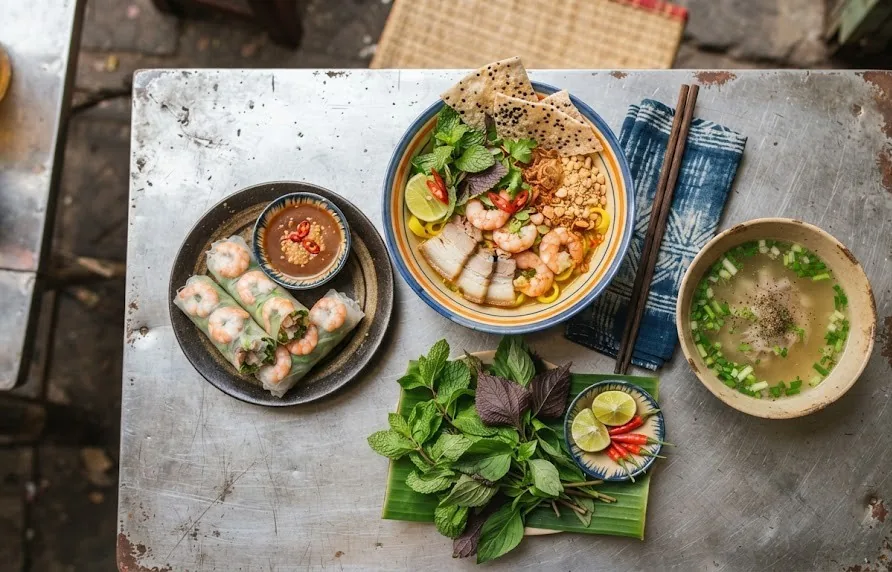
Must-Try Dishes You Won’t Find in Every Travel Guide
These four dishes are the gateway to Da Nang’s real street food culture — each one tells a story about the city’s geography and history. They’re not on every menu, but they’re worth hunting down.
Banh trang cuon thit heo: the art of the rice paper roll
This is the dish that defines Da Nang for locals. Thin, pliable rice paper is dipped in water to soften, then loaded with fresh herbs, slices of grilled pork, and a strip of banana blossom or green apple. You roll it yourself, dip it in a fermented fish sauce called mam nem, and eat it in one or two bites. The sauce is the star — pungent, salty, and slightly sweet, made from fermented anchovies that mellow over months. It’s an acquired taste, but once it clicks, you’ll understand why locals crave it.
Find it at any stall with a grill and a bucket of rice paper; the best ones are on Hoang Hoa Tham Street.
Nam o: the pungent fermented fish noodle soup
Nam o is the dish that separates casual visitors from serious eaters. This noodle soup uses fermented fish — usually mackerel or anchovy — that’s been aged for weeks, giving the broth a deep, funky umami that’s miles away from the clean, clear pho you know. The noodles are thick and chewy, the broth is dark and murky, and the whole thing is topped with fresh herbs and a squeeze of lime. It’s an intense experience, and the smell can be off-putting at first.
But give it a chance — the complexity of the broth is unlike anything else in Vietnamese cooking. Look for nam o stalls in the morning near Con Market.
Banh beo: delicate steamed rice cakes with shrimp topping
Banh beo is the opposite of nam o — subtle, elegant, and built on texture rather than intensity. Tiny rice cakes are steamed in small saucers, then topped with dried shrimp, crispy shallots, and a drizzle of fish sauce. You eat them with a small spoon, scooping up the entire cake in one bite. The contrast between the soft, silky cake and the crunchy topping is the whole point. Vendors at Con Market serve them in sets of five or ten, and they’re best eaten slowly, with a cup of hot tea.
This is a dish for the patient eater — the flavors unfold gradually.
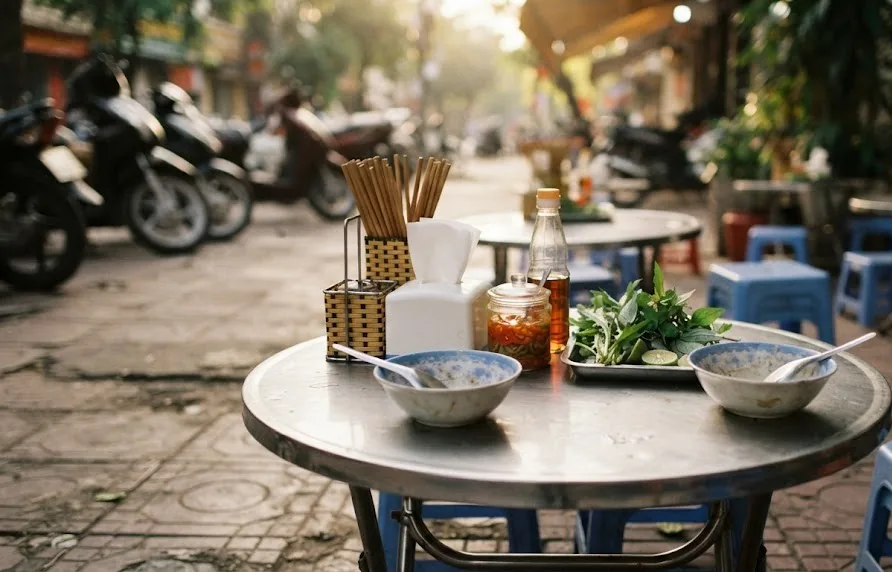
How to Eat Like a Local: Street Food Etiquette and Customs
Eating street food in Da Nang is a social ritual with its own rules — and knowing them makes the experience smoother and more enjoyable. The good news: locals are welcoming to visitors who make an effort, even if you get it wrong.
Mastering the chopsticks and spoon combo
In central Vietnam, you eat with chopsticks in one hand and a spoon in the other. For noodle soups, use the chopsticks to lift the noodles and the spoon to scoop up broth — don’t lift the bowl to your mouth like you might in Japan. For dry dishes like banh trang cuon, the chopsticks are your primary tool, and the spoon is used for dipping sauces. If you’re struggling, nobody will judge you — but making the effort to use the chopsticks-spoon combo shows respect for the culture.
Ordering like a pro: key Vietnamese phrases for food stalls
You don’t need to be fluent, but a few phrases will dramatically improve your experience. “Mot to pho” (one bowl of pho) is the basic order, but you’ll want more specific phrases. “Khong cay” means “not spicy” — essential if you’re not ready for central Vietnam’s heat. “It ngot” means “less sweet.” “Ngon qua” — “so delicious” — is the phrase that will make vendors beam. And if you’re not sure what to order, just point at someone else’s bowl and say “Giong vay” — “same as that.” It’s the easiest way to order like a local.
Navigating the shared table culture
Street food in Da Nang is a communal experience. You’ll often share a low plastic table with strangers, and that’s expected. Don’t be surprised if a local offers you a piece of their food or asks about your order — it’s part of the culture. When you’re done, stack your bowls and chopsticks neatly and say “Cam on” (thank you). Tipping isn’t expected — the price on the menu is what you pay. And don’t be afraid to ask for a plastic bag to take your leftovers home; it’s completely normal.
Street Food Safety: What to Look For and What to Avoid
Street food in Da Nang is generally safe, but a few simple checks will keep your stomach happy and your trip memorable for the right reasons. The rules are straightforward and easy to follow.
Spotting fresh ingredients and clean stalls
Freshness is your first line of defense. Look for stalls where the ingredients are visibly alive or vibrant — live seafood in buckets, greens that look crisp and bright, and broth that’s actively simmering. If the broth isn’t bubbling, it’s been sitting too long. Check the cooking oil: if it looks dark and murky, the stall is reusing it too many times. And trust your nose — a stall with a clean, appetizing smell is usually a safe bet.
The golden rule: eat where locals queue
This is the single most reliable rule in street food: if locals are queuing, the food is fresh and the stall is safe. A long line means high turnover, which means ingredients aren’t sitting around. If a stall is empty while the one next to it has a queue, that’s not a coincidence — go where the locals go. It’s the same logic that applies to any street food city in the world, and Da Nang is no exception.
Handling spicy food and adjusting to local flavors
Central Vietnamese food is genuinely spicy, and the heat can catch you off guard. Start with a small order and add chilies gradually — you can always add more, but you can’t take it out. The fresh herbs and lime that come with most dishes are there to balance the heat, so use them generously. And keep a bottle of water or a sweet drink nearby — not to extinguish the fire, but to reset your palate between bites. If a dish is too intense, don’t force it. The goal is to enjoy the food, not to prove something.
Related on this site
- Da Nang’s Best Street Food Tours: Taste the City in 2026
- Da Nang’s Affordable Eats: Budget-Friendly Meals Under $5 2026
- Da Nang’s Late-Night Eats: Where to Satisfy Cravings After Midnight in 2026
One street snack that deserves its own page: the best banh bao in Da Nang.
Frequently Asked Questions
What is the best time of day to explore Da Nang’s street food?
The sweet spot is between 6 and 8 AM for breakfast — when the most authentic stalls are at their freshest — and again from 5 to 7 PM for dinner. The late-night scene, from 9 PM onward, is more limited but worth exploring on Nguyen Chi Thanh Street for grilled snacks and desserts.
Are there vegetarian options among Da Nang’s street eats?
Yes, but they’re not always obvious. Banh beo is naturally vegetarian-friendly (ask for it without the shrimp topping), and banh trang cuon can be made with just herbs and vegetables. Many stalls also offer tofu versions of their dishes. The key phrase is “chay” (vegetarian) — say “an chay” to indicate you want a vegetarian version.
How much should I budget for a full street food tour in Da Nang?
A serious tasting session across five or six stalls will cost between 200,000 and 300,000 VND ($8-12 USD) per person. That includes drinks and a dessert. If you’re eating at the higher-end street food spots near the river, budget closer to 400,000 VND ($16 USD). This aligns with data from travel industry reports, which indicate that a typical budget for authentic street food experiences in Southeast Asia falls within this range, with variations based on location and specific vendor choices.
What is the most unusual dish to try in Da Nang?
Nam o — the fermented fish noodle soup — is the most challenging and rewarding dish in the city. Its pungent aroma and intense umami flavor are unlike anything you’ll find in Hanoi or Ho Chi Minh City. If you’re feeling adventurous, it’s the dish that will give you bragging rights and a genuine taste of central Vietnam.
Conclusion
Da Nang’s street food scene rewards the curious and punishes the timid. The dishes that define this city — banh trang cuon thit heo, nam o, banh beo — aren’t on every tourist menu, but they’re the ones locals crave. Start your exploration at Con Market in the morning, follow the motorbike queues to hidden alleys off Hoang Hoa Tham and Le Duan, and don’t be afraid to order something you can’t pronounce.
The city’s compact size means you can cover more ground in a day than you’d think possible — and every stall you discover is a story worth bringing home.
- Start early — Hit Con Market between 6 and 8 AM for the freshest banh beo and the most authentic breakfast experience.
- Follow the locals — When you see a queue of motorbikes outside a nondescript stall, join it. That’s where the real food is.
- Learn three phrases — “Mot to” (one bowl), “khong cay” (not spicy), and “cam on” (thank you) will carry you further than any guidebook.
Part of our guide to what to eat in Da Nang.