Mi Quang is the dish visitors come to Da Nang for. Bun cha ca is the one people here actually eat, and they eat it before seven in the morning, standing room only, in shops that have been open for forty years.
If you want to understand how this city works rather than how it presents itself to tourists, this is the bowl. It’s cleaner and lighter than anything you’ll find in Hanoi or Saigon, it costs about a dollar, and the shops that do it best have been doing nothing else for decades.
Quick Summary: Bun cha ca is Da Nang’s everyday breakfast — clear fish-bone broth with pumpkin and tomato, round rice noodles, and two kinds of fish cake (steamed and fried) in the same bowl. Expect 25,000–60,000 VND. The best-known shop is Bun Cha Ca 109 on Nguyen Chi Thanh; Bun Cha Ca Hon holds a MICHELIN Bib Gourmand. Most shops open at 6am and the good ones are busiest before 8.
Updated August 2026 · 8 min read · Local writer, Da Nang
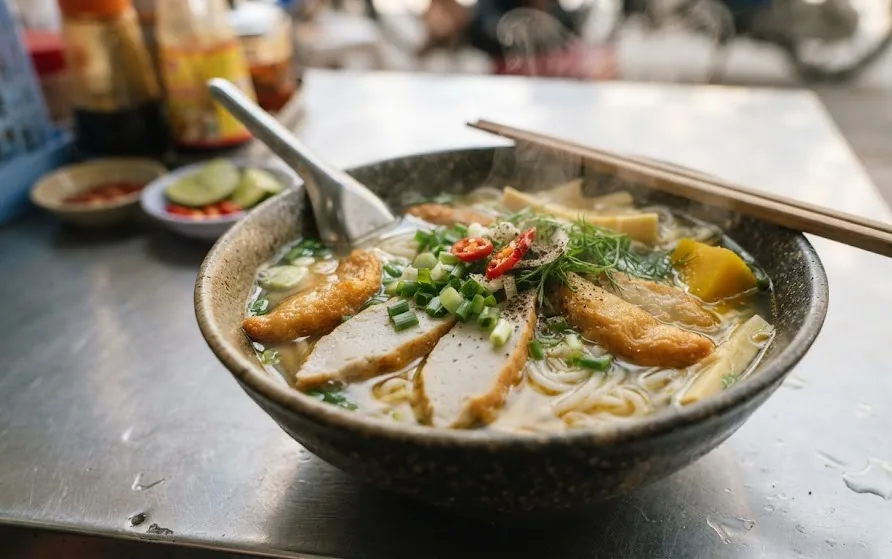
What’s Actually in the Bowl
Two Kinds of Fish Cake
The reason the dish works. A proper bowl contains cha ca hap — steamed fish cake, soft and springy, pale grey — and cha ca chien, the same paste fried until the outside turns gold and slightly chewy.
Getting both is the point. Shops that give you only fried cake are cutting the labour, and the bowl loses its balance.
The paste itself is usually mackerel or a mix of mackerel and other white fish — the same day-boat catch behind Da Nang’s seafood restaurants, pounded with pepper, garlic and dill until it becomes elastic rather than crumbly. That elasticity — a slight resistance when you bite — is what separates a good cha ca from a rubbery one.
The Broth
This is where Da Nang’s version diverges from every other fish noodle soup in Vietnam. The broth is clear, not cloudy, and it’s built on fish bones simmered with vegetables — usually pumpkin, tomato, and sometimes bamboo shoots or cabbage.
The vegetables are the sweetness. A good shop gets a clean, slightly sweet broth with no fishiness at all — the local test is that you should smell aroma, not fish, when the bowl arrives. Some of the better shops use pineapple rather than MSG to round the sweetness out.
The Condiments
You’ll get a small dish of mam ruoc — fermented shrimp paste, salty and deeply savoury — plus chilli, lime and pickled onion or shallot. The mam ruoc is not optional in the way it looks optional. A quarter teaspoon stirred in transforms the bowl from pleasant to complete.
Important note: Mam ruoc contains shrimp. If you have a shellfish allergy, leave it out — the broth itself is fish-based and safe, but say “khong mam ruoc” clearly, because most shops add it by reflex.
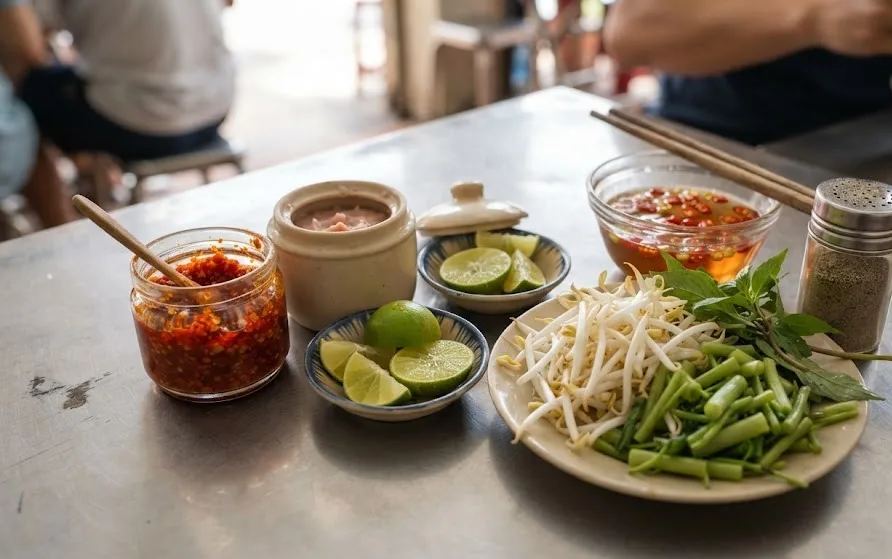
How to Eat It: Four Steps
Step 1 — Taste the broth first, before adding anything. This is how you judge the shop, and you only get one chance. It should be clean and faintly sweet.
Step 2 — Stir in a small amount of mam ruoc. Quarter teaspoon. It’s much stronger than it looks and you can always add more.
Step 3 — Squeeze the lime, add chilli to taste. Green chilli here is hotter than the red. Locals often add both plus a spoon of the chilli-shrimp sauce.
Step 4 — Add the herbs last, a handful at a time. Dumping the whole plate in at once turns them to mush in thirty seconds. Add as you go so the last mouthful is as fresh as the first.
Where to Eat Bun Cha Ca in Da Nang
Almost every shop worth eating at is in Hai Chau, on the west bank. That’s not an accident — this is a working-city breakfast, not a beach dish.
Bun Cha Ca 109
109 Nguyen Chi Thanh, Hai Chau · Open roughly 06:00–22:00 · 25,000–50,000 VND
The name everyone in Da Nang knows, and a MICHELIN Guide entry. Decades old, large room, fast service, and increasingly full of foreign visitors — which has not damaged it.
What sets it apart is the broth: clear, sweetened with pineapple rather than MSG, and noticeably lighter than the competition. The fish cake comes in large pieces, both steamed and fried in the same bowl.
If you only eat this dish once, eat it here. It’s the easiest shop for a visitor to walk into and the most consistent.
Bun Cha Ca Ong Ta
113A Nguyen Chi Thanh, Hai Chau · 30,000–75,000 VND
Four doors down from 109, near the Han River swing bridge, and the two are a genuine local argument. Ong Ta’s broth is more assertive — sweet, salty, sour and rich at once, with cabbage, pumpkin and dried bamboo shoots in the bowl. There’s a rieu tom version with shrimp-and-pork paste that’s worth ordering if you’ve already had the standard.
The shop has an APEC 2017 certificate on the wall, which locals mention more than the food.
A tô thập cẩm — the mixed bowl with everything in it — runs around 60,000 VND and is close to too much food.
Bun Cha Ca Ba Phien (Ba Thua)
63 Le Hong Phong, Hai Chau
Long-established and known for range rather than a single bowl. Beyond standard cha ca, they do bun ca thu and bun ca ngu — mackerel and tuna versions with actual fish steaks rather than cake — plus bun rieu and bun cha tom. Service is quick and the ordering is brisk.
The tuna version is the one to get if you’ve eaten fish cake twice already and want something different.
Bun Cha Ca Hon
In an alley in Hai Chau · MICHELIN Bib Gourmand
The one that looks like somebody’s front room, because it more or less is. Clear broth, fried cake in gold pieces, fresh herbs and hot green chilli. It holds a Bib Gourmand, which in Da Nang tends to mean a kitchen refined by forty years of local expectation rather than culinary ambition.
Harder to find than the Nguyen Chi Thanh shops. Worth the effort if you want the version with no tourists in it.
Bun Cha Ca Ba Lu
Hung Vuong, Hai Chau · Open 24 hours
The budget and late-night option, popular with students and shift workers. Generous portions, both kinds of cake, low prices, and open whenever you need it. Not the best bowl in the city, but the best bowl available at 2am.
Con Market Food Court
Ong Ich Khiem · 40,000–70,000 VND
Several stalls do bun cha ca inside the market’s indoor food section. No English signage. The advantage is that you can eat it, then walk twenty metres and eat something else — see our guide to what to eat in Da Nang for what’s around it.
What a Bowl Costs
| Where | Price |
|---|---|
| Market stalls and neighbourhood shops | 25,000–35,000 VND |
| Established shops (109, Ong Ta, Ba Phien) | 30,000–50,000 VND |
| Mixed bowl with everything | 50,000–75,000 VND |
Insight: A standard bowl at 109 costs about the same as a coffee at a beachfront cafe. Bun cha ca is the cheapest genuinely excellent meal in Da Nang, and the gap in price between the famous shops and the anonymous ones is a few thousand dong — which means there is no reason to settle for a bad one.
When to Go
Before 8am for the full experience. This is a breakfast dish and the shops are at their busiest, freshest and most local in the first two hours. The broth is at its best when the pot has just come up to temperature.
Most shops run through lunch and some to the evening, but the room changes character after ten — quieter, slower, and increasingly foreign.
If you’re staying on the beach side, this is worth crossing the river for. A Grab from An Thuong or My Khe to Nguyen Chi Thanh runs 50,000–80,000 VND and takes ten to fifteen minutes. See our guide to where to stay in Da Nang for how the areas connect.
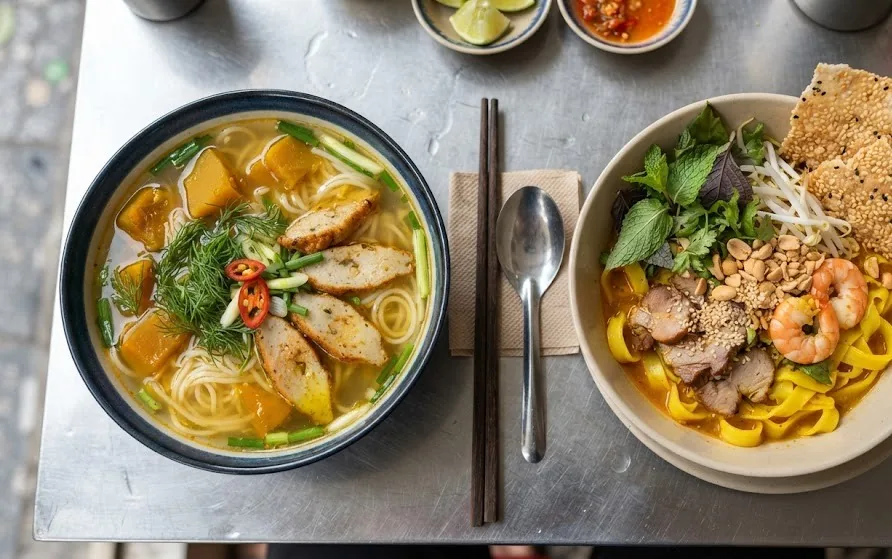
Bun Cha Ca vs Mi Quang: Which First?
They’re the two dishes people argue about here, and they’re not competing for the same slot.
| Bun cha ca | Mi Quang | |
|---|---|---|
| Format | Full soup, clear broth | Barely any broth — closer to a salad |
| Noodle | Round, thin, white | Wide, flat, turmeric-yellow |
| Weight | Light | Rich and dense |
| Best time | Breakfast | Lunch |
| Who eats it | Everyone here, most mornings | Everyone here, plus every visitor |
Eat bun cha ca for breakfast and mi Quang at midday and you’ve covered both in a single day. Our guide to Da Nang’s best mi Quang covers the other half.
Related on this site
Frequently Asked Questions
What is bun cha ca?
A Central Vietnamese noodle soup made with fish cake rather than meat — round rice noodles in a clear broth built on fish bones simmered with pumpkin and tomato, topped with both steamed and fried fish cake. It’s Da Nang’s default breakfast and one of the lightest noodle soups in Vietnamese cooking.
Does bun cha ca taste fishy?
It shouldn’t. The local test for a good shop is exactly this: the broth should smell aromatic rather than fishy, and taste clean and slightly sweet from the vegetables. If a bowl tastes strongly of fish, the bones weren’t fresh or the broth was rushed — go somewhere else next time.
How much does bun cha ca cost in Da Nang?
25,000 to 50,000 VND for a standard bowl at an established shop, which is roughly one to two US dollars. A mixed bowl with every kind of topping runs up to about 75,000 VND. It’s among the cheapest good meals in the city.
What time do bun cha ca shops open?
Most open at 6am. Shops like 109 and Ong Ta stay open through the day and into the evening, but the dish is eaten as breakfast and the atmosphere before 8am is a different experience from the same shop at 3pm. Ba Lu on Hung Vuong runs 24 hours if you need it late.
Is bun cha ca the same as bun ca?
Not quite. Bun cha ca uses fish cake — pounded fish paste, steamed and fried. Bun ca uses pieces of actual fish, usually mackerel or tuna. Several Da Nang shops, including Ba Phien, serve both, and ordering one of each is a good way to see which you prefer.
Can I eat bun cha ca if I don’t eat shellfish?
Yes, with one adjustment. The broth and fish cake are fish-based, not shellfish. But the mam ruoc served alongside is fermented shrimp paste, and most shops add it automatically. Say “khong mam ruoc” when you order.
The Verdict
Bun cha ca doesn’t get written about much outside Vietnam, and that’s exactly why it’s worth your first morning. There’s no queue of visitors, no photo-driven version of the dish, and no premium for being famous — just a clear bowl of broth at 6:30am in a shop that has been making it the same way since before the beach hotels existed.
Start at 109 on Nguyen Chi Thanh. If you like it, walk four doors down to Ong Ta the next morning and decide which side of the argument you’re on. That’s the whole exercise, and it costs less than one coffee at a beach cafe. For the dish to eat at the other end of the day, see banh trang cuon thit heo.