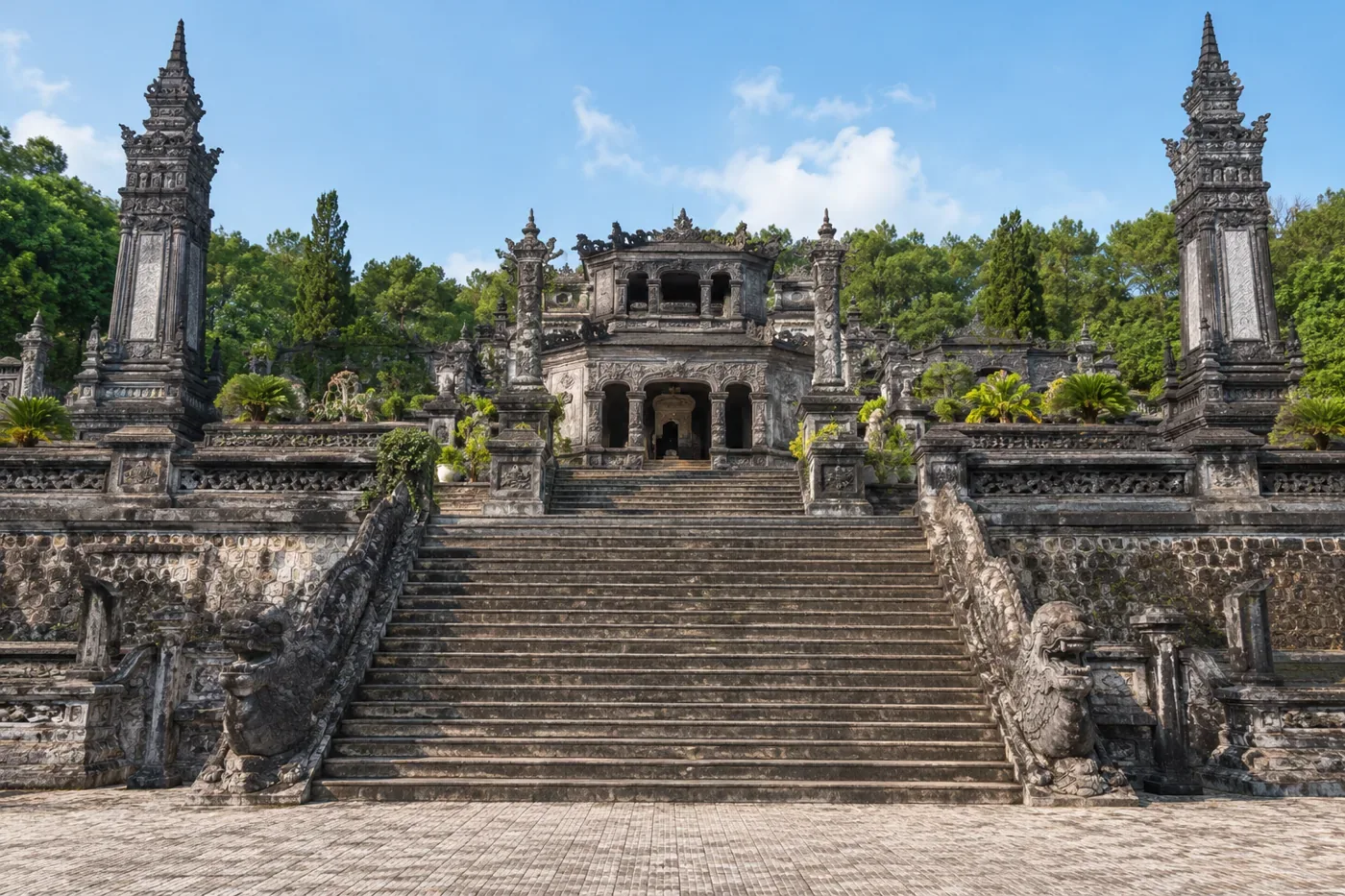
Khai Dinh Tomb is the Hue royal tomb to choose for a compact but dramatic architectural visit: steep terraces lead to an elaborate interior with mosaics and painted decoration. Allow about 45–75 minutes, depending on your pace and queues. The stairs are an important consideration for anyone with limited mobility.
Images in this guide are AI-generated illustrations, not on-site photographs. They do not establish current access, facilities or conditions.
Start with the Hue travel guide to plan transport and compare the city’s heritage stops.
Why choose Khai Dinh?
Unlike the broad garden settings of some other royal tombs, Khai Dinh rises through a series of hillside levels. Vietnam Tourism highlights the contrast between the weathered exterior and richly decorated interiors, combining influences from different architectural traditions.
It suits visitors interested in close-up decorative detail and a distinctive building. If your priority is a longer landscape walk with lakes and shade, consider Minh Mang or Tu Duc as a contrasting stop.
How to approach the visit
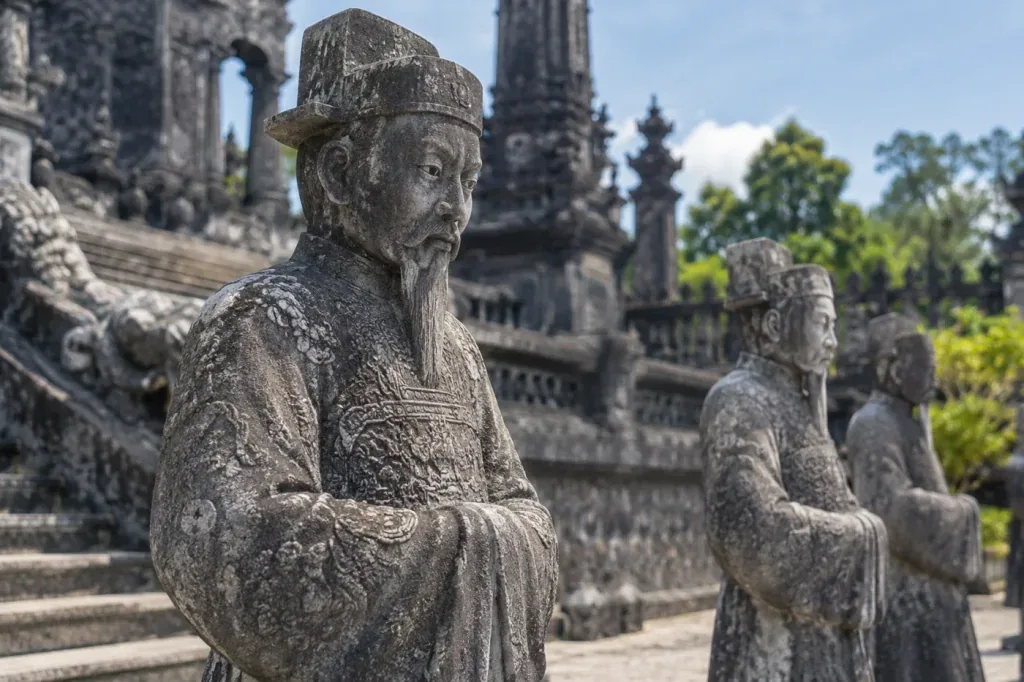
Climb in stages
Begin by assessing the steps from the entrance. Move at your own pace, use available handrails and pause on a level area without obstructing the route. Save energy for the upper building rather than rushing the first flight for a photograph.
Look closely at the interior
The decorative surfaces reward slower observation. Look at how small pieces of material form patterns and scenes, and use the interpretation to understand the emperor and the building. Do not touch mosaics or lean against them for photographs.
A guide can add historical context, but agree the language, length and fee before starting. A short guided explanation may be more useful than trying to photograph every surface in a crowded room.
Tickets and hours
The official Hue monument portal displayed Khai Dinh admission from 150,000 VND per person on 4 October 2026. Check your category, date and final charge before purchase. Compare a combination ticket only against the monuments you intend to visit.
Check the centre’s seasonal opening and ticket-sales schedule. Ticket sales and visitor closing time are different. Arrive with enough time to climb, visit and descend before closing; do not use the final admission minute as your arrival target.
Getting there from Hue
The tomb is outside the central palace area. A booked car with waiting time makes a multi-tomb trip easier to organise. Agree the sequence, total price, waiting allowance and final drop-off. Confirm whether parking, tickets and a guide are included or separate.
If arranging rides independently, plan the return before entering. A vehicle that brought you from central Hue may not remain nearby, and app availability at the end of the visit should not be assumed.
Heat, rain and mobility
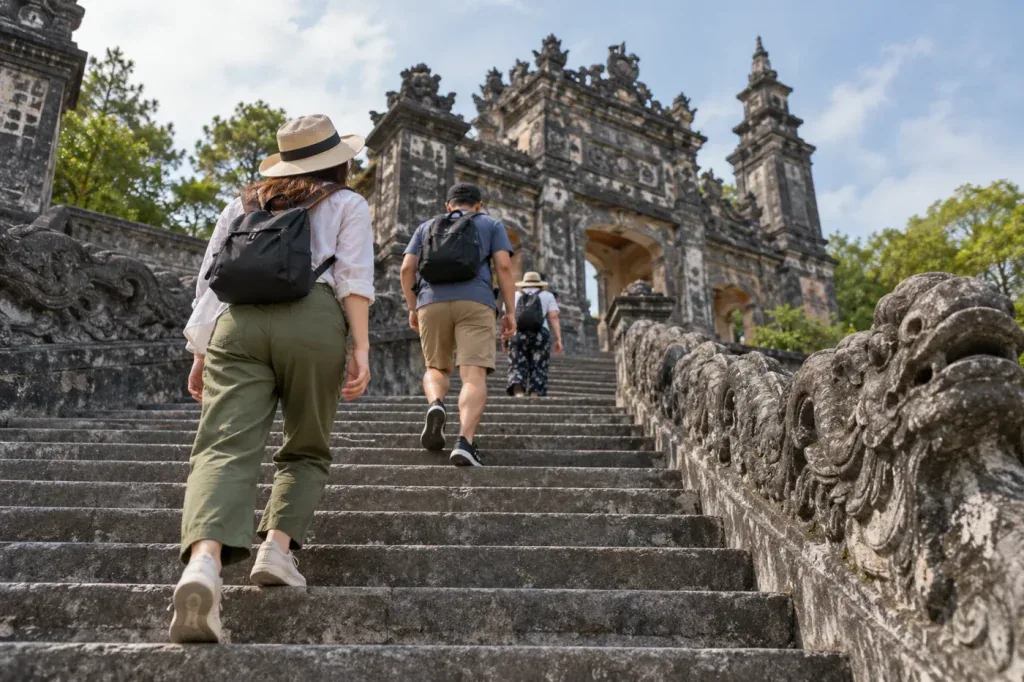
There is a substantial stair approach and limited shelter on parts of the climb. Visit at a cooler time where practical, bring water and wear shoes with grip. Rain can make the steps slippery. A compact footprint does not mean an easy, flat visit.
If stairs are difficult, ask the conservation centre about the currently accessible areas before purchasing. Do not assume there is a lift or a step-free route to the main interior. An exterior stop may still offer context, but decide in advance whether that meets your expectations.
Planning a two-tomb outing
Pair Khai Dinh’s concentrated decoration with one landscape-focused tomb rather than rushing all three major sites. Include driving, ticket checks and rest time in your half-day. Keep a meal break or your onward train buffer intact; the tombs are separate destinations, not adjacent rooms in one complex.
For the larger palace precinct, read the Hue Imperial City guide. It deserves its own substantial block of time.
Look beyond the first impression
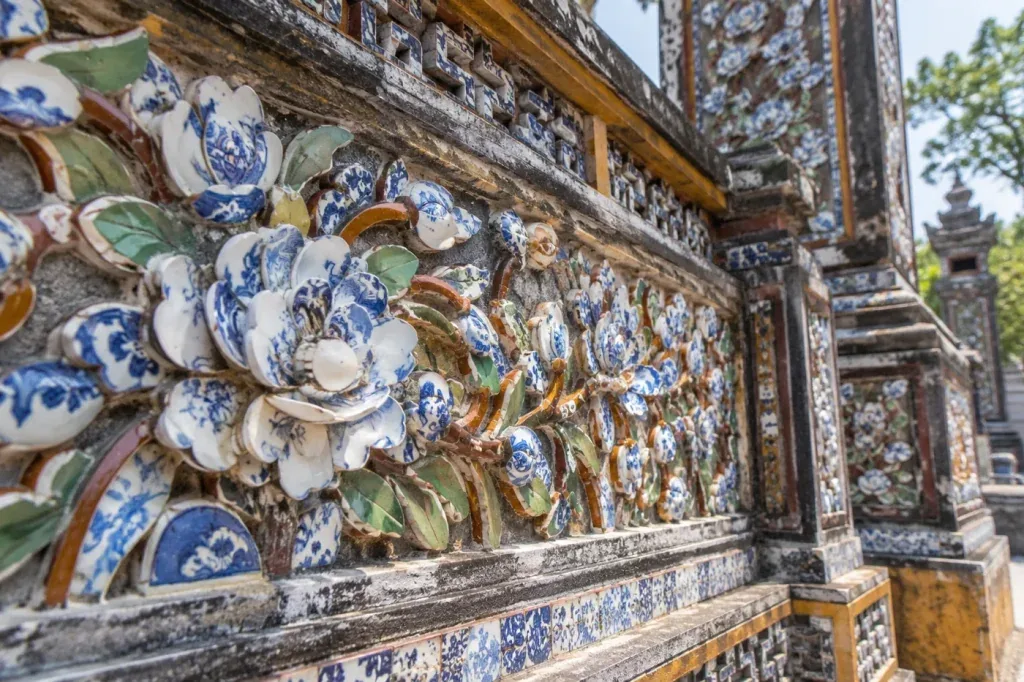
The contrast between the stair approach and the decorated upper interior is a useful way to organise your visit. On the way up, pause at a permitted level area and look at the composition of the terraces rather than treating them only as an obstacle. Inside, choose a few decorative details to examine carefully. Trying to photograph every surface can make it harder to notice how the decoration works as a whole.
Ask a guide or use interpretation to identify the materials and the purpose of the spaces. Do not assume that a shiny surface is a particular stone, metal or gemstone based on appearance alone. When a detail is not labelled, leave its material or symbolism uncertain rather than repeating a confident explanation from an unrelated photograph. Close observation and a few well-supported facts are enough for a worthwhile visit.
Allow time for the descent as well as the climb
Before starting, agree how the group will handle different walking speeds. Faster walkers can wait on a suitable level area; nobody needs to keep pace just to stay together on the steps. Leave enough time at the top for the interior without making the return hurried. A driver waiting at a fixed time should know that the visit includes both ascent and descent.
If someone decides against the climb, clarify where they can wait and how you will reconnect before separating. Do not promise them access to a lift, shaded waiting room or accessible toilet unless those arrangements have been confirmed. If the upper interior is the main reason for your trip and the stairs are unsuitable, choosing a different Hue activity may be more satisfying than paying for a visit that cannot meet that expectation.
Choose a contrasting second monument
Minh Mang Tomb works as a contrast when your group wants to compare concentrated interior decoration with a more extensive ceremonial landscape. Tu Duc Tomb gives another opportunity to focus on water, pavilions and the relationship between a royal retreat and memorial spaces. Neither should be treated as merely another entrance to tick off.
Ask the driver to propose an efficient sequence from your actual accommodation and final destination, then add the time you want inside each site. Two tombs plus a relaxed meal may be a better fit than combining several tombs with a full Imperial City visit. Check any combination ticket only after this route is realistic.
Decide what you want from a guide
For a short visit, request a focused explanation of the emperor, the building’s contrasting influences and the decorative interior. Agree where the explanation begins and ends and whether it includes time for questions. A guide’s role is to add context; it does not remove the need to assess the stairs and weather for yourself.
Frequently asked questions
Is Khai Dinh the easiest tomb to visit?
It can be relatively compact in sightseeing terms, but the stairs make it a poor choice for anyone seeking an easy step-free route.
Does admission include a guide?
Do not assume so. Check the ticket or tour inclusions before paying a separate guide fee.
Can I take photographs inside?
Follow the current signs and staff instructions. Keep equipment away from historic surfaces and avoid blocking the passage.