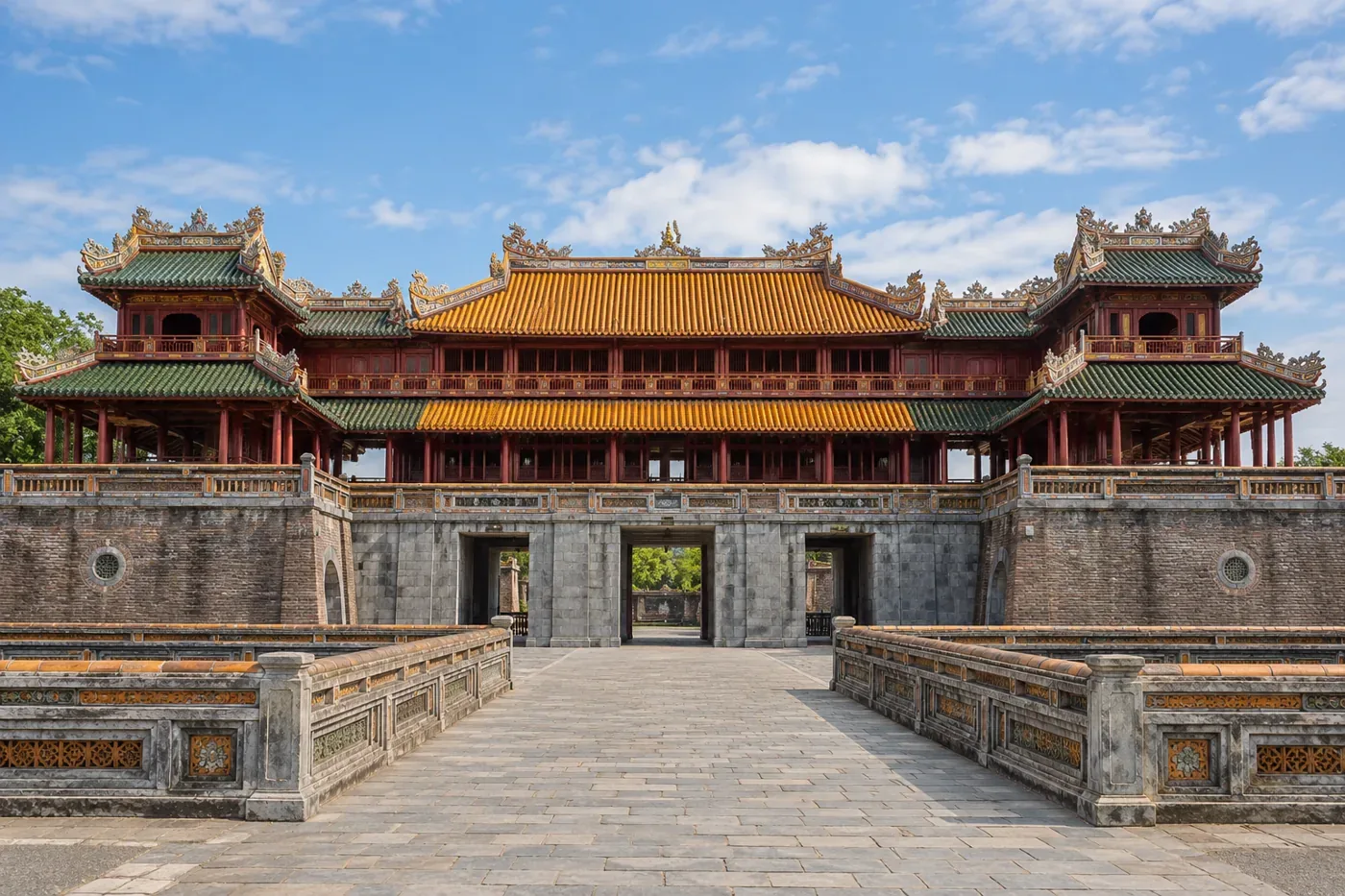
Hue Imperial City is the palace precinct within the larger citadel of Vietnam’s former Nguyen capital. Allow at least two to three hours for a selected route, and longer if you want detailed interpretation. The official ticket portal displayed admission from 200,000 VND per person at our check; confirm your ticket category and date before buying.
Images in this guide are AI-generated illustrations, not on-site photographs. They do not establish current access, facilities or conditions.
Use our Hue travel guide for transport, accommodation and how the palace visit fits with the tombs.
Citadel, Imperial City and Forbidden Purple City
These names describe related but different spaces. The citadel is the larger fortified area; the Imperial City is the royal precinct within it, and the Forbidden Purple City refers to the more restricted inner royal area. A listing simply called “Hue Citadel” may be advertising the same main palace visit, not an additional attraction.
The palace complex belongs to the UNESCO-listed Complex of Hue Monuments, inscribed in 1993. Surviving buildings, damaged spaces and restored structures all form part of what you see. Do not expect a completely intact palace frozen in the Nguyen period.
Tickets and seasonal opening hours
Use the Hue Monuments Conservation Centre’s ticket portal. Its displayed starting rate for the Imperial City was 200,000 VND per person on 4 October 2026. Check concession eligibility, proof requirements and the final payable amount. A multi-site ticket makes sense only if its named monuments and validity fit your actual plan.
| Official general schedule | Ticket sales | Visitor closing time |
|---|---|---|
| 16 March–15 October | 06:30–17:30 | 18:30 |
| 16 October–15 March | 07:00–17:00 | 18:00 |
These are the centre’s published seasonal hours, not a guarantee that every interior stays accessible until the final minute. Recheck special closures and arrive well before ticket sales end.
A manageable first-visit route
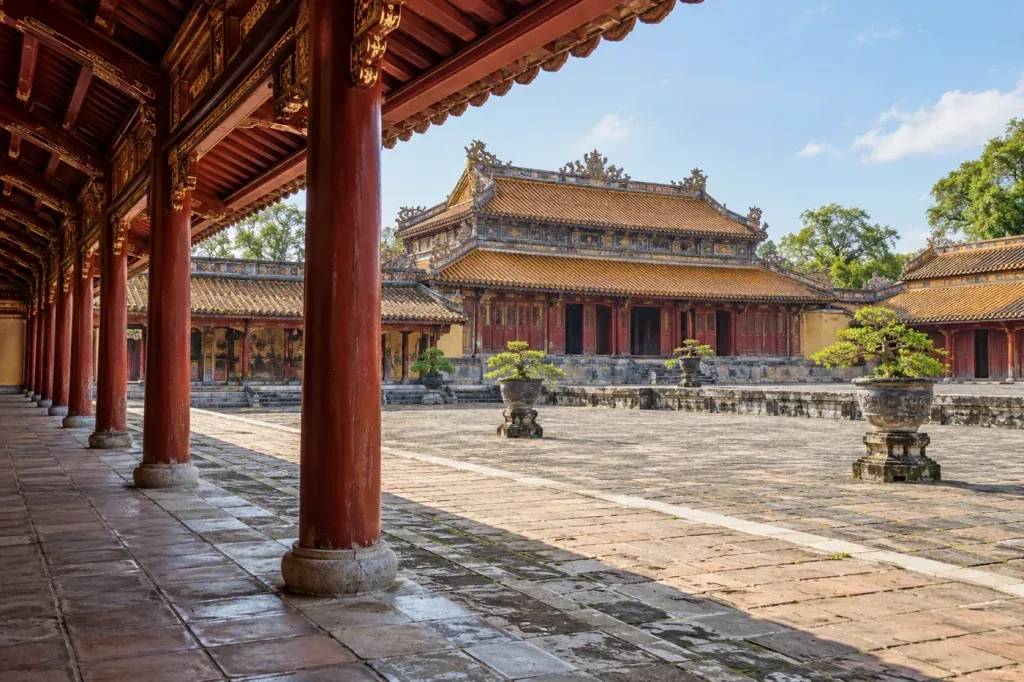
Ngo Mon and the ceremonial approach
Begin at the main visitor entrance around Ngo Mon, collecting the current map and checking any diversion. Pause to understand the sequence of gate, courtyard and palace rather than walking straight through for a photograph.
Thai Hoa and the palace grounds
Follow the signed route towards Thai Hoa Palace and the accessible halls and courtyards beyond. Restoration can affect the circuit. Read the interpretation to distinguish reconstructed elements from historic fabric and to understand how royal ceremony used these spaces.
Choose a side precinct
Add a temple or pavilion area that is open, rather than trying to see every corner. If you visit the The Mieu area, treat it as a commemorative and ritual space. Finish with enough time to reach the designated exit and meet your driver.
Should you hire a guide?
A qualified guide can explain the layout and the purpose of buildings that otherwise look similar. Agree the language, duration, route and total price first. Ask whether the guide fee includes admission; do not assume it does.
For an independent visit, read the map at the beginning and choose a few priorities. A shorter route with context can be more useful than walking every open path without understanding what you are seeing.
Heat, rain and accessibility
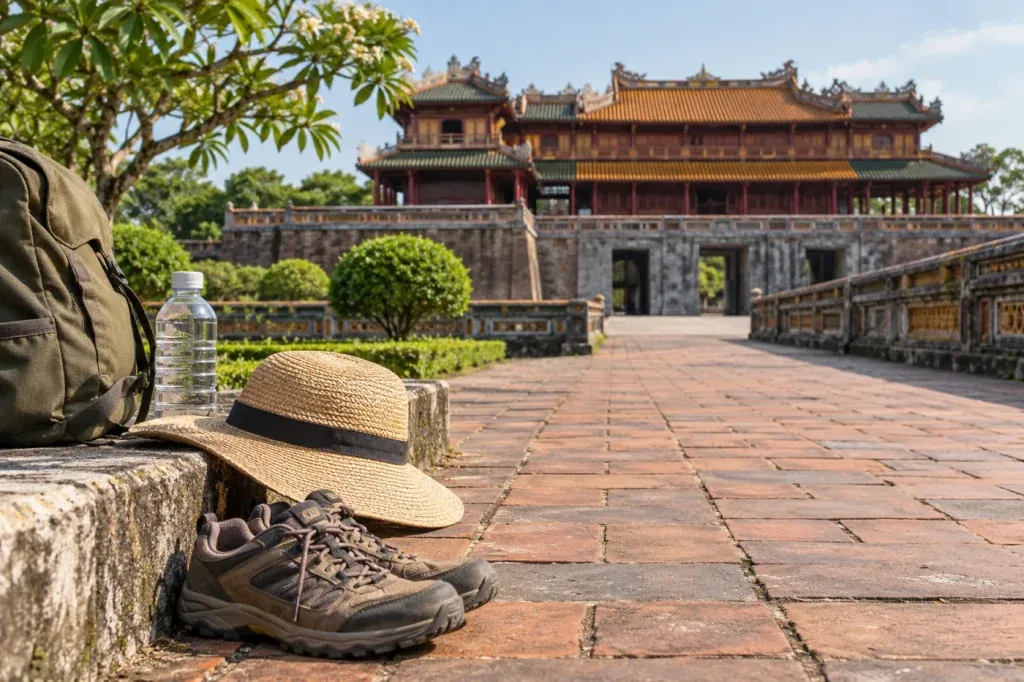
Large outdoor courtyards mean substantial exposure to sun or rain. Bring water, sun protection and comfortable shoes, and build in rest breaks. After rain, watch for slippery paving and avoid any flooded or closed sections.
Raised thresholds, steps and uneven surfaces can interrupt an otherwise flat route. Ask the centre about an accessible entrance, toilets and a suitable circuit before booking if step-free access is essential. Do not assume mobility access from an overhead map.
Etiquette and practical planning
Wear respectful clothing for worship and memorial interiors. Follow photography restrictions, stay behind barriers and never climb on historic features. Give ceremonies and other visitors space.
If arriving from Da Nang by rail, use the train planning guide and subtract transfers and boarding time from your sightseeing window. A palace visit plus lunch is more realistic than adding several distant tombs to a short stay.
Choose a palace visit that fits your available time
About two hours for a first impression
Start with the current visitor map and identify the main ceremonial approach and one additional precinct that is open. Follow that selected route without trying to enter every side passage. Allow time to read interpretation at a few important stops, take a seated break where permitted and return to the exit. If a queue or diversion takes longer than expected, drop the optional precinct instead of rushing through the palace itself.
A longer visit with a guide
Ask the guide to organise the route around how the court used the spaces: arrival, ceremony, worship and more restricted areas. Give the guide your walking limits and interests before setting off. A visitor interested in restoration may want different stops from someone primarily interested in royal administration. Confirm that the agreed duration includes time to move between the buildings rather than expecting continuous commentary without breaks.
Make sense of restored buildings and open spaces
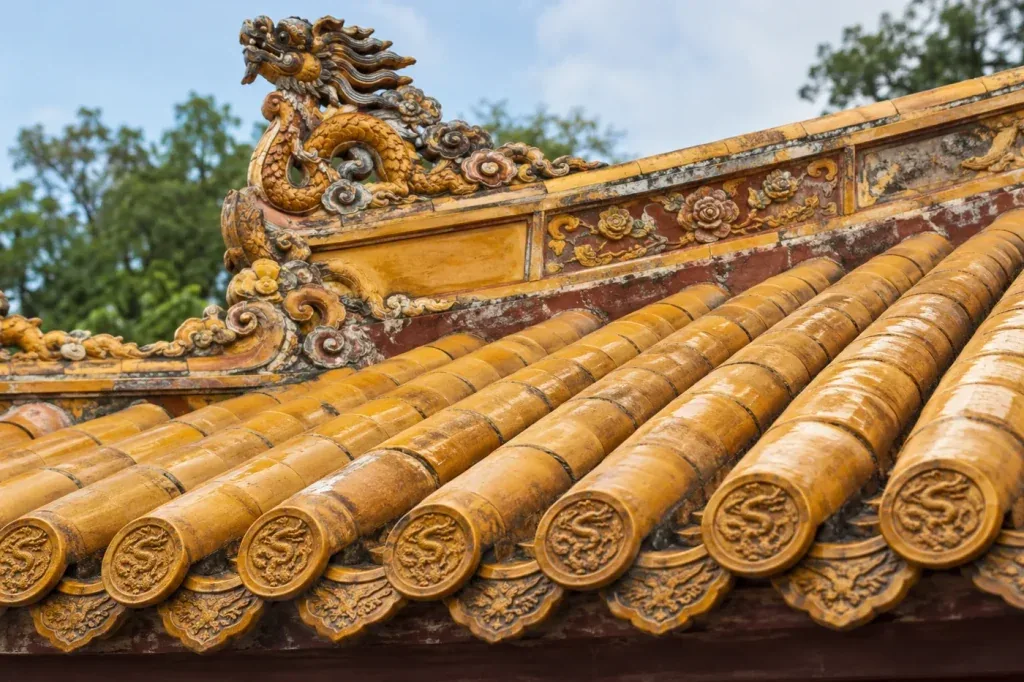
A palace visit is easier to understand when you distinguish what survives, what has been reconstructed and what is represented mainly by its position in the grounds. Use the interpretation to make those distinctions. An apparently empty area may still matter to the site’s layout, while a newly finished surface should not be assumed to be original simply because it stands inside the historic precinct.
Photographs alone cannot establish the age or authenticity of a detail. If a particular hall or decorative feature interests you, ask what the interpretation says about its building phases and conservation. This approach lets you appreciate the work visible today without inventing a story about every object. Keep notes of questions you want to explore afterwards rather than relying on a quick answer overheard from another group.
Single-site admission or a combination ticket?
Write down the monuments you realistically intend to enter before comparing products. Add travel time and walking time for each one, then check the ticket’s named sites and validity. A combination can be poor value if it pushes you into extra visits you do not have time or energy to enjoy. Do not buy it solely because its list looks longer than a single-site ticket.
If you are arriving by train, choose the return departure first and calculate your actual time in the city after transfers. The palace plus a meal may fill that window comfortably. On an overnight stay, you can give the Imperial City its own session and visit Minh Mang or Tu Duc on another day. That separates two substantial walks and leaves room to change plans if the weather turns.
Frequently asked questions
Is one hour enough?
Only for a very selective look. Two to three hours is a more useful starting allowance, with extra time for a guide or slower walking.
Are the royal tombs inside the Imperial City?
No. They are separate sites around Hue with separate transport and ticket considerations.
Can I enter at closing time?
No. Ticket sales finish before the published visitor closing time. Check both times and arrive earlier.