Da Nang is known for its beaches, but drive forty minutes west and the landscape changes completely: river valleys, bamboo groves, and mountains that stay green year-round. This is where the city’s most interesting accommodation sits. If you’re searching for treehouses with forest views, what you’ll actually find here is richer than a novelty stay — elevated wooden stilt houses built by Co Tu communities, canopy-level bungalows on forested hillsides, and platform tents pitched beside mountain streams.
Vietnam’s answer to the treehouse is the nhà sàn, the stilt house — a raised timber structure that has been the standard highland dwelling for centuries. In Da Nang’s western communes and on the Son Tra peninsula, these sit alongside modern eco-bungalows and glamping platforms, all sharing the same essential appeal: you wake up level with the tree line. And since the July 2025 merger with Quang Nam province, the city’s forest territory has expanded enormously, bringing genuine mountain destinations inside Da Nang’s boundaries for the first time.
Quick Summary: Da Nang offers treehouses with forest views across four distinct zones: the Hoa Bac river valley 40 minutes west, the Ba Na foothills, the primary forest of the Son Tra peninsula, and the Co Tu highland villages of the former Quang Nam province. Options range from 200,000 VND platform tents to five-star forest resorts. The one purpose-built treehouse property sits near Hoi An. Book ahead for weekends, verify current operating status for remote properties, and note that some far-western districts sit in restricted border zones.
Updated: August 22, 2026 · Reading time: 13 min · Expertise: Vietnam Travel & Unique Lodging
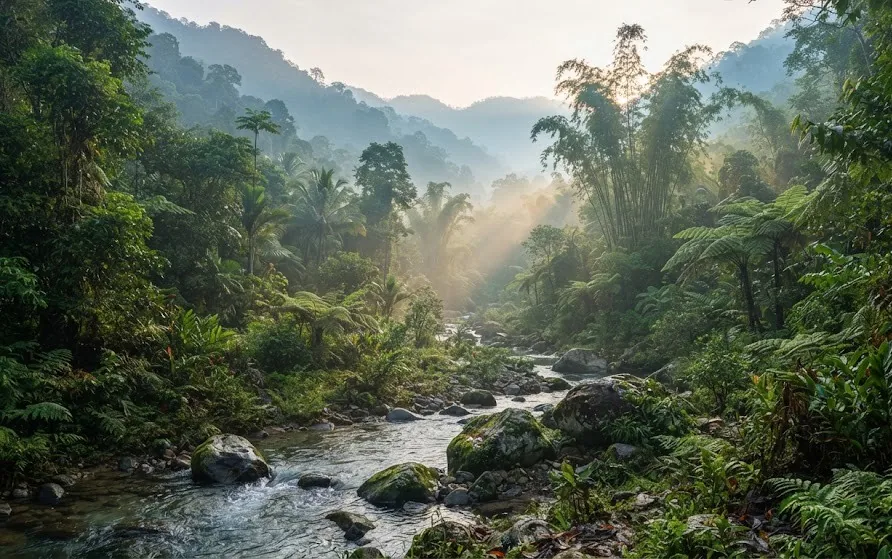
Why Da Nang Works for Forest Lodging
Da Nang’s transformation into a major tourist destination has been overwhelmingly coastal. Over 17.6 million — and the overwhelming majority stayed within two kilometres of the sea.
That concentration is precisely why the forest side of the city remains worth visiting. The Hoa Bac valley, the Co Tu villages along the Ho Chi Minh Road, and the upper reaches of the Son Tra peninsula see a fraction of the traffic that My Khe Beach absorbs on an average Tuesday. You are rarely competing for space.
What the 2025 Merger Changed
On 1 July 2025, Da Nang City and Quang Nam province merged into a single administrative unit retaining the name Da Nang City. The new city covers approximately 11,859 km² — nearly ten times the old footprint — with a population just over 3 million, organised into 23 wards, 70 communes, and the Hoang Sa special zone.
Important note: For anyone hunting forest accommodation, this is the single most consequential change in years. Mountain areas that were previously “a trip to Quang Nam” — the Co Tu villages of Song Kon, the cloud-level ridges of Tay Giang, the Truong Son foothills — are now simply parts of Da Nang. A search for lodging “in Da Nang” that previously returned only beachfront hotels now legitimately includes stilt houses at 1,500 metres elevation.
Four Zones, Four Different Trips
Understanding the geography before you book matters more here than in most cities, because these zones are genuinely far apart.
-
Hoa Bac Valley (west, 40–60 min): The Cu De river, bamboo forest, rice terraces and Co Tu community villages. The densest cluster of camping, glamping and eco-lodge options, and the easiest forest trip from the city.
-
Ba Na Foothills (southwest, 30–40 min): Quieter garden bungalows in the hills below the Ba Na Hills cable car. Good for people who want forest calm without giving up a swimming pool.
-
Son Tra Peninsula (northeast, 20–30 min): Genuine primary coastal forest on the city’s doorstep, home to the endangered red-shanked douc langur. This is the only zone where you get forest and ocean in the same view.
-
The Western Highlands (far west, 2–4 hrs): Song Kon, Tay Giang and the Truong Son range. Authentic Co Tu stilt-house stays and cloud-level ridges. A committed overnight trip, not a day out.
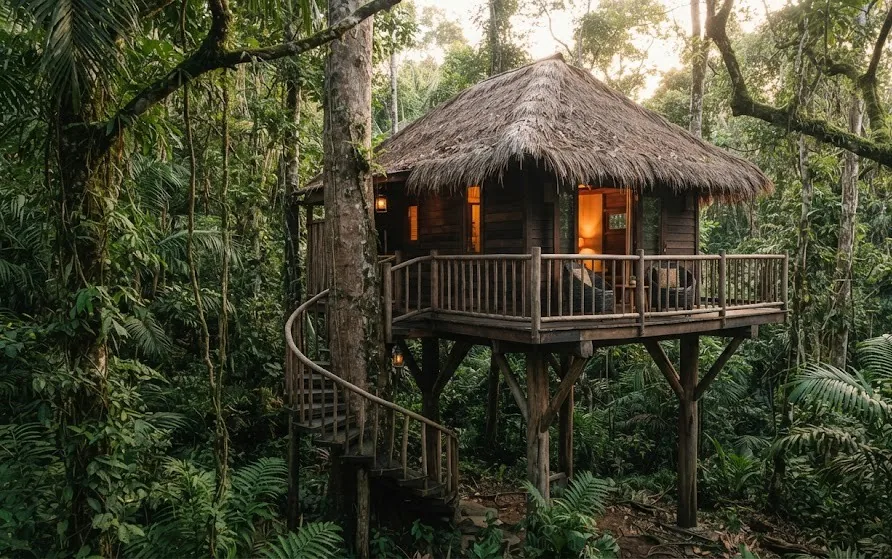
Treehouses and Elevated Stays in Da Nang
The properties below are grouped by zone. All were verified in August 2026, but remote lodging in Vietnam opens and closes with little notice — confirm directly before you travel.
The Purpose-Built Treehouse
Hoi An Unique Treehouse
The only property in the greater Da Nang area built and marketed as an actual treehouse. It sits in Cam Thanh village, roughly 4 km east of Hoi An old town, run by a local host named Xuan who grew up in the area. The structure is a rustic timber house with two bedrooms, two bathrooms, a full kitchen and a private entrance, set in a garden with a pool and free bicycles for guests.
Set expectations correctly on the view: Cam Thanh is water-coconut palm and rice paddy country, not mountain forest. What you get is green, quiet, and low-rise — closer to a garden canopy than a jungle.
Location: Cam Thanh, Hoi An · Type: Standalone treehouse chalet, 2 bedrooms · Getting there: ~25 min from Hoi An old town, ~50 min from Da Nang city centre
Hoa Bac Valley: The Closest Forest
Insight: Hoa Bac is the practical answer for most travellers. It is close enough for a single overnight, cool enough to feel like a genuine change of climate, and it sits on the Cu De river with bamboo forest on both banks. The two Co Tu villages here — Ta Lang and Gian Bi — have been developing community tourism for several years, which means your money stays local.
Leaf Village & Farm (Làng Lá)
The largest and best-established property in the valley, built along the Khe Dao stream in Nam My village. Accommodation spans a range of budgets: proper bungalows at the top end, tented platforms lower down. The setting is the draw — a river running directly along the base of a mountain, with a small farm area that families with young children tend to appreciate.
Common mistake: Assuming the premium price guarantees premium service. Guests paying bungalow rates have reported slow responsiveness and maintenance gaps. The scenery consistently delivers; the hospitality is less consistent. Set expectations accordingly and you’ll enjoy it.
Location: Suoi Khe Dao, ĐT601, Nam My village · Type: Bungalows and tents · Hours: ~5:00 AM – 10:00 PM
Homestay Alang Nhu
A Co Tu-run glamping site in Gian Bi village, set among thornless bamboo groves directly on the Cu De river. Tents are equipped with fans, which matters more than it sounds in a Vietnamese summer. The river here is wide and calm enough for stand-up paddleboarding, and the hosts can connect you to the broader Ta Lang and Gian Bi community tourism circuit.
This is the option to choose if the cultural dimension interests you as much as the forest.
Location: Gian Bi village, Hoa Bac · Type: Glamping tents · Getting there: ~50 min from city centre
Camping Hoà Bắc – Nhà Út
Small, family-run and considerably cheaper than the branded properties nearby. There are both indoor and outdoor sleeping areas, full cooking equipment, tables and chairs — you can order food from the host or bring your own to grill. Not polished, but genuinely warm.
Location: Nam Yen village, Hoa Bac · Type: Camping, indoor and outdoor · Hours: Open 24 hours
Đủng Đỉnh Camping & Nam Yên Camping
Straightforward riverside camping with easy road access — a real consideration in this valley, where some sites require a rough final approach. Good for a first camping trip with people who aren’t sure they like camping.
Location: Nam Yen village, Hoa Bac · Type: Camping · Hours: Open 24 hours
Hoà Bắc Ecolodge – Camping Space Art
Rice field views rather than deep forest, with open space for games and groups. Works best as a social weekend venue rather than a quiet nature retreat.
Location: Bau Bang, Hoa Bac · Type: Camping and lodging
Tuấn Lê Glamping
A larger operation on ĐT601 with a pool, restaurant and river access, about 40 minutes from the city. Well-equipped and popular with domestic groups.
Common mistake: Booking any Hoa Bac riverside site for a quiet weekend without checking the karaoke situation. Vietnamese group tourism and portable speakers travel together, and guests here have specifically reported late, loud music. If silence is the goal, choose a smaller site or ask directly about noise policy when booking.
Location: ĐT601, Hoa Bac · Type: Glamping with pool · Hours: Open 24 hours
Ba Na Foothills: Forest Without Roughing It
Lá Retreat
Open-plan villas arranged around a communal pool in Dong Son village, roughly eight minutes from the Ba Na Hills cable car station and 30–40 minutes from central Da Nang. Large windows facing directly into the garden, a koi pond, home-cooked meals prepared in an outdoor kitchen, and scooters available for rent.
The remoteness cuts both ways: it is genuinely peaceful, but there are few restaurants within walking distance, so plan to eat on site. Staff will arrange taxis, often more cheaply than ride-hailing apps, which don’t reliably serve this area.
Location: Van Thanh road, Dong Son village, Hoa Vang · Type: Garden villas and bungalows · Hours: Open 24 hours
Son Tra Peninsula: Forest Meeting Ocean
Insight: Son Tra is the only place in Vietnam where you can stay inside protected coastal forest twenty minutes from a major airport. The peninsula supports a population of red-shanked douc langurs — a striking, endangered primate — along with troops of macaques that regularly wander through resort grounds. Treat all of them as wildlife: don’t feed them, and secure food and bags on balconies.
Son Tra Resort & Spa
The more characterful of the peninsula’s two established options. Villas are set into forested hillside above a quiet private beach, and the property has an organic, slightly weathered feel that guests consistently prefer to the sterile polish of larger resorts. Monkeys wandering the grounds are a routine occurrence. Beachfront villas are the ones worth paying for.
Manage expectations against the marketing photography — several guests have noted the reality is more rustic than the images suggest. That is arguably the point.
Location: Hoang Sa road, Son Tra · Type: Forest and beachfront villas · Hours: Open 24 hours
InterContinental Danang Sun Peninsula Resort
The luxury end of forest lodging in Da Nang, terraced down a steep forested hillside at Bai Bac on the peninsula’s north side, connected by funicular. Architecturally it is among the most distinctive resorts in Vietnam, and the forest is genuinely all around you rather than landscaped in.
Expensive, and not a nature-immersion experience in the backpacking sense — but if the brief is “forest views without compromise,” this is the property.
Location: Bai Bac, Tho Quang, Son Tra · Type: Luxury forest resort · Hours: Open 24 hours
The Western Highlands: Authentic Stilt Houses
This is where you find the real thing — timber houses raised on posts, built by and for the Co Tu people, in villages surrounded by Truong Son forest. These are the closest genuine equivalent to the treehouses with forest views that most travellers are imagining, and the experience is cultural as much as scenic.
ACu Homestay
A Co Tu family homestay in Bho Hoong village, Song Kon, along the Ho Chi Minh Road. Hosts Cu and Thin have an established reputation among cycling tour operators who stop here for lunch and mountain treks. Guests are typically offered family-distilled rice wine and fruit picked from the garden, and traditional Co Tu music and dance demonstrations are part of a normal evening.
The accommodation is basic. The hospitality is not. This is the single most recommended highland stay in the new Da Nang territory.
Location: Bho Hoong village, Song Kon · Type: Co Tu family homestay · Getting there: ~2.5 hrs from Da Nang city centre
Bho Hoong Bungalows
A community tourism bungalow project in the same village, built in traditional style. Reports on current operating status conflict significantly — some visitors describe a warm, well-run stay, while others have arrived to find the bungalows closed.
Important note: Do not travel here on the assumption it is open. Call ahead and get confirmation, and have ACu Homestay as a backup. This applies to remote lodging across the western highlands generally: listings persist online long after properties stop operating.
Location: Bho Hoong village, Song Kon · Type: Traditional-style bungalows
Lộc Trời Homestay – Đỉnh Quế, Tây Giang
High in the Truong Son range near Dinh Que, a ridge at roughly 1,580 metres that ranks among the most spectacular viewpoints in central Vietnam. The homestay offers teepee-style accommodation with layered mountain views, and sits within reach of the Po Mu and Do Quyen ancient forests. Sunrise from the ridge is the reason people make the trip.
Important note: Tay Giang sits in a designated border zone. Multiple travellers have reported that foreign visitors are not permitted to stay overnight in this area, and that accommodation providers turn them away on arrival — in at least one case after a 4.5-hour motorbike ride. Vietnamese nationals are unaffected. If you hold a foreign passport, verify permit requirements with local authorities before committing to this trip. No amount of advance booking overrides a border regulation.
Location: Dinh Que, Tay Giang · Type: Teepee and homestay rooms · Getting there: ~130 km from Da Nang, mountain roads in poor condition
Hoi An: Garden and Eco Lodging
Hoi An Eco Lodge & Spa
Villa-style rooms with balconies, three swimming pools, and an on-site spa, set in gardens on the outskirts of Hoi An about five minutes from the old town by car. Not forest, but genuinely green, quiet and well-run — and the most reliable comfort option in the area for travellers who want nature without remoteness.
Location: ĐX20, Thanh Nhut, Hoi An Dong · Type: Garden villas and lodge rooms · Hours: Open 24 hours
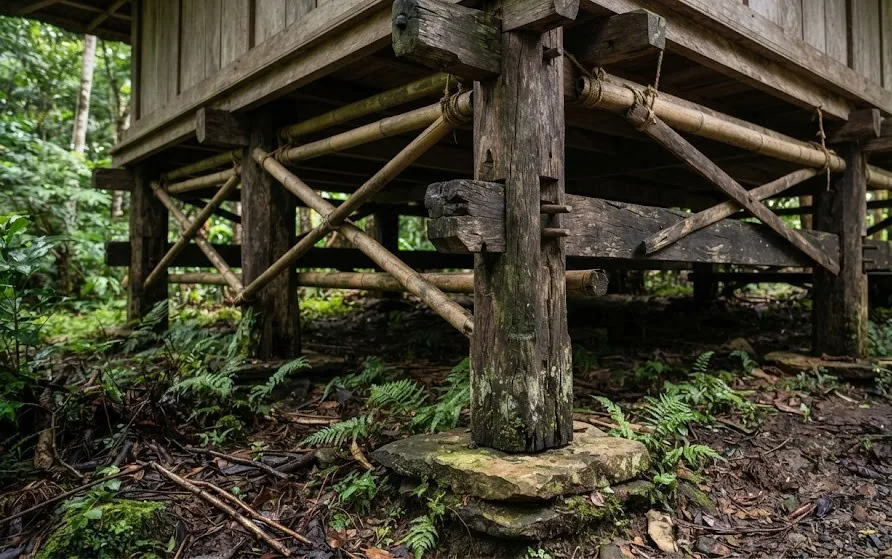
Understanding Vietnamese Elevated Architecture
Knowing what you’re sleeping in makes the stay considerably more interesting.
Traditional Forms
-
Nhà sàn (Stilt House): The standard highland dwelling across Vietnam’s mountain regions — a timber floor raised on posts, historically for protection from flooding, damp and animals. The elevation produces exactly what treehouse travellers are after: airflow, privacy, and a floor level with the surrounding canopy.
-
Gươl (Co Tu Communal House): The soaring, steeply-roofed communal structure at the centre of every Co Tu village, used for meetings, ceremonies and hosting guests. Not usually accommodation, but you’ll see it in Bho Hoong and Gian Bi, and it is the architectural heart of these communities.
-
Moong: The smaller Co Tu guest structure, often used for visitors in community tourism villages.
Modern Interpretations
-
Eco-Bungalow: Timber or bamboo cabins built low-impact into hillsides, usually with large windows or open walls facing the forest. The Ba Na foothills and Hoa Bac are full of these.
-
Glamping Platform: A permanent raised deck with a fixed tent, mattress and often a fan. The dominant format in Hoa Bac and the cheapest way to sleep in the forest comfortably.
-
Hillside Villa: The luxury end — resort architecture terraced into forested slopes, most prominently on Son Tra.
Practical Guide: Booking and Staying
Step 1 – Timing: February through May is the sweet spot: dry, warm, and before the summer heat peaks. The rainy season runs roughly September to December, when mountain roads in Hoa Bac and the western highlands become genuinely hazardous and many camping sites close. Avoid booking remote forest lodging during typhoon season.
Step 2 – Booking: Larger properties list on international platforms. Smaller camping and homestay operations in Hoa Bac and the highlands frequently do not — they run on Facebook pages and Zalo, and you book by phone. If you don’t speak Vietnamese, ask your city hotel to call for you, which is a normal and freely-given favour here.
Step 3 – Payment: QR bank transfer dominates in Vietnam, and small operators often ask for a deposit this way. Without a Vietnamese bank account you’ll need cash, and remote properties rarely accept cards. Withdraw before you leave the city — ATMs in Hoa Bac and the western communes are scarce or nonexistent.
Step 4 – Getting There: Hoa Bac and the Ba Na foothills are comfortable by scooter or Grab, though ride-hailing coverage thins out and return trips usually need the property to call a local driver. The western highlands require a car, a private driver, or genuine motorbike experience — Dinh Que in particular has road conditions that consistently take longer than mapping apps predict.
Common mistake: Treating a highland stay as a spontaneous day trip. Properties are far apart, phone signal is patchy, restaurants close early, and turning up unannounced at a village homestay puts hosts in an awkward position. Confirm the night before, and arrive in daylight.
Data: Da Nang’s accommodation establishments served over 17.The city has set a 2026 target of 19.1 million visitors. Following the July 2025 merger, Da Nang’s total area expanded to approximately 11,859 km², the overwhelming majority of it mountainous and forested rather than coastal. Figures per Da Nang Department of Culture, Sports and Tourism reporting and National Assembly Resolution 202/2025/QH15.
Staying Responsibly in Co Tu Villages
Community tourism in Ta Lang, Gian Bi and Bho Hoong exists because residents chose to open their villages, and it functions best when guests treat it as a visit rather than a product.
A few things that matter locally: ask before photographing people, particularly elders; the gươl is a ceremonial space, so follow your host’s lead on when it’s appropriate to enter; accepting offered rice wine is a gesture of welcome, and a small taste is enough if you’d rather not drink; and booking directly with the family rather than through an intermediary keeps a far larger share of the money in the village.
Future Trends in Da Nang Forest Lodging
Insight: The merger has produced a structural opportunity that operators are only beginning to act on — a single city that now contains beach resorts, an international airport, and 1,500-metre mountain ridges within its own boundaries.
-
Highland Route Development: Expect tour operators to build multi-day itineraries linking coastal Da Nang to the Co Tu villages and Truong Son forests, marketed as a single-destination trip rather than a province-crossing expedition.
-
Purpose-Built Treehouses: The category is genuinely underserved locally, and demand for treehouses with forest views is visible in search behaviour. Hoa Bac’s bamboo groves and river frontage are the obvious location for the first serious operator to build one.
-
Upgraded Glamping: The valley’s camping sites are competing on comfort — fans, proper bedding, private bathrooms — and the gap between “camping” and “boutique lodging” is narrowing quickly.
-
Son Tra Conservation Pressure: Development on the peninsula remains contentious given its protected forest and langur population. Expect continued constraints on new construction, which will keep supply tight and prices firm.
-
Community Tourism Formalisation: As Ta Lang, Gian Bi and Bho Hoong receive more visitors, expect clearer booking systems and better online presence — currently the biggest practical barrier for foreign travellers.
Related on this site
- Da Nang Airbnb Plus Listings: Premium Short-Term Rentals 2026
- Da Nang Romantic Cottages: Cozy Hideaways for Couples 2026
- Da Nang Beachfront Camping Sites: Sleep Under the Stars 2026
Frequently Asked Questions
Are there real treehouses with forest views in Da Nang?
Yes, though the category looks different from what you might expect. One purpose-built treehouse operates near Hoi An, and the broader category of elevated forest lodging — Co Tu stilt houses, hillside eco-bungalows and raised glamping platforms — is well represented across Hoa Bac, the Ba Na foothills, Son Tra and the western highlands.
Which zone should I choose for a single night?
Hoa Bac. It’s 40–60 minutes from the city, has the widest range of price points, and delivers river, bamboo forest and mountain views without requiring a full day of travel each way.
How much does forest accommodation cost?
Camping and glamping platforms in Hoa Bac start around 200,000–500,000 VND per person. Eco-bungalows and homestays typically run 700,000–2,000,000 VND per night. Hillside resort villas on Son Tra range from mid-range to several million VND. Confirm directly, as small operators rarely publish current rates online.
Can foreigners stay in the western highland villages?
In Song Kon and the Bho Hoong area, yes. Tay Giang is a border zone where foreign visitors have reported being refused overnight accommodation, so verify permit requirements before travelling there with a foreign passport.
What’s the best time of year?
February to May. The rainy season from roughly September to December makes mountain roads dangerous and closes many camping sites.
Will I see wildlife?
On Son Tra, almost certainly — macaques are common around resort grounds and red-shanked douc langurs are regularly sighted in the forest. In Hoa Bac expect birds, insects and river life rather than large mammals.
Do I need to book in advance?
For weekends and holidays, yes — Hoa Bac fills with domestic visitors. For remote highland properties, advance contact is essential simply to confirm they’re operating.
Is Hoi An part of Da Nang now?
Yes. The July 2025 merger brought Hoi An, My Son, Cu Lao Cham and the entire former Quang Nam province inside Da Nang’s city limits.
Is camping in Hoa Bac quiet?
Not automatically. Larger riverside sites are popular with domestic groups and karaoke is common into the evening. Smaller family-run sites are considerably quieter — ask about noise policy when you book.
Conclusion
Searching for treehouses with forest views in Da Nang leads somewhere more interesting than a single novelty booking. The city’s elevated lodging runs from 200,000 VND tent platforms beside the Cu De river to Co Tu stilt houses two and a half hours west, to villas terraced into protected forest on the Son Tra peninsula — and each represents a genuinely different trip rather than a different price point for the same one.
The practical advice is to pick your zone before your property. Hoa Bac for an easy first night in the forest, the Ba Na foothills for calm with comforts, Son Tra for forest and ocean together, and the western highlands when you have two days and real curiosity about Co Tu culture. Confirm directly by phone, carry cash, travel in the dry season, and give the mountain roads more time than your map suggests. Da Nang’s forest side rewards exactly this kind of planning — and after the 2025 merger, there is far more of it to explore than most visitors realise.
Properties and locations were verified in August 2026. Remote lodging in Vietnam changes operating status frequently and with little public notice — confirm directly by phone before travelling, particularly for camping sites and highland homestays. Border zone restrictions in Tay Giang are reported by travellers rather than confirmed by this publication; foreign visitors should verify current requirements with local authorities. Administrative changes are per National Assembly Resolution 202/2025/QH15 and Standing Committee Resolution 1659/NQ-UBTVQH15.
Part of our guide to where to stay in Da Nang.