Da Nang’s accommodation market is dominated by one thing: beachfront hotels along the Võ Nguyên Giáp and Trường Sa strip, most of them competent and most of them interchangeable. Look slightly further and the city has genuinely unusual places to sleep — shipping-container rooms in the expat quarter, capsule pods near the Dragon Bridge, Cơ Tu stilt houses in mountain villages, and canvas tents pitched beside a river in bamboo forest forty minutes west.
This guide covers seventeen verified unique accommodations across greater Da Nang, organised by what actually makes each one different. Since the July 2025 merger with Quảng Nam province, the city’s territory now stretches from the Sơn Trà peninsula to the Trường Sơn mountains and south through Hội An, which means the range of what counts as “a stay in Da Nang” has expanded dramatically.
Quick Summary: Da Nang’s unique accommodations fall into six categories: container and capsule stays in the city (from around 350,000 VND), architecturally distinctive hotels, Cơ Tu stilt-house homestays in the western highlands, riverside glamping in the Hòa Bắc valley, forest retreats on Sơn Trà and below Bà Nà, and the Hội An belt including the area’s one purpose-built treehouse. Book ahead for weekends, confirm operating status directly for remote properties, and carry cash outside the city.
Updated: August 22, 2026 · Reading time: 13 min · Expertise: Vietnam Travel & Unique Lodging
What “Unique” Actually Means in Da Nang
Important note: A few accommodation types that appear in searches for Da Nang do not exist here. There are no overnight houseboat stays, no cave hotels, and no floating hotels operating in the city. Boats on the Hàn River and the Thu Bồn run day and evening trips only, and the caves at the Marble Mountains — Âm Phủ and Huyền Không — are visitor attractions rather than lodging. Cave accommodation in Vietnam is associated with Phong Nha in Quảng Bình, roughly 300 km north and a separate trip entirely.
What Da Nang does have is a genuinely wide spread of unusual lodging, and it clusters into six recognisable groups.
The Six Categories
-
Container and Capsule: Repurposed shipping containers and Japanese-style sleeping pods, concentrated in An Thượng and around the Hàn River. The cheapest unique stays in the city.
-
Architectural Landmarks: Hotels where the building itself is the draw — plant-covered facades, hillside terracing, buildings designed by names the architecture press knows.
-
Stilt Houses: Nhà sàn — raised timber dwellings in Cơ Tu villages along the Hồ Chí Minh Road, now inside Da Nang after the merger. The most culturally substantial option on this list.
-
Riverside Glamping: Permanent tents and bungalows along the Cu Đê river in the Hòa Bắc valley, 40–60 minutes west.
-
Forest Retreats: Villas and bungalows set in genuine forest, on the Sơn Trà peninsula and in the hills below Bà Nà.
-
The Hội An Belt: Post-merger, the villa and homestay corridor around Cẩm Thanh and the Thu Bồn river, including the area’s only purpose-built treehouse.
What the 2025 Merger Changed
On 1 July 2025, Da Nang City and Quảng Nam province merged into a single administrative unit retaining the name Da Nang City, covering approximately 11,859 km² with a population just over 3 million, organised into 23 wards, 70 communes and the Hoàng Sa special zone.
For accommodation this is transformative. Hội An, the Cơ Tu villages of Sông Kôn, and the cloud-level ridges of Tây Giang are all now parts of Da Nang. A search for unique accommodation “in Da Nang” that previously returned beachfront hotels now legitimately includes stilt houses at 1,500 metres.
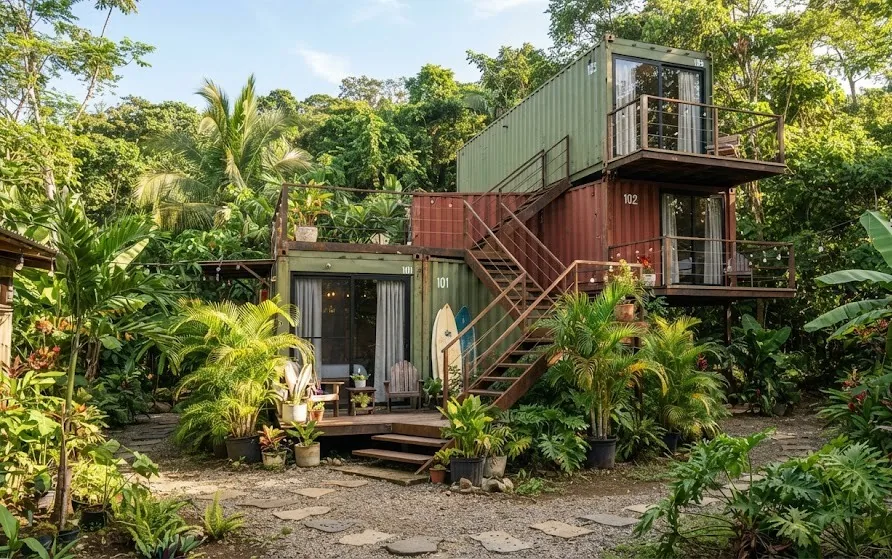
Container and Capsule Stays
Rom Casa Da Nang
The most distinctive budget accommodation in the city: brightly painted shipping containers arranged around a courtyard bar in the An Thượng expat quarter, five minutes’ walk from the beach. Container dorms and private rooms, shared bathroom blocks, and a large social area with a pool table, darts and a PS5.
This is a party hostel and makes no pretence otherwise — quiz nights, pool tournaments and beer pong most evenings, with music until midnight. There is a second, quieter building across the street, which is what to request if the social side isn’t the appeal.
Common mistake: Booking the main building expecting quiet. Guests who want the container concept without the noise should ask specifically for the annexe. Bathroom cleanliness in the dorm blocks also draws recurring complaints, so this is a stay to choose for the atmosphere and price rather than the facilities.
Location: 47 An Thượng 4, Ngũ Hành Sơn · Type: Container dorms and private rooms
The Garden Capsule Hotel
Sleeping pods on Bạch Đằng, close to the Hàn River and a short walk to the Dragon Bridge — well placed for the Friday, Saturday and Sunday night fire show. Rooms are clean and well maintained, linen and towels provided, and the staff have a strong reputation for local food recommendations.
Two things to know: some rooms have no exterior window, and the proximity to reception and the lift makes parts of the property noisy. The social space is small, so this suits travellers who want privacy rather than a hostel community.
Location: 206–208 Bạch Đằng, Hải Châu · Type: Capsule pods and private rooms · Hours: Open 24 hours
Nang Capsule Hostel
A small capsule hostel on Lê Lợi under relatively new ownership, with a live-in owner who has been steadily improving the property — daily-changing breakfast, good bedding, fast Wi-Fi, and a location far enough from the bar strip to avoid late noise. Will accommodate dietary requests like vegan breakfast.
Small operation with a modest review count, but the trajectory is positive and the value is strong.
Location: 56A Lê Lợi, Hải Châu · Type: Capsule hostel · Hours: Open 24 hours
Da Nang Capsule Hotel
The largest and longest-running capsule property in the city, on Chính Hữu near the An Hải side of the river. The pods themselves are generously sized — tall guests report fitting without difficulty — with keycard-operated automatic locks and stable Wi-Fi inside each capsule.
Important note: Include this one with a genuine caveat. Alongside positive reports, multiple recent guests describe the property as run down: broken keycard locks, non-functioning in-pod safes and televisions, and bathroom cleanliness well below what the price suggests. At least one guest reported a serious dispute over a refund. If the capsule concept is what you want, the Garden or Nang properties are the safer bookings.
Location: 103 Chính Hữu, An Hải · Type: Capsule hotel
Architecturally Distinctive Hotels
Insight: These are conventional hotels in every operational sense — front desk, breakfast buffet, housekeeping. What makes them worth listing is that the building itself is the reason to stay, which is rarer in Da Nang than the volume of beachfront construction would suggest.
Chicland Danang Beach Hotel
A green-facade hotel directly opposite Mỹ Khê Beach, wrapped in planting across its full height — the most recognisable building on the Võ Nguyên Giáp strip and a deliberate counterpoint to the glass towers around it. Rooftop pool with a full-time attendant, strong breakfast variety, and a location where crossing the road puts you on the sand.
The property has also drawn specific praise for accessibility, with staff going out of their way to assist guests using wheelchairs.
Common mistake: Assuming the greenery means quiet. There is ongoing construction nearby, and noise has been reported at unpredictable hours including late at night. Request a room away from the construction side when booking.
Location: 210 Võ Nguyên Giáp, An Hải · Type: Green-facade design hotel · Hours: Open 24 hours
InterContinental Danang Sun Peninsula Resort
Architecturally the most ambitious property in the city and arguably in Vietnam — designed by Bill Bensley, terraced down a steep forested hillside at Bãi Bắc on the north side of the Sơn Trà peninsula, with a funicular railway connecting the levels. The black-and-white palette, the layered pavilions and the way the structure disappears into the forest make it a genuine architectural destination rather than a luxury hotel that happens to look nice.
It opened in 2012 and hosted the APEC 2017 leaders’ meeting. Macaques wander the grounds routinely, and red-shanked douc langurs live in the surrounding forest.
Expensive, and the opposite of a backpacking nature experience — but if the brief is a building worth travelling for, this is it.
Location: Bãi Bắc, Thọ Quang, Sơn Trà · Type: Hillside forest resort · Hours: Open 24 hours
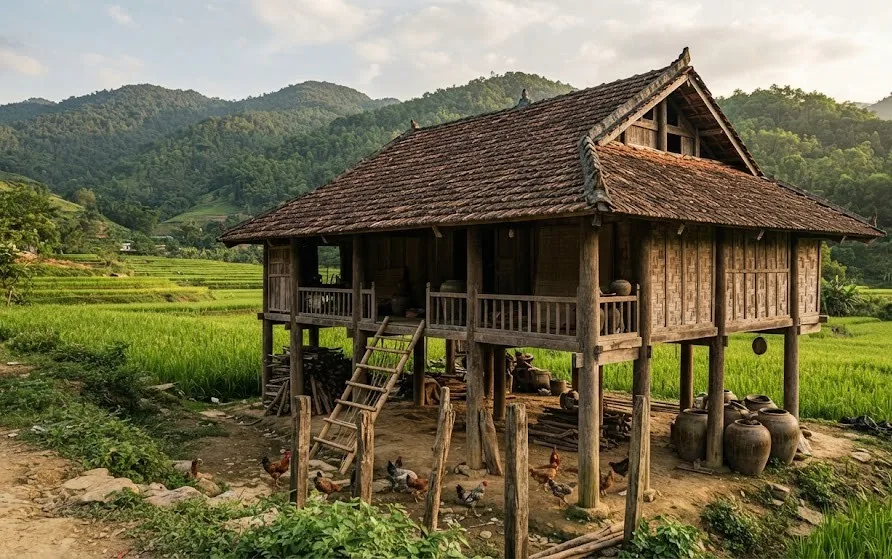
Stilt Houses and Village Homestays
These sit in Cơ Tu villages in the far west of the new Da Nang, along the Hồ Chí Minh Road. Timber houses raised on posts, surrounded by Trường Sơn forest — the most culturally substantial accommodation in the city’s territory, and the closest thing here to the treehouse experience many travellers are actually imagining.
ACu Homestay
A Cơ Tu family homestay in Bhơ Hôông village, Sông Kôn, hosted by Cu and Thin. Cycling tour operators running Hồ Chí Minh Trail routes stop here regularly for lunch and mountain treks, which is a reasonable proxy for reliability. Guests are typically offered family-distilled rice wine and fruit from the garden, and traditional Cơ Tu music and dance form part of a normal evening.
The accommodation is basic. The hospitality is exceptional, and this is the single most recommended highland stay in the new city.
Location: Bhơ Hôông village, Sông Kôn · Type: Cơ Tu family homestay · Getting there: ~2.5 hrs from the city centre
Bho Hoong Bungalows
A community tourism bungalow project in the same village, built in traditional raised style.
Important note: Reports on current operating status conflict sharply. Some visitors describe a well-run stay with excellent hosts; others have arrived to find the bungalows closed. Do not travel here on the assumption it is open — call ahead, confirm, and keep ACu Homestay as a backup. This applies across remote highland lodging generally, where listings persist online long after properties stop trading.
Location: Bhơ Hôông village, Sông Kôn · Type: Traditional-style bungalows
Lộc Trời Homestay – Đỉnh Quế, Tây Giang
Teepee-style accommodation high in the Trường Sơn range near Đỉnh Quế, a ridge at roughly 1,580 metres that ranks among the most spectacular viewpoints in central Vietnam. Within reach of the Pơ Mu and Đỗ Quyên ancient forests. Sunrise from the ridge is the reason people make the journey.
Important note: Tây Giang sits in a designated border zone, and multiple travellers have reported that foreign visitors are not permitted to stay overnight, with accommodation providers turning them away on arrival — in one case after a 4.5-hour motorbike ride. Vietnamese nationals are unaffected. If you hold a foreign passport, verify permit requirements with local authorities before committing. Advance booking does not override a border regulation.
Location: Đỉnh Quế, Tây Giang · Type: Teepee and homestay rooms · Getting there: ~130 km, mountain roads in poor condition
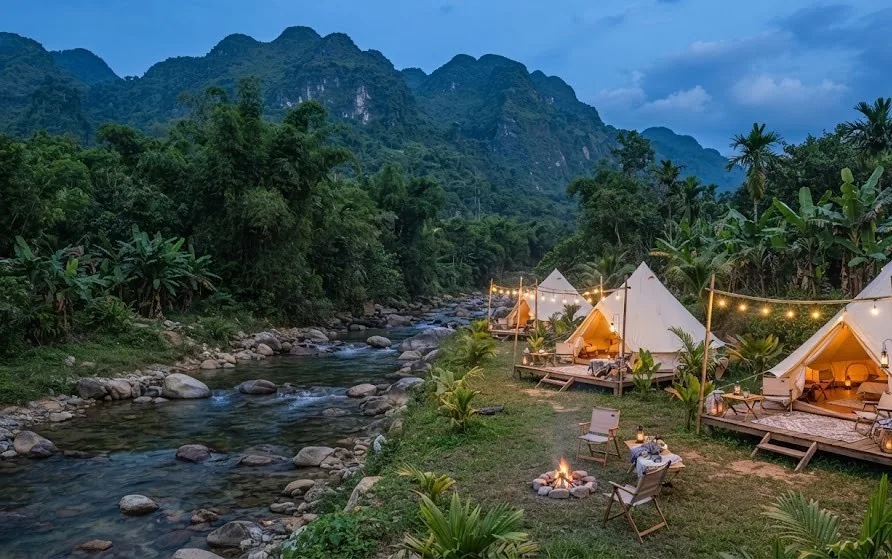
Riverside Glamping in the Hòa Bắc Valley
Insight: Hòa Bắc is the practical answer for most travellers wanting something unusual without committing a full day to travel. The valley sits on the Cu Đê river with bamboo forest on both banks, 40–60 minutes from the centre, and the two Cơ Tu villages here — Tà Lang and Giàn Bí — have been building community tourism for several years.
Leaf Village & Farm (Làng Lá)
The largest and best-established property in the valley, built along the Khe Đào stream in Nam Mỹ village. Accommodation spans budgets: bungalows at the top end, tented platforms below. The setting is the draw — a river running along the base of a mountain, with a small farm area that works well for families with young children.
Common mistake: Assuming the bungalow rate buys resort-level service. Guests paying premium prices have reported slow responsiveness and maintenance gaps. The scenery consistently delivers; hospitality is less consistent.
Location: Suối Khe Đào, ĐT601, Nam Mỹ village · Type: Bungalows and tents · Hours: ~5:00 AM – 10:00 PM
Homestay Alang Nhu
A Cơ Tu-run glamping site in Giàn Bí village, set among thornless bamboo groves directly on the Cu Đê river. Tents come with fans, which matters more than it sounds in summer. The river here is wide and calm enough for stand-up paddleboarding, and the hosts connect guests to the wider Tà Lang and Giàn Bí community tourism circuit.
Choose this one if the cultural dimension matters as much as the setting.
Location: Giàn Bí village, Hòa Bắc · Type: Glamping tents · Getting there: ~50 min from the centre
Camping Hoà Bắc – Nhà Út
Small, family-run, and considerably cheaper than the branded sites nearby. Indoor and outdoor sleeping areas, full cooking equipment, tables and chairs — order food from the host or bring your own to grill. Not polished, genuinely warm.
Location: Nam Yên village, Hòa Bắc · Type: Camping · Hours: Open 24 hours
Tuấn Lê Glamping
A larger operation on ĐT601 with a pool, restaurant and river access, roughly 40 minutes out. Well equipped and popular with domestic groups.
Common mistake: Booking any Hòa Bắc riverside site for a quiet weekend without asking about noise. Group tourism and portable speakers travel together here, and guests at this site specifically have reported loud late-night karaoke. If silence is the goal, choose a smaller site and ask about noise policy when booking.
Location: ĐT601, Hòa Bắc · Type: Glamping with pool · Hours: Open 24 hours
Forest Retreats
Lá Retreat
Open-plan villas around a communal pool in Đông Sơn village, about eight minutes from the Bà Nà Hills cable car station and 30–40 minutes from central Da Nang. Large windows facing directly into the garden, a koi pond, home-cooked meals from an outdoor kitchen, and scooters for rent.
The isolation cuts both ways: genuinely peaceful, but few restaurants within walking distance, so plan to eat on site. Staff arrange taxis, often cheaper than ride-hailing apps, which don’t reliably serve the area.
Location: Vạn Thành road, Đông Sơn village, Hòa Vang · Type: Garden villas · Hours: Open 24 hours
Son Tra Resort & Spa
Villas set into forested hillside above a quiet private beach on the Sơn Trà peninsula. The property has an organic, slightly weathered character that guests consistently prefer to the polish of larger resorts, and monkeys wandering the grounds are routine. Beachfront villas are the ones worth paying for.
Manage expectations against the marketing photography — several guests note the reality is more rustic than the images suggest, which is arguably the appeal.
Location: Hoàng Sa road, Sơn Trà · Type: Forest and beachfront villas · Hours: Open 24 hours
The Hội An Belt
Hoi An Unique Treehouse
The only property in the greater Da Nang area built and marketed as a treehouse, in Cẩm Thanh village roughly 4 km east of Hội An old town, run by a local host who grew up in the area. A rustic timber structure with two bedrooms, two bathrooms, a full kitchen and a private entrance, set in a garden with a pool and free bicycles.
Set expectations on the view: Cẩm Thanh is water-coconut palm and rice paddy country, not mountain forest. Green, quiet and low-rise — a garden canopy rather than a jungle.
Location: Cẩm Thanh, Hội An · Type: Standalone treehouse chalet · Getting there: ~25 min from the old town
L’Heritage Riverside Hoi An Hotel & Spa
A riverside property in Hội An Đông with rooms overlooking the Thu Bồn, a pool, and complimentary bicycles — the ride into the old town along the river takes about five to ten minutes and is one of the more pleasant commutes available in central Vietnam. Quiet, tucked away from the tourist crush, and consistently well reviewed on staff.
Common mistake: Booking a river-front room and not confirming it. Guests have reported being allocated rear-facing rooms looking into the neighbouring building. Confirm the room category in writing before arrival.
Location: 54 Huyền Trân Công Chúa, Hội An Đông · Type: Riverside hotel
Understanding Vietnamese Elevated and Alternative Architecture
Traditional Forms
-
Nhà sàn (Stilt House): The standard highland dwelling across Vietnam’s mountain regions — timber floor raised on posts, historically for protection from flooding, damp and animals. The elevation delivers airflow, privacy, and a floor level with the surrounding canopy.
-
Gươl (Cơ Tu Communal House): The soaring, steeply-roofed structure at the centre of every Cơ Tu village, used for meetings, ceremonies and receiving guests. Rarely accommodation, but the architectural heart of these communities.
Modern Interpretations
-
Container Conversion: Shipping containers cut, insulated and fitted out as rooms. Cheap, fast to build, and visually distinctive — Rom Casa is the clearest example in the city.
-
Capsule Pod: Japanese-derived sleeping compartments with individual lighting, power and locks. Da Nang has four operating properties, more than most Vietnamese cities.
-
Glamping Platform: A permanent raised deck with a fixed tent, mattress and usually a fan. The dominant format in Hòa Bắc and the cheapest comfortable way to sleep in the forest.
Practical Guide: Booking and Staying
Step 1 – Choose Your Zone First: These properties are far apart and the zones are not interchangeable. City container and capsule stays are minutes from the beach. Hòa Bắc is 40–60 minutes west. Sơn Trà is 20–30 minutes northeast. The Cơ Tu villages are two and a half hours out and Tây Giang is four. Pick the zone, then the property.
Step 2 – Booking: Larger properties list on international platforms. Smaller camping sites and village homestays frequently do not — they run on Facebook pages and Zalo, and you book by phone. If you don’t speak Vietnamese, ask your city hotel to call for you; this is a normal and freely given favour.
Step 3 – Payment: QR bank transfer dominates in Vietnam and small operators often request a deposit that way. Without a Vietnamese bank account you’ll need cash, and remote properties rarely take cards. Withdraw before leaving the city — ATMs in Hòa Bắc and the western communes are scarce.
Step 4 – Timing: February through May is the sweet spot. The rainy season runs roughly September to December, when mountain roads become hazardous and many camping sites close. Avoid booking remote lodging during typhoon season.
Common mistake: Treating a highland stay as a spontaneous day trip. Properties are far apart, phone signal is patchy, and turning up unannounced at a village homestay puts hosts in an awkward position. Confirm the night before and arrive in daylight.
Data: Da Nang’s accommodation establishments served over 17.The city has set a 2026 target of 19.1 million visitors. Following the July 2025 merger, Da Nang’s area expanded to approximately 11,859 km², the majority of it mountainous and forested rather than coastal. Figures per Da Nang Department of Culture, Sports and Tourism reporting and National Assembly Resolution 202/2025/QH15.
Staying Responsibly in Cơ Tu Villages
Community tourism in Tà Lang, Giàn Bí and Bhơ Hôông exists because residents chose to open their villages, and works best when treated as a visit rather than a product.
Ask before photographing people, particularly elders. The gươl is a ceremonial space, so follow your host’s lead on when entering is appropriate. Accepting offered rice wine is a gesture of welcome, and a small taste is enough if you’d rather not drink. Booking directly with the family rather than through an intermediary keeps a far larger share of the money in the village.
Future Trends in Da Nang’s Unique Accommodation
Insight: The merger created a single city containing an international airport, beach resorts, and 1,500-metre mountain ridges. Operators are only beginning to build products that use that range.
-
Highland Route Development: Expect multi-day itineraries linking coastal Da Nang to the Cơ Tu villages, marketed as a single destination rather than a province-crossing expedition.
-
Purpose-Built Treehouses: Genuinely underserved locally, with visible search demand. Hòa Bắc’s bamboo groves and river frontage are the obvious site for the first serious operator.
-
Upgraded Glamping: Valley sites are competing on comfort — fans, proper bedding, private bathrooms — and the gap between camping and boutique lodging is narrowing fast.
-
Capsule Consolidation: Four capsule properties in one mid-sized city is a crowded field, and the condition reports on the oldest suggest the segment is due a shakeout.
-
Sơn Trà Constraints: Development on the peninsula remains contentious given protected forest and the langur population. Expect continued limits on new construction, keeping supply tight.
Related on this site
- Unique Treehouse & Glamping Stays Near Da Nang 2026
- Da Nang’s Most Instagrammable Stays for Your Perfect Vacation 2026
- Cozy Cabin Rentals for a Rustic Retreat Near Da Nang 2026
- Da Nang Farmstays with Organic Gardens: Live Like a Local 2026
- Da Nang Art-Themed Hotels: Creative Stays for Culture Lovers 2026
- Da Nang Beachside Cabins with Fire Pits: Cozy Nights 2026
Frequently Asked Questions
What unique accommodations does Da Nang actually have?
Container-room hostels and capsule hotels in the city, architecturally distinctive hotels including a plant-covered beachfront property and a Bill Bensley-designed hillside resort, Cơ Tu stilt-house homestays in the western highlands, riverside glamping in the Hòa Bắc valley, forest villas on Sơn Trà, and a purpose-built treehouse near Hội An.
Are there houseboats or cave hotels in Da Nang?
No. Neither operates in the city. Boats on the Hàn and Thu Bồn run day and evening trips only, and the Marble Mountains caves are attractions rather than lodging. Cave accommodation in Vietnam is associated with Phong Nha in Quảng Bình, about 300 km north.
What’s the cheapest unique place to stay?
Capsule pods and container dorms in the city start at the low end of the market, and family-run camping sites in Hòa Bắc are comparable. Village homestays sit slightly higher but include meals.
Which zone should I choose for one night?
Hòa Bắc. It’s 40–60 minutes from the centre, has the widest range of price points, and delivers river, bamboo forest and mountain scenery without a full day of travel each way.
Can foreigners stay in the western highland villages?
In Sông Kôn and the Bhơ Hôông area, yes. Tây Giang is a border zone where foreign visitors have reported being refused overnight accommodation, so verify permit requirements before travelling there with a foreign passport.
Is Hội An part of Da Nang now?
Yes. The July 2025 merger brought Hội An, Mỹ Sơn, Cù Lao Chàm and the entire former Quảng Nam province inside Da Nang’s city limits.
Do I need to book ahead?
For weekends and holidays, yes — Hòa Bắc fills with domestic visitors. For remote highland properties, advance contact is essential simply to confirm they are operating.
Will I see wildlife?
On Sơn Trà, almost certainly — macaques are common around resort grounds and red-shanked douc langurs live in the surrounding forest. In Hòa Bắc expect birds, insects and river life rather than large mammals.
Conclusion
Da Nang’s unique accommodations are more varied than the beachfront strip suggests, but they reward choosing by zone rather than by category. A container room in An Thượng and a Cơ Tu stilt house two and a half hours west are both distinctive stays, and they are different trips rather than different price points for the same one.
The practical sequence is straightforward: pick the zone that fits your schedule, then the property, then confirm directly by phone — particularly for anything in Hòa Bắc or the highlands, where listings outlive businesses. Carry cash, travel in the dry season, and give mountain roads more time than your map suggests. After the 2025 merger there is considerably more of this city to sleep in than most visitors ever realise.
Properties and locations were verified in August 2026. Remote lodging in Vietnam changes operating status frequently and with little public notice — confirm directly by phone before travelling, particularly for camping sites and highland homestays. Where guest feedback on a property is inconsistent or negative, this has been noted rather than omitted. Border zone restrictions in Tây Giang are reported by travellers rather than confirmed by this publication; foreign visitors should verify current requirements with local authorities. Administrative changes are per National Assembly Resolution 202/2025/QH15 and Standing Committee Resolution 1659/NQ-UBTVQH15.
Part of our guide to where to stay in Da Nang.