The Art of Vietnamese Calligraphy: A Da Nang Workshop Experience is your doorway into one of Vietnam’s most meditative cultural practices, and Da Nang is quietly becoming an accessible place to try it. Unlike the bustling, centuries-old calligraphy scenes of Hanoi or the imperial traditions of Hue, Da Nang offers a relaxed entry point for travelers who want to hold a brush, feel the rhythm of ink on paper, and leave with a piece of art they created themselves.
This guide walks you through exactly what to expect from a workshop—from the tools you’ll use to the cultural history behind every stroke—so you can book with confidence and make the most of your time.
Vietnamese calligraphy workshops in Da Nang typically run 1.5 to 2 hours and cost between $15 and $25 per person. You’ll learn both ancient Chữ Nho (Chinese-derived script) and modern Chữ Quốc Ngữ (Romanized script), guided by local masters. The experience is less about perfection and more about presence—most first-timers leave with a meaningful, frame-worthy piece of “Do” rice paper art.
Why Vietnamese Calligraphy Matters in Da Nang’s Cultural Scene
Da Nang sits in a sweet spot for cultural immersion. It doesn’t carry the heavy historical weight of Hanoi’s thousand-year-old streets or Hue’s imperial citadel, but that’s exactly why it works for beginners. The city has grown into a cultural hub that curates experiences for curious travelers—calligraphy workshops here are designed to be hands-on and welcoming, not intimidating or overly academic.
What makes Da Nang’s scene distinct is its blend of tradition and tourism infrastructure. You get authentic instruction from local artists, but the workshops are structured with foreigners in mind: English-speaking guides, smaller group sizes, and a clear focus on the experience rather than just theory. In Hanoi, you might stumble upon elderly calligraphers writing wishes during Tet (Lunar New Year) in the Temple of Literature. In Hue, calligraphy is tied to royal ceremonies. In Da Nang, you get a curated, intimate version of that heritage—one that respects the art form while making it genuinely accessible.
What to Expect from a Calligraphy Workshop in Da Nang
The typical workshop structure: from tea ceremony to final brushstroke
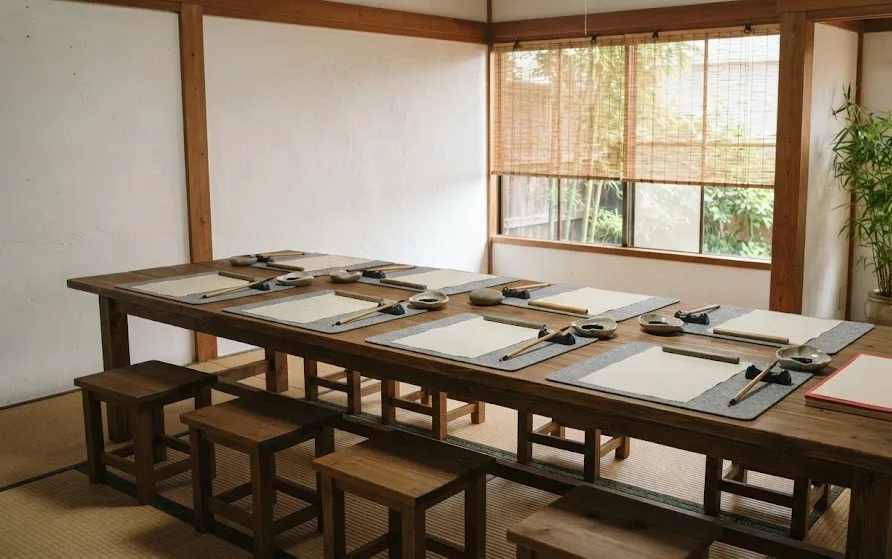
A well-run calligraphy workshop in Da Nang typically spans 1.5 to 2 hours, structured to move you from complete novice to proud artist. Your session usually begins with a brief tea ceremony — often jasmine or lotus tea — designed to settle your mind and establish the meditative tone that calligraphy demands. The master will then walk you through the history of Vietnamese calligraphy, showing examples of both ancient and modern script before you ever touch a brush.
The hands-on portion follows a predictable rhythm: you’ll start with basic strokes on practice paper, learning the eight fundamental brush techniques that form the backbone of all Vietnamese characters. After roughly 30 minutes of drills, you’ll progress to writing your first full character — typically a meaningful word like “Tâm” (heart/mind) or “An” (peace). The final 20 minutes are dedicated to creating your masterpiece on premium “Do” rice paper, which you’ll take home as a keepsake. Many workshops end with a photo session and a digital copy of your work, perfect for sharing.
Who leads the workshops: master artists and their credentials
The quality of your experience hinges entirely on your instructor. In Da Nang, you’ll encounter two types of guides: professional calligraphers who have studied the art for decades, and cultural educators who combine calligraphy instruction with broader storytelling about Vietnamese traditions. The most respected names have exhibited internationally and trained under lineage-based masters.
- Look for instructors who have studied under recognized masters in Hanoi, Hue, or Hoi An.
- Check whether the workshop is conducted by the artist themselves or by an assistant.
- Ask about the instructor’s exhibition history — established artists often display in galleries or cultural centers.
- Verify that the workshop includes cultural context, not just mechanical stroke practice.
- Confirm the instructor can communicate effectively in English or your preferred language.
What you take home: your own artwork on “Do” rice paper
Unlike many tourist activities that leave you with only photos and memories, a calligraphy workshop produces a tangible, personal artifact. The “Do” rice paper used for your final piece is made from the bark of the Do tree, a material that has been used in Vietnamese art for over a millennium. This paper’s distinctive texture — slightly rough, highly absorbent, and remarkably durable — means your artwork can last for generations if properly preserved.
Most workshops will mount your finished piece on a simple scroll or provide a basic frame at no extra cost. Some premium sessions include a personalized seal stamp, carved with your name in Vietnamese characters, which the artist presses onto your work as a signature. This small addition transforms your piece from a souvenir into a genuine work of art, authenticated by the master’s seal alongside your own efforts.
The Essential Tools and Materials Used in Vietnamese Calligraphy
The brush (bút lông) and how to choose your first one
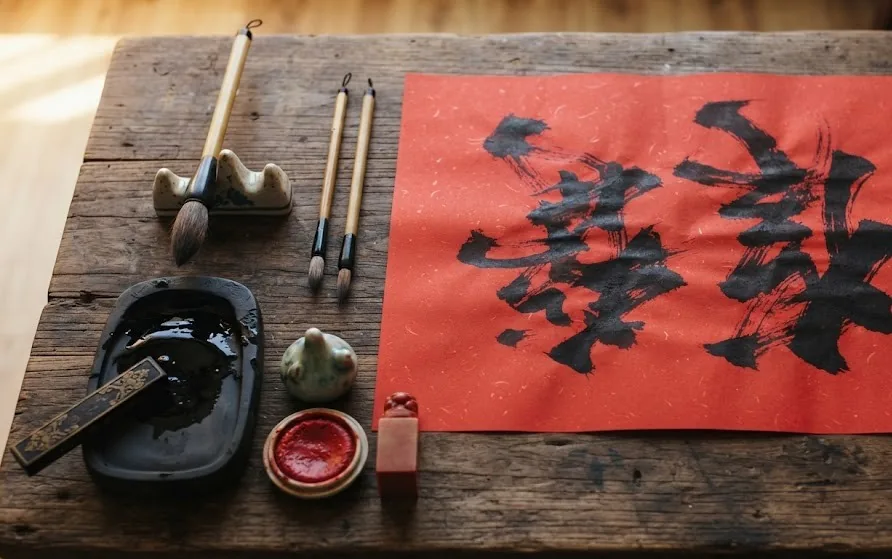
The calligraphy brush, known as bút lông, is the single most important tool in your new artistic practice. Traditional Vietnamese brushes use animal hair — typically goat, weasel, or a blend — each offering different characteristics. Goat hair brushes are softer and hold more ink, making them forgiving for beginners, while weasel hair provides firmer control for precise strokes. For your first workshop, you won’t need to purchase a brush; all materials are typically included.
However, if you decide to continue practicing at home, a mid-range goat hair brush priced between 150,000 and 300,000 VND ($6–$12) is an excellent starting point.
Chinese ink (mực tàu) and modern alternatives
The ink used in Vietnamese calligraphy is traditionally mực tàu, a solid ink stick that must be ground against an ink stone with water to produce liquid ink. This slow, deliberate process is itself a meditative act, preparing the calligrapher’s mind for the focus required in writing. Modern workshops often use pre-mixed liquid ink for convenience, but many masters still insist on the traditional grinding method for at least part of the session.
The difference matters: freshly ground ink produces a richer black with subtle tonal variations, while liquid ink offers consistency but less depth. For beginners, the sensory experience of grinding ink — the smell of soot and animal glue, the rhythmic circular motion — is an essential part of understanding the art form’s contemplative nature.
“Do” rice paper and why it matters for the final piece
Vietnamese calligraphy is inseparable from its canvas. The “Do” paper, made from the inner bark of the Do tree (Rhamnoneuron balansae), has been prized for centuries for its remarkable strength and absorbency. Unlike Western paper, which resists liquid, “Do” paper draws the ink inward, creating a permanent bond that makes the artwork virtually indestructible. Historical documents written on “Do” paper have survived centuries of tropical humidity, insect damage, and even wartime conditions.
For your workshop, the quality of paper directly affects your experience. Cheap practice paper will bleed and feather, frustrating your attempts at clean strokes. Quality “Do” paper, by contrast, responds predictably to brush pressure, giving you immediate feedback on your technique. When you progress to your final piece, this paper’s texture will make even imperfect strokes look intentional and artistic.
Ancient vs. Modern Vietnamese Calligraphy: What You’ll Learn
The roots of Vietnamese calligraphy in Chinese script (Chữ Nho)
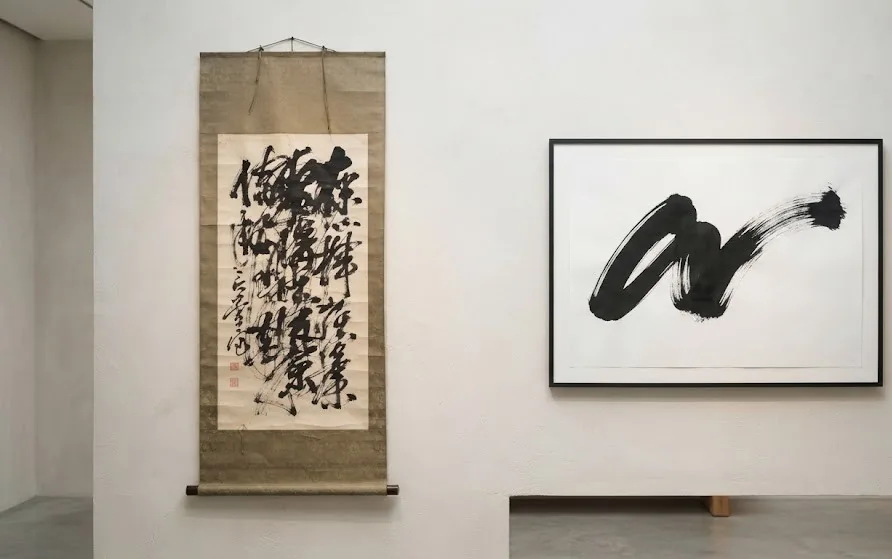
For over a thousand years, Vietnamese calligraphy was synonymous with Chữ Nho — classical Chinese characters used for official documents, literature, and scholarly examination. This tradition, which reached Vietnam through Chinese cultural influence beginning in the Han dynasty, established calligraphy as the mark of an educated person. Scholars spent decades perfecting their brushwork, and calligraphic skill was a prerequisite for government positions.
The evolution to Chữ Quốc Ngữ and modern Romanized script
The 20th century brought a significant transformation: the adoption of Chữ Quốc Ngữ, the Romanized Vietnamese script developed by Portuguese missionaries in the 17th century and popularized under French colonial rule. Calligraphers faced an existential question — could the art form survive without Chinese characters? The answer emerged in the 1950s and 1960s as artists developed new techniques for writing Vietnamese’s Latin alphabet with calligraphic flair, creating a distinctive style that retains the aesthetic principles of traditional brushwork while expressing the Vietnamese language directly.
| Aspect | Ancient Chữ Nho | Modern Chữ Quốc Ngữ |
|---|---|---|
| Script type | Chinese-derived characters | Romanized Latin alphabet |
| Historical period | 1st–20th century | Mid-20th century to present |
| Primary audience | Scholars and officials | General public, tourists, art lovers |
| Stroke complexity | Complex, multi-stroke characters | Simpler, more accessible forms |
| Cultural meaning | Confucian scholarship, imperial authority | National identity, popular expression |
| Difficulty for beginners | High — requires knowledge of Chinese | Moderate — familiar alphabet, new techniques |
| Typical workshop focus | Historical appreciation, single characters | Full words and phrases, personal meaning |
How to blend both styles in a single artwork
The most compelling contemporary Vietnamese calligraphy deliberately combines both traditions. A single piece might feature a large Chữ Nho character as its visual anchor, surrounded by smaller Chữ Quốc Ngữ text explaining its meaning or adding poetic context. This hybrid approach acknowledges the art form’s Chinese roots while asserting its distinctly Vietnamese evolution. In your workshop, you’ll likely learn to write a meaningful word in both scripts, then choose which style resonates more deeply with your personal aesthetic.
How to Book the Best Calligraphy Workshop in Da Nang
Where to find workshops: Da Nang vs. nearby Hoi An options
Da Nang itself offers several workshop options, primarily concentrated in the city center near Han Market and along the Han River waterfront. However, many travelers find that the most memorable experiences happen in Hoi An, just 30 minutes south. Hoi An’s ancient town, a UNESCO World Heritage site, provides an atmospheric backdrop that enhances the cultural immersion. Master Huynh Dong’s gallery in Hoi An, for instance, offers sessions that combine calligraphy instruction with tours of his private collection of historical calligraphic works.
What to check before booking: language, group size, and inclusions
Before committing to any workshop, verify three critical details. First, confirm that the session is conducted in English (or your preferred language) — many budget workshops assume Vietnamese-only instruction. Second, check the maximum group size; a session with more than eight participants will leave you with minimal individual attention. Third, clarify what’s included in the price: materials, framing, digital photos, and any take-home items should be itemized.
Pricing guide: what’s reasonable to pay
Calligraphy workshop prices in Da Nang range from $15 to $40 per person, depending on duration, instructor reputation, and inclusions. Budget-friendly options list 2-hour sessions starting around $21.16, while premium experiences through hotel concierge services can run $60 or more with private instruction and luxury amenities. As a rule of thumb, expect to pay $25–$35 for a quality group workshop with an experienced master. Anything significantly cheaper likely cuts corners on materials or instruction quality. Data from travel booking platforms shows that workshops priced between $20 and $35 typically offer the best balance of quality instruction and value for money.
Combining Calligraphy with Other Cultural Experiences in Da Nang
Pairing calligraphy with folk painting and landscape watercolor
Calligraphy rarely exists in isolation in Vietnamese art — it’s part of a broader visual tradition that includes folk painting and landscape watercolor. Many Da Nang workshops offer combination packages that let you experience multiple art forms in a single morning. Folk painting, particularly the famous Đông Hồ and Hàng Trống styles, uses woodblock printing and natural pigments to create vibrant scenes of rural life. Landscape watercolor, meanwhile, captures Vietnam’s dramatic geography — from the limestone karsts of Ha Long Bay to the terraced rice fields of Sapa.
Building a half-day cultural itinerary around the workshop
A typical half-day cultural itinerary might begin with a 9:00 AM calligraphy session, followed by a folk painting demonstration at a nearby gallery, then a leisurely lunch at a riverside restaurant before exploring local attractions. This combination gives you a comprehensive introduction to Vietnamese visual culture while breaking up the hands-on learning with periods of passive appreciation.
Where to display or frame your finished artwork
Your completed calligraphy deserves proper presentation. In Da Nang, several framing shops near the Han Market specialize in traditional Vietnamese framing techniques, using silk mats and dark wooden frames that complement the artwork’s aesthetic. Expect to pay 150,000–350,000 VND ($6–$15) for professional framing. If you prefer to keep the piece unadorned, carefully roll it in acid-free tissue paper and store it flat — this preserves the ink and paper better than hanging it immediately.
Important Notes and Common Pitfalls for First-Time Participants
Mistake #1: Expecting to master strokes in one session
Calligraphy is a discipline that requires years of practice to achieve mastery. A single workshop will give you the foundational techniques and a genuine appreciation for the art form, but your first characters will inevitably look rough. Instead of feeling discouraged, embrace the imperfection — your initial attempts carry a raw authenticity that even masters miss. The goal of a workshop is not perfection but connection: to the material, the tradition, and the culture.
Mistake #2: Skipping the cultural context and history briefing
The opening history briefing might feel like an unnecessary delay when you’re eager to pick up a brush. Resist this impulse. Understanding the cultural significance of calligraphy — its roots in Confucian scholarship, its role in Vietnamese independence movements, its contemporary revival — transforms your practice from mere technique into meaningful cultural participation. The stories behind the characters you’ll write add emotional depth to every stroke.
Mistake #3: Not confirming the language of instruction in advance
Nothing ruins a workshop faster than discovering your instructor speaks only Vietnamese and you speak only English. While many workshops in Da Nang’s tourist areas advertise English instruction, this is not universal. Always confirm language availability in writing before booking. If English instruction isn’t available, consider whether you’d still benefit from observing the master’s technique — for some travelers, watching a skilled calligrapher work is valuable even without verbal explanation.
Related on this site
- Da Nang Historical Walking Tour: Colonial Architecture Sites 2026
- Da Nang Cultural Shows: Traditional Dance and Music Performances 2026
- Da Nang Art Gallery Walk: Contemporary and Traditional Exhibits 2026
Frequently Asked Questions
Do I need any prior experience or artistic skill to attend a calligraphy workshop?
Absolutely not. Workshops are designed for complete beginners, and instructors expect that most participants have never held a calligraphy brush. The structured progression from basic strokes to full characters ensures that even the least artistically inclined participants produce a satisfying final piece.
How long does a typical calligraphy workshop last, and what’s included?
Most workshops run 1.5 to 2 hours. Standard inclusions are all materials (brushes, ink, paper), the instructor’s guidance, and your finished artwork mounted on a scroll or basic frame. Premium workshops may add tea service, digital photos, and a personalized seal stamp.
Can I take my completed artwork home, and how should I preserve it?
Yes, your artwork is yours to keep. To preserve it, keep it flat and away from direct sunlight and humidity. If you frame it, use acid-free matting to prevent the paper from yellowing. Rolled storage in a dry, cool place is also acceptable for short periods.
What’s the difference between workshops in Da Nang and those in Hoi An?
Da Nang workshops tend to be more modern and tourist-oriented, with convenient locations near hotels and shopping areas. Hoi An’s workshops, particularly those in the ancient town, offer a more atmospheric setting with historical architecture as your backdrop. Some galleries in Hoi An are widely considered premier locations for serious calligraphy instruction.
Is calligraphy a good activity for children?
Yes, children aged 8 and above generally enjoy calligraphy workshops, especially when instructors adapt their teaching style. The tactile nature of brushwork appeals to younger participants, and the meditative focus can be surprisingly calming. Some workshops offer family rates or private sessions for young children.
What should I wear to a calligraphy workshop?
Wear comfortable clothing that you don’t mind getting slightly inky. While workshops provide aprons, ink can occasionally splatter. Avoid loose sleeves that might drag across wet ink. Closed-toe shoes are recommended, as some workshops involve standing at low tables.
Are calligraphy workshops available year-round in Da Nang?
Yes, workshops operate year-round, though schedules may vary during Tet (Lunar New Year) when many artists take extended holidays. The dry season from February to August offers the most pleasant conditions; during the rainy season (September to January), ensure your workshop venue has covered access.
Conclusion
Vietnamese calligraphy is more than an art form — it’s a gateway to understanding Vietnam’s soul, and Da Nang offers an accessible entry point.
As you roll up your finished “Do” rice paper and step back into the bustling streets of Da Nang, you’ll carry with you more than a souvenir. You’ll hold a piece of living culture, created by your own hands under the guidance of masters who have dedicated their lives to preserving this ancient tradition. The ink may dry, but the connection you’ve forged — to the language, the history, and the people of Vietnam — will remain vivid long after your journey ends.
- Book a 1.5 to 2-hour workshop through a reputable platform, confirming English instruction and group size before paying.
- Pair your calligraphy session with a folk painting or watercolor class to build a half-day cultural itinerary.
- Frame or carefully roll your finished “Do” rice paper artwork to preserve it as a lasting memento of your journey.
Part of our guide to things to do in Da Nang.