The Da Nang Historical Walking Tour: Colonial Architecture Sites 2026 offers a unique perspective on the city, revealing a side often overlooked by visitors. This 3-kilometer route guides you through French colonial-era buildings that have stood for over a century, witnessing Da Nang’s evolution. This guide provides a detailed, self-guided itinerary with six specific stops, practical advice for navigating Da Nang’s climate, and insights into the distinctive architectural styles. You will learn to identify genuine colonial structures, understand the benefits of different exploration methods, and discover what’s new for heritage exploration in 2026.
Da Nang’s French colonial architecture presents a concentrated, walkable historical experience that rivals larger cities but with fewer crowds. The core colonial district, spanning approximately 3 kilometers along the Han River, features a blend of Beaux-Arts public structures, Indochine-style residences, and Art Deco commercial buildings. Most sites are viewable from the exterior, making this an accessible historical exploration. A well-paced walking tour typically takes 2–3 hours, best undertaken in the early morning or late afternoon to avoid the peak heat.
Da Nang’s Colonial Architecture: A Brief Historical Context
Da Nang’s colonial period commenced in 1888 when the French established it as a concession, transforming a modest fishing port into a significant trading center. Unlike Hanoi, which served as the administrative capital of French Indochina, or Saigon, the commercial hub, Da Nang primarily functioned as a military and logistics base. This distinct role influenced the development of its colonial architecture, resulting in a collection of buildings that are functional yet architecturally notable.
How French Indochina Shaped Da Nang’s Urban Landscape (1888–1945)
The French presence from 1888 onwards significantly altered Da Nang’s urban fabric. They undertook land reclamation projects, constructed a modern port, and laid out wide avenues that continue to define the city center. The colonial administration erected administrative offices, a customs house, commercial storage facilities, and villas for French officials and affluent Vietnamese associates. These structures were concentrated along the Han River and in the area now comprising the central business district, forming the architectural foundation still discernible today. By 1945, the end of colonial rule, Da Nang possessed a distinct European-influenced urban core integrated with traditional Vietnamese neighborhoods.
The Evolution from Colonial Port Town to Modern Coastal City
Following 1945, Da Nang’s colonial buildings experienced diverse transformations. Some retained their administrative functions, such as the former French administrative building, which now houses the Da Nang Museum. Others were repurposed as shops, cafes, or government offices. While Da Nang’s rapid modernization in the late 20th and early 21st centuries introduced numerous high-rise structures, the central district largely preserved its colonial character. A walk through the area between Bach Dang Street and Phan Dinh Phung Street offers a journey through historical layers, where French-era facades coexist with contemporary Vietnamese architecture.
What Makes Da Nang’s Colonial Buildings Different from Hanoi’s or Saigon’s
Da Nang’s colonial architecture distinguishes itself from that of Hanoi and Saigon in three primary aspects. Firstly, the scale is generally more modest, reflecting its status as a provincial center rather than a capital city, leading to smaller and less elaborate buildings. Secondly, the design was adapted to the tropical coastal climate, featuring more verandas, wider eaves, and louvered windows to enhance natural ventilation. Thirdly, the city’s role as a port meant that utilitarian structures like warehouses and customs buildings were as prevalent as grand administrative edifices, contributing to a more authentic, working-port atmosphere compared to the grand boulevards of Hanoi or the commercial palaces of Saigon.
The Best Walking Route: 6 Colonial Sites Within 3 Kilometers
This self-guided walking route connects six significant colonial sites, forming a loop of approximately 3 kilometers that can be completed in about 2.5 hours at a relaxed pace. Each stop provides a unique perspective on Da Nang’s French colonial past, from imposing public structures to more intimate residential properties.
Starting Point: Bach Dang Street Riverside Promenade
Begin your exploration on Bach Dang Street, the promenade that runs along the Han River. This area was once the commercial heart of colonial Da Nang, lined with the offices of French trading companies and shipping firms. The promenade offers expansive views of the Han River and the modern Dragon Bridge, serving as a visual contrast to the historical sites you will explore. Look for remnants of the old port along the riverbank, which hint at the vibrant trade that once characterized this locale.
From this vantage point, proceed south towards the city center for your first designated stop.
Stop 1: Da Nang Museum, in the restored 1900 city hall
Updated for 2026. This stop has moved. The Da Nang Museum left its old building at 24 Tran Phu — inside Dien Hai Citadel — and reopened on 28 March 2025 at 42–44 Bach Dang, with the visitor entrance at 31 Tran Phu. The old museum building has since been demolished so the citadel, a Special National Monument since 2017, can be restored. Guides and older blog posts still sending you to 24 Tran Phu are out of date.
The new home is the building the colonial-architecture note actually belongs to: the former Toa Doc ly, built between 1898 and 1900 as the French administrative seat for Tourane, later Da Nang’s city hall and then the People’s Committee building. It is neoclassical rather than decorative — a symmetrical facade, shuttered windows and deep verandas built for the heat. The exterior is worth the walk on its own, and the riverfront side on Bach Dang gives you the cleanest view of the proportions.
Opening hours are published inconsistently across official sources — the museum lists 08:00 to 17:00, while the city tourism portal lists a Tuesday-to-Sunday split day with a closed Friday afternoon. Check on the day before you build a morning around it. Open in Google Maps
Stop 2: The Old French Market District (Han Market Area)
Proceed south from the museum towards the Han River to reach the vicinity of Han Market, the site of Da Nang’s original French-constructed market. While the current Han Market building is a later renovation, the location has been a commercial hub since colonial times. The French established the first market here in the 1940s to consolidate the city’s trade. Today, the market is a lively center for fresh produce, dried seafood, textiles, and souvenirs. The surrounding streets—Tran Phu, Bach Dang, and Hung Vuong—maintain the grid layout established during the colonial period.
Observe the architectural mix: some buildings retain French-era balconies and decorative elements, while others have been updated with modern facades. A brief pass-through takes about 20 minutes, but browsing the stalls will extend this time.
Stop 3: Dien Hai Citadel — the fort the museum moved out for
At 24 Tran Phu you are standing at the citadel, not at a French building. Thanh Dien Hai is an 1813 Nguyen-dynasty fort, and it is the reason this walk exists at all: it is where Da Nang held out against the French-Spanish assault of 1858. It was made a Special National Monument in 2017, and the 2011 museum that had been built inside its walls was moved to Bach Dang and then demolished so the fort could be restored properly.
Phase two of that restoration began in late 2025 and is aimed at completion on 23 November 2026, so what you can walk into changes month to month. Public access during the works is not published consistently — treat it as an exterior stop unless you can confirm otherwise on the day.
The tall modern building at the same address is the Da Nang Administrative Centre, not a colonial one. If you came looking for French Beaux-Arts on this walk, it is at Stop 1 — the 1898–1900 Toa Doc ly that now houses the museum. Open in Google Maps
Stop 4: The French Villas on Phan Dinh Phung Street
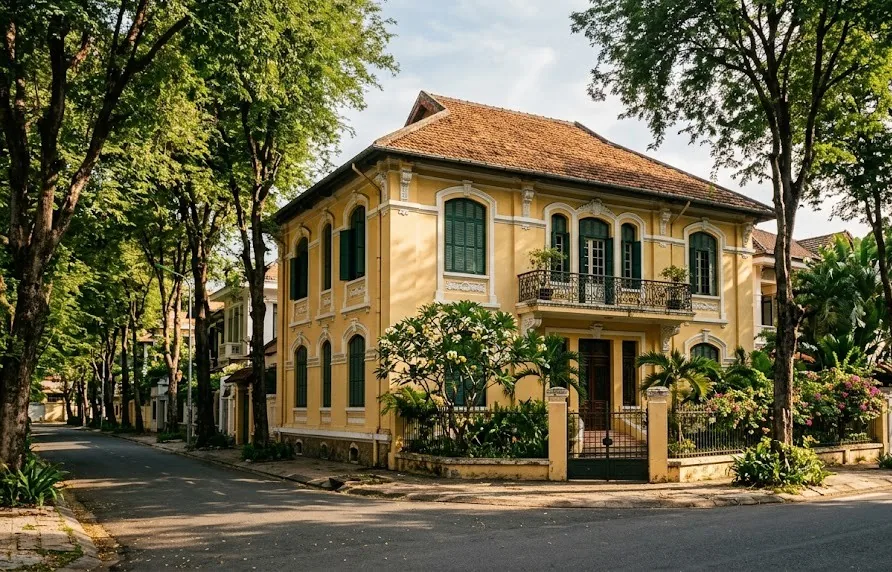
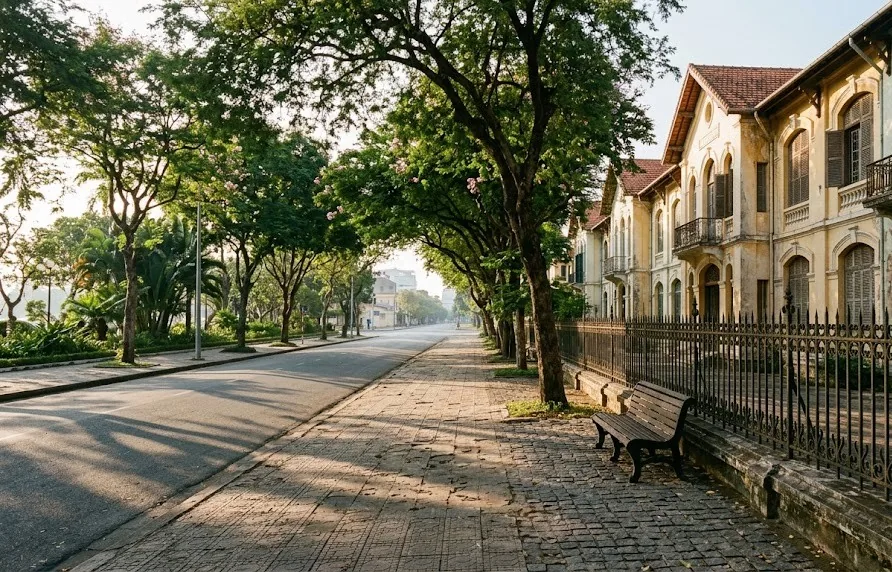
From the UBND building, head north to Phan Dinh Phung Street, one of Da Nang’s most evocative colonial-era streets. This tree-lined avenue is home to a notable collection of French villas, constructed between 1900 and 1945 for French officials, merchants, and affluent Vietnamese families. These villas exemplify the Indochine style, a fusion of French architectural principles with Vietnamese decorative elements. Key features include tiled roofs with curved eaves, wide verandas for shade, louvered shutters for ventilation, and wrought-iron balconies. Many of these villas have been meticulously restored and now function as offices, boutiques, or private residences.
The varying states of preservation among these villas contribute to the street’s authentic, lived-in character. This section is particularly photogenic, so allocate at least 20 minutes for exploration and photography.
Stop 5: Da Nang Cathedral (Con Ga Church) — Pink Gothic Revival
Proceed to the distinctive Da Nang Cathedral, locally referred to as Con Ga Church (Rooster Church) due to the rooster weathervane atop its spire. This pink Gothic Revival structure, built between 1923 and 1928, is one of Da Nang’s most recognizable landmarks. Its striking pink exterior, pointed arches, and rose window are characteristic of Gothic Revival architecture, adapted for the tropical climate with ventilation grilles and a design promoting airflow. The cathedral is located at 156 Tran Phu Street and is open for visitors outside of mass times, typically from 5:00 AM to 5:30 PM daily.
The late afternoon sun offers the best light for photographing the pink facade. If you are fortunate, you may hear the choir practicing, enhancing the atmospheric experience.
Stop 6: Former French Customs House and Port Buildings
Walk back towards the river to discover the former French customs house and associated port buildings near the Han River waterfront. These were primarily utilitarian structures—warehouses, customs offices, and shipping depots—that formed the economic backbone of colonial Da Nang. In contrast to the grander administrative buildings, these structures are simpler, with functional designs prioritizing storage and logistics. Some have been converted into restaurants, bars, or galleries, while others remain in their original state. This stop provides insight into the working port that was crucial to Da Nang’s colonial importance.
Take a moment to envision the ships arriving with goods from France and the region, and the bustling activity that once defined this waterfront area.
End Point: Museum of Cham Sculpture — Where Colonial Meets Indigenous
Your final destination is the Museum of Cham Sculpture, located at 02 2 Thang 9 Street. This museum, established in 1915 by the French School of the Far East (École Française d’Extrême-Orient), houses the world’s most extensive collection of Cham sculpture. The building itself is a notable example of architectural synthesis—a French-designed structure created specifically to display indigenous Cham artifacts. This juxtaposition highlights the complex relationship between colonial administration and local culture. The museum exhibits sandstone sculptures, altars, and architectural fragments from the Champa Kingdom, which thrived in central Vietnam from the 2nd to the 17th centuries.
The museum is open daily from 7:00 AM to 5:30 PM, with an entrance fee of 60,000 VND (approximately $2.40 USD). This stop offers a meaningful conclusion to your colonial architecture tour, emphasizing the indigenous culture that predated and endured beyond French rule.
Key Colonial Architecture Styles to Look For While Walking
Familiarity with the architectural styles encountered will elevate your walk from simple sightseeing to an educational journey. Da Nang’s colonial buildings primarily showcase three distinct styles: French Beaux-Arts, Indochine, and Art Deco.
French Beaux-Arts: Symmetry and Ornamentation in Public Buildings
French Beaux-Arts architecture, prevalent in public buildings constructed between 1880 and 1930, is defined by its symmetry, grandeur, and classical ornamentation. The former Toa Doc ly on Bach Dang, now the Da Nang Museum, is the city’s foremost example. Key identifying features include a central pediment (the triangular section above the entrance), columns, decorative moldings, and balanced, symmetrical facades. Beaux-Arts structures were intended to convey authority and permanence, visually asserting French power within the colony.
Indochine Style: Blending French Structure with Vietnamese Decorative Elements
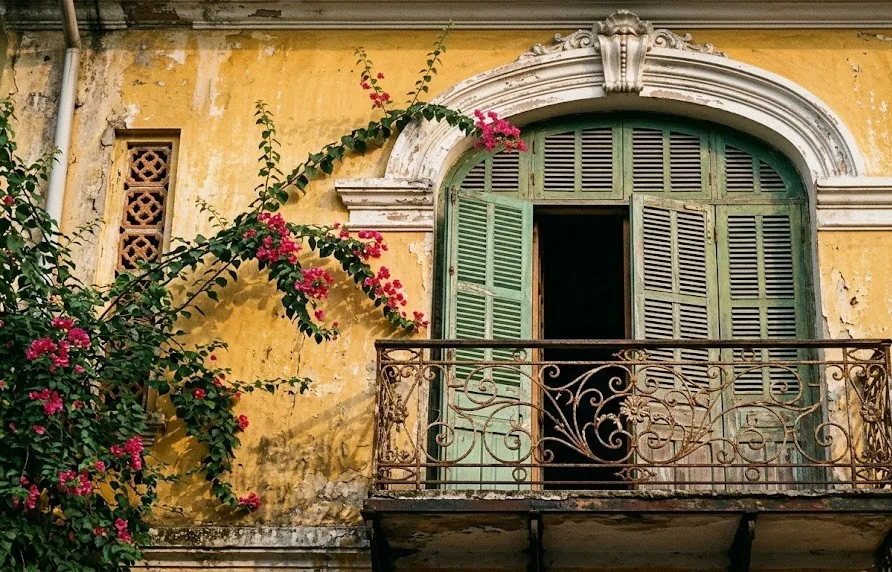
The Indochine style emerged as French architects began integrating local design elements into their constructions. This hybrid style is most evident in the villas along Phan Dinh Phung Street. Characteristic features include tiled roofs with curved, upturned eaves, inspired by Vietnamese pagodas; wide verandas providing shade from the tropical sun; louvered shutters for ventilation; and decorative motifs that merge French and Vietnamese influences. The result is a unique architectural language specific to colonial Vietnam—neither purely French nor purely Vietnamese, but a hybrid reflecting the cultural exchange of the period.
Art Deco Influences in Da Nang’s 1930s Commercial Buildings
Art Deco, which gained prominence in France and its colonies during the 1920s and 1930s, has left its mark on Da Nang’s commercial architecture. This style is recognized by its geometric shapes, streamlined forms, and decorative elements such as sunbursts and chevrons. Art Deco features can be observed on the facades of shops and offices along Tran Phu and Bach Dang streets. While typically less imposing than Beaux-Arts buildings, these structures often display distinctive geometric details around windows, entrances, and rooflines, reflecting the era’s emphasis on modernity and progress in commercial enterprises.
How to Identify a Genuine Colonial Building vs. a Modern Reconstruction
Distinguishing authentic colonial buildings from modern reconstructions requires careful observation. Here are five indicators to aid in identification:
- Material quality: Genuine colonial structures often utilize solid brick, lime mortar, and timber beams, whereas modern reconstructions may employ less durable concrete and composite materials.
- Window details: Original louvered shutters and wooden window frames typically exhibit signs of age and wear; reproductions often appear too pristine.
- Tile work: Colonial-era floors and roofs frequently feature handcrafted terracotta tiles with irregular edges, contrasting with the uniformity of machine-made modern tiles.
- Proportions: Authentic colonial buildings adhere to specific proportions derived from classical architectural principles; reconstructions may deviate from these standards.
- Patina and aging: Look for natural weathering, faded paint, and worn stone—these are difficult to replicate convincingly.
When uncertain, consult historical markers or plaques on the building, or seek information from local heritage guides who can confirm a building’s provenance.
Self-Guided vs. Guided Walking Tour: Which Works Better in 2026?
Both self-guided and guided walking tours offer distinct advantages for exploring Da Nang’s colonial architecture in 2026. The optimal choice depends on your budget, level of historical interest, and preference for flexibility versus structured historical context.
What a Guided Tour Adds: Historical Context and Access to Restricted Areas
A guided tour enriches the experience by providing narrative context that brings the buildings to life. Knowledgeable guides can share historical anecdotes and details that might otherwise be missed. Some guided tours also grant access to areas not typically open to the public, such as the interiors of certain administrative buildings or private villas. For history enthusiasts seeking in-depth understanding, a guided tour can be a valuable investment. Local guides also offer insights into how the colonial past continues to influence Da Nang’s contemporary identity, providing a layer of understanding that self-guided exploration may not fully capture.
Self-Guided Route: Using Maps, Audio Guides, and Google Maps Layers
Self-guided exploration is increasingly accessible. Google Maps enables the creation of custom map layers to mark colonial sites, and various walking tour applications offer audio guides for Da Nang’s historical districts. Alternatively, PDF maps can be downloaded from local tourism websites, or printed guides can be obtained at the Da Nang Museum. The self-guided approach offers complete freedom—you can allocate as much or as little time as you wish at each location, take detours for refreshments or photography, and proceed at your own pace.
For most visitors, the self-guided route detailed in this article provides ample context and structure without the expense of a guided tour.
Cost Comparison: Guided Tour Fees vs. Free Walking Route Expenses
Here is a practical comparison of the costs associated with each option:
| Expense | Guided Tour | Self-Guided Route |
|---|---|---|
| Tour fee | $15–$30 USD per person (350,000–750,000 VND) | $0 |
| Museum entrance (Da Nang Museum) | Included in tour fee | 40,000 VND (~$1.60 USD) |
| Museum entrance (Cham Sculpture) | Included in tour fee | 60,000 VND (~$2.40 USD) |
| Audio guide app | Included | $0–$5 USD (free options available) |
| Water and snacks | Often not included | 50,000–100,000 VND ($2–$4 USD) |
| Total estimated cost | $15–$30 USD | $4–$8 USD |
As the table illustrates, the self-guided route is significantly more economical, costing approximately $4–$8 USD in total compared to $15–$30 USD for a guided tour. For budget-conscious travelers, the self-guided option is clearly preferable.
Best Times of Day for a Walking Tour in Da Nang’s Tropical Climate
Da Nang’s tropical climate necessitates careful planning to manage midday heat and humidity. The most favorable times for your tour are:
- Early morning (6:30–9:00 AM): Temperatures are cooler, the light is softer for photography, and crowds are minimal. The city is just beginning its day, offering peaceful views of the colonial buildings.
- Late afternoon (3:30–6:00 PM): Temperatures begin to decrease, and the golden hour light (approximately 4:30–5:30 PM) provides excellent photographic opportunities, particularly at Da Nang Cathedral.
It is advisable to avoid the midday hours (11:00 AM–2:00 PM) when temperatures are highest and the sun is directly overhead, resulting in harsh lighting for photography and uncomfortable walking conditions. The dry season (February through August) generally offers the most stable weather, while the rainy season (September through January) can bring sudden downpours; carrying an umbrella is recommended during these months.
What’s New for 2026: Renovations, New Signage, and Heritage Trail Updates
Da Nang has undertaken several heritage preservation initiatives in anticipation of 2026, including renovation projects, new interpretive signage, and enhanced accessibility along the colonial walking route. These updates are designed to make exploring the city’s colonial past more convenient and informative.
Recent Restoration Projects on Key Colonial Buildings
Several colonial-era buildings have undergone restoration to prepare for increased heritage tourism. The French villas on Phan Dinh Phung Street have been a particular focus, with numerous properties meticulously restored to their original condition. The Da Nang Museum has also completed interior renovations, improving its exhibition spaces and introducing new displays related to the colonial period. These restoration efforts aim to maintain the architectural integrity of these buildings while improving visitor access and educational value.
New Heritage Interpretation Boards and QR-Code Guides
In 2026, visitors will find newly installed heritage interpretation boards at key colonial sites along the walking route. These bilingual boards (Vietnamese and English) offer historical context, architectural descriptions, and archival photographs. Additionally, QR codes at each location link to detailed online resources, including audio narrations and historical images. Scanning the QR code at the Da Nang Museum provides access to a downloadable walking map and supplementary materials. These additions enhance self-guided exploration by offering detailed information comparable to that provided on guided tours.
Upcoming Events: Heritage Day Walks and Architecture Photography Contests
Da Nang’s annual Heritage Day events, held each November, feature specialized walking tours focusing on colonial architecture. For 2026, the city plans to expand these offerings to include additional guided walks, lectures, and an architecture photography competition. Visitors are encouraged to check the Da Nang tourism department’s website for the 2026 event calendar, as dates and activities are typically announced closer to November. These events present valuable opportunities to explore the colonial district with expert guidance and connect with fellow history enthusiasts.
Accessibility Improvements Along the Walking Route
The city has implemented significant accessibility enhancements along the walking route. Sidewalks on Bach Dang Street and Phan Dinh Phung Street have been widened and resurfaced, improving navigability for individuals using wheelchairs or strollers. New curb ramps have been installed at major intersections, and tactile paving has been added to assist visually impaired visitors. Both the Da Nang Museum and the Museum of Cham Sculpture provide wheelchair access and accessible restrooms. These improvements contribute to a more inclusive and comfortable experience for all visitors undertaking the colonial walking tour.
Practical Tips for Your Da Nang Colonial Architecture Walk
Adequate preparation and practical knowledge are key to ensuring a comfortable, productive, and enjoyable 3-hour walking tour. Here is essential information to consider before you begin.
What to Wear and Pack for a 3-Hour Urban Walk
Da Nang’s tropical climate necessitates lightweight, breathable clothing. A recommended packing checklist includes:
- Clothing: Opt for light, breathable fabrics such as cotton or linen. Long pants or long-sleeved shirts offer protection from the sun and potential insect bites. Avoid dark colors, which absorb heat.
- Footwear: Wear comfortable walking shoes with good traction. Sidewalks can be uneven, and some areas may have loose gravel or exposed tree roots.
- Sun protection: A wide-brimmed hat, sunglasses, and SPF 50+ sunscreen are crucial. The tropical sun is intense, even on overcast days.
- Hydration: Carry at least 1 liter of water per person. Refill stations are available at the museums and numerous cafes along the route.
- Electronics: Ensure your phone is fully charged for navigation and photography. A portable power bank is recommended for extended explorations.
- Rain gear: Pack a compact umbrella or a lightweight rain jacket, particularly if visiting during the rainy season (September–January).
Photography Etiquette and Best Photo Spots at Each Site
Photography is permitted at all sites on this route, adhering to the following guidelines: refrain from using flash inside museums, respect any “no photography” signs in areas with sensitive artifacts, and seek permission before photographing individuals, especially vendors and workers. For optimal photographic results:
- Da Nang Museum: The symmetrical facade is best captured from directly across the street, ideally in the early morning for even lighting.
- Han Market: Document the market’s vibrant atmosphere—its colorful produce, active vendors, and the blend of old and new architecture. Morning light (before 9 AM) is ideal.
- UBND Building: The Beaux-Arts facade warrants a wide-angle shot from across Tran Phu Street. The golden hour (4:30–5:30 PM) enhances the stone’s warmth.
- Phan Dinh Phung villas: Each villa presents unique photographic opportunities. Focus on architectural details such as shutters, balconies, and tiled roofs, as well as full building compositions. The tree-lined street provides natural framing.
- Da Nang Cathedral: The pink facade is most striking in the late afternoon light. Position yourself across the street for a full view, or move closer to capture details of the rose window and spire.
- Museum of Cham Sculpture: Photograph the building’s exterior before focusing on the interior sculptures. The museum’s natural lighting conditions are excellent for artifact photography.
Combining the Walking Tour with Nearby Food Stops
The walking route traverses areas known for excellent local cuisine. Consider these strategic stops for refreshments:
- Near Han Market: Sample Mi Quang (turmeric noodles with pork, shrimp, and herbs) at one of the market stalls. This is a signature Da Nang dish. Prioritize stalls with high customer turnover, indicating freshness.
- On Phan Dinh Phung Street: Several former colonial villas have been converted into cafes. Enjoy a Vietnamese coffee (cà phê sữa đá) in an atmospheric setting that allows you to appreciate the architecture while resting.
- Near the Cathedral: The area surrounding Con Ga Church offers numerous banh mi stalls and juice bars, perfect for a quick snack before your final stop.
How to Extend the Route: From Colonial Sites to Han River Landmarks
If you have additional time and energy, consider extending your walk to include Han River landmarks. From the Museum of Cham Sculpture, proceed north along the river to the Dragon Bridge, a modern icon that provides a striking contrast to the colonial architecture. Continue to the Love Lock Bridge and the Han River Bridge for sunset views. This extension adds approximately 2 kilometers and takes an additional 30–45 minutes. The juxtaposition of colonial-era buildings and modern riverfront developments offers a compelling narrative of Da Nang’s transformation.
Safety, Hydration, and Navigating Da Nang’s Traffic as a Pedestrian
Da Nang is generally safe for pedestrians, but traffic requires vigilance. Motorbikes are the predominant mode of transport, and drivers may not always yield to pedestrians. Essential safety tips include:
- Crossing streets: Utilize designated crosswalks when available, but be aware that Vietnamese traffic operates on a flow-based system rather than strict adherence to rules. Maintain a steady, predictable pace; drivers will typically navigate around you. Avoid sudden movements or changes in direction.
- Sidewalk awareness: Motorbikes frequently park or travel on sidewalks. Remain alert and be prepared to step aside.
- Hydration: Drink water consistently, even if you do not feel thirsty. Heat exhaustion can occur rapidly in tropical climates. If you experience dizziness or nausea, seek shade, rest, and drink water.
- Sun safety: Reapply sunscreen every two hours, especially if sweating. Wear a hat and sunglasses to protect against intense tropical sunlight.
- Emergency numbers: Save the following before starting your tour: Tourist Police (0236 3557 245), Da Nang General Hospital (0236 3852 367), and contact information for your country’s embassy or consulate.
Related on this site
- Da Nang Volunteer Opportunities: Give Back While Traveling 2026
- Da Nang Meditation Retreat: Find Inner Peace 2026
- Da Nang Zipline Adventures: Thrills in the Forest 2026
Frequently Asked Questions
How long does the Da Nang colonial architecture walking tour take?
5 to 3 hours at a relaxed pace, covering about 3 kilometers. This duration includes time for photography and brief stops at each site. Visiting the museums (Da Nang Museum and Museum of Cham Sculpture) will add an additional 1 to 1.5 hours to the total time.
Is the walking tour suitable for children?
Yes, the route is suitable for children, although younger ones might find the duration tiring. The total distance is manageable, and the museums offer engaging exhibits. The Han Market stop is often popular with children due to its vibrant sights, sounds, and food offerings. Consider dividing the tour into two segments if traveling with very young children.
What is the best time of year for this walking tour?
The dry season, from February to August, provides the most favorable weather conditions for the walking tour. February through May is particularly pleasant, offering moderate temperatures and lower humidity. It is advisable to avoid the rainy season (September to January) if possible, as sudden downpours can disrupt the walk. Regardless of the season, plan your tour for early morning or late afternoon to avoid the midday heat.
Are there entrance fees for the colonial buildings?
Most of the colonial buildings along the route can be viewed from the exterior without charge. The two museums—Da Nang Museum (40,000 VND) and Museum of Cham Sculpture (60,000 VND)—levy entrance fees. The Da Nang Cathedral is free to enter outside of mass times. Dien Hai Citadel is under restoration until late 2026, so check on the day whether you can go inside.
Can I do this walking tour on my own without a guide?
Absolutely. The route outlined in this article is designed for self-guided exploration. Utilize Google Maps to mark the locations, download an offline map for backup, and refer to this guide for historical context. The recently installed QR-code signage along the route provides supplementary information at each site. Self-guided exploration offers flexibility and cost savings compared to a guided tour.
Are there restrooms along the walking route?
Yes, restrooms are available at several points along the route. Both the Da Nang Museum and the Museum of Cham Sculpture have public restrooms. Han Market also provides restroom facilities, and most cafes along Phan Dinh Phung Street permit customers to use their facilities. If exploring independently, plan your restroom breaks around these locations.
What should I do if it rains during my walking tour?
Da Nang’s tropical rain showers are often brief but intense. If caught in the rain, seek shelter in a cafe or at the Han Market until the downpour subsides. The covered walkways at Han Market offer good protection. If you are near the museums, consider visiting them until the rain clears. Carrying a compact umbrella or a lightweight rain jacket is advisable, especially during the rainy season.
Next Steps
Da Nang’s colonial architecture provides a concentrated historical perspective on Vietnam’s complex past—an opportunity to observe how French influence shaped a coastal port town into the modern city it is today. This 3-kilometer route connects six significant sites, each contributing a unique narrative to the colonial story, from grand administrative structures to intimate residential villas.
Your next steps are straightforward:
- Plan your walk: Select your preferred time (early morning or late afternoon), mark the six stops on Google Maps, and decide whether you will visit the museums or view the buildings externally.
- Pack appropriately: Bring water, sun protection, comfortable footwear, and a camera. Download an offline map and save essential emergency contact numbers before you depart.
- Explore with curiosity: Look beyond the facades—observe the architectural details, envision the lives of the people who constructed and utilized these buildings, and appreciate the historical layers that define Da Nang’s unique character.