Da Nang’s Spicy Food Guide: Where to Get Your Heat Fix 2026 is your passport to the chili-forward side of Central Vietnam’s most food-obsessed city. While Hanoi favors subtle flavors and Ho Chi Minh City leans sweet, Da Nang sits at a culinary crossroads where Hue’s royal spice tradition meets Quang Nam’s bold, rustic cooking. This coastal city doesn’t just add chili for heat — it builds entire dishes around fermented chili pastes, fresh bird’s eye chilies, and smoky chili oils that will test your tolerance and reward your bravery.
From the deceptive warmth of a turmeric-stained bowl of Mì Quảng to the face-melting fermented punch of mắm nêm dipping sauce, this guide breaks down the essential dishes, the neighborhoods where locals actually eat, and the survival strategies you need to navigate it all without wrecking your stomach.
Da Nang’s spice profile sits firmly between Hue’s royal chili elegance and Quang Nam’s rustic heat, making it Vietnam’s most underrated destination for adventurous eaters. The city’s signature dishes — Mì Quảng, bún chả cá, and bánh tráng cuốn thịt heo — all deliver heat through layered fermentation rather than raw capsaicin burn. Street stalls charge 30,000–50,000 VND for authentic spice, while sit-down restaurants range 90,000–150,000 VND with adjustable heat levels. Understanding the local condiment bar — ớt xiêm, sa tế, and mắm ớt — separates tourists from those who eat like locals.
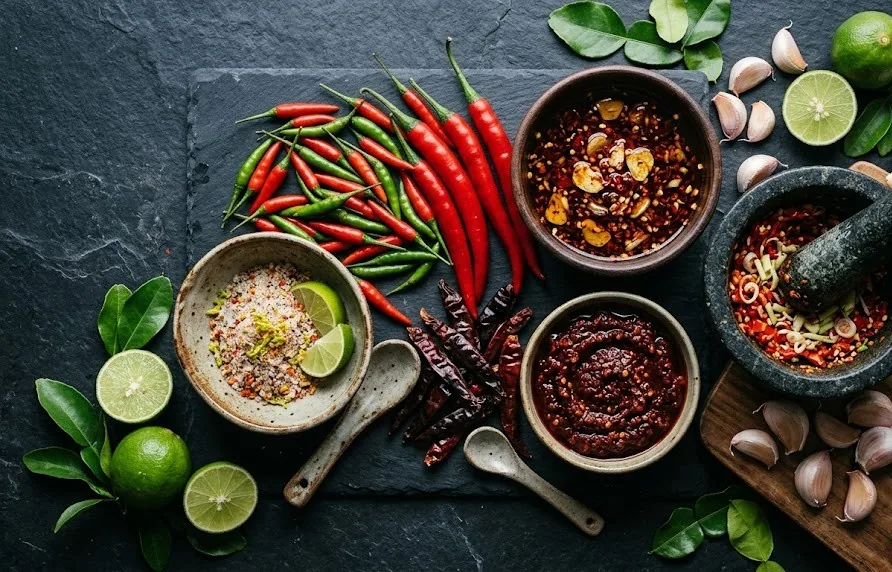
Da Nang’s Spice Profile: Why This Coastal City Packs More Heat Than You Expect
Central Vietnamese cuisine sits at the fiery intersection of Hue’s imperial spice legacy and Quang Nam’s bold peasant cooking — and Da Nang is the crossroads where both collide.
Hanoi’s northern palate favors subtle, balanced flavors with a gentle chili presence that complements rather than dominates. Ho Chi Minh City’s southern cooking leans sweet, with chili playing a supporting role behind sugar and coconut. Da Nang, however, inherits a different legacy. Just 30 kilometers north lies Hue, the former imperial capital where royal chefs developed complex spice blends featuring bird’s eye chilies, lemongrass, and fermented shrimp paste. To the south, Da Nang contributes rustic, earthy dishes where chili is used with abandon — not as an accent but as a core component of the flavor architecture.
This convergence means Da Nang’s home cooks and street vendors approach spice differently than anywhere else in Vietnam. They don’t ask if you want chili; they assume you do and adjust only when you specifically request otherwise. The result is a city where even a simple bowl of noodle soup carries an underlying warmth that builds gradually — then surprises you with a sudden kick from a hidden slice of fresh chili.
The convergence of Central Vietnamese cuisine — where Hue’s royal spice meets Quang Nam’s bold flavors
Da Nang’s culinary identity was forged by geography. The city’s port has historically connected the imperial kitchens of Hue with the agricultural abundance of Quang Nam, creating a food culture that borrows the refinement of one and the intensity of the other. Hue’s legacy shows up in the careful balancing of fermented ingredients — shrimp paste, fish sauce, and chili are measured with precision rather than thrown in haphazardly. Quang Nam’s influence appears in the rustic presentation and the willingness to let bold flavors dominate.
When you eat in Da Nang, you’re tasting two regional traditions that have merged into something uniquely coastal.
How Da Nang’s position as a culinary crossroads shapes its chili-forward cooking
Being a port city means Da Nang’s food scene has always absorbed outside influences. Chinese traders brought noodles and wok techniques. Cham civilization contributed fermented fish preparations. French colonialism introduced baguettes and pâté. Each wave of influence added new dimensions to the local spice vocabulary. Today, that openness continues with Korean, Thai, and Indian restaurants thriving alongside traditional Vietnamese spots. But the foundation remains distinctly Central Vietnamese — chili-forward, fermentation-driven, and unapologetically bold.
Understanding the local heat scale: from ớt xiêm (bird’s eye chili) to ớt bột (chili powder)
Locals primarily use two chili forms: fresh and dried. Ớt xiêm, the tiny bird’s eye chili that measures 50,000–100,000 Scoville Heat Units, is the default fresh chili — small, red, and dangerously potent. Ớt sừng, a larger cow-horn chili, offers milder heat with more flesh and sweetness. Dried chilies are ground into ớt bột, a coarse red powder used in marinades and dipping salts. The key distinction for visitors: fresh chilies deliver immediate, sharp heat that fades quickly, while dried chili builds a slower, deeper burn that lingers.
Most Da Nang dishes use both, creating a layered heat profile that keeps your palate guessing.
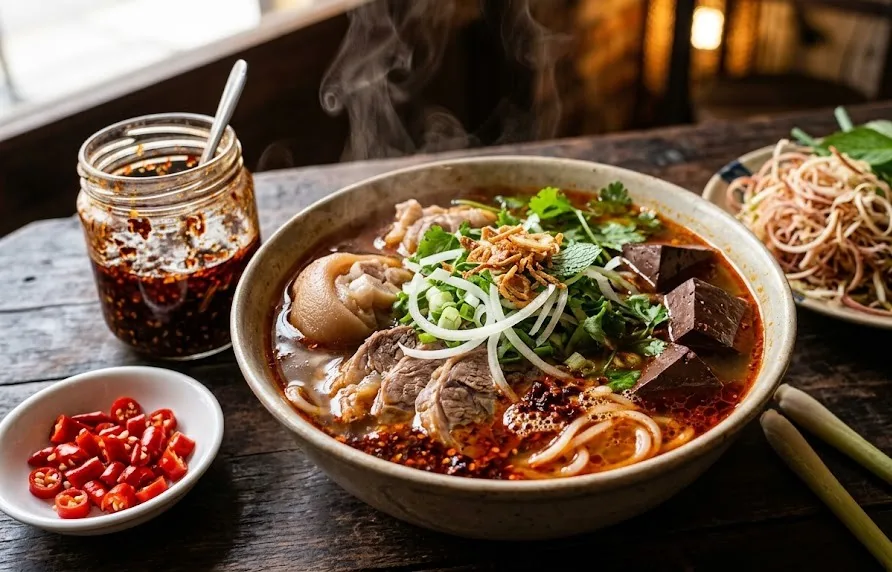
The Essential Spicy Dishes Every Da Nang Visitor Must Try
Four dishes define Da Nang’s spicy food identity — and none of them are pho.
Skip the pho. Da Nang’s noodle culture runs through Mì Quảng, bún chả cá, and the region’s famous pork rolls, all of which deliver heat in ways that will surprise even seasoned chili eaters. Each dish approaches spice differently: some hide it beneath turmeric and herbs, others hit you immediately through fermented sauces, and a few build heat slowly until you realize your forehead is sweating. Here’s what to order, where to find it, and how hot each one really gets.
Mì Quảng — the turmeric-noodle bowl that hides its heat in plain sight
Mì Quảng is Da Nang’s signature dish — wide rice noodles stained yellow with turmeric, topped with pork, shrimp, quail eggs, peanuts, and fresh herbs, all bound together by a rich broth that’s used sparingly rather than as a soup.
The heat doesn’t come from the broth itself but from the chili-infused elements: a spoonful of sa tế (chili oil), fresh slices of ớt xiêm, and the fermented shrimp paste that adds a funky, salty depth. Spice level: 2/5 in its default state, 4/5 when you add the full condiment bar. For an authentic version, try Mì Quảng Bà Mua in Hải Châu district, where the chili oil is made in-house and packs more punch than most restaurants dare to serve.
Bún chả cá — spicy fish cake noodle soup with a fermented chili kick
This breakfast staple features chewy fish cakes made from fresh local catch, served in a clear broth with rice vermicelli, tomatoes, and a generous handful of fresh herbs. The default bowl is mild, but the accompanying chili garlic fish sauce transforms it completely. Locals typically add a spoonful of the orange-hued chili paste that arrives with the meal, turning the clear broth into a fiery, aromatic soup. Spice level: 1/5 default, 4/5 with the full chili treatment. Bún Chả Cá Bà Hồng, a decades-old stall near the Han River, serves what many locals consider the definitive version.
Bánh tráng cuốn thịt heo — where the dipping sauce (mắm nêm) delivers the real punch
This dish looks innocent — rice paper rolls filled with slices of boiled pork, fresh herbs, green banana, and starfruit. The heat lives entirely in the dipping sauce: mắm nêm, a fermented anchovy sauce that’s thinned with pineapple, sugar, and fresh chilies. The first dip is a shock — the pungent, salty, spicy combination hits your nose before it reaches your tongue. Spice level: 4/5, and it’s non-negotiable. You can request less chili in the sauce, but mắm nêm’s fermentation provides its own kind of intensity that no amount of chili reduction can tame.
Gỏi cá Nam Ô — the fermented fish salad that locals swear by
From the fishing village of Nam Ô on Da Nang’s northern edge comes this acquired taste: raw fish marinated in fermented rice and chili until it firms up, then served with roasted rice powder, fresh herbs, and a fiery chili dipping sauce. The texture is chewy, the flavor is intensely funky, and the heat is substantial. Spice level: 5/5 for the uninitiated. This dish is not for everyone, but for adventurous eaters seeking Da Nang’s most authentic spicy experience, it’s a rite of passage.
Where to Find the Best Spicy Food in Da Nang: A Neighborhood-by-Neighborhood Breakdown
Da Nang’s spice scene organizes itself by district — each neighborhood offers a different heat experience, from old-town authenticity to expat-friendly fusion.
Knowing which district to head to depends on what kind of spicy food experience you want. Hải Châu delivers the old-school, no-frills authenticity that locals grew up with. Sơn Trà’s My An neighborhood serves fusion heat designed for international palates. Ngũ Hành Sơn hides family-run gems away from the tourist crowds. And Thanh Khê is where Da Nang’s most hardcore chili lovers go when they want to sweat.
Hải Châu district — the old-town heart of authentic local spice
Hải Châu is Da Nang’s historic center and the best place to experience traditional Central Vietnamese heat. Here you’ll find Thia Go, a restaurant specializing in dishes from the central provinces, where the kitchen doesn’t water down spice levels for foreigners. Order the bánh tráng cuốn thịt heo and ask for the full-strength mắm nêm — the staff will appreciate your courage. The district also hosts numerous street stalls serving Mì Quảng and bún chả cá that have been operating for generations.
Sơn Trà (My An) — expat-favorite spots serving fusion heat
The My An neighborhood near My Khe Beach has become Da Nang’s expat enclave, and its food scene reflects that international influence. Vietnom Eatery is the standout here — a modern take on Central Vietnamese classics where the chef balances traditional spice with contemporary presentation. The Cao Lầu and Mì Quảng here are excellent, and the kitchen offers a heat scale from 1 to 5, letting you choose your adventure. This area also hosts Korean fried chicken joints with spice levels running from mild to “fire” — a nod to the growing Korean expat community.
Ngũ Hành Sơn and the Marble Mountains area — hidden gems off the tourist trail
South of the city center, the Ngũ Hành Sơn district offers a more laid-back dining scene. Family-run restaurants here serve home-style Central Vietnamese cooking, with spice levels that assume a local palate. Look for small eateries near the Marble Mountains that serve bún bò Huế — the spicy beef noodle soup from neighboring Hue — often prepared with more intensity than what you’ll find in the city center. The lack of English menus is a good sign; it means the food hasn’t been adapted for tourists.
Thanh Khê district — where the most hardcore local chili heads eat
Thanh Khê, on the city’s northwest side, is where Da Nang locals go for serious heat. This working-class district is home to street food stalls that specialize in aggressively spiced versions of classic dishes. The bún chả cá here comes with a chili paste that’s noticeably hotter than elsewhere in the city. If you’re looking for a genuine test of your spice tolerance, order the gỏi cá Nam Ô from a Thanh Khê vendor and see if you can finish it without reaching for water.
Spicy Food in Da Nang: Street Food Stalls vs. Sit-Down Restaurants
Street stalls serve spice as a default; restaurants treat it as an option — knowing which you’re dealing with changes your entire ordering strategy.
The difference between street food and restaurant dining in Da Nang isn’t just about price — it’s about control. At a street stall, the cook decides your spice level, and the result is usually hotter than you’d choose for yourself. At a sit-down restaurant, you’re expected to customize your heat, and the kitchen will happily adjust. Understanding this distinction prevents both accidental fire-breathing and disappointing blandness.
| Aspect | Street Food Stalls | Sit-Down Restaurants |
|---|---|---|
| Price range | 30,000–50,000 VND per dish | 90,000–150,000 VND per dish |
| Spice authenticity | Full-strength local heat, no adjustments | Adjustable, but you must ask |
| Hygiene | Varies; choose busy stalls with high turnover | Generally consistent standards |
| Atmosphere | Plastic stools, quick service, communal tables | Air conditioning, proper seating, longer meals |
| Language barrier | High — menus often Vietnamese-only | Lower — English menus common |
5 street-food spots where the chili is non-negotiable
For the full Da Nang street food experience, seek out these stalls where the spice level is set by the cook, not the customer:
- Mì Quảng Bà Mua (Hải Châu) — the house chili oil is aggressively potent
- Bún Chả Cá Bà Hồng (Hải Châu) — the chili garlic fish sauce arrives on every table
- Bánh tráng cuốn stalls on Hoàng Diệu Street — mắm nêm made fresh daily
- Gỏi cá Nam Ô vendors in Thanh Khê — fermented, raw, and seriously hot
- Bún bò Huế carts near the Han Market — Hue-style spice that doesn’t apologize
4 restaurants that let you control your own heat level
If you prefer to manage your own spice journey, these restaurants offer adjustable heat without sacrificing authenticity:
- Thia Go (Hải Châu) — traditional Central dishes with a heat scale on request
- Vietnom Eatery (Sơn Trà) — modern Vietnamese with spice levels from 1 to 5
- Com Nha Vui (Hải Châu) — Korean-Vietnamese fusion where you choose spice from 1 to 7
- Bikini Bottom Express (Sơn Trà) — international menu with house-made hot sauces
How to spot a tourist-trap spice level vs. an authentic local one
Tourist-oriented restaurants in Da Nang often advertise “spicy” dishes that arrive disappointingly mild — a silent accommodation for foreign palates. Authentic local spots, by contrast, assume you want heat and deliver accordingly. A few telltale signs: if the menu lists spice levels in English, it’s been adapted; if the restaurant is packed with Vietnamese customers, the spice is real; if the chili condiments on the table look well-used, the kitchen expects diners to deploy them. When in doubt, order the dish that locals are eating — and don’t ask for “mild” unless you genuinely can’t handle heat.
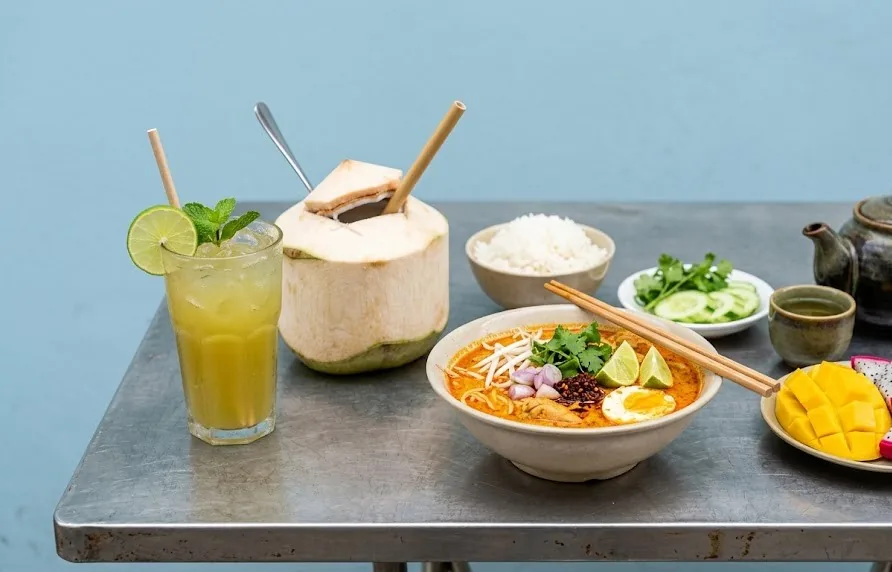
The Spice Survival Guide: How to Handle Da Nang’s Heat Like a Local
Surviving Da Nang’s spice scene isn’t about avoiding heat — it’s about understanding the tools you have to manage it.
The condiment bar at any Da Nang eatery is your control panel for heat management. Learning to use it correctly lets you dial your spice level up or down without offending anyone or suffering unnecessarily. Combined with smart drink choices and a few key Vietnamese phrases, you’ll navigate even the spiciest meals with confidence.
The condiment bar decoded: ớt tươi, ớt bột, sa tế, and mắm ớt — what to use when
Each condiment serves a different purpose. Ớt tươi (fresh sliced chilies) add immediate, bright heat — use them when you want a sharp kick. Ớt bột (chili powder) provides a deeper, smokier burn that builds slowly — better for marinades and dipping salts. Sa tế (chili oil) delivers heat with richness and a garlicky depth, making it ideal for noodle soups. Mắm ớt (chili garlic fish sauce) is the all-purpose table condiment — salty, pungent, and spicy, it works on nearly everything. Start with a small amount of each, taste, and adjust.
The goal isn’t to max out your heat — it’s to find the balance that makes the dish sing.
3 ways to dial down the heat without offending your host
Asking for less spice in Vietnam can feel awkward, but it’s completely acceptable if done politely. First, say “Ít cay” (een kai) before ordering — this requests less chili and works at most establishments. Second, if the dish arrives too hot, ask for a bowl of plain rice to eat alongside it; the starch absorbs heat and resets your palate. Third, order a fresh coconut or sugarcane juice with your meal — the sweetness counteracts capsaicin more effectively than water. These strategies let you enjoy the food without suffering.
What to drink alongside spicy food: bia hơi, nước mía, and sữa đậu nành
Da Nang’s beverage culture offers perfect companions for spicy food. Bia hơi, the fresh draft beer that’s brewed daily and served at street-side stalls, provides crisp carbonation that cuts through chili oil. Nước mía, freshly pressed sugarcane juice, delivers sweetness that soothes the burn. Sữa đậu nành, sweetened soy milk, coats the palate with a creamy buffer that reduces heat perception. Avoid water — it spreads the capsaicin and makes the burn worse. And skip iced coffee if you’re sensitive; the acidity can amplify stomach discomfort.
A quick phrase guide: how to say “not too spicy” and “extra spicy” in Vietnamese
Mastering two phrases transforms your dining experience. “Ít cay” (een kai) means “less spicy” — use it when ordering to preemptively dial down the heat. “Cay nhiều” (kai nyew-uh) means “extra spicy” — deploy it only if you’re confident in your tolerance. For a middle ground, “Cay vừa” (kai voo-ah) requests a moderate level. Add “làm ơn” (lam un) for “please” to sound polite. If you need to ask whether a dish is spicy, “Có cay không?” (kaw kai khom) gets the answer you need before you commit.
Beyond Vietnamese: Da Nang’s International Spicy Food Scene in 2026
Da Nang’s expat community has transformed the city’s food scene, adding Korean, Thai, Indian, Chinese, and Mexican heat to the local spice repertoire.
Vietnam’s growing international population — particularly in Da Nang’s beachside neighborhoods — has created a vibrant global food scene that runs parallel to the traditional Vietnamese offerings. For visitors who want variety or a break from phở and Mì Quảng, these international spots deliver serious heat with flavors from around the world.
Korean fried chicken and tteokbokki — the K-spice invasion in An Thượng
The An Thượng area near My Khe Beach has become a Korean food hub, with fried chicken joints offering spice levels that rival anything in Seoul. Com Nha Vui on 2 Thang 9 Street lets you choose your heat from 1 to 7 — level 7 is genuinely punishing, coated in a gochujang glaze that burns going down. Korean tteokbokki (spicy rice cakes) are also widely available, served with fish cakes and boiled eggs in a fiery red sauce that’s sweeter than Vietnamese chili but no less intense.
Thai and Indian restaurants bringing regional heat to the coast
Da Nang’s international dining scene includes several Thai restaurants serving authentic tom yum and green curry with bird’s eye chili heat, plus Indian spots where the vindaloo and phaal curries are prepared with real spice rather than Westernized restraint. These restaurants cater primarily to expats and tourists, but the kitchens don’t hold back — the Thai papaya salad arrives properly fiery, and the Indian curries are layered with fresh and dried chilies.
The rise of Sichuan-style hotpot and mala in Da Nang’s newer food courts
Chinese investment in Da Nang’s tourism infrastructure has brought a wave of Sichuan restaurants serving mala hotpot — the numbing-spicy broth that’s taken Asia by storm. The signature Sichuan peppercorn creates a tingling sensation that pairs with dried chilies for a heat experience unlike anything in Vietnamese cooking. Several food courts in the city center now feature hotpot restaurants where you choose your broth spice level and cook your own ingredients at the table.
Mexican spots with house-made habanero salsas
Da Nang’s small but passionate Mexican food scene includes restaurants that make their own habanero salsas with chilies imported or locally grown. These spots cater to homesick expats but welcome adventurous Vietnamese diners too. The heat levels are serious — a habanero salsa at a proper Mexican joint will test anyone, regardless of their experience with Vietnamese chili. If you need a break from fish sauce and lemongrass but still want heat, these restaurants deliver.
Spicy Food Safety and Etiquette: What First-Timers Need to Know
Pacing yourself and understanding local dining customs prevents both physical discomfort and social awkwardness.
Eating spicy food in Da Nang is a marathon, not a sprint. The city’s cuisine builds heat across multiple dishes, and newcomers often overcommit early, then struggle through the rest of the meal. A little strategy goes a long way.
How to pace yourself across a multi-dish meal without wrecking your stomach
Start with the mildest dish on the table and work your way up. If you’re sharing a meal with companions, alternate between spicy and non-spicy dishes to give your palate — and stomach — time to recover. Eat rice throughout the meal; it provides a neutral base that absorbs capsaicin and reduces the cumulative burn. And don’t finish the spiciest dish first, no matter how good it looks. Your future self will thank you.
Recognizing your spice tolerance ceiling before you order — not after
Be honest with yourself about your tolerance. If you typically enjoy medium-heat Thai food, Da Nang’s street food will likely exceed your comfort zone. If you order extra spicy at Indian restaurants, you’ll handle most Vietnamese dishes fine. When in doubt, start mild and add condiments — it’s easier to increase heat than to reduce it. And remember: the heat compounds across a meal. A dish that feels manageable on the first bite can become overwhelming by the fifth.
Cultural etiquette: is it rude to ask for less spice at a local spot?
Asking for less spice is not rude in Da Nang — it’s a normal part of ordering. Locals do it all the time, especially when eating with children or older family members. The key is to ask politely and not complain if the dish arrives hotter than requested. Vietnamese hospitality values accommodation, so a simple “Ít cay, làm ơn” (less spicy, please) will be met with a smile. What’s considered rude is sending food back or making a scene about the heat — that reflects poorly on the cook, not on you.
What to do if you’ve overshot: immediate remedies that actually work
If you’ve taken a bite that’s too hot, reach for sugar, not water. A spoonful of sugar or a sweet drink like nước mía dissolves capsaicin more effectively than water, which merely spreads it around your mouth. Dairy is even better — yogurt, milk, or ice cream contain casein, a protein that binds to capsaicin and washes it away. Rice also works as a neutralizer. Avoid beer or carbonated drinks, which can intensify the burn. And don’t tough it out — there’s no shame in reaching for relief.
Related on this site
- Da Nang’s Foodie Date Nights: Romantic Dinner Spots 2026
- Da Nang’s Top Rau Muong Xao: Water Spinach Stir-Fry Favorites 2026
- Da Nang’s Best Nom Hoa Chuoi: Banana Flower Salad Spots 2026
Frequently Asked Questions
Is all food in Da Nang spicy?
No, but the default assumption is that diners want some heat. Many dishes arrive mild by default, with chili served on the side. You can always request less spice, but expect the baseline to be warmer than what you’d find in Hanoi or Ho Chi Minh City.
What is the spiciest dish in Da Nang?
Gỏi cá Nam Ô, the fermented raw fish salad from the Nam Ô fishing village, is widely considered the most intense. The combination of fermentation and fresh chilies creates a heat that’s both sharp and lingering. For cooked dishes, bánh tráng cuốn thịt heo with full-strength mắm nêm is a close second.
Can I request mild versions of spicy dishes at restaurants?
Yes, absolutely. Most restaurants will happily reduce or remove chilies on request. Use the phrase “Ít cay” (less spicy) when ordering. Street stalls may be less accommodating, but they’ll still adjust if you ask politely.
Are there vegetarian options for spicy food lovers in Da Nang?
Yes, though the selection is more limited. Many Buddhist vegetarian restaurants serve spicy versions of traditional dishes using tofu and mushroom-based substitutes. Mì Quảng can be prepared vegetarian, and the chili condiments are typically plant-based. For more options, check out Da Nang’s vegan food guide for dedicated plant-based eateries.
What is the best time of day to eat spicy food in Da Nang?
Breakfast and dinner are the traditional times for spicy dishes like bún chả cá and Mì Quảng. Lunch is lighter, with many locals opting for bánh tráng cuốn or other non-soup dishes. The city’s food stalls typically open early and close by mid-afternoon, so plan your spicy food adventures accordingly.
Is street food in Da Nang safe for tourists?
Yes, if you follow basic food safety practices. Choose stalls with high customer turnover — busy stalls mean fresh ingredients. Watch for stalls where the cooking is done in front of you, and avoid anything that’s been sitting out for hours. Da Nang’s street food culture is well-established, and locals are accustomed to serving visitors.
How do I find the best spicy food spots that locals actually visit?
Look for restaurants and stalls that are crowded with Vietnamese customers, especially during peak meal times. Ask your hotel staff for recommendations — they’ll often share their personal favorites rather than the tourist-oriented spots. And be willing to explore beyond the main tourist areas; the best spice is often found in neighborhoods like Thanh Khê and Ngũ Hành Sơn.
Conclusion
Da Nang’s spicy food scene rewards the adventurous eater with some of Vietnam’s most complex and satisfying heat. From the layered warmth of Mì Quảng to the fermented intensity of mắm nêm, the city’s cuisine builds flavor through chili in ways that differ fundamentally from the rest of the country. Start with the essential dishes, explore the neighborhoods where locals eat, and don’t be afraid to ask for adjustments — the goal is to enjoy the experience, not to prove your tolerance.
Your first bite of a properly spiced Central Vietnamese dish will be the beginning of a beautiful, fiery relationship. Da Nang’s best noodle soups beyond pho deserve equal attention on your culinary journey, and if you’re exploring the city’s broader food scene, you’ll find family-style restaurants that serve these spicy dishes in generous portions meant for sharing.