Da Nang has established itself as Vietnam’s premier destination for outdoor adventures in 2026, offering a diverse range of activities from jungle treks on the Son Tra Peninsula to downhill mountain biking on the Hai Van Pass and sunset kayaking along the Han River. Unlike the flatter cycling routes of Hoi An or the more remote hiking trails near Hue, Da Nang provides three distinct adventure ecosystems—mountain, coast, and city—all accessible within a 30-minute radius. This guide details seven key activities across hiking, biking, and water sports, including specific trail data, 2026 conservation regulations, rental costs, and a month-by-month calendar to facilitate trip planning.
Da Nang’s outdoor adventures in 2026 feature three distinct terrains within a 30-minute drive: the Son Tra Peninsula’s primary forests, the Hai Van Pass’s 21 km downhill bike route, and the Han River’s sunset kayaking corridor. New conservation rules are limiting motorized vehicles on Son Tra trails, prioritizing guided treks for wildlife observation. The dry season, from February to August, offers optimal conditions for hiking and mountain biking, while September to January shifts focus to indoor climbing and hot springs. This guide provides seven activities with route difficulty ratings, essential gear checklists, and 2026-specific regulations for safe exploration.
Why Da Nang Is Vietnam’s Top Outdoor Adventure Hub in 2026
Da Nang integrates mountain, coastal, and urban adventure zones within a 30-minute radius, offering a higher density of activities compared to Hoi An or Hue.
Hoi An’s adventure offerings primarily include cycling through rice paddies and day trips for snorkeling at Cham Island. Hue provides trekking in Bach Ma National Park and kayaking on the Perfume River, but these locations require longer travel times from the city. Da Nang, situated between these two cities, offers direct access to the Son Tra Peninsula’s primary forest trails, the Hai Van Pass summit, and My Khe Beach’s consistent waves, all within a 15–25 minute drive from the city center.
Infrastructure upgrades in 2026 enhance Da Nang’s accessibility for adventure travelers. The Son Tra Peninsula now designates eco-trekking zones with restricted vehicle access; only 50 motorbikes and 20 cars are permitted daily on the main forest loop to protect the red-shanked douc langur population. The expansion of the Hai Van Pass tunnel has reduced truck traffic on the older road, improving safety for cyclists. New signboards indicating trail difficulty and emergency contact numbers have been installed on the Marble Mountains and Son Tra trails.
| Factor | Da Nang | Hoi An | Hue |
|---|---|---|---|
| Activity variety | Hiking, biking, kayaking, snorkeling, canyoning | Cycling, snorkeling, kayaking | Trekking, kayaking, motorbiking |
| Max travel time from center | 30 minutes | 45 minutes | 60 minutes |
| 2026 conservation rules | Son Tra vehicle limits, guided tour requirements | Old Town pedestrian zones only | Bach Ma permit system |
| Best for | Mixed-sport itineraries | Flat cycling + cultural stops | Long-distance hiking |
Transportation choices depend on your planned activities. Renting a motorbike (150,000–200,000 VND/day) offers flexibility for reaching trailheads and bike routes early. Hiring a private driver for a half-day costs 600,000–800,000 VND and is suitable for single-day activities like hiking the Marble Mountains. Guided tours bundle transport, gear, and permits, which is particularly useful for the Son Tra Peninsula where new regulations mandate a certified guide for certain forest trails. For a week-long trip, combining a motorbike for independent morning excursions with a guided tour for afternoon water sports provides a balanced experience of freedom and support.
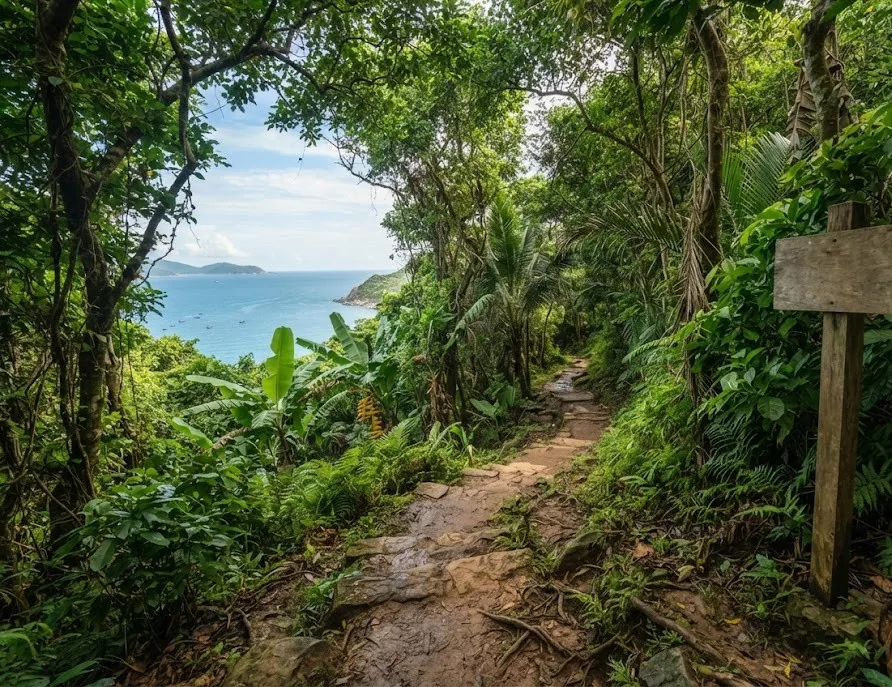
Best Hiking Trails in Da Nang: From Beginner to Expert
Da Nang’s hiking trails span three distinct ecosystems: limestone caves, primary coastal forest, and mountain jungle, each offering a different level of challenge.
The Marble Mountains provide an accessible introduction for beginners. A climb of 156 stone steps leads through the Thuy Son cave network, past Buddhist pagodas and scenic viewpoints overlooking My Khe Beach. The entrance fee is 40,000 VND, and the entire loop typically takes 1–1.5 hours. Visiting between 7–9 AM helps avoid the peak heat and crowds. The trail is clearly marked with Vietnamese and English signage, and shaded rest stops are available. While no guide is required, carrying water is advisable, as vendors on the mountain sell a 500ml bottle for 20,000 VND.
For intermediate hikers, the Son Tra Peninsula trek is a notable experience. The primary trail begins at the Linh Ung Pagoda parking lot and follows a dirt path through primary forest for 6 km to the summit at 696 meters. The route traverses three vegetation zones: coastal scrub, lowland evergreen forest, and cloud forest at higher elevations. Red-shanked douc langur sightings are most common between kilometers 2 and 4, with early morning (6–8 AM) offering the best opportunities. The difficulty is moderate, involving 350 meters of elevation gain over 6 km, with some sections requiring scrambling over roots.
Allow 3–4 hours for the round trip, and carry at least 1.5 liters of water per person.
Ba Na Hills hiking route: bypass the cable car and take the jungle trail
While most visitors ascend Ba Na Hills via cable car to explore the gardens, an adventurous 7 km jungle trail starts at the Suoi Mo entrance and climbs to the French Village at 1,487 meters. This full-day hike (6–8 hours) involves 1,100 meters of elevation gain and is not officially maintained, marked by faded red paint on trees and occasional bamboo bridges. The trail passes through primary forest featuring large ficus trees, wild orchids, and resident macaque troops.
A local guide is recommended for this route due to trail splits and unreliable GPS signal beneath the dense canopy.
Guide services for this route typically cost 600,000–800,000 VND per person for a group of four, often including lunch and water. Booking through operators like Danang Hiking Tours or VietChill Adventures provides English-speaking guides equipped with first aid kits and satellite phones. Starting at 6 AM allows for reaching the summit before midday clouds reduce visibility. The descent via cable car, included in many guide packages (approximately 150,000 VND one-way), helps conserve energy.
Hai Van Pass summit hike: a 2-day option with overnight camping
The Hai Van Pass summit hike presents Da Nang’s most challenging trail for experienced hikers. This route diverges from the main road, following a separate jungle track along the ridge line from Hai Van Station to the summit at 1,172 meters, before descending to Lang Co Beach. The total distance is 18 km with 800 meters of elevation gain, typically completed over two days with an overnight camp. Day 1 covers 10 km through dense bamboo forest and abandoned French bunkers, concluding at a clearing with ocean views.
Day 2 involves an 8 km descent through pine forests and coffee plantations to Lang Co.
This route requires a guide (mandatory from 2026 due to conservation regulations), appropriate camping equipment, and a good level of fitness for approximately 6 hours of hiking daily with a pack. Danang Adventure Tours offers this trip twice weekly (Wednesday and Saturday) for 1,200,000 VND per person, inclusive of tent, sleeping bag, meals, and permits. The optimal months are February–April and August–October, avoiding the rainy season (September–January) when the trail becomes slippery and leeches are prevalent.
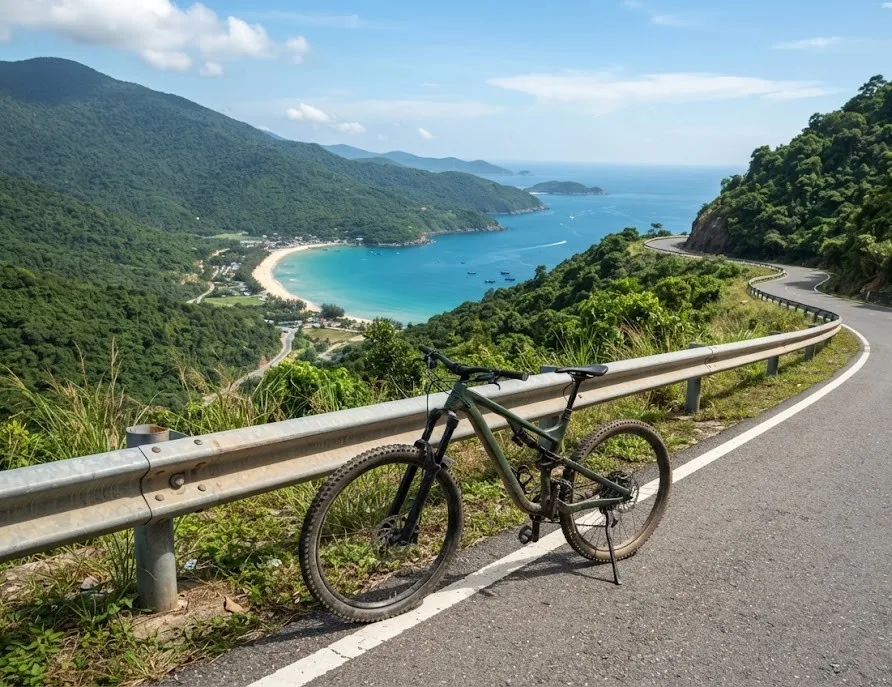
Mountain Biking Routes: Conquering Da Nang’s Coastal and Mountain Terrain
Da Nang offers three distinct mountain biking routes, ranging from a 21 km downhill descent to a leisurely ride through rural landscapes.
The Hai Van Pass downhill is a signature route. Starting from the summit (496 meters), the 21 km descent to Lang Co Beach covers 450 meters of elevation loss over 45–60 minutes. The road is primarily smooth asphalt, interspersed with sections of loose gravel and occasional potholes, particularly after rain. A full-suspension mountain bike with disc brakes is recommended; rental shops in Da Nang typically offer models from Trek and Giant for 350,000–500,000 VND per day. Early morning (6–9 AM) is the ideal time to ride before the road becomes crowded with tour buses and motorbikes.
A windbreaker is advisable, as temperatures at the summit can be significantly cooler than at the base.
The Son Tra Peninsula loop is a 15 km paved road encircling the peninsula through primary forest. With only 200 meters of total elevation gain, it is less technically demanding than Hai Van Pass but offers more scenic views and opportunities for wildlife sightings, including red-shanked douc langurs, macaques, and monitor lizards. The road’s narrow sections (2.5 meters wide) lack guardrails, requiring vigilance for oncoming motorbikes. 5–2 hours, with stops at viewpoints like Ban Co Peak.
The 2026 vehicle restrictions on Son Tra Peninsula contribute to a safer riding environment compared to previous years.
Countryside cycling: Cam Le rice paddies and water buffalo trails
For a less strenuous day, Cam Le route provides a flat 25 km loop through rice paddies, betel nut plantations, and local villages. Starting from Cam Le Bridge, the route follows the Thu Bon River south, passing through Phong Nam village (known for its 200-year-old Cham ruins) and looping back via Tra Que vegetable village. The terrain is entirely paved and flat, suitable for various bicycle types. Navigation can be challenging due to the lack of English signage and inconsistent GPS coverage in rural areas.
Using a bike with a phone mount and downloading offline maps from applications like Maps.me is recommended.
Bike rental options in Da Nang have expanded for 2026. Danang Bike Tours offers Trek X-Caliber 8 models for 400,000 VND/day with complimentary delivery and pickup. Vietnam Bike Tours rents Giant Talon 29ers for 350,000 VND/day, including a helmet, repair kit, and lock. All rental shops are legally required to provide helmets under the 2025 traffic law update, though enforcement varies; riders should insist on a helmet. Guided mountain bike tours typically range from 1,000,000–1,500,000 VND for a half-day trip, including guide, bike, lunch, and transport.
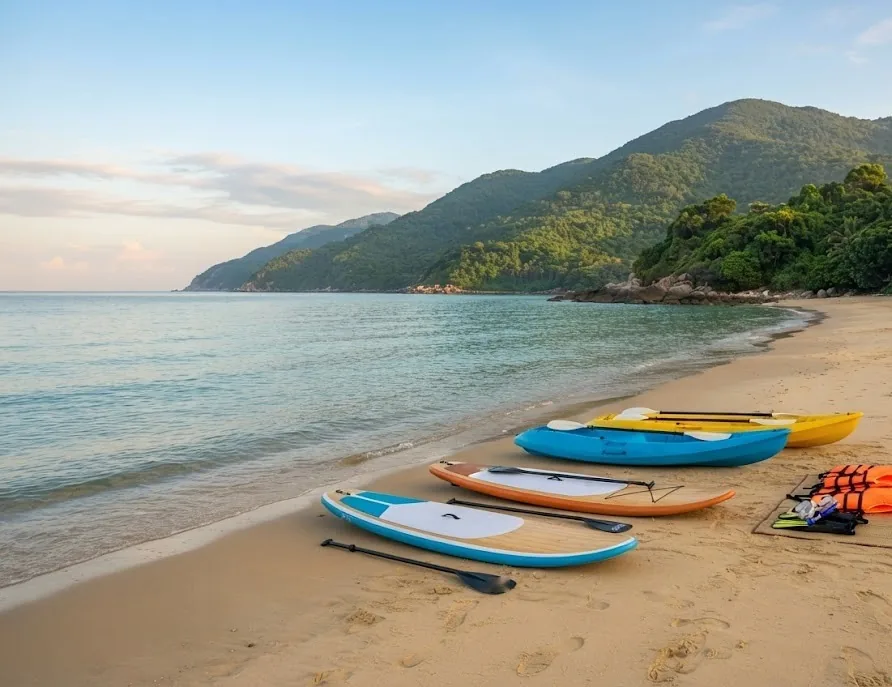
Water Sports and Coastal Adventures Beyond Hiking and Biking
Da Nang’s water sports sector has seen significant development by 2026, with professional operators offering kayaking, snorkeling, surfing, and canyoning within a 45-minute radius of the city.
Kayaking on the Han River is best experienced at sunset, with views of the illuminated Dragon Bridge and the Thuan Phuoc Bridge. Double kayaks can be rented from Han River Kayak (200,000 VND/hour) at the Bach Dang Street dock for a 3 km paddle between the two bridges. The river is generally calm, but avoiding peak hours (5–7 PM) on weekends is advised due to boat traffic. A longer upstream paddle to Tuyen Son Bridge (5 km, 2 hours) offers a glimpse of local stilt houses and fishing activities away from tourist areas.
Full-day trips for snorkeling and diving at Cham Island depart from the Son Tra Peninsula via ferry, with a 30-minute crossing. The best snorkeling spots are around Hon Lao Island, a 20-minute boat ride from the main island, offering visibility of 8–15 meters between February and August. Cham Island Diving offers day trips for 1,200,000 VND, including gear, lunch, and an English-speaking guide.
Surfing and stand-up paddleboarding at My Khe Beach
My Khe Beach experiences consistent waves from October to March, with average swell heights of 1–2 meters and occasional 3-meter sets during typhoon season. The northern end of the beach, near the Son Tra Peninsula, offers the best surf breaks with a right-hand point break created by the reef. Surfboard rentals range from 150,000–250,000 VND/hour at Da Nang Surf School, which also provides 2-hour lessons for 600,000 VND, including board and wetsuit rental.
Stand-up paddleboarding is more suitable during the calmer months (April–September), allowing for coastal paddling and views of the Marble Mountains from the water.
Canyoning at Da Nang’s waterfalls, primarily in the Hoa Trung Lake area 30 km west of the city, offers an adrenaline-fueled experience. This involves abseiling down a 25-meter waterfall, sliding down natural rock formations, and jumping into pools from heights of up to 5 meters. VietChill Adventures offers half-day canyoning trips for 1,500,000 VND per person, covering all gear, lunch, and transport. Participants must be at least 16 years old and able to swim 100 meters in moving water.
The canyoning season runs from February to August; outside these months, water flow may be insufficient for safe abseiling.
2026 Seasonal Calendar: When to Do Which Adventure Activity
Da Nang experiences two primary seasons that influence the suitability of outdoor activities: the dry season (February–August) and the rainy season (September–January).
The dry season is considered peak adventure time. February to April provides ideal conditions for hiking and mountain biking, with average temperatures of 22–28°C, humidity below 70%, and minimal rainfall (under 50 mm per month). This period is optimal for the Hai Van Pass summit hike, Son Tra Peninsula treks, and the Ba Na Hills jungle trail. May to August is hotter (30–35°C) but still conducive to water sports. While waves at My Khe Beach peak in October, snorkeling visibility is best from May to July.
The Da Nang International Fireworks Festival (DIFF 2026, May 30–July 11) coincides with this period, and some tour operators offer evening kayaking packages on the Han River for viewing the displays.
The rainy season (September–January) requires adjustments but does not halt adventure travel. September and October receive the heaviest rainfall (300–400 mm per month) and are prone to typhoons, making activities like Hai Van Pass biking and canyoning inadvisable. November to January experience lighter rain (100–200 mm per month) and cooler temperatures (18–24°C). This period is suitable for indoor climbing at Da Nang Climbing Wall (80,000 VND/entry) and visiting hot springs in the Hoa Trung Lake area (200,000 VND/entry for thermal pools). Surfing conditions are also at their best from October to December.
Monthly Temperature and Rainfall Data for Da Nang
| Month | Avg Temp (°C) | Rainfall (mm) | Best Activities |
|---|---|---|---|
| January | 22 | 100 | Surfing, hot springs, indoor climbing |
| February | 23 | 50 | Hiking (all trails), mountain biking |
| March | 25 | 40 | Hiking, mountain biking, kayaking |
| April | 28 | 30 | Hiking, snorkeling, canyoning |
| May | 31 | 50 | Snorkeling, kayaking, fireworks viewing |
| June | 33 | 60 | Water sports, early morning hiking |
| July | 34 | 70 | Water sports, evening kayaking |
| August | 33 | 100 | Snorkeling, canyoning, countryside cycling |
| September | 30 | 300 | Hot springs, indoor activities |
| October | 27 | 400 | Surfing, hot springs (avoid hiking) |
| November | 24 | 200 | Surfing, indoor climbing |
| December | 22 | 150 | Surfing, hot springs, cultural tours |
Essential Gear, Safety Tips, and Local Regulations for 2026
Packing appropriately for Da Nang’s outdoor adventures requires preparation for both tropical heat and potential sudden rain showers, irrespective of the season.
For hiking and mountain biking, appropriate footwear is crucial. Trail running shoes with good traction are suitable for most hiking trails, while ankle-high boots are recommended for the uneven terrain of the Ba Na Hills jungle route. A hydration pack carrying at least 2 liters of water is essential, given Da Nang’s high humidity. Sun protection, including SPF 50+ sunscreen, a wide-brimmed hat, and polarized sunglasses, is vital. For the rainy season, a lightweight, packable waterproof jacket and a waterproof phone pouch are recommended.
New conservation regulations for the Son Tra Peninsula in 2026 mandate that all visitors obtain a printed or digital permit for entry between 6 AM and 6 PM. Permits are free but must be booked via the Son Tra Management Board website (son-tra.danang.gov.vn) at least 48 hours in advance. Guided tours on Son Tra are limited to a maximum of 12 people per guide, and motorized vehicles are restricted to the main road, prohibiting off-road use.
Violations of these regulations can result in fines ranging from 500,000–2,000,000 VND, with repeat offenders facing potential bans from the peninsula for up to 12 months.
Health and safety: nearest hospitals with English-speaking staff
For minor injuries, Da Nang Family Hospital (218 Nguyen Van Linh Street, 0236 358 6000) offers a 24-hour emergency department with English-speaking staff. For more serious medical needs, Hoan My Hospital (291 Nguyen Van Linh, 0236 365 0676) is the city’s largest private hospital with an international ward. Both facilities accept direct billing from travel insurance providers; ensure your policy covers adventure sports, as many standard plans exclude activities like mountain biking and canyoning.
The national emergency number for ambulances is 115, though response times in the Son Tra area can range from 30–45 minutes. Carrying a basic first aid kit with essential supplies is advisable.
Cultural awareness is also important for safety and positive interactions. When visiting temple areas on the Marble Mountains or Son Tra Peninsula, dress modestly, covering shoulders and knees. Photography is generally permitted on trails, but always ask permission before photographing monks and avoid capturing religious ceremonies. On countryside cycling routes, acknowledging locals with a wave or nod is considered polite and can facilitate communication if assistance is needed.
Related on this site
- Da Nang Zipline Adventures: Thrills in the Forest 2026
- Da Nang’s Best Paintball Fields: Team Battles 2026
- Shooting in Da Nang: Two Real Air-Gun Clubs (No Live Firearms)
Frequently Asked Questions
Do I need a guide for hiking in Da Nang, or can I go solo?
Solo hiking is feasible for the Marble Mountains and the main Son Tra Peninsula trail, as these routes are well-marked and frequently used by other hikers. However, a guide is mandatory from 2026 for the Ba Na Hills jungle trail and the Hai Van Pass summit hike due to conservation rules and safety considerations. These trails are unmarked, and GPS signal can be unreliable in dense forest cover, making them challenging for solo navigation.
What is the best month for mountain biking in Da Nang?
February to April offers the optimal conditions for mountain biking, with temperatures between 22–28°C, low rainfall (under 50 mm per month), and dry road surfaces on routes like the Hai Van Pass. May to August is hotter, necessitating early morning rides to avoid heatstroke. September to November should be avoided due to rain, which can make the Hai Van Pass switchbacks slippery and increase the risk of landslides.
Are there beginner-friendly hiking trails near Da Nang city center?
Yes. The Marble Mountains trail, located about 15 minutes from the city center by taxi (50,000–80,000 VND), takes 1–1.5 hours to complete and involves 156 steps. The Son Tra Peninsula Monkey Trail (2.5 km, easy) is a 20-minute drive from the city center and follows a flat coastal path through primary forest. Both are suitable for beginners with moderate fitness levels.
How much does a full-day outdoor adventure tour cost in Da Nang 2026?
Full-day tours typically range from 1,200,000 VND for a Cham Island snorkeling trip to 1,500,000 VND for canyoning, and 1,200,000 VND for the two-day Hai Van Pass summit hike. Half-day guided mountain biking tours cost 1,000,000–1,500,000 VND. These prices generally include gear, meals, transport, and an English-speaking guide. Independent travel, using motorbike rental and paying trail fees, can cost 200,000–500,000 VND per day, excluding food and water.
Can I combine outdoor activities in Da Nang with a trip to Hoi An in one day?
Combining activities is possible with careful planning. A common itinerary includes a morning hike at the Marble Mountains (1.5 hours), followed by a 30-minute transfer to Hoi An for lunch and a cycling tour of the Old Town and surrounding rice paddies (3 hours). Attempting to combine the Hai Van Pass biking with a Hoi An visit is not recommended due to travel time constraints. Evening kayaking on the Han River can be a suitable addition after a day trip to Hoi An.
Is it safe to rent a motorbike for self-guided adventure trips in Da Nang?
Renting a motorbike for self-guided trips is safe for individuals with prior experience riding in Vietnamese traffic and who possess a valid International Driving Permit with a motorcycle endorsement. Reputable rental shops provide well-maintained bikes and include helmets. Key risks are associated with the Hai Van Pass, particularly sharp corners and heavy traffic, and slippery road conditions during the rainy season. Beginners may prefer sticking to the Son Tra Peninsula loop and countryside routes. Always wear a helmet and avoid riding on rural roads after dark.
Next Steps
Da Nang in 2026 offers unparalleled variety in outdoor adventures, with successful trips depending on aligning activities with the appropriate season and adequate preparation for the terrain.
Advance booking is recommended for Son Tra Peninsula permits and Hai Van Pass summit hike guides, especially during peak months (February–April and June–August). Accommodation choices should align with primary activities: proximity to My Khe Beach is ideal for water sports, the Son Tra Peninsula for hiking and biking, and the Han River area for kayaking and fireworks viewing. Regardless of the season, packing for both sun and rain is essential, as Da Nang’s weather can change rapidly.
- Secure your Son Tra Peninsula trek permit early, as daily allocations are limited and sell out during peak season due to new 2026 vehicle restrictions.
- Consider renting a motorbike for the initial part of your trip to independently access hiking trails and bike routes, then opt for guided tours for water sports and canyoning.
- Pack for variable weather conditions, including both sun and rain, as Da Nang’s climate can shift quickly. A lightweight waterproof jacket is a practical addition.