Da Nang Surfing Lessons: Catch Waves at My Khe Beach 2026 — this is your complete guide to standing up on your first board at one of Vietnam’s most beginner-friendly stretches of sand. The surf scene here has grown from a niche local secret into a full-blown tourist attraction, with schools lining the shore and lessons starting from around $20 USD. This guide breaks down the best seasons, the exact lesson structure, how to pick a trustworthy school, and what you need to know before you paddle out.
My Khe Beach offers the most forgiving learning conditions in central Vietnam: sandy beach breaks, mellow waves during the northeast monsoon (September–March), and water temperatures that rarely drop below 24°C. A standard 90-minute group lesson costs between 500,000 and 800,000 VND ($20–$35 USD) including board and rashguard. The ideal conditions for a great first session involve offshore west winds and mid-tide windows, which create the cleanest waves for beginners.
Why My Khe Beach Is the Best Place for Surfing Lessons in Da Nang
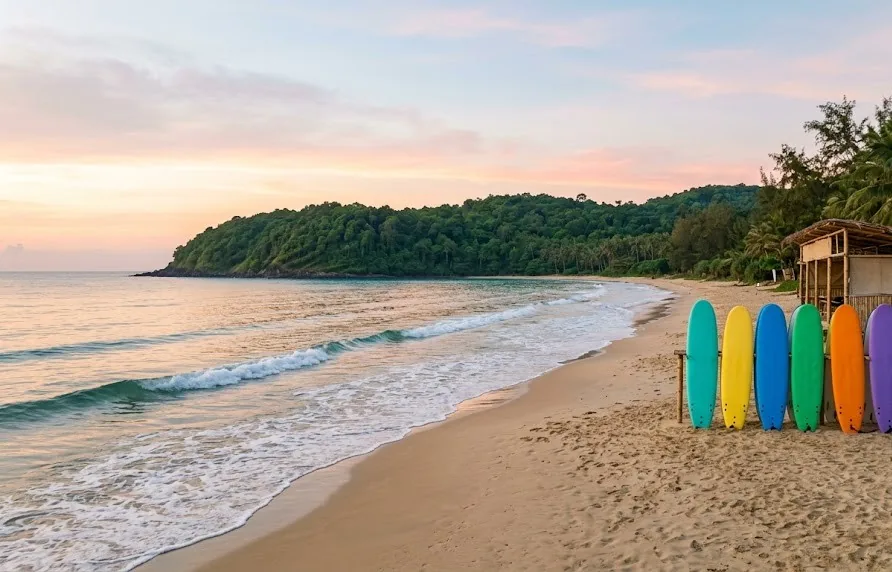
My Khe’s sandy, rolling wave pattern gives beginners the highest chance of standing up on their first session. Unlike reef breaks or fast beach breaks, the waves here peel gently over a sand bottom, meaning a wipeout lands you in soft sand rather than on sharp coral. This geological setup is the single biggest factor that makes Da Nang surfing lessons at My Khe so popular for first-timers.
Beach-break conditions: why sandy, mellow waves suit first-timers
The mechanics are simple: a beach break forms when waves break over a sandy seabed. At My Khe, the sand shifts seasonally, creating multiple peaks that spread the crowd thin. For a beginner, this matters because you get more waves to yourself. The wave face is also less steep than reef breaks like Nam O Point, giving you a longer, slower ride to practice your pop-up. When you fall — and you will fall — the sand bottom means the impact is forgiving, which reduces the fear factor that blocks most new surfers.
My Khe vs. other Da Nang surf spots (Nam O Point, Non Nuoc, Cua Dai)
Da Nang has several surf spots, but they are not created equal for learning. Nam O Point, located north of the city, is a reef break that needs a bigger swell and more experience — this is where you go when you can already catch green waves. Non Nuoc Beach, south of Marble Mountains, has similar conditions to My Khe but is less consistent. Cua Dai in Hoi An is a beach break too, but the currents can be stronger and the sandbars less predictable.
| Spot | Wave Type | Best For | Crowd Level | Difficulty |
|---|---|---|---|---|
| My Khe Beach | Sandy beach break | Beginners, first lessons | Medium (spreads out) | Beginner-friendly |
| Nam O Point | Reef break | Intermediate/advanced | Low | Hard |
| Non Nuoc Beach | Sandy beach break | Beginners (less consistent) | Low | Beginner-friendly |
| Cua Dai (Hoi An) | Sandy beach break | Intermediate (stronger currents) | Medium | Moderate |
What “catch waves at My Khe” actually means for a beginner
When a surf school promises you will catch waves at My Khe, they mean catching whitewater — the already-broken foam that rolls toward the shore. This is the standard first step in surfing. You lie on a soft-top board, paddle with your arms, and when the whitewater reaches you, you push up to your feet and ride it toward the beach. This is not the same as paddling out the back and catching unbroken green waves, which takes months of practice.
Understanding this distinction sets realistic expectations: your first lesson is about feeling the board glide and getting your balance right, not carving down a wave face.
Best Time of Year to Book Surf Lessons at My Khe Beach
Book your Da Nang surfing lessons between September and March for the most consistent swell. The northeast monsoon drives waves into the coast during these months, while the summer period from May to August often brings flat, glassy conditions that make surfing nearly impossible. In 2023, My Khe Beach
Surf season breakdown: September–March (northeast monsoon) vs. flat summer months
The northeast monsoon season is driven by winds blowing from the northeast across the South China Sea, generating groundswell that wraps into My Khe. September and October typically see smaller, more manageable waves — perfect for first-timers. November through February brings bigger swells, occasionally reaching head-high or more, which can be overwhelming for beginners. March is a sweet spot: the swell is still present but the crowds have thinned out. The summer months, especially June and July, are flat more often than not — you might find small windswell on windy days, but you cannot rely on it.
| Month | Swell Size | Wind Direction | Beginner Suitability |
|---|---|---|---|
| September | Small (waist-high) | Variable | Excellent |
| October | Small–medium | Northeast | Excellent |
| November | Medium | Northeast | Good (bigger days) |
| December | Medium–large | Northeast | Good (pick smaller days) |
| January | Medium–large | Northeast | Moderate |
| February | Medium | Northeast | Good |
| March | Medium | Variable | Excellent |
| April | Small | Variable | Fair |
| May–August | Flat–very small | Southwest | Poor |
Ideal tide, wind, and swell conditions for beginner lessons
For a beginner lesson, you want three things aligned: a small swell (waist-high or below), light winds, and the right tide. Offshore winds — blowing from the land toward the sea — groom the waves and keep them clean. At My Khe, this means westerly winds. Onshore winds, blowing from the sea toward the land, make waves choppy and harder to paddle into. The tide matters less at My Khe than at reef breaks, but mid-tide (either rising or falling) generally offers the most consistent sandbar shape.
Ask your school to schedule your lesson for a morning session — the wind is usually calmer before 10 AM.
2026 weather outlook: what to expect for the upcoming season
Meteorological forecasts this far out are best treated as probabilities, but the long-range signals for the 2026 season point toward a standard northeast monsoon pattern. Expect the first consistent swells to arrive in late September, with the peak of the season hitting between November and January. If you are planning a trip in 2026 and want the safest bet for surfable waves, target October or March — both months offer good swell consistency without the storm-driven chaos that can arrive mid-winter.
Always check the live surf forecast on sites like Surf-Forecast for My Khe in the week leading up to your lesson.
What to Expect From a Surf Lesson at My Khe Beach
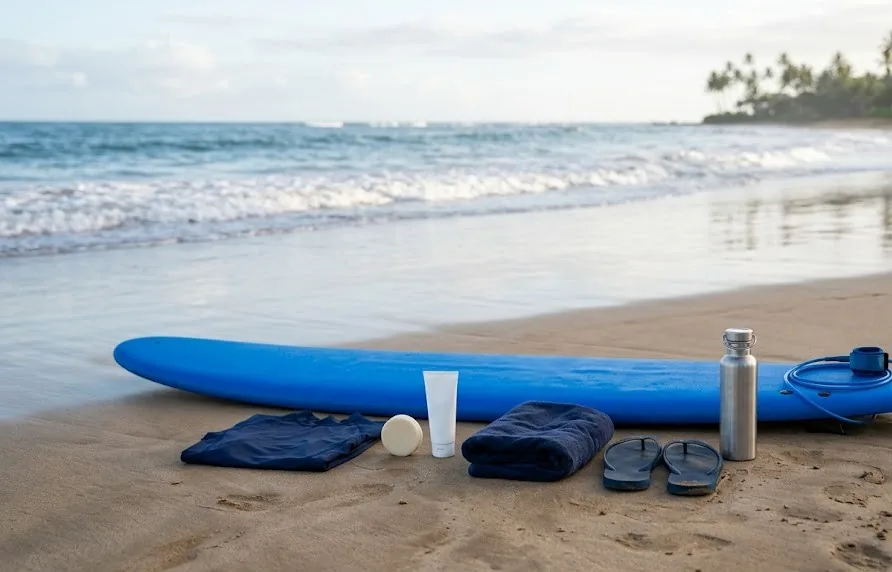
A standard Da Nang surf lesson follows a predictable structure: safety briefing, dry-land practice, then water time. You will be on a soft-top board, which is wider, thicker, and more stable than a hardboard — this is non-negotiable for beginners because it prevents injuries to you and other surfers.
Typical lesson structure: beach safety briefing, dry-land practice, then water time
- Beach safety briefing (10–15 minutes): Your instructor will explain the surf zone, how to identify rip currents, and what to do if you get caught in one. Pay attention — this is the most important part.
- Dry-land practice (10–15 minutes): You practice the pop-up technique on the sand. The instructor corrects your foot placement and body position before you hit the water.
- Water warm-up (5 minutes): You paddle out with the instructor, learning how to lie on the board and kick through whitewater.
- Wave catching (45–60 minutes): The instructor pushes you into whitewater waves. You practice standing up and riding toward the beach.
- Debrief and feedback (5–10 minutes): The instructor reviews what you did well and what to work on for your next session.
The entire session runs 90 minutes to 2 hours, with roughly half the time spent actively surfing. Schools like Epic Surf and Da Nang Surf School run this structure consistently, and it is proven to get most first-timers standing up at least once.
Equipment included: soft-top boards, rashguards, and whether you need booties
Your lesson fee includes the essential gear: a soft-top surfboard, a rashguard (a thin protective shirt that prevents chafing), and sometimes reef-safe sunscreen. You do not need booties for My Khe — the sand bottom is smooth and the water is warm year-round, hovering between 24°C and 29°C. Wetsuits are unnecessary except for the coldest winter mornings, and even then, a rashguard is usually enough. Your school may also provide a locker or watch your belongings while you are in the water, but do not rely on this — leave valuables at your hotel.
Lesson duration and group size — what’s the ideal first session length?
For a first lesson, a 90-minute session is the sweet spot. It is long enough to get through the briefing, dry-land practice, and at least 45 minutes of water time without exhausting you. Two-hour sessions are better if you are reasonably fit and want extra paddle practice, but the last 30 minutes often sees diminishing returns as fatigue sets in. Group sizes matter: the best schools cap groups at 4–6 students per instructor. A 1:4 ratio means you get more personalized push-ins and feedback; a 1:6 ratio means more waiting for your turn in the water.
If you want maximum attention, book a private lesson — the price difference is worth it if you struggle with the pop-up.
How to Choose the Right Surf School in Da Nang
The quality of surf schools in Da Nang varies widely, so your choice determines whether you stand up or spend the session swallowing saltwater. The best schools have licensed instructors, a proper safety protocol, and small group sizes.
Red flags to avoid: unlicensed instructors, no safety briefing, overcrowded groups
Several warning signs should make you walk away from a school. First, if the instructor does not give a beach safety briefing before entering the water, leave — this indicates a lack of training and care. Second, if the group size exceeds 6 students per instructor, you will not get enough attention to actually progress. Third, unlicensed instructors operating without insurance are a liability — if you get injured, you have no recourse. Finally, be wary of schools that rush you into the water without checking your swimming ability or comfort level.
A professional school always asks about your experience and fitness before the lesson starts.
Comparing local schools: Epic Surf School, Surf Da Nang, and independent coaches
Epic Surf School is one of the most established operations, located directly across from TMS Hotel on My Khe Beach. They have a strong reputation on TripAdvisor and Google, with professional instructors and a consistent lesson structure. Surf Da Nang operates similarly, with a focus on beginner lessons and board rentals. Independent coaches can be cheaper, but you sacrifice the safety infrastructure and insurance that established schools provide. For your first lesson, spend the extra money on a registered school — the difference in quality is worth the 200,000–300,000 VND premium.
Reading reviews and asking the right questions before booking
When reading reviews on TripAdvisor or Google, look for specific mentions of instructor quality, safety practices, and how the school handles bad weather. A school that cancels or reschedules when conditions are poor is more trustworthy than one that sends beginners out in dangerous surf. Before booking, ask these questions directly via WhatsApp (the standard booking channel in Da Nang):
- What is the instructor-to-student ratio for group lessons?
- Is the safety briefing included, and how long is it?
- What happens if the waves are flat on my scheduled day?
- Are photos or videos included in the price?
- Do you provide reef-safe sunscreen and drinking water?
Schools that answer these questions clearly and confidently are the ones worth your money.
Surf Lesson Costs and What’s Included in 2026
Expect to pay between 500,000 and 1,200,000 VND ($20–$50 USD) for a surf lesson at My Khe in 2026. The exact price depends on group size, lesson duration, and whether photos are included.
Average price range for group vs. private lessons in VND and USD
| Lesson Type | Price Range (VND) | Price Range (USD) | Duration | What’s Included |
|---|---|---|---|---|
| Group lesson (1:4–1:6) | 500,000–800,000 | $20–$35 | 90 minutes | Board, rashguard, instructor |
| Private lesson (1:1) | 1,000,000–1,200,000 | $40–$50 | 90 minutes | Board, rashguard, dedicated instructor |
| 1-hour taster session | 600,000–700,000 | $25–$30 | 60 minutes | Board, rashguard, basic instruction |
| Board rental only | 250,000 | $10 | 2 hours | Soft-top board |
Board rental prices at My Khe — and when renting makes sense over a lesson
Board rental at My Khe runs around 250,000 VND ($10 USD) for two hours. Renting makes sense only if you have surfed before and know how to paddle out and catch waves on your own. For a true first-timer, renting a board without instruction is a waste of money — you will spend the entire session struggling to paddle and never stand up. Take at least one lesson first, then rent boards for the following days to practice what you learned. Most schools offer discounted multi-day packages that combine lessons and rentals.
Hidden costs: rashguard hire, photos, insurance, and tips
Most schools include the rashguard in the lesson price, but some independent coaches charge an extra 50,000–100,000 VND for hire. Photos and videos are a separate add-on at many schools, typically costing 200,000–400,000 VND for a package of edited shots. Insurance is rarely included in the lesson fee, so check whether your travel insurance covers surfing — if it does not, consider buying a short-term policy that does. Tipping is not mandatory in Vietnam, but a 50,000–100,000 VND tip for a good instructor is appreciated and goes a long way in this service economy.
Essential Tips for First-Time Surfers at My Khe Beach
Your first surf session will be physically demanding, so preparation before you arrive determines how much fun you actually have. Here is what to do in the days leading up to your lesson and what to bring on the day.
Physical prep: paddling strength, swimming confidence, and what to practice beforehand
Surfing uses muscles you probably do not use daily — shoulders, back, and core. A week before your lesson, do three sessions of 20–30 push-ups and 30-second planks to build the upper body strength needed for paddling and popping up. If you are not a confident swimmer, spend time in a pool practicing floating on your back and treading water. You do not need to be an Olympic swimmer — My Khe is shallow enough to stand in most spots — but you need to be comfortable in the water without panicking.
Watch a few videos on the “pop-up” technique so the movement feels familiar before your instructor teaches it on the sand.
What to bring (and leave at the hotel) for a smooth lesson day
Bring only the essentials: a towel, a change of clothes, reef-safe sunscreen, and a bottle of water. Leave your phone, wallet, and jewelry at the hotel — sand and saltwater destroy electronics, and beaches attract opportunistic thieves. Wear a swimsuit that stays put when you wipe out; boardshorts or a one-piece are ideal. Water shoes are optional but useful for walking over the hot sand and protecting your feet from any debris. Apply sunscreen 15 minutes before the lesson and reapply after you dry off — the tropical sun at My Khe is intense, even on cloudy days.
Safety basics: rip currents at My Khe, etiquette in the lineup, and knowing your limits
My Khe does have rip currents, especially during bigger swells. A rip is a narrow channel of water flowing back out to sea — it can pull you away from shore quickly. If you feel yourself being pulled out, do not panic and do not fight it. Swim parallel to the shore until you are out of the current, then swim back in. In the lineup, follow basic surf etiquette: do not drop in on another surfer’s wave, do not paddle through the impact zone, and always hold onto your board when a wave is coming.
Most importantly, know your limits. If the surf looks too big or the current feels too strong, tell your instructor — they will adjust the plan.
How to maximize a single lesson if you only have one day in Da Nang
If you only have one day, book a private lesson for the morning slot — the wind is calmest and the waves are cleanest. Arrive 15 minutes early, warmed up and ready. During the dry-land practice, ask your instructor to watch your pop-up at least five times until it feels automatic. Once in the water, do not waste energy paddling around — let your instructor push you into waves and focus entirely on your pop-up and balance. After the lesson, if you still have energy, rent a board for an hour to practice what you learned.
The combination of a structured lesson followed by free practice is the fastest way to progress in a single day.
Related on this site
- Da Nang Water Park Fun: Slides and Attractions for Families 2026
- Da Nang Night Market Shopping: What to Buy and Eat 2026
- Da Nang’s Top Birdwatching Spots: Nature Lover’s Guide 2026
Frequently Asked Questions
Do I need to know how to swim to take surf lessons at My Khe?
Yes, you should be comfortable in the water and able to swim at least 50 meters. My Khe is shallow enough to stand in most spots, but you need basic swimming skills to handle waves and currents safely. Most schools will ask about your swimming ability before the lesson.
What is the best time of day for a surf lesson?
Morning sessions, between 7 AM and 10 AM, are ideal. The wind is calmer, the sun is less intense, and the beach is less crowded. Afternoon sessions can be wind-affected, making the waves choppier and harder for beginners.
How many lessons do I need to stand up consistently?
Most people stand up on their first lesson, at least briefly. Standing up consistently on every wave typically takes 3–5 lessons, depending on your fitness and coordination. The key is spacing your lessons 2–3 days apart to let your muscles recover and adapt.
Is surfing at My Khe safe for children?
Yes, My Khe is one of the safest beaches in Vietnam for kids to learn surfing. The sandy bottom, mellow waves, and shallow water make it ideal. Many schools offer private lessons for children aged 8 and up, with instructors who specialize in teaching kids.
What happens if the waves are flat on the day of my lesson?
Reputable schools will either reschedule your lesson to another day or offer a refund. Some schools have access to other breaks nearby, but this is rare. Always confirm the cancellation policy before booking, especially if you are on a tight schedule.
Can I surf at My Khe without a lesson if I have experience?
Yes, experienced surfers can rent boards and surf independently at My Khe. However, be aware of the local lineup etiquette and the seasonal conditions. Check the surf forecast and ask a local shop about the day’s conditions before paddling out.
Conclusion
Da Nang surfing lessons at My Khe Beach offer one of the best value-for-money surf experiences in Southeast Asia — a combination of forgiving waves, warm water, and professional schools at prices that undercut Bali and Thailand. Book your lesson between September and March, choose a registered school with small group sizes, and arrive prepared with basic fitness and realistic expectations. Within 90 minutes, you will likely feel the rush of standing up and gliding toward the shore — the moment that turns casual travelers into lifelong surfers.
Once you can stand up, see the best surfing beaches around Da Nang.