Da Nang’s Best Photo Opportunities: Iconic Landmarks and Hidden Gems is a photographer’s guide to capturing the city’s soul, from the fire-breathing Dragon Bridge to misty mountain passes and secret fishing villages where tourists rarely tread.
Da Nang offers a rare mix of iconic landmarks and hidden photographic gems, but nailing the shot requires specific timing and technique. The Dragon Bridge looks completely different at 5:30 AM (empty, blue-hour reflections) versus 9 PM weekends (fire show, crowds). My Khe Beach delivers its best light between 5:45 AM and 6:45 AM from November to March. This guide breaks down 10 locations with exact GPS coordinates, camera settings, and the one-hour windows that separate a good photo from a great one.
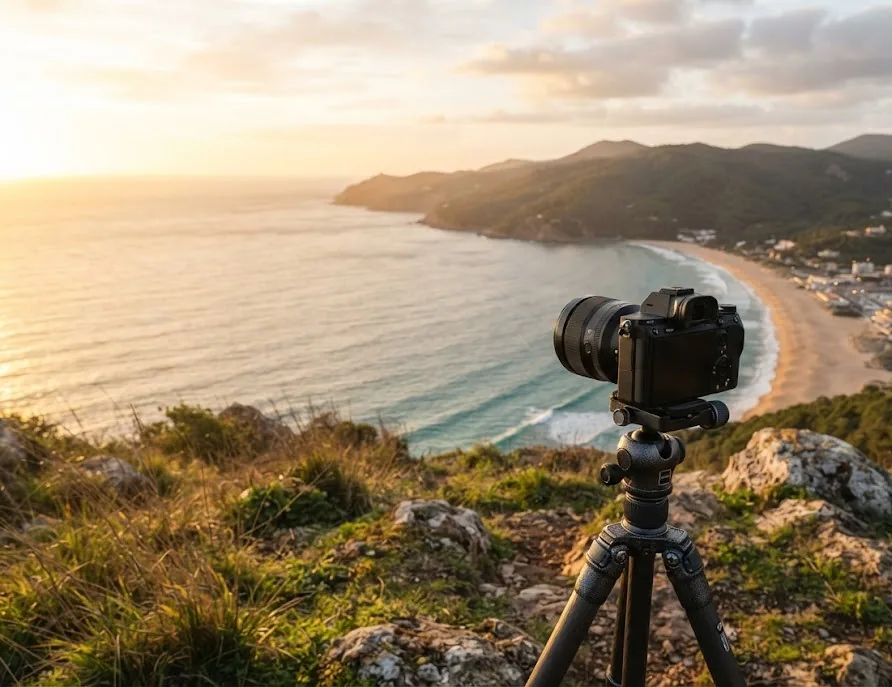
How We Selected Da Nang’s Best Photo Spots — What Makes a Location “Worthy”
We ranked each spot on four criteria: light quality, uniqueness, accessibility, and whether the shot works for Instagram or a wall print.
Timing beats equipment every time. A smartphone shot at the right golden-hour moment outperforms a full-frame camera at noon. We prioritized locations where the light transforms the scene within a 20- to 60-minute window — places where being 15 minutes late means missing the shot entirely.
We also balanced icon recognition with crowd-free composition. The same logic applies to every spot here: we tell you exactly where to stand and when to be there.
- Light quality (1-10): How predictable and dramatic is the natural light at the recommended time?
- Uniqueness (1-10): Can you find this composition anywhere else in Vietnam, or is it Da Nang-specific?
- Accessibility (1-10): How easy is it to reach the exact shooting position?
- “Instagram vs. print” value: Does the shot work best as a quick social media post or as a gallery-worthy print?
1. Dragon Bridge — The Iconic Shot That 90% of Tourists Get Wrong
The best angle isn’t from the river promenade where everyone stands — it’s the eastern approach on Bach Dang waterfront, 150 meters downstream.
Walk to the intersection of Bach Dang Street and Tran Hung Dao Street. From this position, the dragon’s head points toward you, and the bridge’s full curve stretches into the frame. The river promenade angle, by contrast, shoots the bridge from the side, flattening its iconic shape into a generic steel structure.
You get two completely different shots depending on timing. For a blue-hour structure shot, arrive at 5:30 AM on a weekday. The bridge is empty, the sky shifts from deep blue to orange, and the river reflects the dragon’s golden body. Set your camera to f/11, ISO 100, and a 30-second exposure on a tripod. For the fire-breathing weekend show at 9 PM, switch to f/2.8, ISO 1600, and 1/60 second handheld. The fire bursts last 3-4 seconds each, so timing your shutter release with each blast is the difference between capturing flames or just smoke.
2. Golden Bridge (Cầu Vàng) at Ba Na Hills — Shooting Through the Fog
Take the first cable car at 7:30 AM to get 20 minutes of crowd-free frames before the tour buses arrive.
The Golden Bridge is famous for its giant stone hands, but the real magic happens when morning fog rolls through. Between 7:30 AM and 8 AM, the fog creates a “cloud tunnel” effect — the bridge appears to float above a sea of white, with only the hands and the walkway visible. By 8:30 AM, the sun burns through and the scene turns into a standard tourist photo with hundreds of people in the background.
Lens choice changes the story. A 16-35mm wide-angle captures the full hand-to-bridge composition, showing both hands cradling the walkway. A 70-200mm telephoto compresses the perspective, making the fingers appear closer together and emphasizing the texture of the stone. For the fog shots, the telephoto lens isolates the hands against the white background, creating a surreal, otherworldly frame.
3. Marble Mountains (Ngũ Hành Sơn) — Light That Changes Every 20 Minutes
Thuy Son cave at 9 AM creates natural spotlights through limestone cracks, while Huyen Khong cave works best at midday.
Inside Thuy Son cave, sunlight enters through holes in the ceiling, creating beams that shift across the cave floor as the sun moves. At 9 AM, the light hits the central altar from a 45-degree angle, casting long shadows across the Buddha statues. By 10 AM, the beams shift to the right wall. Position yourself so the light beam falls on the main statue, and shoot at f/8, ISO 400, 1/125 second to capture the dust particles floating in the beam.
Huyen Khong cave is the opposite — midday between 11 AM and 1 PM is the only time sunlight hits the Buddha statue at the cave’s far end. The cave’s open ceiling creates a “heavenly light” effect, with a single beam illuminating the statue while the rest of the cave stays dark. Use a wide-angle lens at f/4, ISO 800, and bracket your exposures to capture both the bright beam and the dark cave walls.
After the caves, climb to the summit pagoda for an overlooked panoramic shot of Non Nuoc Beach. The path starts near the Thuy Son ticket booth and takes about 15 minutes. From the top, the beach stretches south with the Marble Mountains in the foreground — best shot between 3 PM and 4 PM when the sun lights the sand without washing out the mountains.
4. My Khe Beach — The One-Hour Window You Cannot Miss
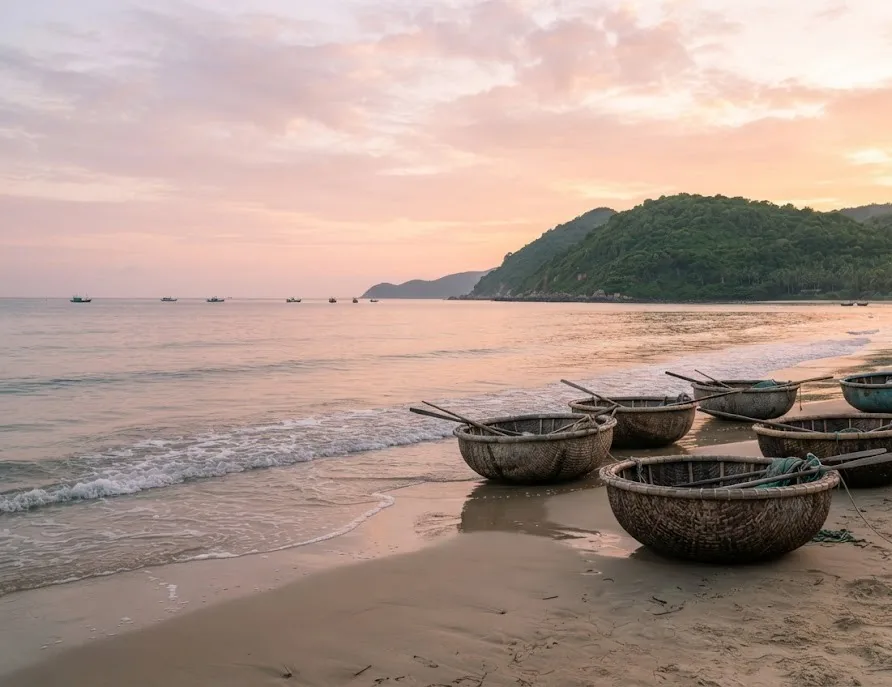
Between November and March, arrive at 5:45 AM for fishing boats, golden light, and zero footprints on the sand.
The 500-meter stretch between Vo Nguyen Giap Street’s intersection with Hoang Sa Street and the My Khe public beach access point outperforms the entire 30-kilometer coastline. Local fishermen launch their boats here at dawn, and their wooden hulls create perfect foreground elements against the rising sun. Stand at 16°03’30″N 108°14’50″E, facing east, and wait for the first light to hit the boats at 5:50 AM.
For long-exposure wave shots, attach a 10-stop ND filter and set your camera to f/16, ISO 100, with a 30-second exposure. The filter turns the breaking waves into silky white mist, while the fishing boats remain sharp. Without the filter, the waves look chaotic and the frame loses its calm, meditative quality. Shoot between 6 AM and 6:30 AM for the best balance of golden light and wave motion.
5. Son Tra Peninsula (Monkey Mountain) — Da Nang’s Secret Jungle Coast
Ban Co Peak requires a 4×4 or a jeep tour to reach, but the reward is a 270-degree view of Da Nang Bay with zero crowds.
The road to Ban Co Peak is unpaved and steep, passable only by high-clearance vehicles. Join a jeep tour from Da Nang city center (around 500,000 VND per person) or rent a dirt bike if you have off-road experience. The viewpoint sits at the top of the mountain, with the entire bay stretching from the Marble Mountains in the south to Hai Van Pass in the north. Shoot at sunrise (5:30-6:30 AM) when the morning mist sits in the valleys below the peak.
Linh Ung Pagoda’s 67-meter Goddess of Mercy statue is the perfect foreground for sunset ocean shots. Position yourself 100 meters west of the statue, using a 24-70mm lens at 50mm to frame the statue’s silhouette against the orange sky. The statue’s white stone turns pink during the last 10 minutes of daylight — shoot at f/8, ISO 200, 1/250 second to capture the color transition.
The abandoned helipad, located 500 meters north of the pagoda, is an off-radar spot for minimalist, surreal portraits. The concrete helipad extends over the cliff edge, with the ocean stretching to the horizon. Stand at the center of the helipad and shoot toward the ocean with a 50mm lens at f/2.8 — the frame creates a leading line from the concrete to infinity.
6. Han River at Blue Hour — Da Nang’s Urban Spine
The 20-minute window starting at 6:15 PM in January produces “impossible purple” skies that last only 3-4 minutes.
Da Nang’s blue hour shifts throughout the year. In January, the sun sets at 5:30 PM, and the sky enters its deepest blue phase at 6:15 PM. The purple hue appears when the last orange light mixes with the dark blue sky — this window lasts exactly 3-4 minutes. Use a weather app to track sunset times for your travel dates, then calculate blue hour as 45 minutes after sunset.
Three bridges fit in one frame from the Bach Dang Street waterfront, between the Dragon Bridge and the Han River Bridge. Stand at 16°04’25″N 108°13’20″E, facing north. The Dragon Bridge fills the left third, the Han River Bridge spans the center, and the Thuan Phuoc Bridge’s suspension cables appear in the distance. Shoot at f/11, ISO 100, with a 10-second exposure on a tripod to capture the bridge lights reflecting on the water.
For a different perspective, shoot from the Novotel rooftop bar (27th floor) or the Brilliant Hotel’s rooftop restaurant (19th floor). The elevated angle compresses the city skyline into a single layer, with the river cutting through the frame. The Novotel bar charges 150,000 VND for a drink, which buys you 45 minutes of shooting time before sunset. The Brilliant Hotel’s rooftop is free for hotel guests but requires a reservation for non-guests.
7. Hai Van Pass — The Frame That Puts Da Nang in Context
The hairpin turn at 16°11’47″N 108°07’23″E offers the classic bay-and-mountain composition that defines Da Nang’s geography.
This exact GPS coordinate sits at the second hairpin turn from the Da Nang side, where the road curves left and the entire bay opens behind you. The frame captures the winding road in the foreground, the jungle-covered mountains in the middle, and Da Nang Bay stretching to the horizon. Shoot at 5:30-7 AM when morning mist fills the valleys, creating depth between the mountain layers.
Morning mist (5:30-7 AM) beats afternoon haze (2-4 PM) for depth. The mist creates three distinct layers: the dark green foreground, the misty middle valley, and the hazy blue bay in the distance. Afternoon haze flattens these layers into a single, washed-out tone. Use a telephoto lens at 70-100mm to compress the layers, and shoot at f/8, ISO 200, 1/500 second.
The Da Nang-Hue railway route offers unique aerial-like perspectives from the train window. Book a seat on the left side of the train (facing Hue) for the best coastal views. The train passes directly above the Hai Van Pass coastline, with the tracks hugging the cliff edge. Shoot at 9 AM when the morning mist still clings to the mountains but the sun lights the ocean. Use a 50mm lens at f/5.6, ISO 400, 1/1000 second to freeze the motion.
8. Hoi An Ancient Town — 30 Minutes from Da Nang, Worth Every Frame
The Japanese Covered Bridge at 5 AM delivers empty streets, lantern reflections on the canal, and soft morning light.
Hoi An’s old quarter fills with tourists by 8 AM, but at 5 AM, the streets belong to you. The Japanese Covered Bridge sits at the intersection of Tran Phu Street and Nguyen Thi Minh Khai Street. The morning light hits the bridge’s wooden structure from the east, creating warm tones on the red-painted pillars. Stand at the north end of the bridge, facing south, and shoot at f/8, 1/125 second, ISO 200 to capture the bridge’s reflection in the canal.
For night photography, the “lantern town” look requires ISO 400 minimum and a steady hand. The lanterns along Nguyen Thai Hoc Street and Bach Dang Street produce enough light for handheld shots at f/2.8, 1/60 second, ISO 800. For sharper results, use a small tripod or rest your camera on a bridge railing. The best time for night shots is 7-8 PM, when the lanterns are lit but the streets are still manageable.
The hidden alley on Nguyen Thai Hoc Street, between numbers 89 and 93, leads to a perfect yellow-wall portrait spot. The alley opens into a small courtyard with a single yellow wall covered in bougainvillea. Shoot at 4-5 PM when the afternoon sun hits the wall from the west, creating soft, even light on the subject. Use a 50mm lens at f/2.8, ISO 200, 1/250 second for a portrait with the yellow wall as the backdrop.
9. Da Nang Museum of Cham Sculpture — Indoor Photography That Actually Works
The central courtyard at 10 AM provides natural top-light on sandstone statues, creating museum-quality shadows.
The museum’s open-air courtyard has a glass roof that filters direct sunlight into soft, diffused light. At 10 AM, the light hits the central sandstone statues from above, casting shadows that emphasize the carvings’ depth and texture. Stand 3 meters from the statue and shoot at f/5.6, ISO 400, 1/125 second to capture both the highlights and shadows.
Cham sculptures demand black-and-white conversion. The sandstone texture, the intricate carvings, and the play of light and shadow all work better in monochrome. In Lightroom, apply +20 contrast, -10 clarity, and +30 sharpening to bring out the stone’s texture. The black-and-white treatment removes the distracting yellow-brown tones of the sandstone and focuses attention on the sculpture’s form.
Gallery 3, on the museum’s second floor, has permission for flash photography. Use a single off-camera flash at 45 degrees to the statue, set to 1/8 power, to create directional light that mimics the courtyard’s natural lighting. Do not use direct flash — it flattens the carvings and can damage the artifacts over time. The museum charges 60,000 VND for admission.
10. Hidden Gems — Three Off-Radar Spots Even Locals Don’t Always Know
Phap Lam Pagoda’s moss-covered stairway, an abandoned water park, and Nam O fishing village offer zero-tourist compositions.
Phap Lam Pagoda at 574 Ong Ich Khiem Street is 200 meters from Dragon Bridge but feels like a different world. The pagoda’s main stairway is covered in moss, with the green stone contrasting against the red-painted wooden temple. Shoot at 8-9 AM when the morning light filters through the temple’s windows, creating dappled light on the stairs. Use a 24-70mm lens at 35mm, f/4, ISO 400, 1/125 second for a wide shot that captures the stairway’s full curve.
The abandoned water park at Hai Van Pass sits near the Hai Van Tunnel toll booth entrance. The concrete slides are overgrown with vegetation, creating a surreal, post-apocalyptic scene. The entrance is unmarked — look for a dirt path 200 meters north of the toll booth. Shoot at 3-4 PM when the afternoon sun creates long shadows across the slides. Use a 16-35mm wide-angle lens at f/8, ISO 200, 1/250 second to capture the full scale of the abandoned structure.
Nam O fishing village, 15 kilometers north of Da Nang city center, offers salt flats, wooden boats, and flamingo-pink skies at sunset. The village sits at the mouth of the Cu De River, where the salt flats reflect the sunset colors. Arrive at 5 PM (November-March) or 5:30 PM (April-October) to catch the last hour of light. Stand on the riverbank facing west, with the wooden boats in the foreground and the salt flats stretching to the horizon. Shoot at f/11, ISO 100, 1/60 second for a wide landscape, or f/2.8, ISO 400, 1/500 second for close-up boat details.
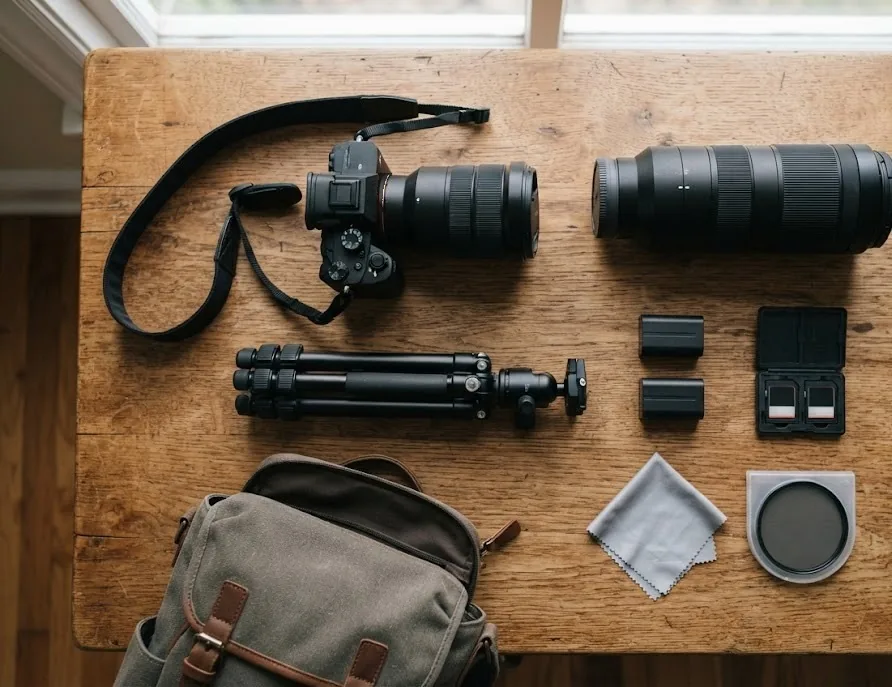
Essential Gear Checklist for Da Nang Photography
Pack a wide-angle zoom, a telephoto lens, a 10-stop ND filter, and a compact tripod to cover every location in this guide.
- Lens 1: 16-35mm f/2.8 or f/4 — Covers Dragon Bridge, Golden Bridge, Marble Mountains caves, and the abandoned water park. The wide angle captures the full scene without stepping backward into traffic or crowds.
- Lens 2: 70-200mm f/2.8 or f/4 — Essential for Hai Van Pass compressed layers, Son Tra Peninsula’s Goddess statue, and the Cham Museum’s detail shots. The telephoto isolates subjects from busy backgrounds.
- 10-stop ND filter — Required for My Khe Beach long-exposure wave shots and Han River blue-hour bridge reflections. A variable ND filter (3-10 stops) covers both scenarios in one filter.
- Compact tripod — Needed for Dragon Bridge blue-hour shots (30-second exposure), Han River night shots (10-second exposure), and Hoi An lantern shots (1-2 second exposure). A travel tripod under 1.5 kg is sufficient.
- Weather protection — Rain covers for camera and lens, plus silica gel packs for the camera bag. Da Nang’s humidity can fog lenses within minutes when moving from air-conditioned spaces to outdoor heat.
- Spare batteries — Cold mornings at Ba Na Hills (15°C at 7:30 AM) drain batteries faster than expected. Carry at least two fully charged spares for a full day of shooting.
Best Time of Year for Da Nang Photography — Seasonal Light Calendar
Da Nang’s seasonal light shifts dramatically: November to January offers the softest, most forgiving light, while May to August demands early mornings and late afternoons for usable results.
November to January: the photographer’s golden window
This is Da Nang’s “winter” — temperatures drop to 18-22°C, humidity sits at 65-70%, and the sun stays low on the horizon until 7 AM. The light is diffused by thin cloud cover, producing soft shadows and saturated colors without harsh contrast. Dragon Bridge at 5:30 AM during this period shows a warm golden glow on the steel structure, while My Khe Beach’s 5:45 AM sunrise paints the fishing boats in pastel pinks and oranges. The trade-off: occasional rain (6-8 rainy days per month) and overcast skies that can flatten landscapes. Bring a weather-sealed body and a lens cloth.
| Location | Light Quality (Nov-Jan) | Best Time | Rain Risk |
|---|---|---|---|
| Dragon Bridge | 9/10 — soft golden light | 5:30-6:15 AM | Medium |
| Golden Bridge | 7/10 — fog adds ethereal effect | 7:30-8:30 AM | High |
| Marble Mountains | 8/10 — diffused cave light | 9 AM-12 PM | Medium |
| My Khe Beach | 9/10 — pastel sunrise | 5:45-6:30 AM | Low |
| Hai Van Pass | 8/10 — misty mountain layers | 5:30-7 AM | High |
February to April: clear skies and blooming landscapes
This is Da Nang’s driest period with only 2-4 rainy days per month. Skies are crystal clear by 8 AM, making it ideal for Marble Mountains’ panoramic summit shots and Ba Na Hills’ distant views of the coastline. However, the sun rises higher faster — by 9 AM, contrast becomes harsh, especially at My Khe Beach and Son Tra Peninsula. Shoot between 5:30-8 AM for golden hour and 4-5:30 PM for warm afternoon light. The blooming bougainvillea along Bach Dang Street adds vibrant magenta foregrounds for Han River compositions.
May to August: harsh midday, spectacular sunsets
Midday light is unusable for most outdoor locations — shadows are deep, highlights blow out, and haze reduces contrast. But the sunsets from May to July are spectacular: the sun sets at 6:15-6:30 PM, creating “impossible purple” and orange skies over the Han River. My Khe Beach’s 5:30-6:30 PM window produces golden reflections on the water that last 45 minutes. Use a polarizer to cut through afternoon haze at Hai Van Pass, and shoot Dragon Bridge at 8:30 PM for the fire show against a deep blue sky.
September to October: dramatic clouds and storms
This transitional season brings unpredictable weather — clear mornings followed by sudden afternoon thunderstorms. The upside: dramatic cloud formations that add texture to landscapes, especially over Son Tra Peninsula and Hai Van Pass. Light quality varies wildly: a storm-clearing sunset can produce the most saturated colors of the year, while overcast days demand higher ISO and wider apertures. The abandoned water park at Hai Van Pass looks especially moody during this period, with storm clouds casting shifting shadows over the overgrown concrete slides. Bring rain covers and shoot between 6-8 AM for the best light before clouds build.
Common Photography Mistakes in Da Nang — And How to Avoid Them
Even experienced photographers make 4 common mistakes in Da Nang: shooting at the wrong time, ignoring light direction, not preparing for humidity, and photographing famous spots without a unique perspective.
Mistake 1: Shooting Dragon Bridge at 10 AM instead of 5:30 AM or 9 PM. Midday light creates harsh shadows on the steel structure, obscuring the dragon’s curves. The result: a flat photo lacking depth. Correction: arrive at Bach Dang waterfront at 5:15 AM for soft, angled light, or at 8:30 PM on weekends for the fire show against a deep blue sky. If you cannot arrive early, shoot from the Novotel rooftop bar at 6:15 PM for a high angle that avoids direct shadows.
Mistake 2: Photographing the Golden Bridge at midday when crowds are heaviest.Furthermore, harsh sunlight creates shadows under the stone hands, disrupting the “cradling” effect. Correction: take the first cable car at 7:30 AM for about 20 minutes of shooting with minimal people. If fog rolls in (common November-January), embrace it – fog creates a “cloud tunnel” effect, making the bridge look more ethereal.
Mistake 3: Not bringing a lens cloth and blower brush. 80% humidity and sea spray at My Khe Beach can fog up lenses within 15 minutes. Many people use shirt sleeves, but rough fabric can scratch lens coatings. Correction: carry a dedicated microfiber cloth and a small blower brush. Wipe your lens every 20-30 minutes, especially when shooting at Ba Na Hills (fog) or My Khe Beach (sea salt). Store your camera in a dry box overnight to prevent mold on the sensor.
Mistake 4: Shooting Hoi An Ancient Town between 6-8 PM when streets are busiest. The old town is packed with tourists from 5-9 PM, especially on weekends. This makes it hard to find empty spots and results in cluttered backgrounds. Correction: visit the Japanese Covered Bridge at 5 AM for empty streets, soft morning light, and lanterns still illuminated from the night before. For night shots, choose a weekday and use ISO 400-800, f/2.8, 1/60s to capture lantern light without a tripod (tripods are restricted in some crowded areas).
Related on this site
- Han River Bridge Views: Best Spots for Evening Ambiance 2026
- Best Places to Take Photos in Da Nang: Instagram Spots
- Photography Hotspots: Capture Stunning Shots of Da Nang in 2026
Frequently Asked Questions About Da Nang Photography
What time of year is best for photography in Da Nang?
February to April is the ideal season. The weather is clear, with minimal rain and pleasant temperatures (22-28°C). Morning light from 5:15 to 6:15 AM offers warm, golden hues. Avoid October to December due to frequent rain and heavy cloud cover, although dramatic clouds can sometimes enhance landscape shots.
Do I need a visa to photograph at Ba Na Hills and the Golden Bridge?
No separate visa is required. Ba Na Hills is a domestic tourist area; you only need the cable car ticket (approximately 750,000-850,000 VND per person, depending on the season). Arrive as early as possible – the first cable car departs at 7:30 AM. Arriving after 9 AM means a 30-45 minute wait and a very crowded Golden Bridge.
Can I take photos with my phone? Or do I need a professional camera?
Modern smartphones (iPhone 15 Pro, Samsung S24 Ultra, Google Pixel 8 Pro) are perfectly capable of producing beautiful photos. ProRAW or RAW modes allow for post-processing similar to dedicated cameras. The only limitation is low-light performance; for night shots like the Dragon Bridge fire show, a mirrorless camera still has an advantage. Tip: use a small tripod (like a Joby Gorillapod) for your phone and shoot in Night Mode for 3-5 second exposures.
Which locations are free to photograph?
Most locations mentioned in this guide are free or have a minimal entrance fee. Dragon Bridge, Han River, My Khe Beach, Hai Van Pass, and Nam O fishing village are free. Marble Mountains has an entrance fee of 40,000 VND (approximately $1.7 USD). Ba Na Hills is the most expensive (around $30-35 USD per person). Hoi An Ancient Town charges 120,000 VND for foreigners, but often there’s no ticket check before 7 AM or after 9 PM.
How can I avoid crowds when photographing?
Arrive before 7:30 AM for all outdoor locations. For Ba Na Hills, take the first cable car at 7:30 AM and head straight to the Golden Bridge for about 20 minutes of near-empty shooting. For Dragon Bridge, shoot at 5:30 AM on weekdays instead of weekends. To photograph Hoi An Ancient Town without crowds, visit at 5 AM for an absolute 45-minute window of empty streets.
Should I hire a local photography guide?
Yes, if you want to discover unique angles and hidden spots not covered in guides. Some local photographers offer tours (around $50-80 USD for half a day). They know the exact sunrise/sunset times, unobstructed viewpoints, and secret locations like the rock formations at My Khe Beach or specific vantage points for the Dragon Bridge. For beginners, this is an efficient way to learn techniques and get great shots quickly.
How should I edit photos to capture Da Nang’s characteristic colors?
Da Nang’s colors are a blend of the sea’s blue, the sun’s gold, and the sand’s white. In Lightroom or Capture One, slightly increase saturation for blues (hue 200-220) and oranges (hue 25-35). Reduce highlights to retain sky detail and increase shadows to reveal dark areas. Tip: use a graduated filter for the sky (exposure -0.7 to -1.0) to balance light. Avoid over-editing; Da Nang’s natural beauty is already striking.
Conclusion — Your Next Steps for a Da Nang Photography Adventure
Da Nang is not just a destination — it’s an outdoor studio waiting for you to capture it.
Every street corner, every wave, every sunbeam tells a story. You don’t need expensive gear or complex techniques — just patience, curiosity, and a willingness to wake up earlier than usual. The best photos often come from unplanned moments: a boat passing through your frame, a cloud opening up at the right time, or a local smiling at you.
Three actionable steps to get started:
- Plan your shots by season — check the weather forecast 7 days before your trip. If it’s the rainy season (October-December), prioritize indoor locations like the Cham Museum and cafes with good views. If it’s the dry season, focus on sunrise and sunset outdoors.
- Pack a minimalist yet strategic gear bag — one camera, two lenses (e.g., a 16-35mm for architecture and wide landscapes, and a 50mm or 85mm for details and portraits), a carbon fiber tripod, a 10-stop ND filter, and a polarizing filter. Avoid overpacking; you’ll get tired and miss moments while changing equipment.
- Schedule a test shoot for one day prior — visit your planned locations at the intended shooting times, but without the pressure to get the perfect shot. Observe the light direction, scout angles, and note where to stand.
Bring your lens, patience, and a spirit of adventure. The most memorable photos often come when you venture beyond the typical tourist map.
Part of our guide to things to do in Da Nang.