Vietnam is the world’s second-largest coffee producer and it grows mostly robusta — higher in caffeine, heavier, more bitter than the arabica most visitors are used to. Everything about how coffee is served here follows from that one fact.
Da Nang has more cafes per square kilometre than almost any city its size in Vietnam, and the good news is that a genuinely excellent cup costs less than a dollar. The confusing news is a menu of six or seven drinks with names that don’t translate, half of which are recent inventions from other cities. Coffee here is as much a part of what to eat in Da Nang as any dish. Here’s what each one is and what to order first.
Quick Summary: Start with cà phê sữa đá — iced coffee with condensed milk, 20,000–35,000 VND at a local cafe. Then try cà phê muối (salt coffee), which despite what many guides claim originated in Hue, not Da Nang, around 2010. Specialty and view cafes charge 45,000–70,000 VND. The densest cafe area is An Thuong, behind My Khe Beach.
Updated August 2026 · 9 min read · Local writer, Da Nang
How Vietnamese Coffee Actually Works
The Phin
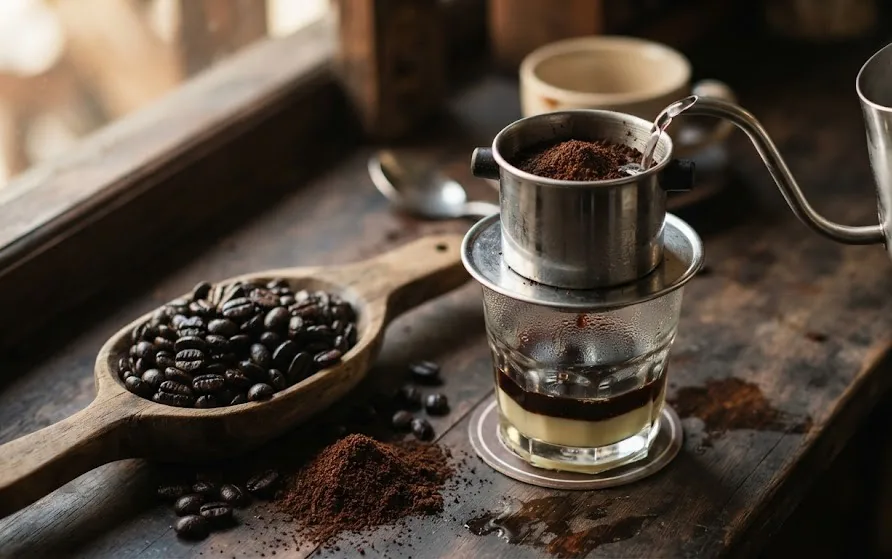
Coffee here is brewed one cup at a time in a phin — a small metal filter that sits on top of your glass. Ground coffee goes in, a weighted plate presses it down, hot water goes on top, and it drips through over four or five minutes.
You will be served the phin still dripping. That’s not impatience on the cafe’s part — it’s how it’s done. Wait until it stops.
Why Condensed Milk
Robusta brewed slowly through a phin produces something close to espresso in strength and considerably more bitter. Fresh milk was scarce and expensive in Vietnam for most of the twentieth century, so sweetened condensed milk became the standard cut — and it works, because the sugar and the fat both blunt robusta’s edge.
Cà phê sữa đá — coffee, condensed milk, ice — is the result, and it’s still what most people here drink most days.
Important note: Vietnamese coffee is significantly stronger than most Western coffee. Two cà phê sữa đá in an afternoon will keep a lot of people awake. This is not a warning people take seriously until the second night.

The Da Nang Coffee Menu, Decoded
Cà Phê Sữa Đá — Iced Milk Coffee
20,000–35,000 VND local, 45,000–70,000 VND specialty
The baseline and the one to judge a cafe by. Strong, sweet, cold, and served in a glass with a lot of ice. Order this first, before anything more interesting.
The hot version is cà phê sữa nóng. The black version is cà phê đen đá — no milk, just sugar, and considerably more aggressive.
Cà Phê Muối — Salt Coffee
25,000–45,000 VND
The one everyone asks about, and the one most guides get wrong.
It did not originate in Da Nang. Salt coffee came from a single small cafe on Nguyễn Lương Bằng street in Hue, around 2010. That shop patented the recipe and built a regional following, and by 2023 the drink had spread so far that essentially every cafe in Da Nang and Hoi An carried it. Several travel sites now credit Da Nang as the birthplace. They’re wrong, and Hue is ninety minutes north if you want the original.
What it is: strong phin coffee under a layer of lightly salted whipped cream, traditionally made with fermented condensed milk, which adds a faint yogurt tang. The salt doesn’t make it taste salty — it suppresses robusta’s bitterness and amplifies the sweetness underneath, so the result reads closer to salted caramel than to anything savoury.
Because it’s everywhere here, quality varies more in Da Nang than in Hue, where there’s a stronger local consensus on what it should taste like. No single Da Nang cafe dominates the way the original does in Hue. The practical approach: search “cà phê muối” on Google Maps and pick somewhere with a high volume of local reviews.
If you’re doing a day trip to Hue, drink it there and compare.
Cà Phê Trứng — Egg Coffee
35,000–60,000 VND
A Hanoi invention, created in 1946 at Café Giảng by a bartender named Nguyễn Văn Giang during a wartime milk shortage — whipped egg yolk with sugar and condensed milk, used as a foam substitute over black coffee.
It tastes like warm tiramisu, not like eggs. Order it hot; the cup is usually served sitting in a bowl of hot water to keep the foam stable. It’s a Hanoi drink that travelled south with northern transplants, and Da Nang now has a genuine retro-cafe scene serving it along the Han River and near My Khe.
Cà Phê Cốt Dừa — Coconut Coffee
35,000–55,000 VND
Coffee blended with coconut cream and crushed ice into something closer to a frozen dessert than a drink. Made famous by the Cộng Cà Phê chain. Sweet, cold, and the most likely of these to convert someone who doesn’t otherwise like Vietnamese coffee.
Bạc Xỉu
25,000–40,000 VND
The gentle option: more condensed milk, less coffee. Historically what was ordered for children and for people who wanted the ritual without the caffeine. Worth knowing if the standard cà phê sữa đá is too much. And if coffee isn’t for you at all, Vietnam’s other cold-drink culture is fruit-based — see Da Nang’s fruit smoothies.
Where to Drink It
For specific addresses rather than areas, see our roundup of 27 of the best cafes in Da Nang.
An Thuong — The Cafe Grid
The highest concentration of cafes in the city, a few blocks back from My Khe Beach. Air conditioning, reliable wifi, English menus, and a long-term resident crowd that has already worked out which places are good.
This is where to go if you want to sit and work for three hours. Nobody will move you along — that’s not how cafes operate here.
Hai Chau — Alley Cafes and Upper Floors
The west-bank centre hides its best cafes down alleys and on the upper floors of older buildings, often with balconies over the street. Cheaper than An Thuong and considerably more local. Google Maps is essential; several have no visible signage from the road.
The Han Riverfront
Bạch Đằng and the streets behind it have the view cafes — higher prices, worth it once at sunset or on a Dragon Bridge show night. See our guide to things to do in Da Nang for how to time that.
The Chains
Highlands Coffee, Cộng Cà Phê, Trung Nguyên and The Coffee House are everywhere and are reliable rather than interesting. Cộng is worth one visit for the coconut coffee and the deliberately retro socialist-era styling.
Insight: The price difference between a 25,000 VND neighbourhood cà phê sữa đá and a 65,000 VND specialty version is mostly air conditioning, wifi and a chair you can sit in for three hours. The coffee itself is often the same beans. Pay for the room when you need the room.
How to Order: Four Steps
Step 1 — Say the drink name, not a description. “Cà phê sữa đá” gets you exactly what you want. “Iced coffee with milk” produces uncertainty in half the city’s cafes.
Step 2 — Specify hot or cold. Nóng is hot, đá is iced. The word goes at the end: cà phê sữa nóng, cà phê sữa đá.
Step 3 — Wait for the phin to finish. If it arrives still dripping, leave it. Stirring early gives you weak coffee and a mess.
Step 4 — Stir the layers together before drinking. Condensed milk sits at the bottom; salt coffee’s cream sits on top. Both are built to be mixed, not drunk in layers.
Common mistake: Drinking salt coffee without stirring, to taste the layers. You get bitter coffee and then a mouthful of cream. Stir it — the whole point is what happens when salt, sugar and robusta combine.
Buying Coffee to Take Home
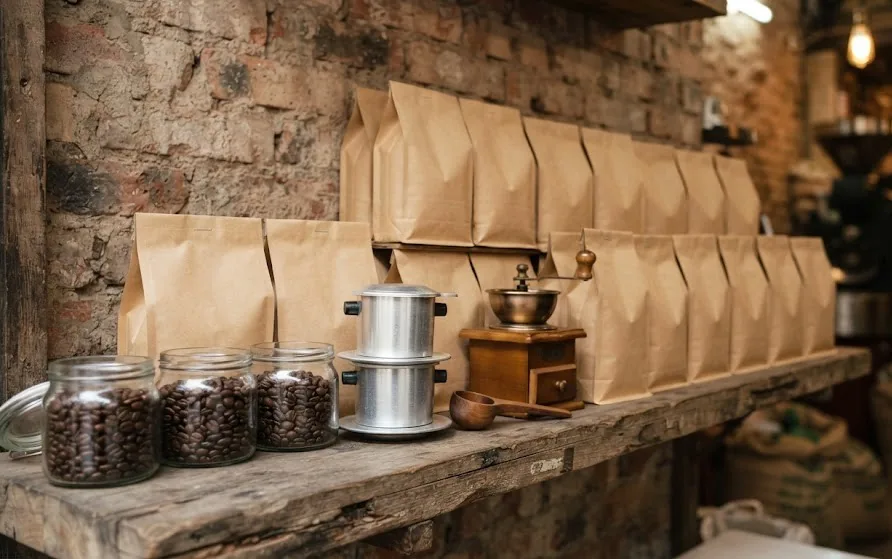
Han Market is the best place for beans and ground coffee — whole bean runs from around 80,000 VND per 500g. If you’d rather see where it grows, the hills west of the city have working farms that take visitors — see our guide to the coffee farms around Da Nang. Vendors will brew you a sample, and you should take it: quality varies a lot and robusta that’s been sitting in a warm market for months tastes like it.
A phin filter costs almost nothing and is the only way to reproduce the drink properly at home. Buy one of the heavier stainless steel ones rather than the thin aluminium version.
Bring back condensed milk too, or the coffee won’t taste like it did here.
What Coffee Costs in Da Nang
| Drink | Local cafe | Specialty / view cafe |
|---|---|---|
| Cà phê sữa đá | 20,000–35,000 VND | 45,000–70,000 VND |
| Cà phê muối | 25,000–45,000 VND | 50,000–75,000 VND |
| Cà phê trứng | 35,000–60,000 VND | 60,000–80,000 VND |
| Cà phê cốt dừa | 35,000–55,000 VND | 55,000–75,000 VND |
| Whole beans, 500g | from 80,000 VND at Han Market | — |
Frequently Asked Questions
Did salt coffee originate in Da Nang?
No. Cà phê muối came from a small cafe on Nguyễn Lương Bằng street in Hue, around 2010. It spread across central Vietnam so quickly that by 2023 nearly every cafe in Da Nang and Hoi An served it, which is why several travel guides now credit Da Nang. Hue is about ninety minutes north, and the original shop is still there.
What should I order first in a Da Nang cafe?
Cà phê sữa đá — iced coffee with condensed milk. It’s the standard by which everything else is judged, it costs 20,000–35,000 VND, and it tells you whether the cafe is any good before you try the more elaborate drinks.
Why is Vietnamese coffee so strong?
Vietnam grows mostly robusta rather than arabica. Robusta contains roughly twice the caffeine and has a heavier, more bitter profile. Brewed slowly through a phin filter into a small glass, it produces something closer to espresso in concentration — which is exactly why condensed milk became the standard accompaniment.
How much does coffee cost in Da Nang?
20,000–35,000 VND for a standard iced milk coffee at a neighbourhood cafe, or 45,000–70,000 VND at a specialty or view cafe. Salt coffee runs 25,000–45,000 VND. Even at the high end it’s inexpensive by Western standards, and the cheaper cafes are frequently just as good.
What is the best cafe area in Da Nang?
An Thuong, the grid a few blocks behind My Khe Beach, has the highest density and the most reliable wifi and air conditioning. For something more local and cheaper, Hai Chau’s alley cafes and upper-floor balcony spots are better — you’ll need Google Maps to find them, since several have no signage.
Can I get good coffee without condensed milk?
Yes. Ask for cà phê đen (black coffee, with sugar) or cà phê đen không đường (no sugar). Da Nang also has a growing specialty scene doing lighter arabica and pour-overs for people who want something closer to third-wave coffee — you’ll find most of them in An Thuong.
The Verdict
Coffee in Da Nang is one of the few things here that’s genuinely cheaper and better than almost anywhere else you’ll drink it, and the barrier to entry is a five-word menu vocabulary. Learn sữa, đá, nóng, muối and đen and you can order anything in the city.
Start with a cà phê sữa đá at a neighbourhood place in Hai Chau for 25,000 VND. Then try salt coffee — and if you’re taking the train up to Hue, order it again there and see whether the original is worth the fuss. Most people find it is.