Da Nang is often celebrated for its sandy beaches and the famous Dragon Bridge, but a deeper layer of history lies just beyond the city limits. Exploring Da Nang’s ancient towers offers an invitation to step back over a thousand years. These red-brick sanctuaries, from the UNESCO-listed My Son Sanctuary to lesser-known sites like Chien Dan Cham Tower, are the remnants of the mighty Champa Kingdom.
For the culturally curious traveler, this guide offers a detailed roadmap to understanding the architecture, spirituality, and legacy of the Cham people, providing context that standard travel guides often miss.
The Champa Kingdom existed for over 1,600 years (192–1832 AD), building dozens of brick temple-towers across central Vietnam. My Son Sanctuary, a UNESCO World Heritage site with 71 remaining structures, is the most famous. However, other sites like Po Klong Garai and Đồng Dương offer unique architectural styles and fewer crowds. New conservation pathways at My Son and enhanced museum exhibits in Da Nang make this an opportune time to explore this pre-colonial heritage. This article covers the historical timeline, architectural styles, and practical tips for visiting these sacred sites.
The Champa Kingdom: A 1,600-Year Legacy Behind Da Nang’s Ancient Towers
Understanding the Champa Kingdom is essential to appreciating the ancient towers around Da Nang; it was a sophisticated civilization that thrived for over 16 centuries.
From Lin Yi to the fall of Vijaya: key milestones in Champa history
The history of the Champa Kingdom begins around 192 AD with the formation of Lin Yi, a state that emerged from the Han dynasty’s southern territories. The kingdom reached its political and cultural zenith between the 4th and 10th centuries, with its power centered in the region around present-day Da Nang and Quang Nam (now part of Da Nang). A critical turning point was the fall of Vijaya, the Cham capital, to the Vietnamese Đại Việt kingdom in 1471.
This event fragmented Champa, leading to the gradual annexation of its remaining territories, which concluded with the final Cham principality being absorbed in 1832 under the Nguyễn dynasty.
Why Da Nang became the spiritual and political heartland of the Cham civilization
Da Nang’s location was strategic. The area around the Thu Bồn River valley, including sites like Trà Kiệu (the first capital, Simhapura) and Mỹ Sơn, was the cradle of Cham power. The region’s proximity to the sea facilitated trade with India, China, and Southeast Asia, which heavily influenced Cham art and religion. The fertile river valley supported a large population, and the surrounding mountains were considered sacred, making it an ideal location for building temple complexes dedicated to Hindu deities, primarily Shiva.
New archaeological discoveries and conservation efforts
Interest in Cham heritage is experiencing a revival. New archaeological projects are underway at Trà Kiệu, unearthing artifacts that provide fresh insights into daily Cham life. Conservation at My Son Sanctuary has introduced new pathways that protect the fragile foundations while allowing visitors closer access. The Da Nang Museum of Cham Sculpture, which houses the world’s largest collection of Cham artifacts, has also updated its exhibits with digital displays that contextualize the artifacts within the broader Champa timeline, making the history more accessible than ever. According to a 2023 report by the Vietnam Institute of Archaeology, ongoing excavations at Trà Kiệu have revealed over 500 new artifacts, including pottery shards and bronze tools, dating back to the 4th century.
My Son Sanctuary: The Crown Jewel of Cham Temple Architecture
My Son Sanctuary is the most important complex of Cham temples, representing the spiritual and architectural peak of the Champa Kingdom.
Decoding the brick-bonding mystery: how Cham builders joined bricks without visible mortar
One of the most enduring mysteries of Cham architecture is the brick-bonding technique used at My Son. Unlike Khmer or Javanese builders who used plant-based mortar, Cham stonemasons developed a method using a unique adhesive, likely a resin from the Dipterocarpus alatus tree. The bricks were fired at low temperatures, then polished and fitted together with such precision that a knife blade cannot be inserted between them. This technique, combined with the use of vegetable glue, created structures that have withstood centuries of tropical weather and warfare, a feat that modern engineers still study.
The Shiva worship complex: linga-yoni altars and sacred water channels
At the heart of My Son’s religious function was the worship of Shiva, represented by the linga (a phallic symbol) placed within a yoni (a vulva-shaped base), symbolizing creation and cosmic energy. The main temple in each group was dedicated to a linga, which was often housed in a dark, windowless central chamber (garbhagriha). Sacred water channels were carved into the stone to drain offerings, particularly water and milk, which were poured over the linga during rituals.
The layout of the temple complex, with its concentric walls and gateways, was designed to guide worshippers from the profane world into the sacred space of the deity.
Navigating My Son: new visitor pathways, restricted zones, and conservation areas
Visiting My Son requires some planning. The site is divided into several clusters (Group A, B, C, D, E, F, G, H), with Group A and B being the most accessible. New wooden walkways have been installed to protect the ancient foundations, and some towers in Group E and F are now behind restricted zones for conservation. The entry fee is around 150,000 VND (~$6 USD). To avoid the midday heat and the largest crowds, plan to arrive when the site opens at 7:00 AM. Electric cars shuttle visitors from the parking lot to the main temple area, a 2-kilometer ride.
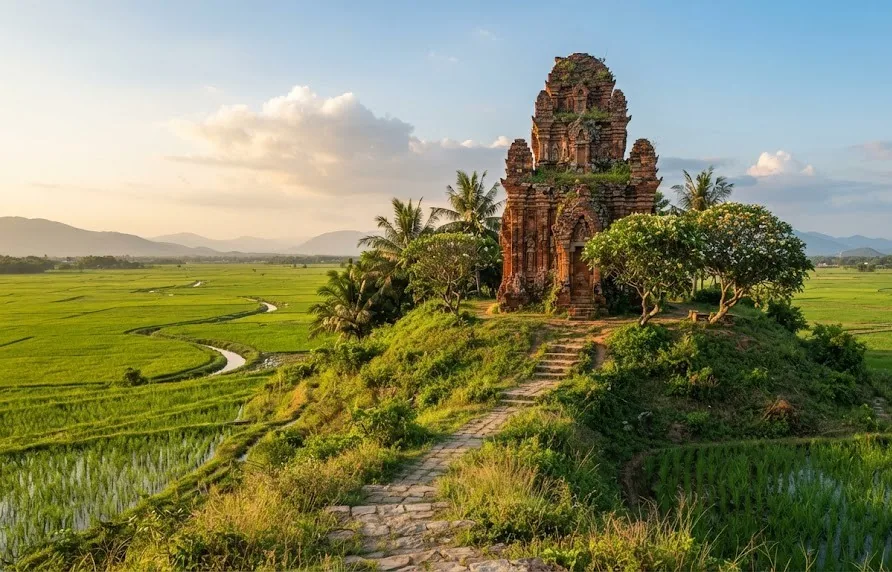
Beyond My Son: Lesser-Known Cham Towers Within a Day Trip from Da Nang
While My Son is the most famous, several other Cham towers offer unique experiences and are accessible as day trips from Da Nang.
Đồng Dương Buddhist Monastery: the only Mahayana Buddhist complex built by a Hindu kingdom
Approximately 60 kilometers south of Da Nang lies Đồng Dương, a unique site built in the 9th century under King Indravarman II. This is the only known Mahayana Buddhist monastery constructed by a Hindu-influenced Cham kingdom. The architecture here is distinct, featuring a large, rectangular monastery complex rather than the typical tower-style temples. The sculptures from Đồng Dương, now housed in the Da Nang Museum, are famous for their fierce, meditative expressions, which differ from the more serene styles of other Cham sites. Today, the site is mostly in ruins, offering a raw, archaeological experience.
Po Nagar Cham Towers (Nha Trang): the enduring goddess worship tradition
Located about 500 kilometers south of Da Nang (a 9-hour drive or a short flight), the Po Nagar Cham Towers in Nha Trang are a testament to the enduring local worship of the goddess Yan Po Nagar (identified with the Hindu goddess Bhagavati). The site consists of four main towers built between the 7th and 13th centuries. Unlike My Son, Po Nagar is still an active place of worship for the local Cham community and Vietnamese Buddhists. The main tower, 23 meters high, is a masterpiece of Cham architecture and is open to visitors.
The site also offers stunning views of the Cai River and the city below.
Po Klong Garai (Phan Rang): the best-preserved Cham tower with intact sculpture
Roughly 600 kilometers south of Da Nang, the Po Klong Garai temple complex in Phan Rang is often considered the best-preserved Cham tower in Vietnam. Built in the late 13th to early 14th century, the three-tower complex is remarkably intact, with much of its original sandstone sculpture still in place. The main tower (kalan) features a stunning relief of the god Shiva dancing on a pedestal, and the intricate carvings on the doorways and false doors are exceptionally detailed.
The site is smaller than My Son, but its state of preservation allows for an intimate and close-up study of Cham stone carving.
| Site | Distance from Da Nang | Preservation Level | Unique Feature |
|---|---|---|---|
| My Son Sanctuary | ~70 km (1.5 hr drive) | High (UNESCO managed) | Largest complex, unique brick-bonding technique |
| Đồng Dương | ~60 km (1.5 hr drive) | Low (mostly ruins) | Only Mahayana Buddhist Cham monastery |
| Po Nagar Cham Towers | ~500 km (flight or long drive) | High (active worship site) | Enduring goddess worship tradition |
| Po Klong Garai | ~600 km (flight or long drive) | Very High (best preserved) | Intact original sandstone sculptures |
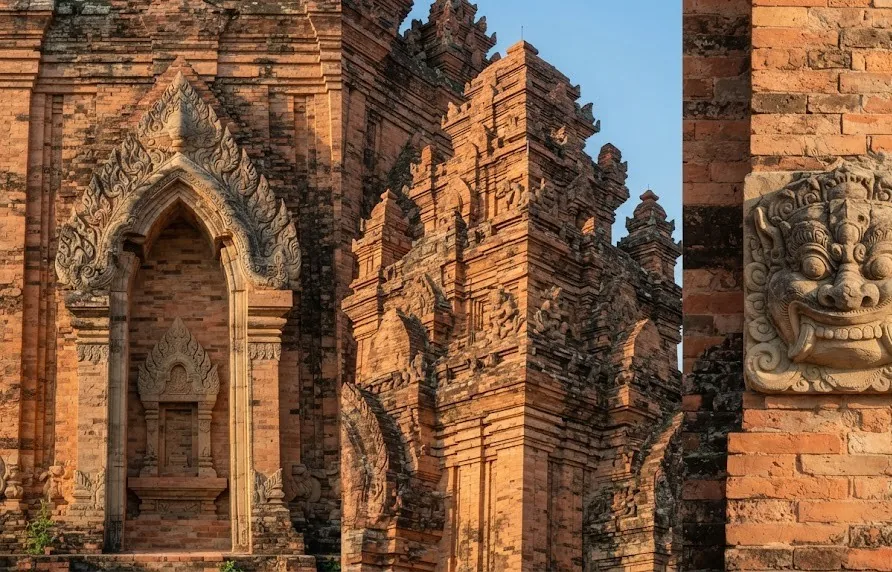
Decoding Cham Architecture: Three Distinct Styles Every Visitor Should Recognize
Recognizing the three main styles of Cham architecture transforms a visit to the towers into a journey through history.
Early style (4th-7th century): simple brick shrines and the My Son E1 foundation
The earliest Cham architecture is characterized by its simplicity and small scale. The primary example is the My Son E1 foundation, which is believed to date from the 4th century. These early structures were simple, single-cell brick shrines with a flat roof, lacking the elaborate carvings and soaring towers of later periods. The brickwork was less refined, and the decorative motifs were limited to basic geometric patterns. This period reflects the formative stage of Cham culture, heavily influenced by Indian Gupta-style architecture but adapted to local materials and techniques.
Classical style (8th-11th century): soaring towers, false doors, and sandstone reliefs
The classical period, from the 8th to 11th century, represents the golden age of Cham architecture. This is when the iconic “temple-mountain” form emerged, with towers (kalan) rising in a tiered, pyramidal shape. The My Son A1 tower, though heavily damaged, is the classic example. Key features include false doors carved from sandstone, which were meant to be the portals for the gods, and elaborate reliefs depicting scenes from Hindu mythology, including the gods Shiva, Vishnu, and Brahma.
The use of sandstone for door frames, lintels, and decorative panels became standard, contrasting sharply with the red brick of the main structure.
Late style (12th-15th century): Khmer influences and the decline of monumental construction
The late style, from the 12th to 15th century, shows a clear influence from the Khmer Empire of Angkor. Towers became more slender and less ornate, with a focus on verticality. The Po Klong Garai complex is the finest surviving example of this period. The decorative motifs shifted, with the inclusion of more narrative scenes and a reduction in the number of mythical creatures like the makara (a sea monster) and kala (a time demon).
This period also saw a decline in the scale of construction, reflecting the shrinking territory and resources of the Champa kingdom as it faced increasing pressure from the Đại Việt.
Planning Your Champa Heritage Tour from Da Nang: Logistics and Tips
A well-planned itinerary ensures you can comfortably visit the key Cham sites without rushing or exhausting yourself in the tropical heat.
Best time to visit: avoiding heat, rain, and peak tourist crowds
The best time to explore the ancient towers is during the dry season, from February to August. The weather is most pleasant from February to May, with lower humidity and temperatures averaging 25-30°C (77-86°F). June to August is hotter but still dry. Avoid September to January, which is the rainy season. For My Son, a morning departure (7:00-8:00 AM) is ideal to beat the heat and the crowds. Weekdays are generally less busy than weekends and public holidays.
Getting there: private car vs. guided tour vs. self-drive motorcycle
You have three main options for getting to My Son and other nearby towers. A private car with a driver is the most comfortable and flexible option, costing around $50-70 for a half-day trip. A guided tour, often bookable through hotels, is convenient and includes historical context, but is less flexible. For the adventurous, a self-drive motorcycle is a popular choice, but requires a valid international driving permit and a good sense of direction.
For sites further away like Po Nagar or Po Klong Garai, a flight to Nha Trang or Phan Rang is the most practical option.
What to pack: sun protection, respectful attire for temple sites, and photography restrictions
Packing correctly is crucial for a comfortable visit. Here is a checklist of essential items:
- Sun protection: High-SPF sunscreen, a wide-brimmed hat, and sunglasses are non-negotiable.
- Respectful attire: Cover your shoulders and knees. This is a requirement at all temple sites, even ruins.
- Footwear: Closed-toe shoes are recommended for climbing uneven stone steps and pathways.
- Hydration: Carry at least 2 liters of water per person for a half-day visit.
- Photography gear: A camera with a good zoom lens is ideal. Flash is strictly prohibited near linga-yoni altars and some ancient sculptures to prevent damage.
- Insect repellent: Essential for the jungle areas around the towers.
Connecting Champa Heritage with Modern Da Nang: Museums and Cultural Experiences
To fully appreciate the towers, a visit to Da Nang’s museums and cultural venues is essential for understanding the artifacts and traditions that have survived.
Da Nang Museum of Cham Sculpture: the world’s largest collection of Cham artifacts
Located at 02 2 Thang 9 Street, the Da Nang Museum of Cham Sculpture is a must-visit before or after your trip to the towers. It houses the world’s largest collection of Cham artifacts, with over 2,000 pieces, including sculptures, altars, and architectural fragments from all the major Cham sites. The museum is organized chronologically and by site, allowing you to see the evolution of Cham art. The museum features digital tablets that provide detailed information about each artifact, including its original location and historical context. The entrance fee is 60,000 VND (~$2.50 USD).
Cham dance performances: where to watch traditional Apsara and goddess dances
Traditional Cham dance, with its graceful hand movements and elaborate costumes, is a living link to the temple culture. You can watch performances at several venues. The My Son Sanctuary itself often hosts performances as part of a combined ticket. The Furama Resort in Da Nang also offers cultural evenings that include Cham dances. For a more authentic experience, check the schedule of the Cham Museum, which occasionally hosts performances during special exhibitions. The dances are typically dedicated to the goddesses and gods of the Cham pantheon, telling stories from the Ramayana and local legends.
Trà Kiệu excavation site: visiting the first Cham capital and its ongoing archaeological work
Just 45 kilometers south of Da Nang, the Trà Kiệu excavation site is the location of Simhapura, the first capital of the Champa Kingdom. While there are no standing towers, the site is of immense archaeological importance. Ongoing excavations have uncovered new foundations, pottery, and sculptures. Visitors can walk the site and see the outlines of ancient buildings. The nearby Trà Kiệu village is also known for its traditional silk weaving, a craft that has been practiced in the area since the Cham era, making for a rich cultural day trip.

Key Considerations for a Respectful and Safe Visit to Cham Temple Sites
Observing proper etiquette and safety precautions ensures both your safety and the preservation of these sacred sites for future generations.
- Dress code: Always cover your shoulders and knees. This is a sign of respect, particularly at sites like Po Nagar where worship is still active.
- Photography: Do not use flash near linga-yoni altars or sculptures with visible paint or gilding. Flash accelerates the deterioration of these ancient materials.
- Behavior: Do not climb on the towers or touch the carvings. Stay on the designated pathways.
- Health: The tropical sun is intense. Take breaks in the shade, and follow the hydration strategy of 2 liters of water for a half-day visit.
- Safety: The terrain around the towers can be uneven, with loose stones and steep steps. Wear closed-toe shoes with good grip. Be aware of wildlife, including snakes and insects, in the jungle areas.
Related on this site
- Da Nang’s Must-Visit Pagodas: Spiritual Sites with Stunning Architecture 2026
- Non Nuoc Stone Carving Village: Traditional Crafts Near Da Nang 2026
Frequently Asked Questions
How long does it take to visit My Son Sanctuary from Da Nang?
A typical half-day tour from Da Nang to My Son takes about 4 to 5 hours, including a 1.5-hour drive each way and 2 hours to explore the site.
Are the Cham towers in Da Nang free to visit?
No, most Cham tower sites require an entrance fee. My Son Sanctuary costs around 150,000 VND, while the Da Nang Museum of Cham Sculpture costs 60,000 VND. Fees are subject to change.
What is the best way to get to Po Klong Garai from Da Nang?
The most efficient way is to fly from Da Nang to Cam Ranh International Airport (near Nha Trang) and then take a bus or private car for the remaining 2-hour drive to Phan Rang.
Can I visit the Cham towers during the rainy season?
Yes, but be prepared for heavy downpours and muddy paths. The towers can be slippery, and some pathways may be closed for safety. The dry season (February to August) is far more comfortable.
Is it safe to travel to the Cham towers alone?
Yes, it is generally safe. The sites are well-touristed, and the main roads are in good condition. However, for sites like Đồng Dương, which are more remote, it is advisable to hire a guide or go with a group.
What is the significance of the linga and yoni in Cham temples?
The linga and yoni are a sacred symbol representing the union of the male and female principles of the universe, specifically the god Shiva and his consort Shakti. They are the central objects of worship in most Cham Hindu temples.
Are there any active Cham communities in Da Nang today?
While the Cham population is now concentrated in Ninh Thuan and Binh Thuan provinces, you can find Cham cultural events and artisan products in Da Nang. The Cham Museum and special exhibitions are the best places to connect with this living heritage.
Conclusion: Your Next Steps
The ancient towers around Da Nang are more than just old ruins; they are the enduring legacy of a sophisticated civilization that shaped the cultural landscape of central Vietnam. By understanding the history, architecture, and spiritual significance of these sites, your visit becomes a meaningful journey rather than a simple checklist of tourist stops.
- Plan your itinerary: Decide which towers you want to see based on the time you have. A 3-day trip can cover My Son, the Cham Museum, and a day exploring Trà Kiệu and Đồng Dương.
- Book your transport: Reserve a private car or join a guided tour in advance, especially during peak season (February to August).
- Prepare for the conditions: Pack sun protection, respectful clothing, and plenty of water. Your comfort and respect will ensure a rewarding experience.
Part of our guide to places to visit in Da Nang.