Da Nang’s museum scene offers far more than a rainy-day backup plan. From ancient Cham sculptures carved over a thousand years ago to interactive 3D art rooms and a private collector’s trove of Central Vietnam’s heritage, the city’s cultural institutions tell the story of a region that has been a crossroads of civilization for centuries. This guide covers eight must-visit museums, with practical tips on routes, costs, and how to see 3-4 in a single day without feeling rushed.
Da Nang’s museums span 1,000+ years of history, from the world’s largest Cham sculpture collection (60,000 VND entry) to a free maritime sovereignty exhibition. The city’s eight key museums cover ancient Champa art, modern Vietnamese paintings, war history, and hands-on optical illusions. Most are within a 15-minute walk of each other in the city center, making a multi-museum day trip practical. The Da Nang Museum now features 3D mapping technology, while the Fine Arts Museum offers a quieter, more contemplative experience in a French colonial building.
How to Choose Your Museum Route in Da Nang: Matching Museums to Your Interests
Your ideal museum route depends entirely on what you want to learn or experience. Da Nang’s museums are clustered in the city center, so you can easily visit 2-3 in a single morning or afternoon without wasting time on transport. The key is picking the right combination for your travel style.
It is worth checking Da Nang’s official tourism board for current opening hours and seasonal events before you visit.
For history buffs: Cham Sculpture Museum + Da Nang Museum + Hoang Sa Exhibition House
This route covers ancient Champa civilization (2nd-15th centuries), the city’s modern development from a fishing village to a major port, and Vietnam’s maritime history in the South China Sea. Start at the Cham Museum at 7:00 AM when it opens — the light is best for photographing the stone carvings. Walk 10 minutes north to the Da Nang Museum (31 Tran Phu Street) for the chronological journey. The Hoang Sa Exhibition House is another 5-minute walk north and is free, so you can finish the trio in about 3-4 hours total.
For art lovers: Da Nang Fine Arts Museum + 3D Art in Paradise + Dong Dinh Museum
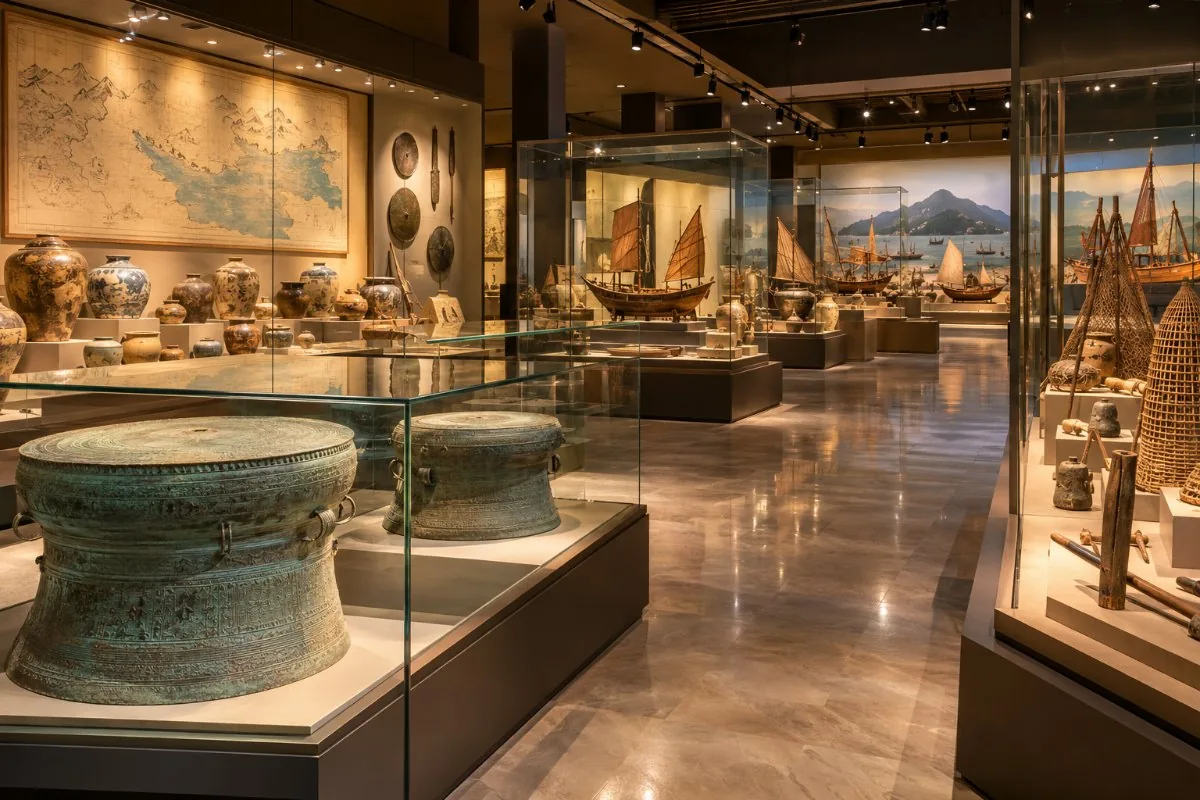
Art enthusiasts get three distinct flavors: contemporary Vietnamese paintings in a colonial building, playful optical illusions perfect for Instagram, and a private collection of folk art and antiques that public museums rarely display. The Fine Arts Museum at 78 Le Duan Street requires about 60-90 minutes. 3D Art in Paradise is a 15-minute taxi ride away and works well for a lighter afternoon activity. Dong Dinh Museum is the wildcard — a hidden gem that rewards patient browsers with unexpected finds like Dong Son bronze drums and Cham pottery.
For families with kids: Da Nang Museum + 3D Art in Paradise + Non Nuoc Memory Museum
The Da Nang Museum’s new 3D mapping displays and interactive screens engage children more effectively than static exhibits. 3D Art in Paradise is the clear winner for kids — they can pose as part of the paintings and the photos become souvenirs. The Non Nuoc Stone Carving Memory Museum sits at the foot of Marble Mountains, so you can combine a morning at the mountain with an afternoon craft visit. The stone carvers often demonstrate their techniques, which fascinates children who have never seen hand-carving in action.
1. Da Nang Museum of Cham Sculpture — The Crown Jewel of Ancient Champa Art
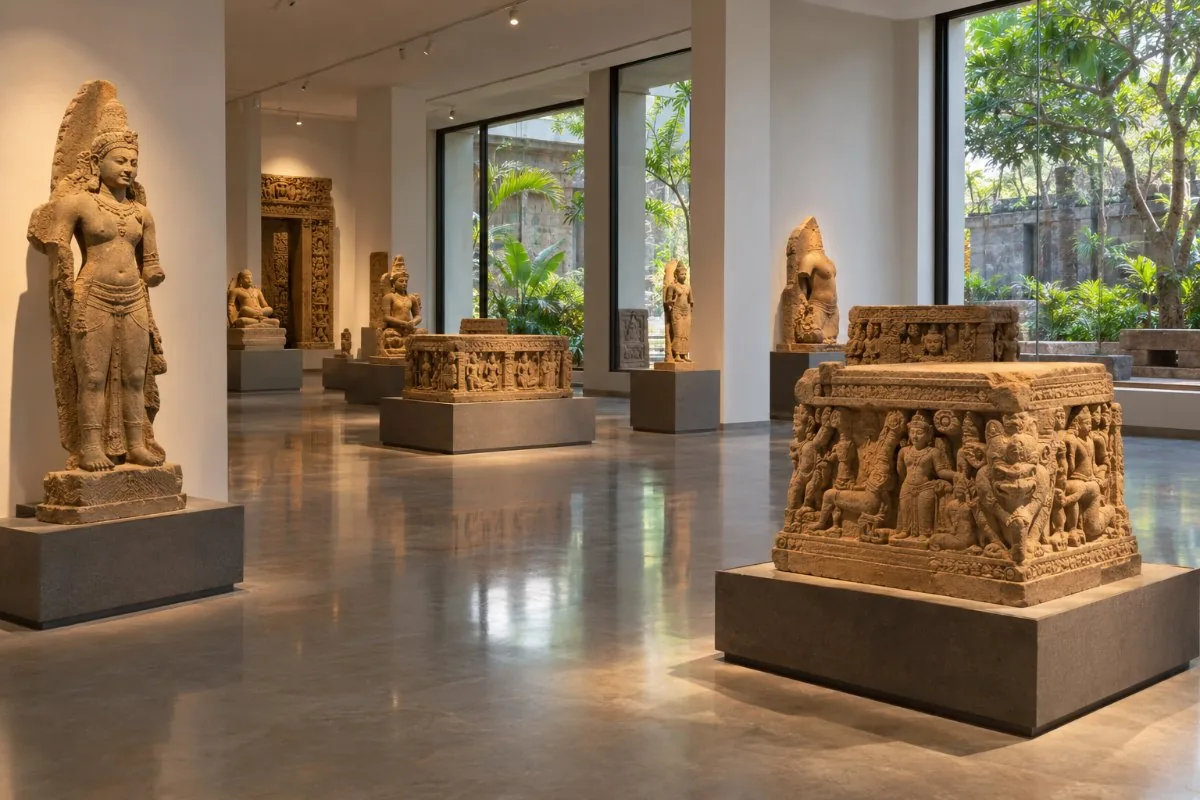
This museum houses the world’s largest collection of Cham artifacts, with over 300 stone and bronze pieces dating from the 4th to the 14th centuries. Located at 02 2 Thang 9 Street in Hai Chau district, the building itself is a blend of French colonial architecture and Cham design elements. The museum opened in 1919 under the French School of the Far East (EFEO) and has since become the definitive repository for Cham sculpture rescued from temples across Central Vietnam, particularly from the My Son Sanctuary and Tra Kieu sites.
Why this museum holds the world’s largest Cham artifact collection
The Cham civilization flourished along Vietnam’s central coast from roughly the 2nd century AD, creating a distinct Hindu-influenced art style. When French archaeologists began excavating sites like My Son and Tra Kieu in the late 19th century, they recognized the need for a dedicated museum. The collection grew through decades of excavation and preservation efforts. Today, the museum’s ten galleries display artifacts organized by their excavation sites, allowing visitors to trace the evolution of Cham art from early simple forms to the elaborate, highly decorative carvings of the 10th-13th centuries.
Must-see national treasures: Tra Kieu Altar, My Son E1 Altar, Tara Bodhisattva statue
Three pieces demand your attention. The Tra Kieu Altar (7th-8th century) is a massive sandstone relief depicting scenes from the Ramayana — it’s considered the masterpiece of Cham sculpture for its narrative complexity and fine detail. The My Son E1 Altar (10th century) shows the peak of Cham stone carving with its intricate lotus motifs and dancing Apsara figures. The Tara Bodhisattva statue (9th century) is one of the few bronze Cham statues to survive, showing clear Mahayana Buddhist influence.
Don’t miss the Garuda mythical bird carvings and the Shiva statues that dominate several galleries — the linga (phallic symbol) collection illustrates the Hindu cosmology that shaped Cham religious art.
Practical info: address, entrance fee (60,000 VND), hours (7:00-17:00 daily)
The museum is at 02 2 Thang 9, Hai Chau, Da Nang. Opening hours are 7:00 AM to 5:00 PM daily, including weekends and most public holidays. Entrance costs 60,000 VND (about $2.50 USD) for adults. Children under 6 enter free. Audio guides are available in English, French, and Vietnamese for an additional 30,000 VND. Photography without flash is permitted in most galleries. The museum is wheelchair accessible on the ground floor. Allow 60-90 minutes for a thorough visit, longer if you want to read every exhibit panel.
2. Da Nang Museum — A Chronological Journey from Prehistory to Modern City
The Da Nang Museum at 31 Tran Phu Street offers the most comprehensive overview of the city’s evolution, from prehistoric settlements to its current status as a major economic hub. With over 2,500 artifacts spread across three floors, this museum fills the gap between the ancient Cham period covered by the Cham Museum and the modern era. The building underwent a major renovation in 2026-2023, adding digital displays that make the museum more engaging for younger visitors.
Floor-by-floor breakdown: natural resources → war history → ethnic minority culture
The ground floor covers Da Nang’s natural geography and early history — displays of minerals from the Truong Son mountain range, fishing tools from coastal communities, and artifacts from the Sa Huynh culture (500 BC-100 AD) that predated the Cham. The first floor focuses on the French colonial period (1858-1954) and the Vietnam War (1954-1975), with photographs, weapons, and personal items from soldiers and civilians. The second floor showcases the cultures of Central Vietnam’s ethnic minorities — the Co Tu, Gie Trieng, and Bru Van Kieu groups — with traditional costumes, musical instruments, and ritual objects.
This floor also has a gallery dedicated to Da Nang’s post-1975 economic development, including the city’s transformation into a major seaport and tourist destination.
New 2025-2026 feature: 3D mapping technology and interactive digital displays
The museum introduced 3D projection mapping in late 2025 on the first floor, creating a 10-minute visual journey through Da Nang’s history projected onto a large curved wall. The interactive touchscreens allow visitors to explore artifacts in 360-degree rotation and zoom in on details. A digital timeline wall lets you scroll through key dates in the city’s history, with photos and short video clips. These additions make the museum more accessible for visitors who prefer visual learning over reading text panels. The free audio guides (available in Vietnamese, English, and French) sync with the digital displays at key points.
Practical info: 31 Tran Phu Street, 50,000 VND, closed Mondays, free audio guides
Address: 31 Tran Phu Street, Hai Chau. Opening hours: 7:30 AM to 5:00 PM, Tuesday through Sunday. Closed on Mondays and certain public holidays. Entrance fee: 50,000 VND (about $2 USD). Audio guides are free with admission — just leave your ID or a small deposit. The museum is wheelchair accessible via a ramp at the side entrance. Photography without flash is allowed. Allow 90-120 minutes for a complete visit, especially if you use the audio guide.
The museum’s central location makes it easy to combine with the Cham Museum (10-minute walk) or the Hoang Sa Exhibition House (5-minute walk).
3. Da Nang Fine Arts Museum — Contemporary Vietnamese Art in a Colonial Building
The Da Nang Fine Arts Museum at 78 Le Duan Street offers a quiet, contemplative experience focused on modern and contemporary Vietnamese art, housed in a beautifully preserved French colonial villa. Unlike the ancient artifacts at the Cham Museum, this collection spans the 20th and 21st centuries, with a strong emphasis on artists from Central Vietnam. The building itself — a two-story colonial structure with high ceilings, wooden shutters, and a shaded courtyard — adds to the experience.
The collection focus: Central Vietnam life through modern and contemporary lenses
The permanent collection features over 500 works, including oil paintings, lacquer paintings, silk paintings, sculptures, and folk art. The dominant theme is everyday life in Central Vietnam — farmers in rice paddies, fishermen at dawn, market scenes in Hoi An, and portraits of ethnic minorities. Artists like Dinh Quan (known for his abstract landscapes inspired by the Truong Son mountains) and Le Thiet Cuong (whose silk paintings capture Hue’s imperial elegance) are well-represented. The museum also hosts rotating exhibitions every 2-3 months, often featuring young Vietnamese artists experimenting with mixed media and installation art.
Architectural note: French colonial building at 78 Le Duan Street
The villa was built in the early 20th century as a residence for a French colonial administrator. Its symmetrical facade, arched windows, and terracotta roof tiles are typical of the Indochine style. The interior retains original features: wooden floorboards, ceiling moldings, and a grand staircase. The courtyard garden, shaded by frangipani trees, is a pleasant spot to rest between galleries. The building’s scale — smaller and more intimate than the Cham Museum — makes the art feel more personal. You can walk through the entire collection in about 45-60 minutes without feeling overwhelmed.
How this museum differs from the Cham Sculpture Museum (art eras comparison)
The Cham Museum covers sacred, religious art from a lost civilization — Hindu gods, mythical creatures, and temple decorations carved in stone. The Fine Arts Museum covers secular, human-focused art from living Vietnamese traditions — portraits, landscapes, and scenes of daily life in paint, lacquer, and silk. The Cham Museum’s artifacts are ancient (4th-14th centuries) and monumental. The Fine Arts Museum’s works are modern (20th-21st centuries) and intimate. If you visit both, you’ll see how Vietnamese art evolved from religious symbolism to personal expression, from stone carving to oil painting, from anonymous craftsmen to named artists with individual styles.
4. Ho Chi Minh Museum (Military Zone 5 Branch) — War History and Revolutionary Artifacts
This branch of the Ho Chi Minh Museum focuses specifically on the revolutionary leader’s connection to Central Vietnam and the region’s role in the Vietnam War. Located at 3 Nguyen Van Linh Street in Hai Chau district, the museum occupies a modern building with a distinctive curved roof. It sits adjacent to the Military Zone 5 Museum, creating a combined war history complex that can be visited in 1-2 hours.
What makes this branch unique: focus on Central Vietnam’s wartime role
While Ho Chi Minh museums in Hanoi and Ho Chi Minh City cover the national narrative, this branch emphasizes the Central Vietnam theater — the Quang Tri-Hue-Da Nang campaigns, the Ho Chi Minh Trail’s eastern branches, and the region’s strategic importance during the American War (1959-1975). Exhibits include personal items belonging to Ho Chi Minh, including his handwritten letters to soldiers in the Central Highlands, photographs from his visits to the region, and gifts from local ethnic minority groups.
The museum does not shy away from the war’s human cost — one gallery displays photographs of civilian life under bombing campaigns in Quang Tri province.
Military Zone 5 Museum next door: tanks, aircraft, and outdoor exhibits
The adjacent Military Zone 5 Museum features an outdoor courtyard with decommissioned military hardware — a Soviet T-54 tank, an American M-113 armored personnel carrier, anti-aircraft guns, and a MiG-21 fighter jet. The indoor galleries display weapons, uniforms, maps, and dioramas of key battles in the region. The two museums share a ticket (40,000 VND combined, about $1.60 USD) and can be visited in sequence. The outdoor exhibits are particularly photogenic in the late afternoon light. Allow 60-90 minutes for both museums combined.
Practical info: combined visit possible in 1-2 hours
Address: 3 Nguyen Van Linh Street, Hai Chau. Opening hours: 7:30 AM to 11:00 AM and 1:30 PM to 4:30 PM, Tuesday through Sunday. Closed on Mondays. Combined entrance fee: 40,000 VND. Photography is allowed in most areas, but some indoor galleries restrict flash. The museums are about a 15-minute walk from the Cham Museum or a 5-minute taxi ride. Given the subject matter, the museum is best suited for visitors with a serious interest in Vietnam War history — it may be too intense for young children.
5. Hoang Sa (Paracel) Exhibition House — Maritime Sovereignty and Ocean Heritage
This free exhibition house documents Da Nang’s historical connection to the Hoang Sa (Paracel) archipelago, with a focus on maritime sovereignty and the traditional fishing communities that have worked these waters for centuries. Located at 17 Le Duan Street, just a 5-minute walk from the Da Nang Museum, the exhibition occupies a modern two-story building with a prominent display of a traditional fishing boat at the entrance.
Why this exhibition matters: Da Nang’s connection to the Paracel Islands
Da Nang has historically been the mainland base for fishermen and naval operations in the Paracel Islands, located about 300 kilometers east of the city. The exhibition presents historical maps from the 17th-19th centuries showing Vietnamese sovereignty over the archipelago, including a replica of the 1838 “Dai Nam Nhat Thong Toan Do” (Unified Map of Dai Nam) commissioned by Emperor Minh Mang. The exhibition also documents the lives of the “Hoang Sa” militia — fishermen who were officially tasked with patrolling and collecting resources from the islands under the Nguyen Dynasty.
Artifacts on display: historical maps, documents, and fishermen’s tools
The ground floor features a collection of ancient maps, royal decrees, and administrative documents from the Nguyen Dynasty. The upper floor displays fishing equipment from the 17th-19th centuries — bamboo fish traps, hand-woven nets, and navigation tools used by Central Vietnamese fishermen on long voyages to the islands. A section is dedicated to the “Hoang Sa” militia system, with replicas of their official seals and uniforms. The exhibition also includes photographs from the 20th century showing life on the islands and the remains of ancient temples and wells built by Vietnamese settlers.
Practical info: free admission, located near Da Nang Museum
Address: 17 Le Duan Street, Hai Chau. Opening hours: 7:30 AM to 11:00 AM and 1:30 PM to 4:30 PM, Tuesday through Sunday. Closed on Mondays. Admission is free. Photography is allowed. Allow 30-45 minutes for the exhibition. The compact size makes it an easy add-on to a visit to the Da Nang Museum. Given the geopolitical sensitivity of the South China Sea disputes, the exhibition presents Vietnam’s official position on sovereignty. Visitors interested in maritime history or contemporary Asian geopolitics will find it particularly relevant.
6. 3D Art in Paradise Danang — Interactive Optical Illusion Museum
3D Art in Paradise offers a completely different museum experience — instead of looking at art, you become part of it through cleverly painted optical illusions designed for photography. Located at 02 2 Thang 9 Street (in the same complex as the Cham Museum), this indoor attraction is especially popular with families and Instagram-focused travelers. The concept originated in South Korea and has expanded to several Asian cities, with the Da Nang branch featuring locally themed zones alongside universal fantasy scenes.
Why it’s a top choice for families and Instagram travelers
The museum’s appeal lies in its interactivity. Every painting is designed with a marked “photo spot” where you stand to create the illusion — you appear to be flying on a magic carpet, escaping from a dinosaur’s mouth, or walking on water. For families with children aged 5-15, this is often the highlight of a museum day because it requires active participation rather than passive viewing. For Instagram travelers, the museum provides ready-made content with good lighting and clear photo spots. The staff can take your photos if you’re traveling solo.
Themed zones: underwater world, jungle safari, Vietnamese landmarks
The museum is divided into about 10 themed zones. The underwater world zone features giant sea creatures and coral reefs. The jungle safari zone includes tigers, elephants, and monkeys on painted backgrounds. The Vietnamese landmarks zone is particularly interesting — you can pose as if you’re standing on the Golden Bridge at Ba Na Hills, rowing a basket boat in Hoi An, or flying over Ha Long Bay. Other zones include a fantasy castle, a horror room (with skeletons and vampires), and a classic art zone where you can “interact” with famous paintings like Van Gogh’s Starry Night.
Each zone has multiple photo spots, so plan to spend at least 60-90 minutes to get through all of them.
Practical info: indoor activity (good for rainy days), photo-friendly lighting
Address: 02 2 Thang 9 Street, Hai Chau (same complex as Cham Museum). Opening hours: 8:00 AM to 9:00 PM daily. Entrance fee: 150,000 VND for adults (about $6 USD), 100,000 VND for children (about $4 USD). The museum is fully indoor with air conditioning, making it an excellent choice for rainy days or hot afternoons. The lighting is designed for photography — no flash needed. Wear comfortable shoes as you’ll be standing and posing frequently. The museum provides a map of suggested photo spots and poses at the entrance.
7. Dong Dinh Museum — Private Collection of Central Vietnam’s Cultural Heritage
Dong Dinh Museum is a hidden gem — a private museum created by a local collector passionate about preserving Central Vietnam’s disappearing cultural heritage. Located in a residential area of Hai Chau district, this museum offers a more personal and less curated experience than the public institutions. The collection reflects the owner’s personal taste and decades of acquisition, resulting in an eclectic mix that fills gaps left by larger museums.
What makes Dong Dinh unique: a private collector’s passion project
Unlike state-run museums with professional curators and thematic organization, Dong Dinh feels like a treasure hunter’s personal archive. The artifacts are displayed in crowded glass cases and on open shelves, often without the detailed labels you’d find in larger museums. This lack of polish is actually part of the charm — you discover things organically, and the owner or staff can often tell you the story behind specific pieces if you ask. The museum has grown over 20+ years through purchases from antique markets, donations from local families, and items rescued from demolition sites.
Collection highlights: ancient pottery, bronze drums, traditional costumes
The collection spans several categories. The pottery section includes Cham ceramic fragments, 18th-19th century Vietnamese blue-and-white porcelain, and earthenware jars used for fish sauce fermentation. The bronze drum collection features several Dong Son drums (circa 500 BC-100 AD) — the iconic artifacts of Vietnam’s Bronze Age civilization, decorated with geometric patterns and scenes of daily life. The textile section displays traditional costumes from the Co Tu, Hre, and Bru Van Kieu ethnic groups, with intricate embroidery and beadwork. Other highlights include wooden Buddha statues, betel nut cutting tools, and agricultural implements from the pre-industrial era.
Why this museum fills a gap that public museums don’t cover
Public museums in Da Nang focus on fine art (Fine Arts Museum), ancient sculpture (Cham Museum), or official history (Da Nang Museum). Dong Dinh covers the everyday material culture that these museums overlook — the tools, household items, and folk art that ordinary Vietnamese people used and created. If you’re interested in how people actually lived rather than just the grand historical narrative, this museum provides that perspective. The collection also includes items that are no longer made, preserving crafts and technologies that have disappeared from modern Vietnamese life.
8. Non Nuoc Stone Carving Memory Museum — Marble Mountain’s Craft Heritage
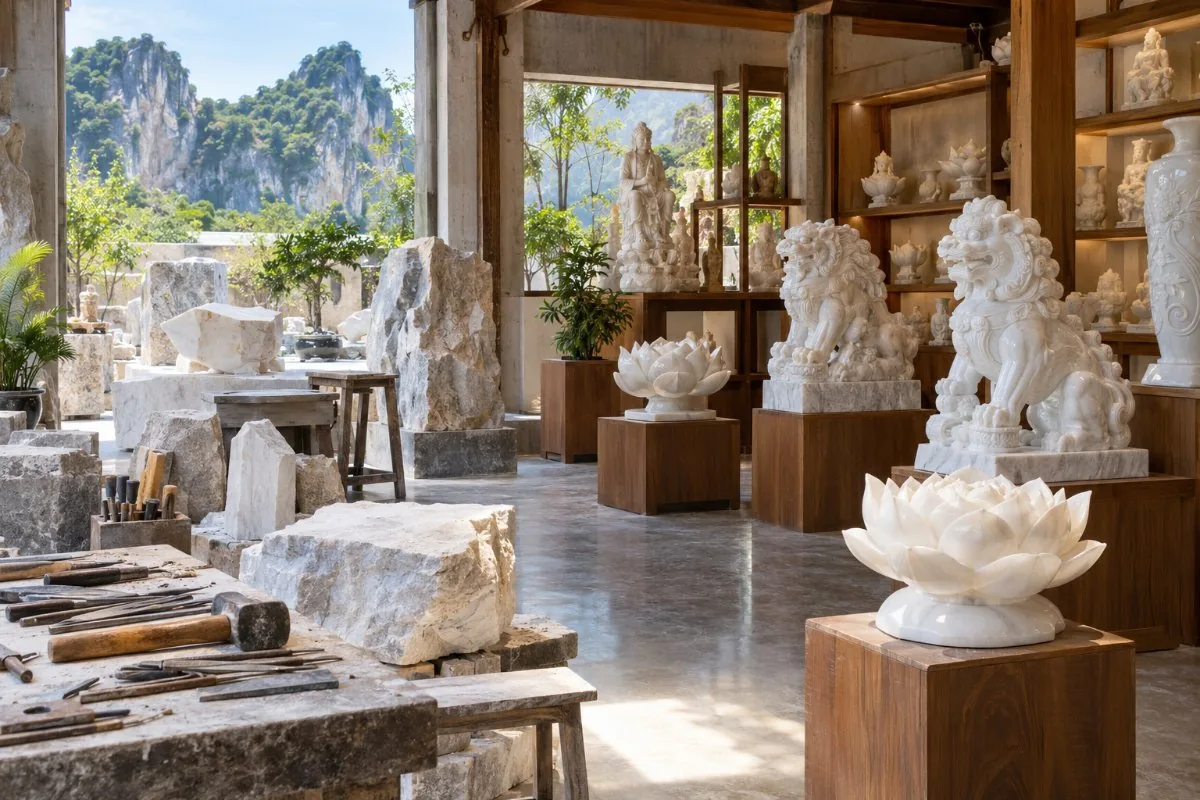
This museum at the foot of Marble Mountains preserves the 400-year history of Non Nuoc stone carving village, one of Vietnam’s oldest craft communities. The village has supplied carved stone products — Buddha statues, architectural ornaments, tomb decorations — to the entire country for centuries. The museum documents the techniques, tools, and master carvers who have kept this tradition alive through wars and economic changes.
The 400-year history of Non Nuoc stone carving village
The village’s origins trace back to the 17th century, when the Nguyen Lords encouraged craftsmen from Thanh Hoa province to settle near the marble-rich mountains. The carvers initially produced religious statues for local pagodas and architectural elements for the Hue imperial city. By the 19th century, Non Nuoc stone was being exported to Cambodia, Laos, and Thailand. The village declined during the Vietnam War when many carvers were conscripted, but revived in the 1990s with the tourism boom. Today, about 300 families still work in the craft, though many now use electric tools alongside traditional hand chisels.
What you’ll see: tools, unfinished works, master carver demonstrations
The museum displays the evolution of carving tools — from simple iron chisels used in the 17th century to modern pneumatic hammers and diamond-tipped grinders. A section shows unfinished works at various stages: rough blocks with initial outlines, partially carved figures emerging from the stone, and pieces ready for final polishing. The highlight is the demonstration area where master carvers work on-site, usually during morning hours (9:00 AM-11:00 AM). You can watch them transform raw marble into a Buddha head or a decorative dragon in about 30 minutes. The museum also displays awards and certificates from national craft competitions.
Practical info: located at the foot of Marble Mountains, combine with mountain visit
Address: Hoa Hai Ward, Ngu Hanh Son (at the base of Marble Mountains, near the main entrance to Thuy Son mountain). Opening hours: 7:30 AM to 5:00 PM daily. Entrance fee: 20,000 VND (about $0.80 USD). The museum is small — you can see everything in 20-30 minutes. The real value is combining it with a visit to Marble Mountains (40,000 VND entrance) and exploring the carving workshops that line the streets around the mountain. Many workshops allow you to watch carvers at work for free.
You can also purchase small carved items directly from the artisans — prices are lower than in the souvenir shops at the mountain’s summit.
Comparing Da Nang’s Museums: Which One Deserves Your Time?
With eight museums to choose from and limited vacation time, a quick comparison helps prioritize your visits. The table below shows the key practical differences — ticket prices, average visit duration, and the type of visitor each museum suits best.
| Museum | Ticket Price (VND) | Average Visit Time | Best For |
|---|---|---|---|
| Cham Sculpture Museum | 60,000 | 60-90 min | History & archaeology lovers |
| Da Nang Museum | 50,000 | 90-120 min | First-time visitors, families |
| Fine Arts Museum | 40,000 | 45-60 min | Art enthusiasts, quiet afternoons |
| Ho Chi Minh Museum + Military Zone 5 | 40,000 (combined) | 60-90 min | War history buffs |
| Hoang Sa Exhibition House | Free | 30-45 min | Maritime history, quick add-on |
| 3D Art in Paradise | 150,000 | 60-90 min | Families, Instagram travelers |
| Dong Dinh Museum | Free (donation) | 30-45 min | Curious explorers, hidden gem seekers |
| Non Nuoc Memory Museum | 20,000 | 20-30 min | Craft heritage, Marble Mountain visitors |
How to visit 3-4 museums in one day without rushing
The city center cluster — Cham Museum, Da Nang Museum, Fine Arts Museum, and Hoang Sa Exhibition House — are all within a 15-minute walk of each other. Start at the Cham Museum at 7:00 AM (it opens earliest). Walk north to the Da Nang Museum for 9:00 AM. Visit the Hoang Sa Exhibition House (10-minute walk north) for 30 minutes around 11:00 AM. After lunch, visit the Fine Arts Museum (15-minute walk south) from 1:30-2:30 PM. This route covers four museums in about 5 hours with a lunch break.
For a less packed day, choose 2-3 museums and add 3D Art in Paradise or a Marble Mountains trip in the afternoon.
Budget-friendly tip: free admission days and combo discounts
The Da Nang Museum occasionally offers free admission on national holidays (September 2, April 30, and May 1). The Hoang Sa Exhibition House and Dong Dinh Museum are always free. The Cham Museum and Fine Arts Museum do not offer regular free days, but their ticket prices are already low by international standards — combined entry to all four paid museums costs about 190,000 VND (under $8 USD). There are no official combo tickets, but you can negotiate group discounts at the Fine Arts Museum for parties of 10 or more.
Practical Tips for Visiting Da Nang Museums in 2026
A few practical strategies can make your museum visits more comfortable and efficient. Da Nang’s tropical climate, with high humidity and temperatures often exceeding 35°C (95°F) from April to August, affects both your energy levels and the museum experience. Plan accordingly.
Best time to visit: morning vs afternoon crowd patterns
The Cham Museum and Da Nang Museum are busiest between 10:00 AM and 2:00 PM, when tour groups arrive. Visit at opening time (7:00 AM for Cham Museum, 7:30 AM for Da Nang Museum) to avoid crowds and enjoy cooler morning temperatures. The Fine Arts Museum and Dong Dinh Museum are quieter throughout the day — you’ll often have entire galleries to yourself in the early afternoon. 3D Art in Paradise gets busy on weekends and public holidays, especially between 1:00 PM and 4:00 PM.
The Non Nuoc Memory Museum is least crowded in the late afternoon (3:00-4:30 PM), when most Marble Mountains visitors have already left.
Transportation: walking routes between city center museums
The four city center museums — Cham Museum, Da Nang Museum, Fine Arts Museum, and Hoang Sa Exhibition House — are all within walking distance of each other. The walking route Cham Museum → Da Nang Museum → Hoang Sa Exhibition House is about 1.2 kilometers and takes 15 minutes. The walk from Da Nang Museum to Fine Arts Museum is about 800 meters and takes 10 minutes. For 3D Art in Paradise (located near the Cham Museum complex), you don’t need transport — it’s in the same area.
For the Ho Chi Minh Museum complex, take a 5-minute taxi from the city center (about 30,000-50,000 VND). For Non Nuoc Memory Museum, take a 15-minute taxi or Grab from the city center to Marble Mountains (about 80,000-120,000 VND).
What to bring: water, camera rules, dress code for war memorials
Bring a reusable water bottle — most museums don’t have drinking fountains, but you can refill at cafes nearby. Camera rules vary: photography without flash is allowed in most museums, but the Cham Museum and Fine Arts Museum prohibit tripods and selfie sticks. The Ho Chi Minh Museum and Military Zone 5 Museum restrict photography in certain galleries (usually those with sensitive war documents). For the war memorials, dress modestly — shorts are fine, but avoid wearing clothing with offensive slogans or symbols. The 3D Art in Paradise and Dong Dinh Museum have no specific dress codes.
All museums require you to leave large backpacks at the reception desk — small daypacks are usually allowed.
Frequently Asked Questions
What are the opening hours for Da Nang museums?
Most museums open from 7:00-7:30 AM to 5:00 PM daily, with a lunch break from 11:00 AM to 1:30 PM at some smaller museums (Ho Chi Minh Museum, Hoang Sa Exhibition House). The Da Nang Museum and Fine Arts Museum are closed on Mondays. The Cham Museum and 3D Art in Paradise are open daily. Always check the specific museum’s schedule before visiting, as hours can change during public holidays.
How much does it cost to visit museums in Da Nang?
Ticket prices range from free (Hoang Sa Exhibition House, Dong Dinh Museum) to 150,000 VND (3D Art in Paradise). The average is about 40,000-60,000 VND ($1.60-$2.50 USD) for the main museums. Combined entry to all paid museums costs under 400,000 VND (about $16 USD) — a very affordable cultural itinerary compared to museum prices in Europe or North America.
Which Da Nang museum is best for children?
3D Art in Paradise is the clear winner for children aged 5-15 — the interactive photo opportunities keep them engaged for 60-90 minutes. The Da Nang Museum’s new 3D mapping displays and interactive touchscreens also appeal to older children (10+). The Non Nuoc Memory Museum’s carving demonstrations fascinate children who enjoy hands-on crafts. The Cham Museum and Fine Arts Museum are less suitable for young children due to the quiet, contemplative atmosphere and lack of interactive elements.
Are there English audio guides available?
The Da Nang Museum offers free audio guides in English, Vietnamese, and French. The Cham Museum offers audio guides for an additional 30,000 VND in English, French, and Vietnamese. The Fine Arts Museum, Ho Chi Minh Museum, and smaller museums do not offer audio guides but have English text panels for major exhibits. 3D Art in Paradise and Dong Dinh Museum do not require audio guides — the experience is visual and interactive.
Can I visit multiple museums in one day?
Yes. The four city center museums (Cham Museum, Da Nang Museum, Fine Arts Museum, Hoang Sa Exhibition House) are within walking distance and can be visited in 4-5 hours. Add 3D Art in Paradise for a full day of museum-hopping. The Ho Chi Minh Museum complex requires a short taxi ride but can be added to a city center route. The Non Nuoc Memory Museum is best combined with a Marble Mountains visit rather than a city center museum day.