Da Nang’s Han River is a photographer’s canvas, adorned with six major bridges, each a unique architectural statement. From the ethereal Golden Bridge, seemingly held aloft by ancient stone hands, to the spectacular Dragon Bridge that ignites the weekend sky with fire and water, Da Nang has cemented its status as Vietnam’s most visually captivating urban destination. This guide details the five essential bridges for photographers in 2026, providing precise camera settings, optimal timing, and strategic vantage points that elevate your shots beyond the ordinary.
TL;DR: Da Nang’s five must-photograph bridges—Golden, Dragon, Han River, Tran Thi Ly, and Love Bridge—each require a tailored approach. The Golden Bridge is best captured before 8 AM with a wide lens at f/8 for its misty morning allure. For the Dragon Bridge’s 9 PM fire show, aim for Tran Hung Dao Street with a 1/125s shutter speed. The Han River Bridge’s 11 PM rotation demands a tripod and a 30-second exposure for light trails. Tran Thi Ly Bridge’s modern design and purple LEDs are stunning during blue hour, especially with its reflection. This guide offers specific timing, gear, and composition tips, plus a one-day itinerary to capture them all.
Why Da Nang is a Photographer’s “City of Bridges”
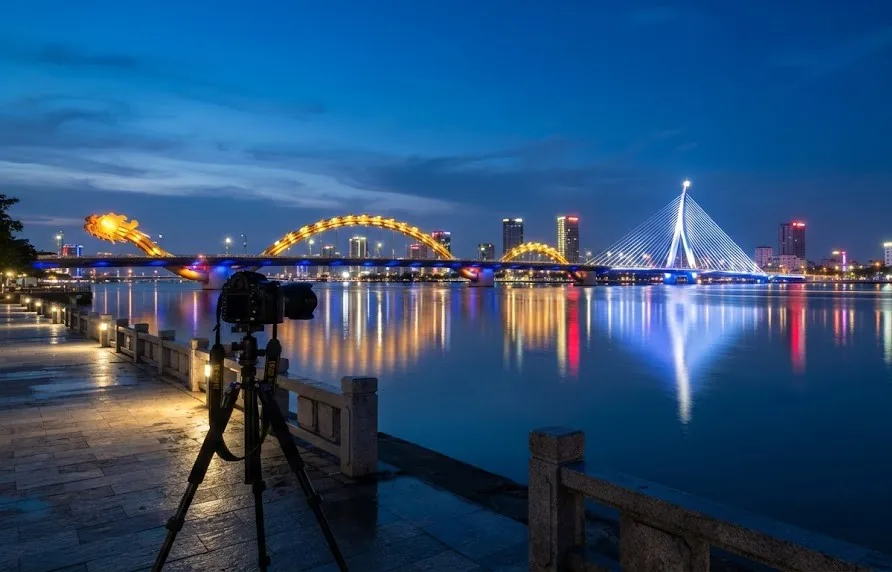
Da Nang’s collection of bridges over the Han River forms a distinctive urban photography landscape that transforms with the light.
Unlike mere functional structures elsewhere, Da Nang’s bridges are celebrated as public art. The Dragon Bridge performs a dramatic fire and water show on weekend evenings, while the Han River Bridge mechanically rotates at 11 PM to allow maritime traffic. High above the city, the Golden Bridge on Ba Na Hills appears as a flowing golden pathway supported by colossal stone hands. This remarkable concentration of architectural innovation within a single city offers unparalleled photographic opportunities.
Photographers can capture five distinct subjects within a compact area, from a mountain-top marvel at dawn to a riverside spectacle illuminated by LEDs at midnight. The Han River divides the city, and most bridges connect its eastern and western banks, providing diverse framing possibilities. The river’s surface also acts as a natural reflector, amplifying the visual impact of the bridges’ lighting schemes during twilight hours.
The Golden Bridge (Cầu Vàng): An Iconic Shot at 1,414 Meters
To capture the Golden Bridge’s iconic stone hands and sweeping arc, aim for a morning shoot before 8 AM to benefit from soft, directional light and potentially ethereal mist.
Best Time of Day: Misty Mornings for Ethereal Views
The Golden Bridge is located within Sun World Ba Na Hills, which opens its cable cars at 7:30 AM. The journey to the bridge takes approximately 30 minutes, including the cable car ride and a short walk. Arriving around 8:00 AM places you on the bridge just as the morning mist often begins to dissipate. This misty period, typically from 7:30 AM to 9:00 AM, is ideal for photography. The fog softens the background, isolating the bridge and its supporting hands against a serene, atmospheric canvas, a stark contrast to the harsher light and crowds that appear later.
Camera Settings & Lens Recommendations for the Stone Hands Composition
For the classic composition featuring both the hands and the full curve of the bridge, a wide-angle lens is essential. The following settings have proven effective:
| Setting | Recommended Value | Reason |
|---|---|---|
| Focal length | 16–24mm (full-frame) or 10–16mm (APS-C) | Enables capturing both the supporting hands and the entire bridge arc in a single frame. |
| Aperture | f/8 to f/11 | Ensures adequate depth of field to keep both the foreground and background elements of the bridge sharp. |
| ISO | 100–200 | Sufficient morning light allows for low ISO, minimizing digital noise and preserving image quality. |
| Shutter speed | 1/125 to 1/250 second | Adequate for handheld shooting in good light, freezing any slight movement without needing a tripod. |
| Focus point | Single point on the nearest hand | At f/8 or narrower, the depth of field will cover the entire bridge structure. |
Position yourself at the far end of the bridge, looking back towards the hands. This perspective compresses the scene, making the hands appear more dominant. Avoid a direct side-on shot, which can flatten the three-dimensional form of the hands. A slight offset from the center railing adds depth to the composition.
How to Avoid Crowds for a Clean Frame
The Golden Bridge attracts significant visitor numbers, especially during peak seasons. To achieve a crowd-free photograph:
- Purchase your Sun World Ba Na Hills tickets online in advance. Aim to arrive at the cable car station by 7:00 AM to catch the first departure at 7:30 AM.
- Proceed directly to the Golden Bridge upon arrival, deferring exploration of the French Village or other attractions until later.
- Consider shooting from the lower walkway beneath the main bridge deck for an alternative angle that often has fewer people.
- Visiting on a weekday (Tuesday to Thursday) can result in fewer crowds compared to weekends or public holidays.
Dragon Bridge (Cầu Rồng): Capturing the Fire and Water Show
The Dragon Bridge performs its fire and water show every Saturday and Sunday at 9 PM. The optimal vantage point is from Tran Hung Dao Street, approximately 150 meters from the dragon’s head.
The Perfect Vantage Point: Tran Hung Dao Street vs. Love Bridge
Two primary locations offer excellent views of the Dragon Bridge show. Tran Hung Dao Street, situated on the east bank, provides a direct, head-on perspective of the dragon. This angle is ideal for capturing the full force of the fire blast. The Love Bridge, on the west bank, offers a side profile with the city skyline as a backdrop, which is better suited for capturing traffic light trails with the dragon in the distance.
To secure a good position, especially at the railing, plan to arrive at your chosen spot by 8:30 PM.
Long Exposure vs. Action Shot: Photographing the Spectacle
The fire and water show lasts about 10 minutes, featuring several bursts of fire and water sprays. Each fire blast typically lasts 3 to 5 seconds. To freeze the flames sharply, use a shutter speed of 1/125 second. For capturing the motion of water sprays, a faster speed like 1/250 second is more effective.
For a composite shot that includes both the fire and the surrounding night traffic, mount your camera on a tripod. Set your camera to f/11, ISO 100, and use a 30-second exposure with a remote shutter release. This will render the fire as a bright streak and capture car headlights as colorful trails along the bridge. Experiment with exposure settings to achieve the desired effect.
The 2026 LED Light Schedule: A Dazzling Display
The Dragon Bridge is illuminated by 15,000 LED lights that change color nightly from 6 PM to 11 PM. While the exact schedule can vary, common patterns include:
- Monday to Thursday: Primarily solid white or warm yellow lighting, highlighting the bridge’s architecture.
- Friday: A transition to blue and purple hues, setting a more vibrant weekend tone.
- Saturday and Sunday: A dynamic multi-color cycle (red, green, blue, gold), often synchronized with the fire and water show.
The weekend multi-color display offers the most visually engaging options for photographers, allowing for shots where the bridge’s colors complement the fire. The Monday-Thursday white lighting provides a clean, neutral backdrop suitable for black-and-white conversions.
Han River Bridge (Cầu Sông Hàn): The Rotating Bridge at Night
The Han River Bridge rotates 90 degrees at 11 PM nightly to permit ship passage. Capturing this requires a tripod, a remote shutter, and arriving by 10 PM to secure a prime location.
The 11 PM Swing: Timing Your Shot for the Rotation
The bridge rotation commences at 11 PM and typically takes 15 to 20 minutes. While the rotation occurs most nights due to regular cargo ship traffic, it is not guaranteed and depends on maritime schedules. Confirm the day’s schedule with the Da Nang Port Authority online or through your hotel concierge.
If a rotation is scheduled, reach the east bank (Tran Hung Dao Street side) by 10 PM to set up your equipment before the road closure at 10:45 PM.
Best Composition from the East Bank at Night
Position yourself on the east bank, about 200 meters south of the bridge. This vantage point allows you to photograph the bridge as it swings from left to right, with the city skyline providing a dramatic backdrop. A 24-70mm lens set to around 35mm is suitable for this composition. Employ a 20- to 30-second exposure at f/11 and ISO 100 to capture the light trails of vehicles on the adjacent roads. The bridge’s LEDs are deactivated during rotation, creating a silhouette effect enhanced by the city lights.
Why a Tripod is Essential for This Bridge
Photographs of the Han River Bridge rotation necessitate long exposures, often exceeding one second. A tripod is indispensable for maintaining sharpness and capturing the bridge’s structural lines without motion blur. Utilize a remote shutter release or the camera’s 2-second self-timer to prevent vibration when triggering the shutter. If a tripod is unavailable, a stable surface like a beanbag on the ground, combined with the self-timer, can yield interesting low-angle shots.
Tran Thi Ly Bridge (Cầu Trần Thị Lý): Sleek Modernity and Reflections
Tran Thi Ly Bridge’s distinctive single cable-stayed tower and its purple LED illumination create a minimalist aesthetic, best captured during blue hour from the Han River bank to include its reflection.
The Unique Cable-Stayed Design and Its Best Photo Angles
In contrast to the Dragon Bridge, Tran Thi Ly Bridge is characterized by its clean, modern geometry. Its single, A-shaped tower stands 145 meters tall, supporting 28 pairs of cables. The bridge deck spans 731 meters. The most compelling angle is from the west bank (Nguyen Van Thoai Street), looking east, which aligns the tower with the setting sun for a silhouette effect during golden hour. For a reflection shot, position yourself on the east bank (Tran Hung Dao Street) and utilize the river’s surface as a mirror, effectively doubling the tower’s visual height.
Shooting at Blue Hour: The Purple and Blue LED Scheme
The bridge’s LED lighting activates around 6 PM and transitions between purple and blue hues until 10 PM. Blue hour, the period of twilight after sunset, typically occurs between 5:15 PM and 6:00 PM in Da Nang. This provides a window to capture the deep blue sky alongside the bridge’s emerging lights. The purple LEDs will provide a complementary accent. Use a 24mm lens at f/8 with a 2-second exposure on a tripod to achieve a smooth river surface and a clear reflection.
Complementing the Dragon Bridge Skyline Shot
From the Han River bank near the Dragon Bridge, it’s possible to frame both structures in a single panoramic composition. 5 kilometers apart. A 24mm lens is suitable for this wide view, highlighting the contrast between the Dragon Bridge’s mythical form and Tran Thi Ly Bridge’s modern design. This dual-bridge shot is most effective during blue hour when both bridges are illuminated.
Building Your 2026 Da Nang Bridge Photography Itinerary
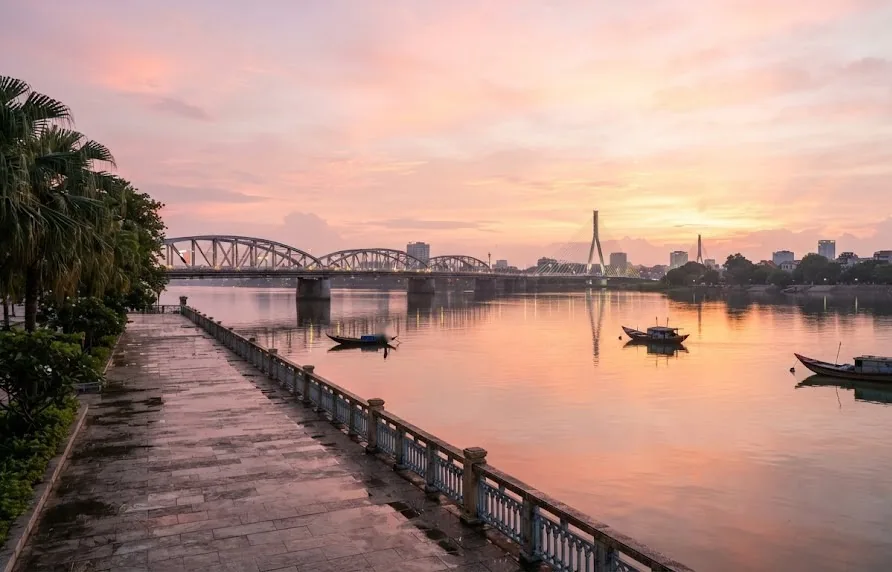
A comprehensive one-day itinerary covering all five bridges requires an early start at Ba Na Hills and concludes with the Han River Bridge rotation, incorporating travel and meal times.
Morning: Golden Bridge and Ba Na Hills (7 AM – 12 PM)
Begin at 7:00 AM at the Ba Na Hills cable car station. Take the first cable car up, proceed directly to the Golden Bridge, and photograph from 7:30 AM to 9:00 AM. After the main crowds arrive, explore the French Village and gardens. Descend by cable car around 12:00 PM. This segment requires approximately 5 hours, including transit and potential waiting times.
Afternoon: Tran Thi Ly and Han River Bridges for Blue Hour (4 PM – 6 PM)
Rest during the midday heat (12 PM to 4 PM). At 4:00 PM, travel to the west bank of the Tran Thi Ly Bridge. Scout your composition for the blue hour reflection shot. Set up your tripod by 5:00 PM for the blue hour period (approx. 5:15 PM to 6:00 PM). Afterwards, walk south along the river to the Han River Bridge to reserve your spot for the 11 PM rotation. You can depart and return later, but securing the location early is advisable.
Evening: Dragon Bridge Fire Show and Night Lights (8 PM – 10 PM)
Take a dinner break at a riverside restaurant on Bach Dang Street around 6:00 PM. By 8:00 PM, make your way to Tran Hung Dao Street for the Dragon Bridge fire show at 9:00 PM. Capture the show from 9:00 PM to 9:10 PM. Subsequently, walk to the Han River Bridge, arriving by 9:30 PM to set up your tripod for the 11:00 PM rotation. Conclude your day’s shooting by 11:20 PM.
Important Notes for 2026: Drone Laws, Weather, and Permits
Drone operations are restricted within a 2-kilometer radius of the Dragon Bridge and Golden Bridge. The rainy season (October to December) can impact outdoor photography.
- Drone Regulations: Flying drones over bridges, the Han River, and within Da Nang city limits requires a specific permit from the Civil Aviation Authority of Vietnam. Unauthorized flights incur significant fines. Exercise caution and adhere to all regulations.
- Weather Considerations: The rainy season from October to December brings frequent downpours. Ensure you have adequate rain protection for your camera gear. Overcast skies during this period can provide soft, diffused light beneficial for certain shots, like the Golden Bridge’s misty mornings. The Dragon Bridge fire show is typically cancelled during heavy rain.
- Permits and Access: Standard handheld and tripod photography on public bridges does not require special permits. Access to the Golden Bridge is included with your Sun World Ba Na Hills admission ticket.
- Temperature Variations: Ba Na Hills is situated at a higher elevation, resulting in cooler temperatures (5–10°C lower) than Da Nang city. A light jacket is recommended, especially for early morning visits. The Golden Bridge can be windy and misty; ensure your camera is secured.
Related on this site
- Exploring Da Nang’s Ancient Towers: A Journey Through Champa History 2026
- Must-See Architectural Wonders in Da Nang 2026
Frequently Asked Questions
What is the best time of year to photograph Da Nang’s bridges?
February to April is generally considered optimal, offering clear skies, low humidity, and pleasant temperatures (22–28°C). This period minimizes the risk of rain affecting the Dragon Bridge show and provides consistent conditions for twilight photography.
Can I photograph the Dragon Bridge fire show from a boat on the Han River?
Yes, several boat tours operate on the Han River, offering unique perspectives of the Dragon Bridge show from the water. These tours provide a low-angle view with the fire reflected on the river’s surface. Bookings can be made through hotels or local tour agencies.
Do I need a special lens for the Golden Bridge’s stone hands?
A wide-angle lens (16–24mm on a full-frame camera) is highly recommended to capture both the hands and the bridge’s arc. While a standard zoom (24–70mm) can work for closer shots, it won’t fit the entire scene. Smartphone users should utilize the ultra-wide camera mode.
Is the Han River Bridge rotation guaranteed every night?
No, the rotation is dependent on ship traffic. While it occurs frequently, it is not guaranteed nightly. Checking the Da Nang Port Authority schedule or consulting with your hotel concierge is advised.
Can I walk across the Golden Bridge for free?
No, the Golden Bridge is part of Sun World Ba Na Hills and requires an admission ticket. As of 2026, the ticket price includes cable car access and entry to all attractions, including the bridge.
What is the best vantage point for a panoramic shot of all bridges?
The Son Tra Peninsula (Monkey Mountain), specifically the viewpoint near Linh Ung Pagoda, offers a high-angle panoramic vista of the Han River and its bridges. A telephoto lens (70–200mm) can compress the scene effectively.
Are there any photography restrictions at the Golden Bridge regarding tripods?
Tripods are permitted on the Golden Bridge, but their use can be challenging during peak hours due to visitor density. Early morning visits (7:30 AM – 9:00 AM) offer more space and fewer crowds, making tripod setup more feasible.
Part of our guide to places to visit in Da Nang.