Da Nang sits at the edge of one of Southeast Asia’s most significant archaeological zones. Thirty kilometers southwest, the My Son Sanctuary holds the remnants of the Champa Kingdom, a civilization that dominated central Vietnam for over a thousand years. Exploring Da Nang’s ancient Cham ruins is a journey into the religious, political, and architectural heart of a maritime power that rivaled the Khmer Empire at its peak.
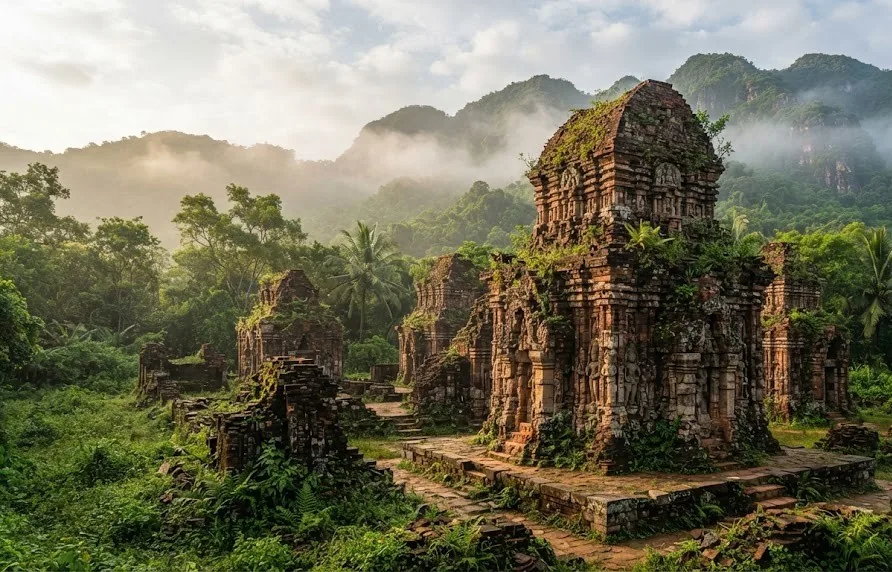
My Son Sanctuary, a UNESCO World Heritage site since 1999, is the most substantial surviving complex of Cham Hindu temples in Vietnam. The site contains over 70 structures built between the 4th and 14th centuries, with the oldest dated inscriptions tracing back to King Bhadravarman I in the late 4th century. Unlike the sprawling Angkor Wat, My Son feels intimate — a cluster of red-brick sanctuaries set in a narrow valley surrounded by jungle-covered mountains. This guide covers the historical context of the Champa Kingdom, the temple layout at My Son, how to get there from Da Nang in 2026, the best time to visit, and practical tips for making the most of your trip.
The Champa Kingdom: A Historical Journey Through Da Nang’s Ancient Ruins
The Champa Kingdom was a collection of independent principalities, not a single unified empire, and its influence stretched from Quang Binh in the north to Binh Thuan in the south.
Who were the Cham people? Tracing the origins of a maritime kingdom
The Cham people were Austronesian speakers who arrived on the coast of central Vietnam around the 2nd century CE. They established a network of port cities that connected China, India, and the Indonesian archipelago. Unlike the agrarian Dai Viet to the north, the Cham economy relied heavily on maritime trade — sandalwood, spices, and slaves were their primary exports. This trade wealth funded the construction of the temple complexes at My Son, which served as the spiritual and political heart of the kingdom.
Timeline of power: From the 4th century to the 15th century
King Bhadravarman I built the first wooden temple at My Son in the late 4th century, dedicating it to the Hindu god Shiva. The 7th and 8th centuries saw a golden age under King Prakasadharma, who expanded the complex and introduced the distinctive brick architecture that survives today. The 13th century marked the peak of Cham naval power — they raided the Khmer capital of Angkor in 1177 and again in 1190. By the 15th century, the Dai Viet had pushed southward, and the Cham capital of Vijaya fell in 1471. My Son was gradually abandoned to the jungle.
The spiritual heartland: Why My Son Sanctuary was the religious and political center
My Son was not a city — it was a sacred site where Cham kings performed rituals, consecrated new rulers, and buried their ancestors. The valley’s isolation, surrounded by the Cat’s Tooth Mountains, made it a natural sanctuary. The central temple in each group was built to house a linga, the symbol of Shiva, which was believed to embody the king’s power. The site remained active for over 1,000 years, with each successive king adding new temples to demonstrate their piety and legitimacy.
My Son Sanctuary: A Complete Guide to the Temple Complex Layout
The My Son temple complex is divided into eight distinct groups labeled A through K, each representing a different construction period and architectural style.
Decoding the temple groups: What do the groups A, B, C, D, G, H, K mean?
The groups are spread across the valley floor and are connected by a network of footpaths. Group A is the oldest and most significant section, containing the largest temples. Group A1, the main sanctuary, is the most photographed structure at My Son. Group B and C sit adjacent to Group A and were built later, featuring more elaborate carvings. Group G is located near the entrance and houses the performance area where traditional Cham dance shows are held. Groups H and K are smaller and less restored, offering a more rugged exploration experience.
A map at the ticket counter shows the walking paths, but the layout is straightforward — you follow the main path from the entrance and branch off to each group.
The Main Sanctuary (Kalan Tower): Architectural symbolism and Mount Meru
The Kalan tower is the central structure in each temple group. Cham architecture follows a strict symbolic blueprint: the base represents the earthly world, the body represents the intermediate world, and the pyramid-shaped roof represents Mount Meru, the home of the gods in Hindu cosmology. The towers were built without mortar — the bricks were held together by a plant-based resin that hardened over time. This technique is still not fully understood by modern archaeologists.
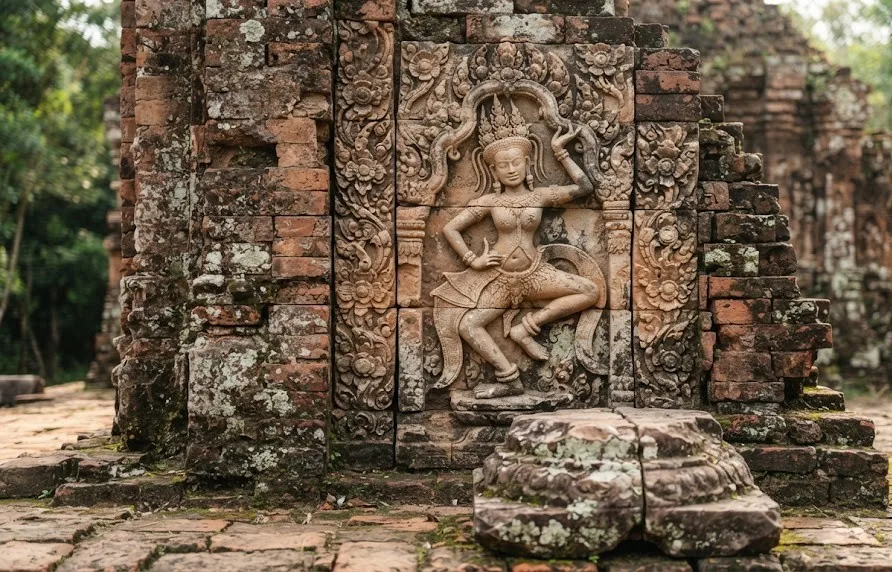
The carvings on the tower walls depict scenes from Hindu epics, dancers, and mythical creatures like the makara (a sea monster) and the garuda (a bird-like deity).
The Ancient Royal Road and wartime ruins: Two contrasting walks through history
As you walk from the entrance toward Group A, you follow the ancient royal road that Cham kings once used for processions. The path is lined with remnants of gateways and small shrines. However, the walk also passes bomb craters from the Vietnam War — My Son was heavily bombed during the conflict, and over half of the temples were damaged or destroyed. The contrast between the ancient brickwork and the raw scars of war creates a powerful emotional experience.
The site was used as a base by the Viet Cong, and the U.S. military targeted it in 1969 during Operation Nevada, causing significant destruction to Group B and C.
How to Get to My Son Sanctuary from Da Nang in 2026
Getting to My Son Sanctuary from Da Nang takes approximately one hour by car, and there are three main options in 2026: private car, motorbike, or guided tour.
By private car or taxi: Estimated cost and travel time (approx. 1 hour)
A private car from Da Nang to My Son costs between 600,000 and 800,000 VND for a round trip, including waiting time. The drive takes 50 to 70 minutes via Highway 1A and Route 537. Taxis from Mai Linh or Vinasun are reliable but cost slightly more. You can also book a private car through Grab, though availability for long-distance trips can be limited. The entrance fee to My Son in 2026 is 150,000 VND per person.
By motorbike: A scenic route through Quang Nam (now part of Da Nang)
Renting a motorbike in Da Nang costs around 150,000 to 200,000 VND per day. The route follows Highway 1A south toward Hoi An, then turns west onto Route 537 through the countryside. The road is well-paved and the scenery is beautiful — rice paddies, water buffalo, and the distant mountains. The ride takes about 1 hour and 15 minutes. Parking at My Son costs 10,000 VND. This option gives you maximum flexibility but requires a valid international driving permit and confidence riding in Vietnamese traffic.
Joining a guided tour: Pros and cons of half-day vs. full-day tours from Da Nang
Half-day tours from Da Nang cost between 500,000 and 900,000 VND per person and typically include hotel pickup, entrance fee, and an English-speaking guide. Full-day tours add a visit to the Marble Mountains or Hoi An Ancient Town. The pros of a tour: you get historical context from a guide, transportation is handled, and you don’t need to navigate. The cons: you are on a fixed schedule, and the group size can be 15 to 30 people. Platforms like Klook and GetYourGuide offer booking options with free cancellation.
| Transport Option | Cost (Round Trip) | Travel Time | Best For |
|---|---|---|---|
| Private car | 600,000 – 800,000 VND | 50 – 70 minutes | Small groups, flexibility |
| Motorbike | 150,000 – 200,000 VND (rental) | 1 hour 15 minutes | Independent travelers |
| Half-day guided tour | 500,000 – 900,000 VND/person | 4 – 5 hours total | First-time visitors |
| Full-day guided tour | 800,000 – 1,500,000 VND/person | 7 – 9 hours total | Combining multiple sites |
Best Time to Visit My Son Sanctuary: Seasonal Guide for 2026
The best time to visit My Son Sanctuary is between late December and February, when temperatures are cool and rainfall is minimal.
Dry season (March to August): Early morning vs. late afternoon for photography
The dry season brings clear skies and intense heat. Temperatures can reach 38°C by midday. For photography, the early morning window between 6:00 AM and 8:00 AM offers golden light that illuminates the red brick of the temples. Late afternoon, from 3:30 PM to 5:00 PM, provides softer shadows and a warmer color temperature. The site opens at 6:00 AM, so arriving at opening time gives you an hour of near-empty crowds before the tour buses arrive around 8:30 AM.
Rainy season (September to December): What to expect and how to prepare
Rainfall peaks in October and November. The jungle becomes lush and green, and the fog that rolls through the valley creates a mystical atmosphere — but the paths can be muddy and slippery. Bring a rain jacket and waterproof shoes. The afternoon downpours are heavy but usually short. The advantage of visiting during the rainy season is the lack of crowds — you may have entire temple groups to yourself.
Best time of the year (Late December to February): Cool weather and fewer crowds
This is the peak tourist season in central Vietnam for good reason. Daytime temperatures hover around 22°C to 25°C, making the walk through the temple complex comfortable. The skies are often partly cloudy, which provides natural diffused lighting for photography. The Tet holiday period (late January to early February) sees a spike in domestic visitors, so plan your visit for late December or mid-February to avoid the crowds.
What time of day should you go to avoid crowds?
The 6:00 AM opening time is the best window. Most guided tours from Da Nang and Hoi An depart around 7:30 AM and arrive at My Son by 8:30 AM. If you arrive at 6:00 AM, you have roughly two hours of quiet exploration. The second window is after 2:00 PM, when the morning tour groups have left and the afternoon heat begins to subside.
What to See and Do Inside My Son Sanctuary
Beyond the temple ruins, My Son offers cultural performances, a museum, and even kayaking on a nearby lake.
The Cham dance performance: Schedule and where to watch it (Performance House vs. Tower G)
Traditional Cham dance and music performances are held daily at the Performance House near the entrance. Shows run at 9:30 AM, 10:30 AM, and 2:30 PM, each lasting about 20 minutes. The dancers wear elaborate costumes inspired by the carvings on the temple walls. During peak season, an additional performance is sometimes staged at Tower G, which uses the ancient structure as a natural amphitheater. Check the schedule at the ticket counter upon arrival.
“Echoes of My Son” show: A new immersive experience in 2026?
The “Echoes of My Son” show is a nighttime immersive experience that uses projection mapping to bring the temple ruins to life. As of 2026, the show is still being developed and is not yet running on a regular schedule. Check with the My Son management office or local tour operators for the latest updates. If available, tickets cost approximately 300,000 VND and include a guided walk through the illuminated ruins.
The My Son Museum: A 2km walk to understand the relics before you explore
The My Son Museum is located about 2 kilometers from the main temple complex, near the ticket entrance. It houses a collection of stone carvings, statues, and inscriptions recovered from the site. The museum is small but well-curated, with English descriptions explaining the symbolism of the artifacts. Visit the museum before exploring the ruins to understand what you are looking at — the linga platforms, the pedestal carvings, and the statue of Shiva will make more sense in context.
Kayaking on the nearby lake: An unexpected activity after the temple visit
A small lake near the My Son entrance offers kayak rentals for 50,000 VND per 30 minutes. The lake is man-made and surrounded by jungle-covered hills. It is not a highlight of the visit, but it provides a relaxing way to cool off after a morning of walking through the ruins. The kayaks are basic plastic boats, and life jackets are provided.
Essential Tips for Visiting My Son Sanctuary
A little preparation goes a long way — My Son is a sacred site in a humid jungle environment, and the experience is much better when you come prepared.
What to wear and bring: Modest clothing, comfortable shoes, and sun protection
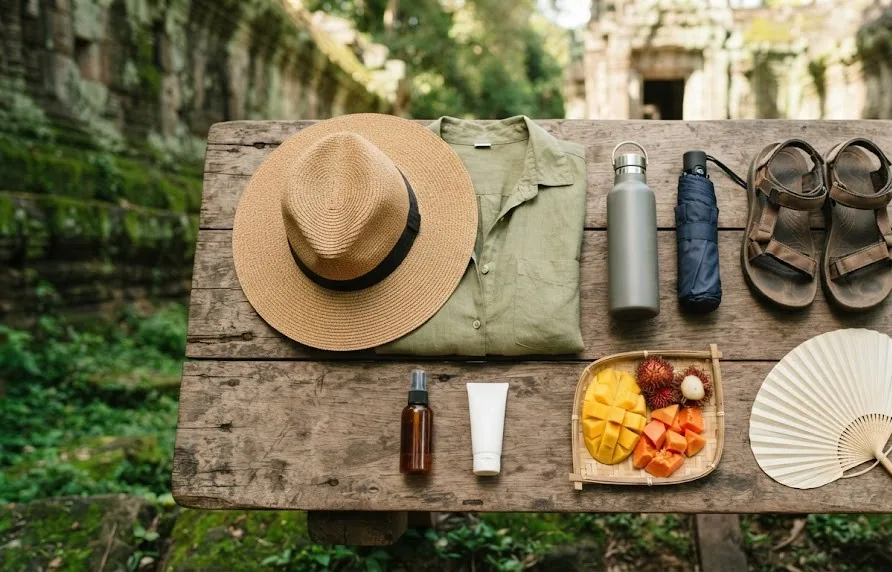
My Son is a Hindu temple complex, and while there is no strict dress code, dressing modestly shows respect. Lightweight long pants and a t-shirt are ideal. Comfortable walking shoes are essential — the paths are uneven and can be slippery. Bring a hat, sunglasses, and sunscreen. The sun is intense even in the morning. A small backpack is useful for carrying water and snacks.
Staying hydrated: Why you need to carry water in the humid jungle
You will sweat more than you expect. The site has a few small drink stalls near the entrance and the performance area, but they are not always open. Carry at least 1.5 liters of water per person. Reusable water bottles are recommended — there are water refill stations near the ticket counter.
Hiring a local guide vs. exploring independently: Which is better for a historical journey?
If you want to understand the historical and cultural significance of My Son, a local guide adds immense value. The guides at the entrance charge 200,000 to 300,000 VND for a 90-minute tour. They explain the symbolism of the temple architecture, the history of the Champa Kingdom, and the impact of the war. If you prefer to explore at your own pace, the information panels at each temple group provide adequate context in English and Vietnamese.
Should you book a tour for context?
For a historical journey, yes. The Cham ruins are not visually dramatic like Angkor Wat — they are subtle, and the story behind them is what makes the visit meaningful. A tour provides the narrative thread that connects the scattered temple groups. If you book a guided tour from Da Nang, check that it includes a licensed guide who specializes in Cham history, not just a driver who drops you at the entrance.
Related on this site
- Da Nang’s Hidden Movie Theaters: Cinema Experiences 2026
- Shooting in Da Nang: Two Real Air-Gun Clubs (No Live Firearms)
- Da Nang’s Top Birdwatching Spots: Nature Lover’s Guide 2026
Frequently Asked Questions
How much time do I need to explore My Son Sanctuary?
Most visitors spend 2 to 3 hours at the site. This allows time to walk through the main temple groups (A, B, C, D, and G), watch the Cham dance performance, and visit the museum. If you plan to kayak or attend the “Echoes of My Son” show, budget 4 to 5 hours.
Is My Son Sanctuary suitable for children and elderly visitors?
The walking paths are mostly flat and well-maintained, but the distance between temple groups adds up to about 2 kilometers of walking. Electric carts are available from the entrance to the main temple area for 15,000 VND per person each way. This makes the site accessible for elderly visitors and families with young children.
Can I visit My Son Sanctuary and Hoi An in the same day?
Yes. Many full-day tours combine My Son in the morning with Hoi An Ancient Town in the afternoon. My Son is about 40 kilometers from Hoi An, a 45-minute drive. Start at My Son at 6:00 AM, finish by 10:00 AM, and you can be in Hoi An by 11:00 AM with the rest of the day to explore.
Are there restaurants or food options inside My Son Sanctuary?
There is a small canteen near the entrance that serves basic Vietnamese dishes like pho and com tam (broken rice) for 30,000 to 50,000 VND. The options are limited, so bring snacks if you have dietary restrictions. There are no restaurants inside the temple complex itself.
What is the best way to learn about Cham history before visiting?
The Museum of Cham Sculpture in Da Nang is the best starting point. It houses the world’s largest collection of Cham artifacts, including statues, altars, and inscriptions. Visit the museum before your trip to My Son — it provides the historical and religious context that transforms the ruins from piles of bricks into a meaningful archaeological site.
Is My Son Sanctuary accessible for wheelchair users?
Partial accessibility. The electric carts can transport wheelchair users from the entrance to the main temple area. However, the paths within the temple groups are uneven and may be difficult to navigate with a standard wheelchair. The museum is fully accessible.
Are drones allowed at My Son Sanctuary?
No. Drones are prohibited at My Son Sanctuary to protect the integrity of the site and ensure the safety of visitors. Security staff monitor the area, and violators may have their drones confiscated.
Conclusion
My Son Sanctuary is a testament to the architectural ambition and spiritual depth of the Champa Kingdom. The red-brick towers rising from the jungle floor, the carved inscriptions that have survived a millennium, and the quiet solemnity of the valley create a travel experience that is both educational and reflective. Plan your visit for early morning during the dry season, hire a guide for historical context, and take the time to walk through each temple group. The journey from Da Nang to My Son is short, but the historical distance it covers spans 1,600 years.
Part of our guide to things to do in Da Nang.