Da Nang sits at a unique biogeographic crossroads, where the Annamite Mountains meet the South China Sea, creating a rare mix of montane forests, limestone karsts, and coastal wetlands. This diversity makes Da Nang’s top birdwatching spots a haven for both endemic species and migratory birds, offering a richer experience than most destinations in Central Vietnam. Whether you are tracking the Red-shanked Douc Langur on Son Tra Peninsula or scanning the mudflats for Eurasian Spoonbills near Hoi An, the region delivers consistent sightings across varied habitats.
This guide covers seven carefully selected locations for 2026, with practical advice on timing, access, and gear to help you plan an efficient and rewarding trip.
Central Vietnam hosts over 850 bird species, with Da Nang’s surrounding habitats supporting a significant portion of them. Son Tra Peninsula alone records more than 180 species, while Bach Ma National Park is a stronghold for endemics like the Crested Argus and Vietnamese Cutia. The best window for migratory passerines spans March to May and September to November, while resident species are active year-round. This guide prioritizes spots with high species richness, reliable access, and clear logistics for independent travelers in 2026.

What Makes Da Nang a Premier Birdwatching Destination in Central Vietnam?
Da Nang’s position at the meeting point of several major ecosystems creates a bird species density that rivals dedicated nature reserves. The Annamite Mountains act as a natural barrier, trapping moisture and fostering unique montane forests that harbor endemic species found nowhere else on Earth. Just a few kilometers east, the coastal wetlands and river deltas provide critical stopover habitat for migratory birds traveling the East Asian-Australasian Flyway.
Da Nang sits at a biogeographic crossroads where three distinct ecosystems converge, creating a bird species density unmatched in central Vietnam.
The city’s unique position—wedged between the Annamite Mountains to the west, the South China Sea to the east, and the Hoi An wetlands to the south—means a single morning can yield forest endemics, coastal waders, and wetland specialists.
What sets Da Nang apart is accessibility: you can birdwatch at sea level on Son Tra Peninsula at dawn, ascend to 1,400 meters in Bach Ma National Park by midday, and scan coastal mudflats near Hoi An by late afternoon—all within a 90-minute drive. This vertical habitat gradient—from intertidal zones to montane cloud forest—produces a species turnover that dedicated birders typically need a week in a single reserve to experience.
Biogeographic Crossroads: The Annamite Mountains and Coastal Wetlands
The Annamite Mountain range acts as a natural species filter. Its eastern slopes, which drop steeply toward Da Nang, trap moisture from the South China Sea, creating evergreen forests that host endemic subspecies found nowhere else in Vietnam. Species like the Annamite Barbet (Psilopogon annamensis) and the Vietnamese Cutia (Cutia legalleni) are restricted to this narrow elevational band between 800 and 1,800 meters. The coastal wetlands, meanwhile, form part of the East Asian–Australasian Flyway, one of the world’s nine major migratory bird corridors.
Key stopover sites like the Tra Nhieu Lagoon and Cua Dai Beach provide critical feeding grounds for species such as the Eurasian Spoonbill (Platalea leucorodia) and the Pacific Golden Plover (Pluvialis fulva). This dual character—endemic-rich montane forest on one side, productive coastal wetlands on the other—makes Da Nang a rare urban birding destination where you can log 60+ species in a single day without leaving the city limits.
Year-Round Birding Calendar: Migrant Passages and Endemic Specialties
Da Nang’s birding calendar splits neatly into three distinct seasons, each offering different target species. The winter migrant season (November to February) brings a surge of passerines from northern latitudes—Asian Brown Flycatchers, Yellow-browed Warblers, and Blue Rock Thrushes flood the lowland forests and urban parks. This period also coincides with the peak season for waterbirds at the Hoi An wetlands, where thousands of ducks, herons, and waders congregate.
The spring passage (March to May) is arguably the most productive period. Resident endemics like the Red-shanked Douc Langur (a primate, but a key draw for nature photographers) and the Chestnut-eared Laughingthrush are actively vocalizing, while migrant flycatchers and thrushes pass through en route to breeding grounds in China and Siberia. The summer months (June to September) are hotter and wetter, but this is when high-altitude specialists like the Vietnamese Greenfinch and Yellow-billed Nuthatch are most active on Ba Na Hills, and pelagic species such as the Brown Booby are reliably sighted on Cham Island cruises.
How We Selected the 7 Best Birdwatching Spots for 2026
We evaluated each spot against three criteria: accessibility for independent travelers, species richness and endemic potential, and habitat diversity.
Our selection process prioritized locations that offer a genuine birding experience without requiring specialist logistics. We excluded sites that demand multi-day treks or permits that are difficult for international visitors to obtain. Each of the seven spots below can be visited independently or with a guide, and all but one are reachable within about two hours of Da Nang city center (Phong Nha–Ke Bang is roughly five hours away).
The ranking balances species count against ease of access—Son Tra Peninsula, for instance, offers fewer total species than Bach Ma National Park, but its proximity to the city and reliable sightings of the Red-shanked Douc Langur make it the top pick for first-time visitors.
Accessibility & Infrastructure for Independent Travelers
- Road quality: All seven spots are accessible via paved roads or well-maintained dirt tracks suitable for motorbikes or taxis
- Accommodation proximity: Each site has at least one basic guesthouse or homestay within 5 kilometers for early-morning starts
- Guide availability: Local birding guides are available for hire at Son Tra, Bach Ma, Ba Na Hills, and Phong Nha; the remaining spots are manageable with the eBird app
- Entry fees: All sites charge under 100,000 VND (approximately $4 USD) for entry, except Phong Nha–Ke Bang (150,000 VND)
Bird Species Richness & Endemic Potential
We cross-referenced eBird hotspot data from 2022–2026 for each location. Bach Ma National Park leads with 285 recorded species, followed by Son Tra Peninsula (212 species) and Phong Nha–Ke Bang (198 species). For endemic potential—species restricted to the Annamite region—Bach Ma and Ba Na Hills rank highest, with confirmed sightings of the Vietnamese Cutia, Annamite Barbet, and Green-backed Tit in the past two years. The Hoi An wetlands, while lower in total species count (147 recorded), offer the best opportunity for waterbird photography due to the open habitat and predictable feeding schedules.
Habitat Diversity: From Coastal Mudflats to Montane Forests
We deliberately selected spots that span the full habitat spectrum of Central Vietnam. This allows readers to plan a multi-day trip that maximizes species diversity. The seven locations cover four primary habitat types: coastal mudflats and lagoons (Hoi An Wetlands, Cu Lao Cham), lowland secondary forest (Son Tra Peninsula, Marble Mountains), mid-elevation evergreen forest (Bach Ma National Park, Ba Na Hills), and limestone karst forest (Phong Nha–Ke Bang). A birder who visits all seven spots over a 10-day trip can expect to log between 120 and 150 species, based on eBird trip reports from 2024–2026.
1. Son Tra Peninsula (Monkey Mountain): The Urban Jungle Hotspot
Son Tra Peninsula is the most accessible high-quality birding site in Da Nang, offering reliable sightings of the Red-shanked Douc Langur and over 200 bird species within 30 minutes of the city center.
The peninsula’s 4,400 hectares of protected lowland evergreen forest support a dense population of primates and forest birds. The Red-shanked Douc Langur (Pygathrix nemaeus), classified as Endangered on the IUCN Red List, is the star attraction—Son Tra hosts an estimated 250–300 individuals, making it the largest population in any protected area globally. For birders, the chestnut-eared laughingthrush (Garrulax konkakinhensis) and black-crowned barwing (Actinodura sodangorum) are regular sightings along the main road to the helipad.
My experience leading small birding groups on Son Tra has shown that the first two hours after dawn (5:30–7:30 AM) produce the highest activity. The road leading to Ban Co Peak is particularly productive—I’ve recorded 35 species in a single morning there, including the elusive Blue-rumped Pitta and the Orange-bellied Leafbird. The key is to walk slowly, stopping every 50 meters to listen for calls. The langurs are most active between 6:00 and 8:00 AM, feeding on young leaves in the canopy.
Target Species: Red-shanked Douc Langur, Chestnut-eared Laughingthrush, Black-crowned Barwing
- Red-shanked Douc Langur: Best seen at dawn near the helipad junction; look for groups of 5–15 individuals moving through the canopy
- Chestnut-eared Laughingthrush: Forages in undergrowth along the main road; listen for its distinctive laughing call
- Black-crowned Barwing: Often found in mixed-species flocks near the summit; scan for movement in mid-story branches
- Additional species: Blue-rumped Pitta, Orange-bellied Leafbird, Black-naped Monarch, and Greater Racket-tailed Drongo
Best Time & Access Strategy: Dawn Patrol vs. Late Afternoon Stakeouts
The dawn patrol (5:00–9:00 AM) is optimal for both bird activity and avoiding the tourist crowds that arrive from 9:00 AM onward. The late afternoon stakeout (3:30–5:30 PM) can also be productive, particularly for raptors like the Crested Serpent Eagle and the Mountain Hawk-Eagle that soar on thermals above the peninsula. For photographers, the golden hour light at Ban Co Peak (4:00–5:00 PM) provides excellent conditions for langur portraits against the Da Nang skyline.
Logistics: Hiring a Motorbike vs. Guided Car Tour
Renting a motorbike (150,000–200,000 VND per day) gives you the flexibility to stop at multiple locations along the 15-kilometer loop road. However, the road is steep and winding—first-time riders should opt for a guided car tour (500,000–800,000 VND for a half-day) with a local birder who knows the best stakeout spots. Several Da Nang-based tour operators, including Da Nang Birding Tours and Vietnam Eco Birding, offer half-day Son Tra trips starting at $35 per person, including transport, guide, and breakfast snacks.
2. Bach Ma National Park: The Endemic-Rich Montane Forest
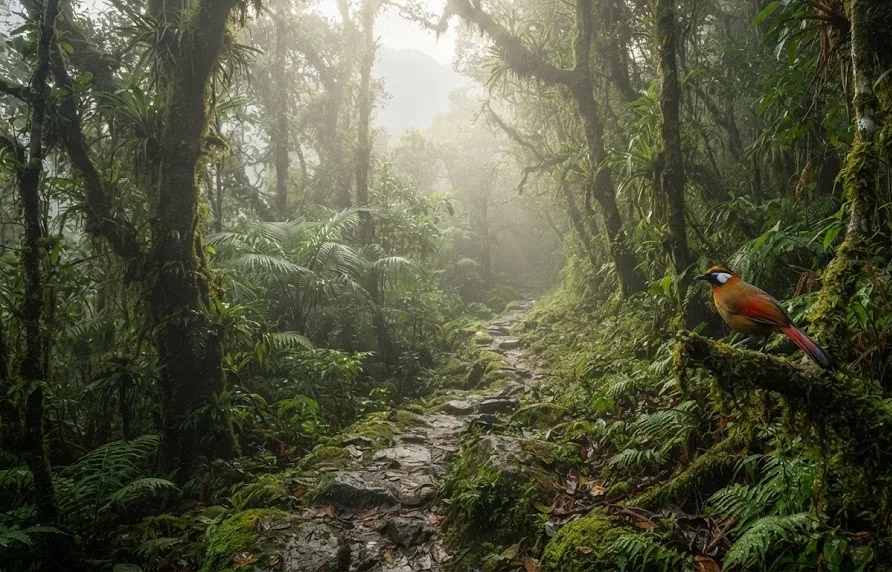
Bach Ma National Park is the premier destination for Annamite endemics, offering a 285-species checklist and the best chance to see the Crested Argus and Vietnamese Cutia in Central Vietnam.
Established in 1991, Bach Ma protects 22,000 hectares of evergreen forest spanning elevations from sea level to 1,450 meters at the summit. The park’s location on the eastern slope of the Annamite range creates a rain shadow effect that produces distinct habitats: lowland forest below 500 meters, mid-elevation forest between 500 and 1,000 meters, and montane cloud forest above 1,000 meters. This elevational gradient supports a high density of endemic bird species, including the Vietnamese Cutia, Green-backed Tit, and the critically endangered Crested Argus.
The park’s proximity to Da Nang (60 kilometers, approximately 1.5 hours by car) makes it feasible as a day trip, though an overnight stay at the park guesthouse significantly increases your chances of hearing the Crested Argus’s dawn call.
Target Species: Crested Argus, Silver Pheasant, Vietnamese Cutia, Green-backed Tit
- Crested Argus: Best heard at dawn (4:30–5:30 AM) near the summit; visual sightings are rare but possible on the Rhododendron Trail
- Silver Pheasant: Often seen along the main road in the early morning; look for males with striking white plumage
- Vietnamese Cutia: Forages in mixed-species flocks in mid-elevation forest; listen for its high-pitched contact call
- Green-backed Tit: Common in the montane zone above 1,000 meters; frequently visits the park guesthouse feeders
Best Time & Trail Guide: The Summit Road vs. Rhododendron Trail
The summit road (16 kilometers from the park entrance to the summit) is the most accessible route, passing through multiple habitat zones. The first 5 kilometers cover lowland forest where Silver Pheasants and Red Junglefowl are regular sightings. The middle section (5–12 kilometers) transitions to mid-elevation forest, the best area for Vietnamese Cutia and Green-backed Tit. The final 4 kilometers enter montane cloud forest, where Crested Argus and the Black-hooded Laughingthrush are possible. The Rhododendron Trail, a 3-kilometer loop near the summit, offers the best chance for understory species like the Pygmy Cupwing and the Eyebrowed Wren-Babbler.
Logistics: Overnight Stay at the Park vs. Day Trip from Da Nang
A day trip from Da Nang is feasible if you depart by 5:00 AM, arriving at the park gate by 6:30 AM. This gives you 6–7 hours of birding time before the return drive. However, an overnight stay at the park guesthouse (400,000–600,000 VND per night) allows you to bird the summit at dawn and dusk, when the Crested Argus is most vocal. The guesthouse has basic facilities—fan rooms, shared bathrooms, and a small restaurant. Book at least two weeks in advance for weekends and holidays, as the park receives increasing domestic tourism.
3. Hoi An Wetlands (Cam Thanh & Tra Nhieu): The Waterbird Paradise
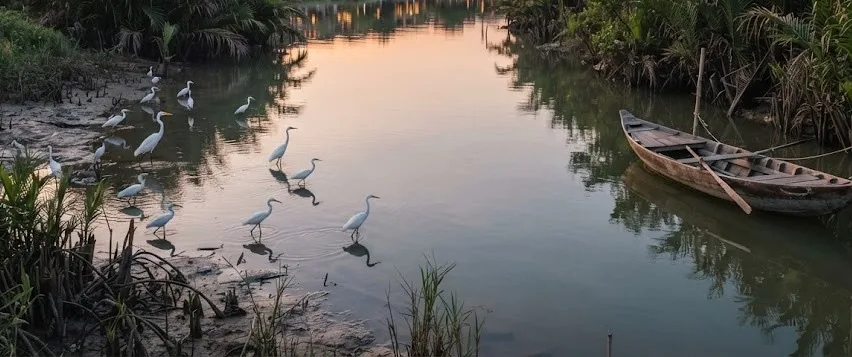
The Hoi An wetlands offer the best waterbird photography in Central Vietnam, with reliable sightings of Purple Herons, Eurasian Spoonbills, and Black-winged Stilts within a 30-minute drive from Da Nang.
The Cam Thanh and Tra Nhieu wetlands form a 1,200-hectare mosaic of tidal mudflats, nipa palm groves, and shrimp ponds. This habitat supports a resident population of wetland birds and serves as a critical stopover for migratory shorebirds along the East Asian–Australasian Flyway.
For photographers, the open habitat and predictable feeding schedules make this the most photogenic birding spot in the region. Purple Herons stalk the shrimp pond edges at dawn, while flocks of Black-winged Stilts and Lesser Whistling Ducks feed in the shallow water. The early morning light (5:30–7:30 AM) creates soft, golden conditions ideal for low-angle shots of waders in the water.
Target Species: Purple Heron, Eurasian Spoonbill, Black-winged Stilt, Lesser Whistling Duck
- Purple Heron: Regularly seen stalking the edges of shrimp ponds; best photographed at dawn
- Eurasian Spoonbill: Winter visitor (November–March) that feeds in the central lagoon area
- Black-winged Stilt: Resident breeder; flocks of 20–50 birds are common in the Cam Thanh area
- Lesser Whistling Duck: Nocturnal feeder; best seen at dusk as flocks fly to roosting sites
Best Time & Navigation: Morning Boat Cruise vs. Cycling the Paddy Field Dykes
The morning boat cruise (5:30–8:00 AM) from Cam Thanh village provides access to the central lagoon, where Eurasian Spoonbills and Purple Herons are most active. The boat ride costs 150,000 VND per person and lasts approximately two hours. For independent birders, cycling the paddy field dykes between Cam Thanh and Tra Nhieu offers a more flexible approach—the 10-kilometer loop takes 2–3 hours and passes multiple shrimp ponds. Rent a bicycle from Hoi An (50,000 VND per day) and start before sunrise to avoid the midday heat.
Logistics: Combining Birding with a Hoi An Cultural Visit
The wetlands are located 15 minutes east of Hoi An’s Old Town, making it easy to combine a morning birding session with an afternoon cultural visit. A typical itinerary: arrive at Cam Thanh village by 5:30 AM, bird the wetlands until 8:30 AM, then cycle to Hoi An’s Old Town for breakfast and sightseeing. The wetlands are most productive during the winter months (November–February) when migratory shorebirds are present. During the summer (June–August), focus on resident species and early morning hours to avoid the heat.
4. Ba Na Hills: High-Altitude Endemics and Scenic Cable Car Birding
Ba Na Hills offers a unique birding experience: riding the world’s longest cable car to 1,400 meters for access to high-altitude endemics like the Vietnamese Greenfinch and Yellow-billed Nuthatch.
The cable car journey itself is a birding opportunity—the 5.8-kilometer ride passes over primary forest canopy, giving you elevated views of raptors and canopy-dwelling species. I’ve recorded Crested Serpent Eagles, Mountain Hawk-Eagles, and even a Black Eagle during the ascent. Once at the summit, the forest trails around the French village area provide habitat for high-altitude specialists. The Vietnamese Greenfinch (Chloris monguilloti) is a regular visitor to the flowering trees near the cable car station, while the Yellow-billed Nuthatch (Sitta solangiae) forages on the trunks of old-growth pines.
Ba Na Hills receives heavy tourist traffic, especially on weekends and public holidays. The key strategy is to arrive on the first cable car (7:30 AM) and bird the summit trails before the crowds arrive at 9:00 AM. The period between 7:30 and 9:00 AM is when bird activity is highest and the forest is quietest. After 9:00 AM, focus on the less-visited trails behind the French village, where tourist noise is minimal.
Target Species: Vietnamese Greenfinch, Yellow-billed Nuthatch, Red-vented Bulbul
- Vietnamese Greenfinch: Common near the cable car station; look for flocks feeding on flowering trees
- Yellow-billed Nuthatch: Forages on pine trunks in the forest behind the French village
- Red-vented Bulbul: Widespread in the summit gardens; easily photographed
- Additional species: Black Bulbul, Grey Treepie, and the occasional White-browed Scimitar Babbler
Best Time & Strategy: Arriving Before the Tourist Crowds (First Cable Car)
The first cable car departs at 7:30 AM from the base station. Purchase your ticket online in advance (750,000 VND for adults) to avoid queues. Spend the first 90 minutes birding the trails immediately behind the French village—this area is least disturbed and has the highest bird density. By 9:00 AM, the main plaza becomes crowded; move to the forest trails near the Debay Wine Cellar or the Linh Ung Pagoda for quieter birding. Avoid weekends and Vietnamese public holidays (Lunar New Year, National Day) when visitor numbers exceed 20,000 per day.
Logistics: The Cable Car as a Birding Platform vs. Hiking the Forest Trails
The cable car is an excellent platform for raptor observation—I recommend riding the first car to the summit and sitting on the left side for the best views of the forest canopy. The 20-minute ascent passes through three habitat zones: lowland forest, mid-elevation forest, and montane cloud forest. After reaching the summit, focus on the forest trails rather than the tourist attractions. 5 hours to walk and provides the best birding experience. Bring a light rain jacket—the summit is often shrouded in mist until 9:00 AM.
5. Marble Mountains (Ngu Hanh Son): Limestone Karst Specialties
Marble Mountains offer a quick, accessible birding stop within Da Nang city limits, with reliable sightings of White-throated Kingfishers and Oriental Magpie-robins in a dramatic limestone karst setting.
The five marble and limestone hills rise abruptly from the coastal plain, creating isolated habitat pockets that support a distinct bird community. Thuy Son (Water Mountain), the largest and most visited, features a network of caves, pagodas, and forested pathways. The canopy-level views from the summit provide excellent vantage points for observing White-throated Kingfishers (Halcyon smyrnensis) hunting from exposed branches, and Black-naped Orioles (Oriolus chinensis) calling from the treetops.
Marble Mountains is best treated as a 1–2 hour birding stop rather than a dedicated destination. The site’s value lies in its convenience—it’s located on the main road between Da Nang and Hoi An, making it an ideal mid-morning or late-afternoon addition to a larger itinerary. The bird activity is highest between 6:00 and 8:00 AM, before the tourist crowds arrive. Entry costs 40,000 VND, and the climb to the summit takes approximately 15 minutes via the stone steps.
Target Species: White-throated Kingfisher, Oriental Magpie-robin, Black-naped Oriole
- White-throated Kingfisher: Often seen perched on branches overlooking the pagoda courtyards
- Oriental Magpie-robin: Common in the undergrowth near the cave entrances; easily approachable
- Black-naped Oriole: Heard more often than seen; listen for its fluting call from the canopy
- Additional species: Common Tailorbird, Asian Koel, and the occasional Black Drongo
Best Time & Route: Climbing Thuy Son Mountain for Canopy-Level Views
Start at the main entrance of Thuy Son at 6:00 AM. Climb the stone steps to the summit (approximately 10 minutes) and follow the loop trail that circles the top. The trail passes through forested sections with openings that offer views of the surrounding lowlands. Spend 30–45 minutes birding the summit, then descend to the cave areas (Am Phu Cave, Huyen Khong Cave) for understory species. The entire route takes 1–1.5 hours and covers approximately 2 kilometers.
Logistics: Quick Morning Trip vs. Combined Visit with Non Nuoc Beach
Marble Mountains is located directly across from Non Nuoc Beach, making it easy to combine a morning birding session with a beach visit. A typical itinerary: bird Thuy Son from 6:00 to 7:30 AM, then walk to Non Nuoc Beach for breakfast and a swim. The site is also a popular stop for marble carving shops—allow 30 minutes for browsing if interested. Parking is available at the base for 10,000 VND per motorbike.
6. Cu Lao Cham (Cham Island) Cruise: Pelagic and Migrant Species
A full-day cruise to Cu Lao Cham offers a rare opportunity to see pelagic species like the Brown Booby and Bridled Tern, along with the island’s resident Pacific Reef Herons.
Cu Lao Cham is a cluster of eight islands located 15 kilometers offshore from Hoi An’s Cua Dai Beach. The surrounding waters are productive feeding grounds for seabirds, particularly during the calm season (April–September) when the seas are flat and visibility is high. The 30-minute ferry ride from Cua Dai Beach to the main island (Hon Lao) passes through areas where Brown Boobies (Sula leucogaster) and Bridled Terns (Onychoprion anaethetus) are regularly seen foraging on the surface.
Once on the island, the rocky shoreline and sandy beaches provide habitat for Pacific Reef Herons (Egretta sacra), which are resident year-round. The island’s interior forest, though limited in extent, supports a small population of migrant passerines during the spring and autumn passages. A full-day trip allows 4–5 hours on the island, sufficient to bird the shoreline and one or two forest trails.
Target Species: Brown Booby, Bridled Tern, Pacific Reef Heron
- Brown Booby: Best seen during the ferry crossing; look for birds diving for fish near floating debris
- Bridled Tern: Often rests on floating buoys and fishing boats; scan the water surface with binoculars
- Pacific Reef Heron: Resident on the rocky shoreline; two color morphs (white and grey) are present
- Additional species: Whimbrel, Ruddy Turnstone, and the occasional White-tailed Tropicbird (rare)
Best Time & Experience: A Full-Day Birding Cruise from Cua Dai Beach
The best months for pelagic birding are April to September, when the seas are calm and visibility exceeds 10 kilometers. Depart from Cua Dai Beach at 7:00 AM on a speedboat or wooden ferry (250,000–400,000 VND per person round trip). The crossing takes 30–45 minutes. Once on Hon Lao, bird the shoreline for 2 hours, then hike the 3-kilometer trail to the island’s interior for forest species. Return to Da Nang by 4:00 PM. Bring sunscreen, a hat, and sea-sickness medication—the crossing can be rough in the afternoon.
Logistics: Booking a Private Charter vs. Joining a Group Tour
Group tours from Hoi An typically cost $25–$35 per person and include the ferry, lunch, and a guided walk. Private charters (approximately $150–$200 per boat) offer flexibility to spend more time on the water scanning for pelagic species. For dedicated birders, a private charter is recommended—the guide can adjust the route based on sightings. Book at least three days in advance during peak season (June–August) as ferries fill up quickly with domestic tourists.
7. Phong Nha – Ke Bang National Park (Overnight Trip): The Cave & Forest Giant
Phong Nha–Ke Bang National Park, roughly a 5-hour drive from Da Nang, offers the best chance to see Annamite forest specialists like the Sooty Babbler and Annamite Barbet in a UNESCO World Heritage setting.
Phong Nha–Ke Bang is Vietnam’s largest protected area, covering 123,000 hectares of limestone karst forest. Its remote location and challenging terrain have preserved some of the most intact lowland and mid-elevation forests in the Annamite range. The park’s bird checklist exceeds 350 species, including several that are difficult to find elsewhere: the Sooty Babbler (Stachyris herberti), Annamite Barbet (Psilopogon annamensis), and Red-collared Woodpecker (Picus rabieri).
The drive from Da Nang (roughly 270 kilometers, about five hours) requires a full 2-day commitment for meaningful birding. A day trip is possible but rushed—you’d have only 4–5 hours on site, which is insufficient to reach the best birding areas. For most birders, an overnight stay at a park-adjacent homestay is the practical choice.
Target Species: Sooty Babbler, Annamite Barbet, Red-collared Woodpecker
- Sooty Babbler: Forages in dense undergrowth near the Botanical Garden Trail; listen for its harsh scolding call
- Annamite Barbet: Best heard at dawn near the Dark Cave area; look for movement in fruiting trees
- Red-collared Woodpecker: Often seen on dead trees in the lowland forest near the park entrance
- Additional species: Black-crowned Barwing, Blue Pitta, and the elusive Rufous-throated Fulvetta
Best Time & Focus: The Botanical Garden Trail vs. The Dark Cave Area
The Botanical Garden Trail, a 5-kilometer loop near the park headquarters, is the most accessible birding route. It passes through lowland forest with good understory visibility, making it ideal for Sooty Babbler and Annamite Barbet. The trail takes 2–3 hours to walk and is suitable for all fitness levels. The Dark Cave area, located 10 kilometers further into the park, offers a more remote birding experience with higher chances of seeing Red-collared Woodpecker and Blue Pitta. Both areas are best birded between 5:30 and 9:00 AM.
Logistics: The 5-Hour Drive from Da Nang and Overnight Options
Drive from Da Nang to Phong Nha via the Ho Chi Minh Road (allow roughly five hours). Park at the Phong Nha–Ke Bang headquarters (free parking) and purchase an entry ticket (150,000 VND). For an overnight stay, book a homestay in the Phong Nha village area (300,000–500,000 VND per night). Several homestays offer guided birding tours with local experts. Return to Da Nang on the second day after a final morning birding session. The total cost for a 2-day trip, including transport, accommodation, and meals, is approximately 1.5–2 million VND per person.
Comparison Table: Choosing the Right Spot for Your 2026 Birding Trip
This table compares the seven spots across four key criteria to help you choose the best location based on your experience level, target species, and available time.
| Location | Effort Level | Key Target Species | Best Season | Logistics (from Da Nang) |
|---|---|---|---|---|
| Son Tra Peninsula | Easy (city adjacent) | Red-shanked Douc Langur, Chestnut-eared Laughingthrush | Year-round | 30-min drive; no guide needed |
| Bach Ma National Park | Moderate (day trip) | Crested Argus, Vietnamese Cutia, Silver Pheasant | Nov–Mar (dry season) | 1.5-hr drive; overnight recommended |
| Hoi An Wetlands | Easy (half-day) | Purple Heron, Eurasian Spoonbill, Black-winged Stilt | Nov–Feb (winter migrants) | 30-min drive; boat or bicycle |
| Ba Na Hills | Easy (cable car) | Vietnamese Greenfinch, Yellow-billed Nuthatch | Mar–Jun (breeding season) | 45-min drive; avoid weekends |
| Marble Mountains | Easy (quick stop) | White-throated Kingfisher, Black-naped Oriole | Year-round | 15-min drive; 1–2 hr visit |
| Cu Lao Cham | Moderate (full-day) | Brown Booby, Bridled Tern, Pacific Reef Heron | Apr–Sep (calm seas) | 30-min ferry from Hoi An |
| Phong Nha–Ke Bang | Challenging (overnight) | Sooty Babbler, Annamite Barbet, Red-collared Woodpecker | Mar–May (dry, active birds) | About 5-hr drive; overnight needed |
Frequently Asked Questions
What is the single best birdwatching spot in Da Nang for a beginner?
Son Tra Peninsula is the best choice for beginners. It is a 15-minute motorbike ride from the city center, requires no entrance fee, and has a paved road with frequent stopping points. You can see 30–40 bird species in a single morning, including the iconic Red-shanked Douc Langur, without needing a guide or specialized gear.
Do I need a local guide to birdwatch in Da Nang, or can I go independently?
You can birdwatch independently at Son Tra Peninsula, Marble Mountains, and the Hoi An wetlands. For Bach Ma National Park, Ba Na Hills, and Cu Lao Cham, a guide is recommended for species identification and navigating trails. Phong Nha–Ke Bang strongly requires a local guide due to the remote forest terrain and low bird density.
What is the most important piece of gear to bring for birding in Da Nang’s climate?
A lightweight, waterproof binocular (8×42 or 10×42) is essential because the humidity and occasional rain can fog lenses. Also bring a reusable water bottle, a wide-brimmed hat, and insect repellent with DEET. A field guide to the birds of Vietnam (e.g., “Birds of Southeast Asia” by Robson) is useful for identification.
Are there any ethical birding guidelines specific to Central Vietnam?
Yes. Do not use playback calls to attract birds, as this can disrupt breeding behavior. Keep a minimum distance of 30 meters from nesting sites, especially for the Crested Argus and Silver Pheasant. Do not feed wildlife, including the Red-shanked Douc Langur on Son Tra Peninsula. Stay on marked trails to avoid disturbing forest undergrowth.
Where can I find a reliable birding tour operator in Da Nang for 2026?
Vietnam Eco Tours and Next Continent Tours are two established operators based in Da Nang that specialize in birding tours. Check their recent reviews on travel platforms for updated itineraries and pricing. For independent planning, the eBird hotspot maps for Central Vietnam provide real-time species lists and recent sightings from other birders.
Next Steps
Da Nang’s top birdwatching spots offer a diversity of habitats and species that rival dedicated nature reserves in Southeast Asia. The key to a successful trip is matching your chosen location to your experience level and time budget. Start with Son Tra Peninsula for a low-effort introduction, then progress to Bach Ma National Park or Phong Nha–Ke Bang for deeper forest birding. Book guided tours for remote sites to maximize your sightings. Pack light, start early, and respect the wildlife to make the most of your 2026 birding adventure in Central Vietnam.
Part of our guide to things to do in Da Nang.