Da Nang offers more than just stunning beaches and Marble Mountains. A short drive from the city center lies a network of traditional craft villages where centuries-old skills are still practiced daily. This guide focuses on the hands-on experiences available in 2026, detailing exactly how you can participate in stone carving, fish sauce making, rice paper crafting, mat weaving, and sesame cracker production. You will leave with a clear itinerary, practical booking tips, and the knowledge to create your own authentic souvenirs directly from the artisans who have mastered these crafts.
Five traditional craft villages within 15 kilometers of Da Nang city center offer hands-on workshops in 2026. Non Nuoc stone carving village has operated for over 400 years at the foot of Marble Mountains. Nam O fish sauce ferments for a minimum of 12 months using only anchovies and salt. Tuy Loan rice paper requires a batter consistency similar to heavy cream for proper spreading. Cam Ne mat weaving uses reeds harvested from local riverbanks during the dry season. Cam Le sesame crackers maintain a 3:1 sesame-to-sugar ratio for optimal crunch. This guide covers logistics, workshop details, and cultural etiquette for each village.
Planning Your Da Nang Craft Village Itinerary: Logistics for 2026
Visiting all five craft villages comfortably requires two full days, with the best weather window falling between February and April.
The central Vietnam climate divides into two distinct seasons. The dry season runs from February through August, with February to April offering the most pleasant temperatures averaging 25-30°C. The rainy season peaks from October to December, when afternoon downpours can disrupt outdoor workshops. The Da Nang International Fireworks Festival (DIFF) typically runs from June to July, drawing large crowds and increasing accommodation prices by an estimated 30-40% during weekends. If you prefer quieter visits, plan your craft village tour for weekday mornings in March or April.
Getting around requires a choice between three main transport options. Renting a motorbike costs approximately 150,000-200,000 VND per day and offers maximum flexibility for reaching villages located on smaller roads. A private car with driver costs roughly 800,000-1,200,000 VND for a full day, covering all five villages comfortably. Organized tours run by local operators typically cost 500,000-700,000 VND per person and include English-speaking guides who can facilitate workshop participation. For first-time visitors unfamiliar with Vietnamese traffic, the private car or organized tour provides a less stressful experience.
A practical single-day route from Da Nang city center starts with Non Nuoc Stone Carving Village at 8:00 AM, located just 8 kilometers southeast near Marble Mountains. From there, drive 10 kilometers north to Nam O Fish Sauce Village for a mid-morning visit. Continue 5 kilometers inland to Tuy Loan Rice Paper Village, where you can participate in a workshop before lunch. After eating, head 7 kilometers southwest to Cam Ne Mat Weaving Village, then finish 3 kilometers east at Cam Le Sesame Rice Cracker Village. This route minimizes backtracking and covers all five villages without rushing.

Non Nuoc Stone Carving Village: Watching Masters Shape Marble
The 400-year history of stone carving at the foot of Marble Mountains
Non Nuoc Stone Carving Village has transformed marble from the nearby Marble Mountains into intricate sculptures for over four centuries, blending Cham and Vietnamese artistic traditions.
Founded in the 17th century by artisans who discovered the unique white and blue-veined marble deposits at Ngu Hanh Son, the village became a royal supplier during the Nguyen Dynasty. Today, over 300 workshops line the streets, their open fronts revealing a symphony of chisels striking stone. The craft requires extraordinary patience — a single Buddha statue can take three months to complete, with masters working 10-hour days. What sets Non Nuoc apart is the natural vein of the marble itself: the stone’s internal patterns dictate the final design, meaning no two pieces are identical.
In 2026, the village has embraced modern tools like electric grinders for rough shaping, but the finishing work — eyes, fingers, folds of fabric on robes — remains hand-done by masters who learned the trade from their fathers and grandfathers.
Hands-on experience: trying your hand with a chisel under a master’s eye
Most workshops offer 30-60 minute beginner sessions where you carve a small animal or geometric pattern from a pre-cut marble block, guided step-by-step by an experienced artisan.
The experience typically costs 200,000-400,000 VND and includes all tools and materials. You’ll start by tracing a template onto the stone surface using a pencil, then progress to rough shaping with a hammer and flat chisel. The master will demonstrate the correct angle — 45 degrees for marble — and the precise force needed to avoid cracking the stone. After rough shaping, you switch to finer tools: a pointed chisel for details and a rasp for smoothing edges. Expect dust: wear old clothes or use the provided apron.
The session ends with you polishing your piece using wet sandpaper, revealing the stone’s natural luster. One tip from local artisans: breathe through your mouth, not your nose, to avoid inhaling fine marble particles. Your finished piece — often a small turtle, lotus bud, or heart — becomes a souvenir with genuine personal effort embedded in it.
What to buy: spotting quality stoneware and negotiating prices
High-quality Non Nuoc stoneware features smooth surfaces, symmetrical proportions, and consistent vein patterns — avoid pieces with visible cracks or uneven coloring.
Authentic marble feels cool to the touch and has a slight weight advantage over painted resin imitations sold at tourist markets. Check the base: genuine stoneware has a rough, unpolished bottom where the craftsman cut it from the block. Popular purchases include:
- Miniature statues (100,000-300,000 VND): Small Quan Am (Goddess of Mercy) or Buddha figurines, palm-sized and easy to pack.
- Stone paintings (500,000-2,000,000 VND): Thin marble slabs with engraved landscapes, backlit for wall display.
- Bracelets and pendants (50,000-150,000 VND): Polished marble beads in white, green, or pink hues.
Negotiation is expected — start at 60% of the quoted price for items over 500,000 VND. Workshops that display “fixed price” signs usually offer better quality. Ask for a certificate of authenticity if spending over 1,000,000 VND; reputable sellers provide one. For shipping large pieces, most workshops partner with local couriers charging 200,000-500,000 VND for international delivery.
Nam O Fish Sauce Craft Village: Da Nang’s Liquid Gold
The traditional fermentation process: anchovies, salt, and time
Nam O fish sauce is made by layering fresh anchovies with sea salt in wooden barrels and fermenting for 12-18 months, producing a rich amber liquid prized across Vietnam.
The process begins at sea: fishermen catch ca com (commerson’s anchovy) during the peak season from January to April, when the fish are fattest and most flavorful. Back in the village, the anchovies are mixed with Phan Rang sea salt at a ratio of 3:1 (fish to salt) and packed into 200-liter teak barrels. A bamboo press is placed on top, weighted with stones, and the barrels are left in covered sheds for at least one year. During fermentation, natural enzymes break down the fish proteins into amino acids, creating the sauce’s umami depth.
Master fermenters check progress monthly, tasting samples and adjusting salt levels. The first extraction — called “nước mắm nhỉ” — is the highest quality, reserved for dipping sauces. Subsequent extractions use the same fish but yield lighter, less complex sauces suitable for cooking. In 2026, only 15 families in Nam O still practice the traditional method, producing roughly 30,000 liters annually versus industrial factories making millions.
Tasting the difference: Nam O sauce vs. mass-produced fish sauce
Nam O fish sauce has a deeper amber color, thicker consistency, and more complex flavor profile than mass-produced alternatives, with notes of roasted nuts and sea brine rather than just saltiness.
To experience the difference, visit a family workshop where they offer tasting flights of three grades: first-press (20-25°N protein content), second-press (15-18°N), and third-press (10-12°N). Mass-produced sauces often contain caramel coloring, monosodium glutamate, and preservatives — Nam O sauce lists only three ingredients: anchovies, salt, and time. The texture tells the story: authentic Nam O sauce coats the tongue and lingers, while industrial versions feel watery and evaporate quickly.
Local chefs recommend pairing first-press sauce with simple steamed vegetables or white rice to appreciate its purity. The price reflects the craft: 80,000-120,000 VND per liter for first-press Nam O versus 20,000-40,000 VND for mass-market bottles.
Visiting a family workshop: what to look for and ask
When visiting a Nam O workshop, look for wooden barrels in shaded sheds, a strong but not overpowering fishy smell, and families willing to explain their process in detail.
Start at the Nam O Fish Sauce Cooperative (số 1 đường Nguyễn Tất Thành), which connects visitors with participating families. Ask these questions to gauge authenticity:
- “How long do you ferment?” — Traditional producers answer 12-18 months; anything under 6 months indicates accelerated chemical fermentation.
- “Where do your anchovies come from?” — Local fishermen within 20 km of Da Nang coast, not imported frozen fish.
- “Can I see your barrels?” — Genuine workshops proudly show their aging inventory, often with dates written on each barrel.
Bring your own container if possible — some workshops will fill it fresh from the barrel. The best souvenir is a 500ml bottle of first-press sauce, which keeps for 2-3 years unopened and 6 months after opening. Store it in a cool, dark cupboard — refrigeration is unnecessary and can crystallize the natural proteins.
Tuy Loan Rice Paper Village: Making and Cooking with Bánh Tráng
From rice batter to crispy sheets: the making of Tuy Loan rice paper
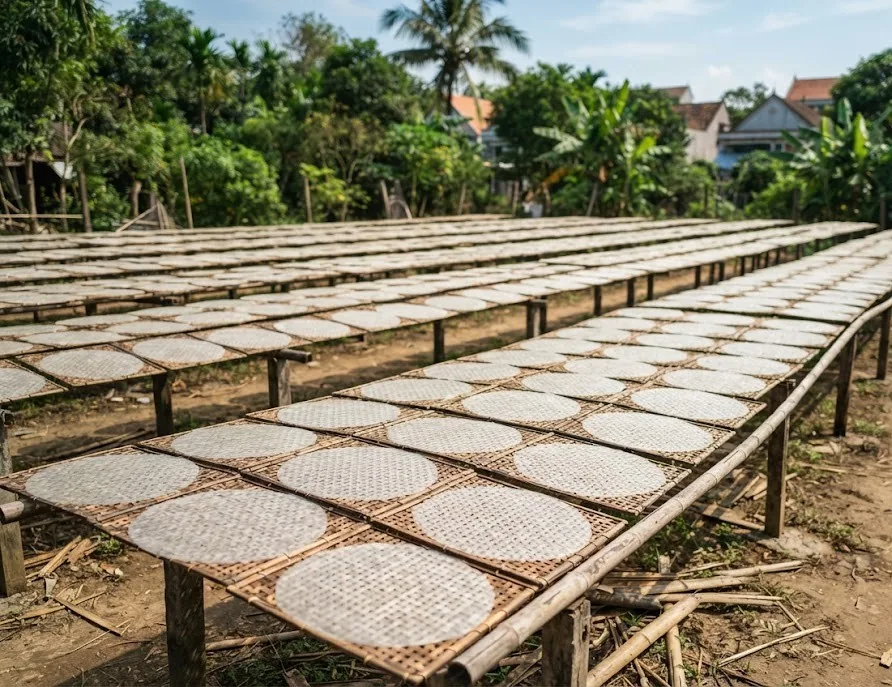
Tuy Loan rice paper starts with a simple batter of rice flour, water, and salt, which is spread onto a cloth-covered drum, steamed for 30 seconds, then dried under the sun for 2-3 hours.
The village, located 15 km west of Da Nang center, has produced bánh tráng for over 200 years. Each family follows a closely guarded recipe for the batter consistency — too thin and the paper tears, too thick and it becomes chewy rather than crispy. The key ingredient is the rice itself: Tuy Loan families use a specific variety of long-grain rice from Quang Nam (now part of Da Nang), which has a higher amylose content for better crispness. After steaming, the sheets are transferred to bamboo racks and carried to open fields where they dry under direct sunlight.
Experienced workers can tell when the paper is ready by its slight curl at the edges and a papery sound when tapped. In 2026, some families have added mechanized drying for rainy days, but sun-dried sheets remain the gold standard for texture and flavor. A single family produces 300-500 sheets daily during peak season.
Hands-on workshop: spreading, steaming, and drying your own batch
A 90-minute workshop at Tuy Loan costs 150,000-250,000 VND and lets you make 5-10 sheets of rice paper from scratch, from mixing batter to peeling the finished product.
The process breaks into four steps. First, you stir the batter until smooth — lumps cause holes in the final sheet. Second, you ladle a thin layer onto the cloth drum and spread it evenly with a circular motion, similar to crepe-making. Third, you cover the drum and wait for the steam to cook the batter (count to 30 Mississippi). Finally, you use a bamboo spatula to peel the translucent sheet from the cloth and transfer it to a drying rack. The tricky part is the peeling: too slow and the sheet sticks, too fast and it tears.
Most beginners tear their first two sheets before getting the rhythm. After drying, you can toast your sheets over a charcoal fire for 10 seconds — they puff up and become the bánh tráng nướng (grilled rice paper) sold by street vendors across Vietnam. The workshop includes a tasting session where you dip your fresh sheets in homemade sauce made from Nam O fish sauce, garlic, and chili.
Local dishes to try: bánh tráng cuốn thịt heo and other specialties
The most iconic dish using Tuy Loan rice paper is bánh tráng cuốn thịt heo — fresh sheets wrapped around boiled pork, herbs, and green banana, dipped in fermented shrimp sauce.
After your workshop, visit one of the village’s family-run eateries for a full meal. The dish involves dipping the dry rice sheet in warm water for 5 seconds to soften it, then layering it with slices of pork belly, fresh lettuce, mint, cilantro, and thin slices of green banana (which adds a tangy, slightly astringent note). The roll is then dipped in mắm nêm (fermented anchovy sauce) mixed with pineapple, garlic, and chili. Other local specialties include:
- Bánh tráng trộn: Shredded rice paper mixed with quail eggs, dried beef, mango, and tamarind sauce — a popular street snack.
- Bánh tráng nướng: Grilled rice paper topped with quail egg, dried shrimp, scallion oil, and mayonnaise.
- Bánh tráng cuốn chả: Fresh rolls with grilled pork sausage and pickled vegetables.
Prices at village eateries range from 30,000-60,000 VND per dish. The experience of eating fresh rice paper — still warm from the drying rack — is something you cannot replicate with store-bought sheets.
Cam Ne Mat Weaving Village: The Art of Reed and Rush
Harvesting and preparing natural fibers for weaving
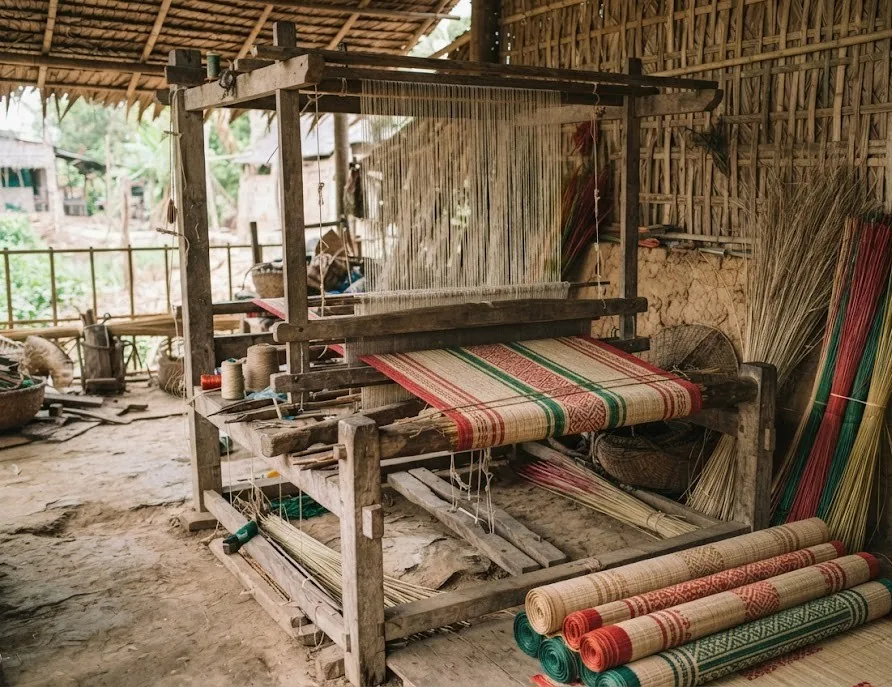
Cam Ne mat weavers use two primary materials: cói (a type of sedge grass) harvested from flooded fields around Hoi An, and lác (rush) grown in the sandy soils of Cam Le district.
The harvesting season runs from June to August, when the reeds reach 1.5-2 meters in height. Farmers cut them by hand at dawn, when the stems contain maximum moisture and flexibility. Back in the village, the reeds are split lengthwise using a simple wooden tool, then sun-dried for 3-5 days until they turn a pale golden color. The drying process is critical: under-dried reeds rot within months, while over-dried ones become brittle and snap during weaving. Some families dye the reeds using natural pigments — indigo for blue, turmeric for yellow, and mangrove bark for brown.
The dyed reeds are then soaked in water for 30 minutes to restore flexibility before weaving begins. In 2026, only about 40 families in Cam Ne still practice the craft, down from 200 in 1990, as younger generations move to city jobs. Those who remain have shifted focus to higher-end products like wall hangings and placemats to compete with machine-made alternatives.
Learning the loom: basic mat-weaving techniques for beginners
A beginner weaving session at Cam Ne lasts 60-90 minutes and teaches the basic over-under pattern used to create a 30×40 cm coaster or small placemat.
The workshop starts with you selecting your reed colors — most families offer 6-8 natural shades. The master demonstrates the setup: vertical warp threads are stretched on a wooden frame, and you weave horizontal weft reeds through them, alternating over-one-under-one for a plain weave pattern. The key technique is maintaining even tension: too tight and the mat curls at the edges; too loose and gaps appear between rows. You’ll use a wooden comb called a “lược” to push each row firmly against the previous one.
After 20-30 rows, you learn to introduce color changes by overlapping a new reed over the old one’s end. The session ends with you trimming the edges and folding them under for a finished look. The cost is 100,000-200,000 VND, and you leave with your handwoven piece. One memorable detail: the reeds release a subtle grassy fragrance as you work, especially when they’re slightly damp from the pre-weaving soak.
Modern applications: from traditional mats to contemporary home decor
Cam Ne weavers now produce table runners, lamp shades, yoga mat rolls, and even handbag panels alongside traditional floor mats, adapting the craft for modern Vietnamese and export markets.
The shift began around 2018 when a local cooperative partnered with Da Nang designers to create contemporary products that appeal to younger buyers. A standard floor mat (1.8m x 2m) costs 500,000-1,200,000 VND depending on pattern complexity and dye quality. Smaller decor items like coasters (set of 4 for 80,000 VND) and trivets (50,000 VND each) make affordable souvenirs. For serious buyers, custom orders are possible: choose your dimensions, color palette, and pattern (stripes, checks, or geometric motifs). Production takes 3-7 days for a custom mat.
The durability surprises most visitors — a well-made Cam Ne mat lasts 10-15 years with proper care (avoid direct sunlight and moisture). When shopping, look for tight, uniform weaving with no visible gaps. Run your hand across the surface: quality mats feel smooth, not prickly. The natural reed color deepens to a richer honey tone over time, adding character.
Cam Le Sesame Rice Cracker Village: A Sweet and Savory Snack
Ingredients and the traditional roasting process
Cam Le sesame crackers combine glutinous rice flour, sesame seeds (white, black, or both), sugar, and coconut milk, roasted over charcoal until golden and crisp.
The village, just 5 km south of Da Nang center, has specialized in bánh mè (sesame crackers) for over 100 years. The process begins with mixing the rice flour with coconut milk and sugar to form a thick paste. Sesame seeds are then folded in — the ratio is roughly 3:1 sesame to flour by volume, giving the crackers their characteristic nutty crunch. The paste is shaped into small balls, pressed flat into 8 cm discs using a wooden mold, then arranged on a wire rack over a charcoal fire.
The roaster must constantly rotate the rack and flip each cracker every 30 seconds to ensure even browning. Overcooking by just 15 seconds produces a burnt, bitter taste. The finished crackers have a deep golden color with sesame seeds visible on both surfaces. In 2026, a typical family produces 500-800 crackers daily, selling them fresh from the village or to distributors across central Vietnam.
Hands-on session: pressing and toasting your own sesame crackers
A 45-minute workshop at Cam Le costs 80,000-150,000 VND and lets you make 10-15 crackers, from mixing dough to packaging your finished batch.
The session starts with you measuring ingredients: 200g rice flour, 100g sesame seeds, 50g sugar, and 100ml coconut milk. You mix by hand until the dough is smooth and pliable — if it sticks to your fingers, add more flour. Next, you pinch off walnut-sized pieces, roll them into balls, and press them into the wooden mold. The mold has a carved pattern that imprints a decorative design onto the cracker surface. The fun part comes at the charcoal fire: you place your crackers on the wire rack and learn to read the heat.
The perfect temperature is when you can hold your hand 15 cm above the coals for 5 seconds before it becomes uncomfortable. You’ll flip each cracker 4-5 times over 3-4 minutes until it turns an even golden brown. The master will tap a finished cracker with tongs — the sound should be a clear “clink,” not a dull “thud.” Your batch goes into a paper bag while still warm, and the village aroma of toasted sesame and coconut will follow you for the rest of the day.
Packaging and taking home: best ways to store and enjoy
Fresh Cam Le sesame crackers stay crispy for 2-3 weeks when stored in an airtight container at room temperature — avoid refrigeration, which introduces moisture.
The village sells crackers in simple plastic bags (20,000-30,000 VND for 10 pieces) or decorative bamboo baskets (50,000-80,000 VND for 20 pieces) that make attractive gifts. For longer storage, vacuum-sealed packs last 3-4 months. When packing for your flight home, place the crackers in your carry-on luggage — checked baggage can experience temperature fluctuations that compromise crispness. Enjoy them as a snack with tea or coffee, or crush them over salads and soups for texture. Locals also use crushed sesame crackers as a coating for fried chicken or fish, creating a nutty crust.
The sweet variety (with extra sugar) pairs well with fresh fruit, while the savory version (with added salt and black pepper) complements cold beer. One tip from village elders: warm the crackers in a dry pan over low heat for 2 minutes before serving to revive the freshly-toasted flavor and aroma.
Key Tips for a Respectful and Rewarding Village Visit
Etiquette: asking permission before photographing artisans
Always ask before taking photos or videos of artisans — a simple smile and gesture toward your camera is usually sufficient, and most will happily pose for you.
Many craftspeople work in their family homes, not tourist studios, so treat their workspace with the same respect you would someone’s living room. If an artisan declines to be photographed, accept the refusal gracefully and focus on capturing the tools, materials, or finished products instead. Some workshops charge a small photography fee (10,000-20,000 VND) for commercial use, which is reasonable given that the craftspeople are working. When photographing the process, avoid using flash — it can distract the artisan and disrupt delicate work like chisel strokes or weaving patterns.
A good practice is to take photos during the workshop portion of your visit, when the artisan is already demonstrating for you, rather than during their independent work time. Remember that your presence is a privilege: these families open their homes to share traditions that have sustained them for generations.
Supporting the community: buying direct vs. buying from resellers
A Nam O fish sauce bottle priced at 120,000 VND in the village might sell for 250,000 VND in the city. Direct purchases also guarantee authenticity: you see the workshop, meet the maker, and can verify the production process. When buying, consider these factors:
- Bulk discounts: Most villages offer 10-20% off for purchases over 500,000 VND.
- Custom orders: Many workshops accept orders for larger quantities or specific designs.
- Payment methods: Cash is king in villages — only a few workshops have card terminals.
If you cannot visit the villages, look for products with the “One Commune One Product” (OCOP) certification label, a Vietnamese government program that verifies local origin and quality. Supporting these communities directly helps preserve the crafts for future generations — your purchase is a vote for tradition over mass production.
Language basics: useful Vietnamese phrases for the workshop floor
Learning a few Vietnamese phrases transforms your interaction from transactional to genuinely warm — artisans appreciate the effort even if your pronunciation is imperfect.
Here are the most useful phrases for your village visits:
- “Cảm ơn” (gam-un): Thank you. Use this frequently and with a smile.
- “Bao nhiêu?” (bow-nyew): How much? Essential for price negotiation.
- “Tôi muốn làm thử” (toy mun lam thuh): I want to try. Opens the door to hands-on participation.
- “Đẹp quá!” (dep kwa): So beautiful! A genuine compliment that delights artisans.
- “Cho tôi xin một cái” (chaw toy sin mot kai): Please give me one. Useful when buying.
When an artisan speaks to you in Vietnamese, don’t panic — they likely know more English than you realize. Use hand gestures, point at objects, and smile. The universal language of appreciation — watching someone’s face light up when they see you genuinely admire their work — transcends any vocabulary gap. Write down key phrases on your phone before visiting, and don’t be shy about using them. Even a mispronounced “cảm ơn” will earn you a broader smile than perfect English ever could.
Comparison of Craft Village Experiences
| Craft Village | Primary Craft | Hands-On Workshop Duration | Approximate Cost (Workshop) | Key Souvenir | Cultural Significance |
|---|---|---|---|---|---|
| Non Nuoc | Stone Carving | 30-60 minutes | 200,000 – 400,000 VND | Marble figurines, small sculptures | 400+ years of tradition, Cham & Vietnamese influences |
| Nam O | Fish Sauce Fermentation | Tasting session (no hands-on making) | 50,000 – 100,000 VND (for tasting) | Bottled traditional fish sauce | Preservation of authentic fermentation methods |
| Tuy Loan | Rice Paper Making | 90 minutes | 150,000 – 250,000 VND | Handmade rice paper sheets | Centuries of culinary tradition |
| Cam Ne | Mat Weaving | 60-90 minutes | 100,000 – 200,000 VND | Woven coasters, placemats | Adaptation of natural materials into functional art |
| Cam Le | Sesame Cracker Production | 45 minutes | 80,000 – 150,000 VND | Freshly made sesame crackers | Local snack heritage, unique flavor profile |
Related on this site
- Discovering Da Nang’s Folk Music Traditions: From Instruments to Melodies 2026
- Da Nang’s Top Cultural Villages: Traditional Crafts and Local Life 2026
- Da Nang’s Cultural Festivals Calendar: Events You Can’t Miss in 2026
Frequently Asked Questions
1. Do I need to book workshops in advance, or can I just show up?
Most villages accept walk-in visitors, but booking 1-2 days in advance ensures the artisan prepares materials and sets aside time for you. Contact your hotel concierge or search for direct workshop numbers. During peak season (June-August and December), advance booking is strongly recommended.
2. Are the workshops suitable for children?
Yes, most workshops welcome children aged 8 and above. The sesame cracker pressing and rice paper spreading activities are particularly child-friendly, with minimal safety risks. Younger children can observe but should be supervised near charcoal fires and sharp tools at stone carving and mat weaving villages.
3. What should I wear for a craft village visit?
Wear comfortable, breathable clothing that you don’t mind getting dusty or stained. Closed-toe shoes are essential, especially at Non Nuoc (marble dust) and Cam Ne (reed splinters). Long pants protect against mosquito bites in rural areas. Avoid loose jewelry that could catch on weaving looms or stone carving equipment.
4. Can I ship my handmade items home?
Most villages have partnerships with local shipping services. Stoneware and fish sauce bottles are easier to ship than bulky items like floor mats. Expect shipping costs of 200,000-500,000 VND for small packages to international destinations. Ask the workshop to pack items with bubble wrap and double cardboard boxes.
5. How much time should I allocate per village?
For a meaningful hands-on experience, allocate 90 minutes to 2 hours per village. This includes the workshop session, browsing finished products, and enjoying any food offerings. Rushing through in under an hour defeats the purpose of immersive participation — you’ll miss the stories and techniques that make each craft special.
6. Is it possible to visit all five villages in one trip?
Technically yes, but practically not recommended. You would spend 6-7 hours in transit and only 30 minutes per village. A better approach is 2-3 villages per day over 2-3 days, allowing genuine engagement. The route combining Non Nuoc, Nam O, and Tuy Loan works well for a single day.
7. What happens if it rains during my scheduled workshop?
Most workshops have covered areas for rainy-day operation. Rice paper drying and sesame cracker roasting may be affected, as both require outdoor sun or charcoal fire. Check the weather forecast and choose stone carving or mat weaving (indoor-friendly) on rainy days. Workshops typically offer rescheduling with 24-hour notice.
Conclusion: Your Next Steps
Da Nang’s traditional craft villages offer something no museum or souvenir shop can replicate: the chance to create something with your own hands, guided by masters who have spent lifetimes perfecting their art. From the chisel marks on marble to the scent of fermenting fish sauce, each village tells a story of patience, skill, and cultural continuity. Your handmade rice paper, sesame crackers, or woven mat becomes more than a souvenir — it’s a tangible connection to the people and traditions of central Vietnam.
- Choose your top three villages from this guide based on your interests — prioritize hands-on workshops over passive observation. Contact your hotel or local tour operator to arrange transportation and confirm workshop availability at least 48 hours before your visit.
- Prepare your visit kit: cash (1,000,000-2,000,000 VND), comfortable shoes, a reusable water bottle, and a small bag for handmade purchases. Download a translation app and save the Vietnamese phrases from this guide on your phone.
- Share your experience responsibly: Post photos with permission, tag the villages if they have social media, and consider leaving a review on Google Maps or TripAdvisor to help other travelers discover these authentic experiences.
Part of our guide to places to visit in Da Nang.