Da Nang’s Top Cultural Villages: Traditional Crafts and Local Life 2026 offers travelers a chance to step beyond the beaches and into centuries-old communities where artisans still shape stone, ferment fish sauce, and weave palm mats by hand. With Vietnam home to more than 5,400 craft villages and nearly 2,000 recognized as traditional, the cultural belt around Da Nang and Hoi An has become a focal point for slow travel and authentic local experiences. This guide covers the five most accessible villages, what to see and do at each, and practical planning advice for your 2026 visit.
The craft villages around Da Nang are not museum pieces but living communities where you can watch masters at work, join hands-on workshops, and buy directly from makers. Non Nuoc stone carving, Nam O fish sauce, Thanh Ha pottery, Tuy Loan rice paper, and Cam Ne mat weaving each offer a distinct window into local life. Most sit within 10 to 16 kilometers of the city center, making half-day and full-day itineraries easy to arrange by motorbike or taxi.
Da Nang’s Cultural Villages: A 2026 Guide to Traditional Crafts and Local Life
Why Da Nang’s craft villages are becoming a top cultural tourism draw in 2026
Vietnam’s tourism landscape has shifted toward experiential travel, and craft villages are riding that wave. According to recent statistics cited by industry sources, Vietnam now has more than 5,400 craft villages, including roughly 2,000 traditional ones, with 57 recognized as national treasures. Da Nang sits at the center of this cultural map, surrounded by villages that have operated for centuries.
The city’s tourism board has actively promoted these destinations as part of a broader strategy to diversify beyond beach tourism, and the new inland waterway pier at Thanh Ha Pottery Village signals a coordinated effort to link Da Nang with the Hoi An cultural belt.
What to expect: hands-on workshops, artisan meet-and-greets, and slow travel experiences
Visiting these villages in 2026 is not a passive sightseeing exercise. Expect to roll up your sleeves at a pottery wheel, try your hand at chiseling marble, or watch fish sauce being drawn from century-old jackfruit wood vats. Many workshops now cater to international visitors with English-speaking guides and structured sessions that last 30 to 90 minutes. The pace is deliberately slow, giving you time to chat with artisans, understand their craft, and appreciate the patience that goes into each product. This is travel that connects you to place and people rather than simply checking off sights.
How to Choose Which Cultural Villages to Visit Near Da Nang
Distance and transport: motorbike, taxi, or organized tour from Da Nang center
Your choice of transport shapes how many villages you can realistically visit. Non Nuoc Stone Carving Village sits closest at roughly 10 kilometers from Da Nang center, about 20 minutes by motorbike or taxi. Tuy Loan Rice Paper Village is around 14 kilometers away, while Cam Ne Mat Weaving Village lies approximately 16 kilometers southwest. Organized tours bundle two or three villages with round-trip transport, which removes navigation stress but limits flexibility.
For independent travelers, renting a motorbike from Da Nang costs roughly 150,000 to 200,000 VND per day, and a taxi ride to any single village runs between 150,000 and 250,000 VND one way.
Time budget: half-day vs. full-day village-hopping itineraries
With a half-day, pick one village and explore it thoroughly. Non Nuoc works well in the morning combined with a climb up Marble Mountains, while Nam O Fish Sauce Village pairs naturally with lunch at a local seafood spot. A full day allows for two villages: combine Non Nuoc with Thanh Ha Pottery for a craft-heavy itinerary, or pair Tuy Loan with Cam Ne for a cultural deep dive into Hoa Vang’s traditions. The key is avoiding over-scheduling, as each village rewards unhurried exploration.
Matching villages to traveler interests: foodies, photographers, families, and craft enthusiasts
Different villages appeal to different traveler profiles. Foodies should prioritize Nam O Fish Sauce Village and Tuy Loan Rice Paper Village, where tasting is central to the experience. Photographers will find endless material at Non Nuoc Stone Carving Village, where marble sculptures contrast against the dramatic Marble Mountains backdrop. Families with children often enjoy Thanh Ha Pottery Village most, since hands-on pottery classes keep young hands busy and engaged. Craft enthusiasts who want to see rare techniques should not miss Cam Ne Mat Weaving Village, where the custom-dyeing process is unique to this community. Here is a quick reference:
- Foodies: Nam O Fish Sauce, Tuy Loan Rice Paper
- Photographers: Non Nuoc Stone Carving, Marble Mountains backdrop
- Families: Thanh Ha Pottery, hands-on classes for all ages
- Craft enthusiasts: Cam Ne Mat Weaving, rare dyeing technique
- History buffs: Tuy Loan communal house, Non Nuoc’s 400-year legacy
Non Nuoc Stone Carving Village: The 400-Year-Old Art at the Foot of Marble Mountains
The history: from artisan Huynh Ba Quat to National Intangible Cultural Heritage status
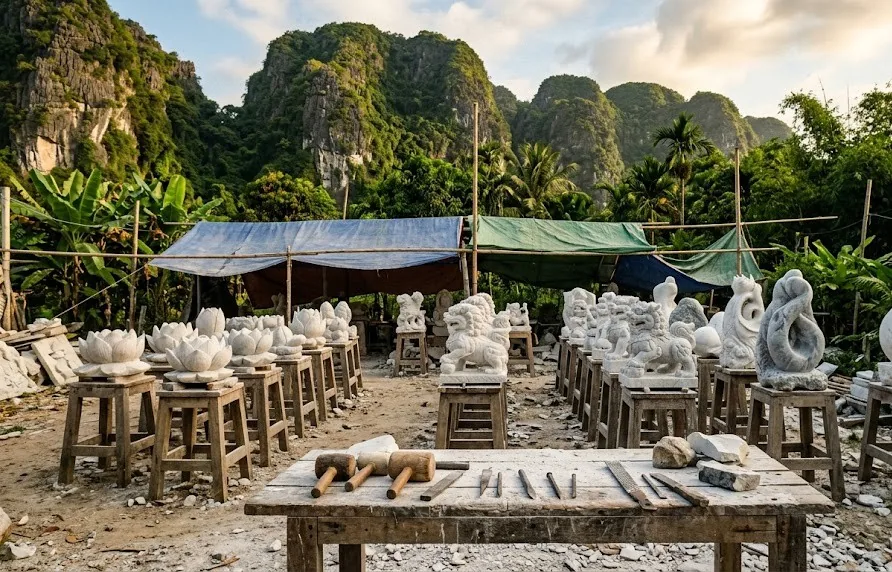
Non Nuoc Stone Carving Village traces its origins to the 17th century, when artisan Huynh Ba Quat from Thanh Hoa Province settled at the foot of Marble Mountains and began shaping the local marble into religious and decorative objects. Over four centuries, the craft passed through generations, evolving from simple stone tools to intricate sculptures. In 2026, the village’s stone carving craft earned National Intangible Cultural Heritage status, cementing its importance to Vietnamese cultural identity. The Da Nang government has since implemented a preservation program with planning horizons to 2030 and 2045, ensuring the craft survives for future generations.
What you’ll see: from Buddha statues to modern stone jewelry and paintings
Walking through Non Nuoc’s workshops feels like stepping into an open-air gallery. You will see artisans chiseling large Buddha statues destined for pagodas, crafting delicate stone jewelry, and producing modern marble paintings that reinterpret traditional subjects. The village hosts the “Soul of Non Nuoc stone” sculpture competition, which attracts artists from across Vietnam and keeps the craft evolving. Many workshops welcome visitors to observe the carving process up close, and you can purchase finished pieces ranging from small ornaments to substantial sculptures.
Hands-on experience: trying your hand at chiseling marble under a master’s guidance
Several workshops now offer short hands-on sessions where visitors can try chiseling marble under a master’s supervision. These sessions typically last 30 to 45 minutes and cost around 100,000 to 200,000 VND. You will start with a small piece of soft stone, learn the basic techniques for shaping and smoothing, and leave with a simple carved keepsake. The experience gives you a genuine appreciation for the skill involved in transforming raw stone into art, and the artisans are patient teachers who take pride in sharing their craft.
Nam O Fish Sauce Village: Tasting the Soul of Vietnamese Cuisine
The secret recipe: long-jawed anchovies caught in the lunar March and jackfruit wood vats
Nam O Fish Sauce Village, located at the Cu De River estuary beneath Hai Van Pass, has produced nước mắm for over a century. The secret lies in two elements: the long-jawed anchovies caught during the lunar March, when the fish are at their fattest, and the large vats made from jackfruit wood that impart a subtle sweetness to the sauce. The village’s location at the river mouth provides the ideal combination of fresh seawater and river nutrients that give the anchovies their distinctive flavor.
The slow fermentation process: why time and cool, dark storage create the richest flavor
Nam O fish sauce follows a patient fermentation process that can last 12 to 18 months. The anchovies are layered with sea salt in the jackfruit wood vats, then sealed and left to ferment in cool, dark storage. Over time, the fish break down into a rich, amber liquid with a complex umami profile. The first extraction produces the highest quality sauce, often reserved for dipping and finishing dishes, while subsequent extractions yield lighter grades used in cooking. This slow process explains why authentic Nam O fish sauce commands premium prices compared to mass-produced alternatives.
A visit in 2026: touring the workshop and buying premium fish sauce to take home
A visit to Nam O Fish Sauce Village in 2026 typically includes a guided tour of a family workshop, where you will see the vats, learn about the fermentation process, and taste different grades of sauce. The tasting is the highlight, letting you compare the rich, complex first-extraction sauce with lighter versions. Most workshops sell bottled fish sauce on site, with premium first-extraction bottles ranging from 150,000 to 300,000 VND depending on size. The village also offers the chance to see how local families use fish sauce in everyday cooking, making it a deeply sensory cultural experience.
Thanh Ha Pottery Village: 500 Years of Ceramic Heritage on the Thu Bon River
The shift from household pottery to tourism-driven handicrafts since 2026
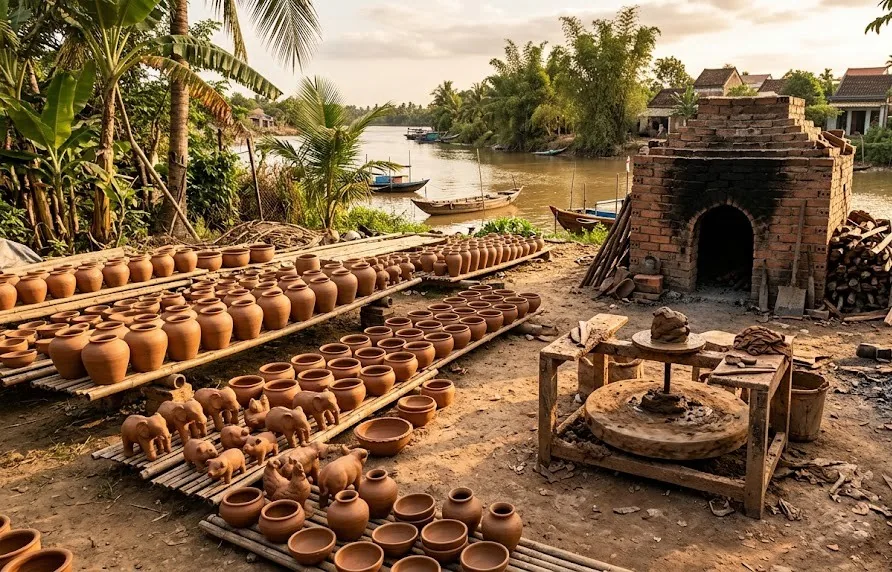
Thanh Ha Pottery Village has shaped clay along the Thu Bon River for roughly 500 years, originally producing household items like pots, jars, and roof tiles for local communities. The turning point came in 2026, when Hoi An’s growing tourism industry prompted a shift toward decorative handicrafts and tourist-oriented products. This transition allowed the village to survive while adapting to modern market demands, and it now produces everything from ceramic souvenirs to architectural terracotta elements for restoration projects in Hoi An’s ancient town.
Meeting the artisans: 32 workshops and 70 craftspeople keeping the tradition alive
These artisans range from elderly masters who have shaped clay for decades to younger potters who are experimenting with contemporary designs. Walking through the village, you will see workshops open to the street, with potters working at their wheels and kilns firing in the background. The artisans are welcoming and happy to explain their techniques, from preparing the clay to glazing and firing.
Getting your hands dirty: pottery-making classes for all skill levels
Pottery classes at Thanh Ha are the main draw for many visitors. Sessions typically last one to two hours and cost between 100,000 and 250,000 VND depending on the complexity of the project. Beginners start with basic techniques, learning to center clay on the wheel and shape simple bowls or vases. More experienced participants can attempt larger pieces or decorative items. The instructors provide patient guidance, and your finished piece can be fired and shipped internationally for an additional fee.
The new inland waterway pier at Thanh Ha makes the village even more accessible, with boat connections linking it directly to Hoi An’s riverside.
Tuy Loan Rice Paper Village: A 500-Year-Old Culinary Tradition
The village’s ancient roots in Hoa Vang and its communal house
Tuy Loan Rice Paper Village sits in Hoa Phong Commune, Hoa Vang, and traces its history back roughly 500 years. The village’s ancient communal house, which dates to the 17th century, serves as the spiritual and social heart of the community, hosting traditional festivals that celebrate the rice paper craft. These festivals, held at various points throughout the year, feature offerings, folk games, and demonstrations of the craft, drawing both locals and visitors who want to experience authentic rural Vietnamese culture.
The craft: making bánh tráng by hand, from rice batter to sun-dried sheets
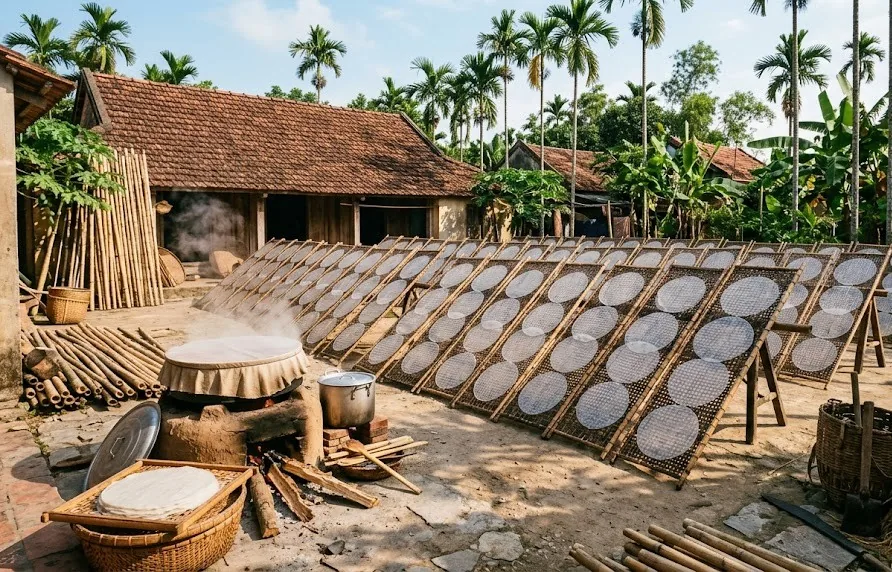
The rice paper production process at Tuy Loan is meticulous and labor-intensive. Rice is soaked, ground into a fine batter, and then spread in thin circles onto cloth stretched over steaming pots. After a brief steaming, the sheets are transferred to bamboo racks and dried in the sun until they become crisp and translucent. The entire process requires precise timing, as the weather dictates the drying phase. Many households still produce bánh tráng by hand, maintaining methods passed down through generations rather than industrializing the craft.
Tasting local life: pairing fresh rice paper with herbs and grilled meats
Tasting rice paper at Tuy Loan is a culinary experience that goes beyond the dried sheets sold in stores. Locals often use fresh, soft rice paper to wrap grilled meats, fresh herbs, and vegetables, creating spring rolls that highlight the paper’s delicate texture. You can also try bánh tráng nướng, a grilled version topped with egg, dried shrimp, and scallion oil that has become a popular street snack across Vietnam. Pairing these dishes with local herbs and dipping sauces gives you a genuine taste of how this staple ingredient anchors Vietnamese cuisine.
Cam Ne Mat Weaving Village: The Rhythm of Handwoven Reed Mats
The materials: selecting straight, lightweight, and strong old palm trees
Cam Ne Mat Weaving Village, located about 16 kilometers southwest of Da Nang, specializes in mats woven from the leaves of old palm trees. The selection of raw materials is critical: artisans choose palm leaves that are straight, lightweight, and strong, ensuring the finished mats will be durable and comfortable. The leaves are harvested, split into strips, and dried before weaving begins. This careful preparation is the foundation of the village’s reputation for high-quality mats that can last for years.
The weaving process and the unique custom-dyeing technique
The weaving process at Cam Ne is rhythmic and methodical, with artisans working on wooden looms to interlace the palm strips into tight, even patterns. What sets this village apart is its custom-dyeing technique, which allows weavers to create mats in specific colors and patterns to match customers’ preferences. This flexibility has helped the village maintain relevance in a market increasingly dominated by factory-made alternatives. Watching the weavers work, you will notice the precision and muscle memory developed over years of practice, transforming simple palm strips into functional art.
Supporting the community: how buying a mat helps preserve the village’s livelihood
Purchasing a mat from Cam Ne is not just a souvenir purchase; it directly supports a community whose livelihood depends on this craft. The village has faced challenges from cheaper, machine-made mats, and each handwoven purchase helps sustain the tradition. Mats are priced based on size and complexity, with basic options starting around 200,000 VND and larger, custom-dyed pieces costing more. Beyond the financial support, buying from the village signals that handmade crafts still have value in a globalized market, encouraging younger generations to learn the craft from their elders.
Practical Tips for Visiting Da Nang’s Craft Villages in 2026
Best time to visit: early mornings to avoid heat and see artisans at work
Plan your village visits for the morning hours, ideally starting between 8:00 and 9:00 AM. This timing serves two purposes: you avoid the intense midday heat that can make exploring uncomfortable, and you catch artisans at their most active, as many begin work early and slow down by early afternoon. The soft morning light also provides better conditions for photography, especially at Non Nuoc where the marble sculptures catch the sun beautifully.
Etiquette and photography: asking permission before taking close-up shots
While artisans generally welcome photography, it is respectful to ask permission before taking close-up shots of them at work or their products. A simple smile and gesture often suffice, and many artisans will happily pose for photos when asked. When visiting workshops, avoid touching tools or unfinished pieces without invitation, as these are the artisans’ working materials. Remember that these villages are living communities, not staged attractions, so treat residents with the same courtesy you would expect in your own neighborhood.
Budgeting: entrance fees, workshop costs, and what souvenirs are worth buying
Most craft villages do not charge entrance fees, though some workshops may request a small donation or charge for guided tours. Budget for hands-on experiences: pottery classes at Thanh Ha cost roughly 100,000 to 250,000 VND, while stone carving sessions at Non Nuoc run 100,000 to 200,000 VND. Souvenir prices vary widely, but expect to pay 50,000 to 150,000 VND for small items like ceramic ornaments or stone jewelry, and 150,000 to 300,000 VND for premium products like first-extraction fish sauce or custom-dyed mats.
Motorbike rental for a day costs approximately 150,000 to 200,000 VND, and a taxi ride to any village runs 150,000 to 250,000 VND each way.
Combining villages: suggested routes that link Non Nuoc, Nam O, and Cam Ne with ease
To maximize your time, consider these combinations. Route one links Non Nuoc Stone Carving Village with a visit to Marble Mountains in the morning, followed by Nam O Fish Sauce Village for a late lunch and tasting session. Route two pairs Tuy Loan Rice Paper Village with Cam Ne Mat Weaving Village, both located in Hoa Vang, allowing for a cultural deep dive without backtracking. Route three, for a full day, combines Non Nuoc and Thanh Ha Pottery Village, taking advantage of the new inland waterway pier that connects Thanh Ha to Hoi An.
Each route keeps travel time manageable and provides a varied cultural experience.
Frequently Asked Questions
How far are the craft villages from Da Nang city center?
Non Nuoc Stone Carving Village is closest at approximately 10 kilometers, about 20 minutes by motorbike or taxi. Tuy Loan Rice Paper Village sits around 14 kilometers away, and Cam Ne Mat Weaving Village is roughly 16 kilometers southwest of Da Nang. Nam O Fish Sauce Village lies about 15 kilometers north near the Cu De River estuary, while Thanh Ha Pottery Village is closer to Hoi An, around 25 kilometers from Da Nang center.
Can I participate in hands-on workshops at these villages?
Yes. Thanh Ha Pottery Village offers pottery-making classes suitable for all skill levels, typically costing 100,000 to 250,000 VND. Non Nuoc Stone Carving Village provides short sessions where you can try chiseling marble under a master’s guidance. Other villages primarily offer observation and tasting experiences rather than hands-on workshops.
What is the best time of year to visit Da Nang’s cultural villages?
The dry season from February to August offers the most reliable weather for village visits, with sunny days ideal for sun-drying rice paper at Tuy Loan and exploring outdoor workshops. Avoid the rainy months from September to December, when heavy downpours can disrupt outdoor activities and make unpaved village roads muddy. Early mornings are the best time of day to visit, regardless of season.
Are the villages suitable for children and families?
Yes, particularly Thanh Ha Pottery Village, where hands-on pottery classes keep children engaged and entertained. The villages are generally safe and walkable, though some areas have uneven surfaces. Families should plan for shorter visits with breaks, carry water and sun protection, and choose morning hours to avoid the heat.
Next Steps
Da Nang’s cultural villages offer a meaningful counterpoint to the city’s beach scene, connecting you to crafts and traditions that have shaped local life for centuries. Whether you spend a half-day at Non Nuoc or dedicate a full day to village-hopping, these experiences reward those who slow down and engage with the artisans. Start planning your route now, decide which villages match your interests, and build in time for hands-on experiences that will become lasting memories of your 2026 trip.
For more ideas on exploring Da Nang’s local side, check out our guide to farmstays with organic gardens or discover where to find the best guided street food tours to complement your cultural journey.
Part of our guide to places to visit in Da Nang.