Most visitors to Da Nang know it for its beaches and bridges, but the city’s real story is written in its concrete, stone, and steel. From the Cham kingdom’s ancient towers to French colonial villas and futuristic dragon-shaped crossings, Da Nang offers a condensed visual history of Vietnam’s central coast. This exploration of Da Nang’s unique architecture reveals how the city’s skyline became a canvas for cultural fusion, engineering ambition, and tropical modernism.
Da Nang’s architecture is a layered story spanning over 1,000 years, from Cham Hindu temples at the Marble Mountains to the 2018 Golden Bridge held by giant stone hands. The city’s identity is defined by its six iconic river crossings, each with a distinct design philosophy, and a growing movement of “resort-in-house” tropical modernism by local architects like Ho Khue. New lighting projects along the Han River and renovated cable car stations at Ba Na Hills continue to reshape the urban canvas, making Da Nang a living museum of Vietnamese architectural evolution.
Da Nang’s Architectural Identity: Where Tradition Meets Modernity on the Central Coast
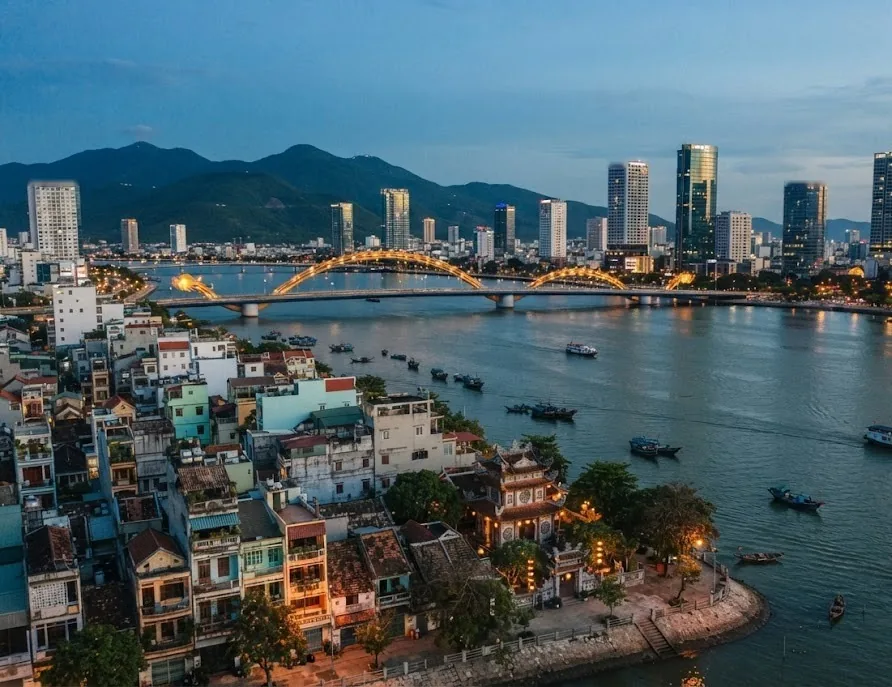
Three historical layers—Cham, French colonial, and contemporary Vietnamese—form the foundation of Da Nang’s built environment, each visible within a two-kilometer radius of the city center.
From Cham temples to French villas: 3 historical layers shaping the cityscape
The earliest architectural layer belongs to the Cham civilization, which ruled the central coast from the 2nd to the 15th century. The Cham Museum, built in 1915 by French archaeologists, houses the world’s largest collection of Cham sculpture—over 300 sandstone pieces recovered from temples across Quang Nam (now part of Da Nang). The museum itself is a blend of French colonial structure and Cham decorative motifs, a physical representation of how two cultures merged on this coastline.
Walking through the Hai Chau district, you’ll find French colonial villas from the 1920s with their signature shuttered windows, high-pitched terracotta roofs, and wrap-around verandas designed to catch coastal breezes. These sit alongside post-1975 Vietnamese tube houses, narrow and deep, optimized for narrow street frontages.
The “City of Bridges” concept: How river crossings define Da Nang’s skyline
The Han River cuts through Da Nang’s center, and each bridge that spans it tells a different design story. Unlike Ho Chi Minh City’s utilitarian crossings or Hanoi’s historic Long Bien Bridge, Da Nang’s bridges are deliberate architectural statements. The city has six main river bridges, each built in a different decade with a different aesthetic philosophy: from the cable-stayed Thuan Phuoc (2009) to the dragon-shaped bridge (2013) and the pedestrian Love Lock Bridge (2015). This concentration of distinct bridge designs within a single river stretch is rare globally—most cities have one signature bridge, not six.
2026 update: New architectural projects reshaping the urban canvas
Recent developments continue this trajectory. The Sun World cable car station at Ba Na Hills underwent a renovation that expanded its waiting areas with glass-walled observation decks, blending function with the fantasy aesthetic of the hill station. APEC Park along the Han River, completed in late 2025, adds a modern cultural and architectural attraction with open-air performance spaces and sculptural pavilions designed by Vietnamese and international architects. These projects reinforce Da Nang’s strategy of using architecture as a tourism draw, not just as infrastructure.
Iconic Bridges: The Beating Heart of Da Nang’s River Architecture
Da Nang’s six bridges are not just transportation links—they are the city’s most photographed landmarks, each designed with a specific visual impact in mind.
Dragon Bridge: The fire-breathing steel dragon and its engineering marvel
Completed in 2016 at a cost of over $88 million, Dragon Bridge spans 666 meters across the Han River. Its design, by American firm Louis Berger Group and Vietnamese architects, mimics a golden dragon soaring toward the East Sea—a reference to the Ly dynasty’s dragon motifs. The bridge’s steel body weighs 9,000 tons and uses a continuous arch structure that eliminates the need for expansion joints, allowing the dragon shape to remain uninterrupted. On weekend nights at 9 PM, the dragon breathes fire and water from its head, a performance that draws thousands of spectators to the riverbanks.
The bridge also shifts color: red during Tet, blue for national holidays, and multicolored during the annual Da Nang International Fireworks Festival.
Love Lock Bridge vs. Thuan Phuoc Bridge: Romantic vs. industrial aesthetics
These two bridges, separated by just one kilometer, represent opposite ends of Da Nang’s architectural spectrum. Love Lock Bridge, opened in 2015, is a pedestrian-only structure designed for romance: its railings are covered with thousands of padlocks left by couples, and its LED lighting creates a soft pink and purple glow at night. The bridge is intentionally low to the water, allowing pedestrians to feel close to the river. In contrast, Thuan Phuoc Bridge, completed in 2009, is a cable-stayed suspension bridge spanning 1,856 meters—the longest suspension bridge in Vietnam.
Its two H-shaped towers rise 80 meters above the water, and its steel cables create a geometric pattern that changes perspective as you drive across. One bridge invites intimacy; the other commands scale.
The “Lighting Up the Han River” project (2025–2026): How LED technology transforms bridge facades
Da Nang’s urban lighting initiative has transformed the riverfront into a nightly light show. The project installed programmable LED systems on all six bridges, allowing synchronized color displays that shift with seasons and festivals. Dragon Bridge now features over 15,000 LED nodes that can animate along its spine, creating the illusion of the dragon swimming through the night. Thuan Phuoc Bridge’s cables are lit from below, casting a spiderweb of light onto the water.
The most dramatic effect occurs at Tran Thi Ly Bridge, whose single inclined arch now pulses with gradient colors that reflect perfectly on the river surface—a photographer’s favorite spot for long-exposure shots.
Ba Na Hills: A French Colonial Fantasy Suspended in the Clouds
Ba Na Hills is not a preserved historical site but a deliberate architectural fantasy—a 20th-century French village recreated at 1,487 meters elevation, complete with a bridge held by giant stone hands.
The Golden Bridge: Giant stone hands and the illusion of suspended architecture
The Golden Bridge, opened in June 2018, is arguably Vietnam’s most Instagrammed architectural structure. Designed by TA Landscape Architecture, the bridge appears to be held aloft by two weathered stone hands emerging from the mountainside. The hands were built from steel mesh and fiberglass, then coated with a moss-like finish to simulate centuries of aging. The bridge itself is just 150 meters long, but its design creates a powerful optical illusion: from certain angles, the hands appear to be ancient ruins that nature has reclaimed, supporting a modern golden walkway.
The bridge’s color—a warm yellow-gold—was chosen to contrast with the green forest and blue sky, ensuring it photographs well in any weather.
French Village replica: How 19th-century European facades were adapted for Vietnamese climate
The French Village at Ba Na Hills is not a single authentic reproduction but a pastiche of architectural styles from different French regions and periods. You’ll find Norman half-timbered buildings next to Provencal stone cottages and a Parisian square with a replica Notre-Dame-style cathedral facade. What makes this adaptation clever is the climate consideration: the buildings use Vietnamese materials like laterite stone for walls (which breathes better in humidity) and wide eaves borrowed from local architecture to shade interiors from the tropical sun.
The village was designed by French architects working with Vietnamese builders, and the result is a hybrid that looks European but functions in a Vietnamese highland climate.
Cable car stations: World-record architecture blending function with fantasy
Ba Na Hills holds four Guinness World Records for its cable car system, including the longest non-stop single-track cable car at 5,801 meters. The cable car stations themselves are architectural statements: the Suoi Mo station resembles a French mountain chalet with its steep slate roof and stone facade, while the Ba Na station features a massive glass dome that floods the interior with natural light. The 2025 renovation added glass-floored cabins and observation decks at the mid-station, allowing passengers to photograph the forest canopy and the Golden Bridge from above.
The stations are designed as destinations, not just transit points, with cafes, viewing platforms, and photo spots integrated into each level.
Marble Mountains & Non Nuoc: Spiritual Architecture Carved by Nature and Man
The Marble Mountains are not just a natural wonder—they are a sacred architectural complex where human-made pagodas and altars integrate with natural limestone caves, creating a spiritual landscape that has been active for over 400 years.
Thuy Son caves: How natural limestone formations became sacred pagodas
Thuy Son (Water Mountain) is the largest and most visited of the five marble mountains. Its caves were originally used by Cham people as Hindu sanctuaries in the 9th century, then adapted by Buddhist monks from the 17th century onward. Huyen Khong Cave, the largest, is a natural cavern with a skylight that directs a beam of sunlight onto the main altar during certain times of day. The cave walls are embedded with Buddhist reliefs carved directly into the limestone, and the floor is polished smooth by centuries of barefoot pilgrims.
Am Phu Cave (Hell Cave) takes visitors through a narrow, dark passage representing the journey through hell, emerging into a bright chamber with statues of Buddha and Quan Am—a physical metaphor for spiritual enlightenment. The architecture here is minimal: the cave itself is the structure, and human intervention is limited to altars, paths, and lighting.
Non Nuoc stone carving village: The artisans behind Da Nang’s sculptural heritage
At the base of the Marble Mountains lies Non Nuoc stone carving village, a craft settlement that has operated for over 400 years. The village produces everything from small Buddha statues for home altars to massive stone lions for temple gates. Local artisans use marble sourced from the mountains themselves, carving with chisels and electric grinders in open-air workshops. The village’s signature product is the “Da Nang stone Buddha,” characterized by a gentle smile and elongated earlobes—a style that blends Cham and Vietnamese Buddhist iconography.
Visiting the village gives context to the statues you see throughout Da Nang: the 10-meter-tall Quan Am statue at Linh Ung Pagoda on Son Tra Peninsula was carved here, as were the decorative elements at the Cham Museum.
Tam Thai Pagoda: 17th-century Buddhist architecture integrated into mountain terrain
Tam Thai Pagoda, built in 1630 under the Nguyen lords, is the oldest religious structure on the Marble Mountains. Its architecture follows the traditional Vietnamese “internal worship, external garden” layout: the main hall faces a courtyard with a bonsai garden, and the buildings step up the mountain slope rather than sitting on a flat foundation. The pagoda’s roof uses yin-yang tiles (ngoi am duong), a traditional Vietnamese roofing system where concave and convex tiles interlock without nails, allowing natural ventilation.
The pagoda’s location—nestled against a limestone cliff with a view of the East Sea—demonstrates the Vietnamese principle of “dia linh nhan kiet” (sacred land produces talented people), where architecture is positioned to harmonize with natural energy flows.
Modern Tropical Residences: Da Nang’s Contemporary Architecture Movement
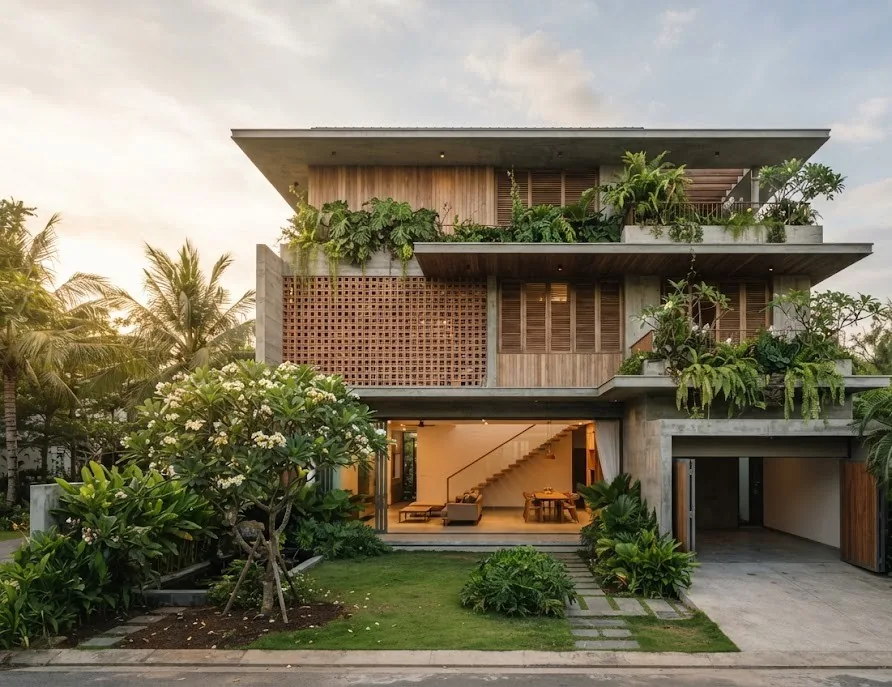
Da Nang has become a laboratory for tropical modernism, with local architects developing climate-responsive designs that work for Vietnam’s hot-humid climate while achieving international aesthetic standards.
Ho Khue Architects and the “Resort in House” concept: Climate-responsive design for urban plots
Ho Khue Architects, a Da Nang-based firm founded in 2009, has pioneered the “Resort in House” concept—designing urban homes that feel like resort villas despite being on standard city plots. Their 2016 project, simply called “Resort in House,” is a 240-square-meter home on a narrow urban plot that uses a central courtyard with a swimming pool as the organizing element. All rooms open onto this courtyard through floor-to-ceiling glass doors, creating cross-ventilation that eliminates the need for air conditioning during eight months of the year.
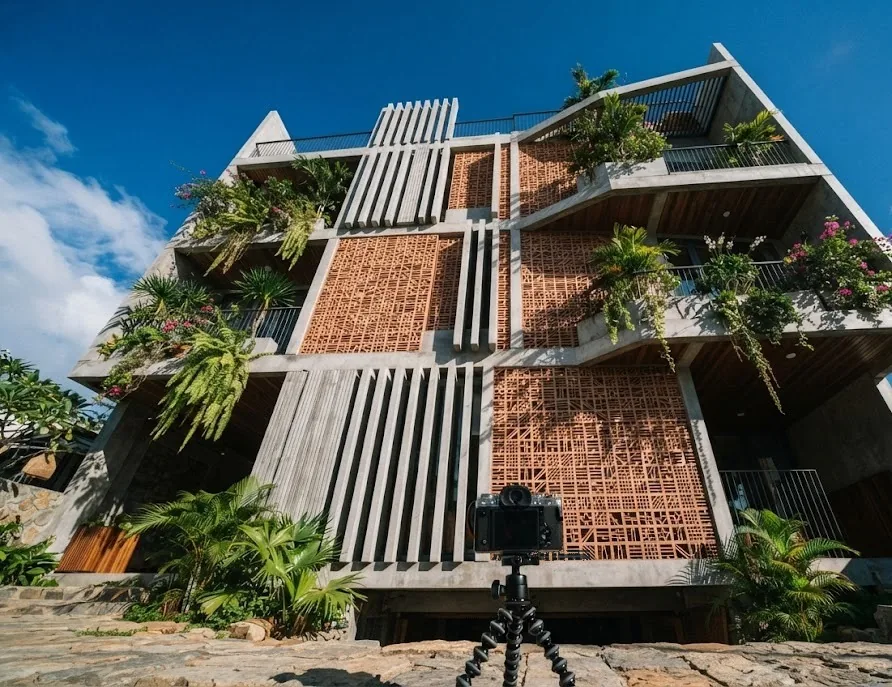
The facade uses perforated concrete blocks that filter sunlight while maintaining privacy—a technique borrowed from traditional Vietnamese lattice walls but executed with contemporary materials. This project has been featured on ArchitectureMind and other international design platforms, demonstrating that Vietnamese tropical modernism can compete globally.
Beachfront villas vs. city apartments: How tropical modernism adapts to different contexts
The tropical modernism movement in Da Nang splits into two distinct approaches based on location. Beachfront villas along Vo Nguyen Giap Street prioritize horizontal lines, deep overhangs, and outdoor living spaces that blur the boundary between interior and the beach. Materials lean toward natural stone, teak wood, and white plaster that reflects heat. In contrast, city apartments in Hai Chau and Thanh Khe use vertical solutions: rooftop gardens, sky terraces, and double-height living spaces that create the illusion of outdoor space within a high-rise.
The Monarchy Resort, a beachfront development, exemplifies the first approach with its low-rise villas arranged around lagoons, while the new condominiums on Vo Nguyen Giap Street use cantilevered balconies and green walls to achieve the resort feel on 30 floors.
Sustainable materials and passive cooling: The trend in Da Nang residential architecture
Da Nang’s residential architecture is shifting toward passive cooling strategies and locally sourced materials. Architects are reviving traditional Vietnamese techniques: (1) using hollow clay bricks for walls to reduce heat transfer, (2) designing double-roof systems with an air gap between the roof and ceiling for natural ventilation, and (3) orienting buildings to capture prevailing winds from the East Sea.
Several recent apartment buildings in the Ngu Hanh Son district have incorporated green facades with climbing plants that reduce surface temperature by 5–8 degrees Celsius during summer months. These trends represent a return to vernacular wisdom, updated with modern engineering.
Best Photography Spots for Da Nang Architecture
Da Nang offers distinct photographic opportunities at different times of day, from sunrise over Linh Ung Pagoda to the golden-hour glow on Dragon Bridge and the neon reflections on the Han River at night.
Sunrise at Son Tra Peninsula: Capturing Linh Ung Pagoda against the bay
The best time to photograph Linh Ung Pagoda is between 5:15 AM and 6:00 AM during the dry season (February to August). Position yourself at the viewpoint near the pagoda’s main gate, coordinates 16.0992° N, 108.2778° E. From this angle, the 67-meter-tall Quan Am statue is backlit by the rising sun, and the pagoda’s curved roof tiles catch the first light. Use a focal length of 24–35mm to capture both the statue and the bay below. A polarizing filter helps reduce haze from morning humidity.
Golden hour on Dragon Bridge: Angles for the perfect fire-breathing shot
For Dragon Bridge, the golden hour (30 minutes before sunset) provides warm light on the golden steel body. The best angle is from the east bank of the Han River, near the Love Lock Bridge pedestrian area. Position yourself at the base of the dragon’s head, looking west, so the sun backlights the bridge’s arch. For the fire-breathing performance (weekends at 9 PM), use a tripod and a shutter speed of 1/15 second to capture the flame streak while keeping the bridge sharp. A 50mm lens works well for isolating the dragon’s head against the dark sky.
Night photography along Han River: Long-exposure tips for bridge reflections
The Han River promenade between Dragon Bridge and Tran Thi Ly Bridge offers the best night photography. Use a tripod and set your camera to bulb mode with a 10–15 second exposure at ISO 100 and f/11. The key is to shoot on calm nights when the river surface is still, creating perfect mirror reflections of the bridge lights. The new LED installations cycle through colors every 30 seconds, so wait for the blue or purple phase—these colors reflect best on dark water.
The best spot is the Tran Thi Ly Bridge pedestrian walkway, which provides a direct view of the bridge’s arch reflected in the river below.
Drone restrictions and permits: What changed in 2026 regulations
Drone photography in Da Nang is restricted within 5 kilometers of the Da Nang International Airport (which covers most of the city center and the Han River). As of 2026, you need a permit from the Da Nang Department of Transport for any drone flight within city limits, with processing time of 7–10 business days. The Son Tra Peninsula and Ba Na Hills are designated no-fly zones due to military installations and cable car operations.
For legal aerial shots, use the observation decks at Sun World Ba Na Hills (at 1,487 meters elevation) or the Son Tra Peninsula viewpoint at 600 meters—both provide elevated perspectives without needing a drone.
Frequently Asked Questions
What is the most photographed building in Da Nang?
The Golden Bridge at Ba Na Hills holds this title, with over 3 million visitor photos shared on social media since its 2018 opening. The Dragon Bridge and Linh Ung Pagoda’s Quan Am statue are close contenders.
Can I visit the Marble Mountains without a guide?
Yes, the Marble Mountains are open to independent visitors. The entrance fee is approximately 40,000 VND ($1.70 USD), and the site is open daily from 7 AM to 5:30 PM. A guide is helpful for understanding the historical context of the caves and pagodas.
When is the best time to photograph the Dragon Bridge fire show?
The fire-breathing performance occurs at 9 PM every Saturday and Sunday, plus major holidays. Arrive by 8:30 PM to secure a spot on the east bank of the Han River near the Love Lock Bridge for the best viewing angle.
How long does it take to explore Ba Na Hills’ architecture?
Plan for a full day, from 7 AM to 4 PM. The cable car ride takes 20 minutes each way, and you need at least 4–5 hours to see the French Village, Golden Bridge, Linh Ung Pagoda, and the gardens. Skip the amusement park rides if you’re focused on architecture.
What is the “Resort in House” architectural style?
It’s a design concept by Ho Khue Architects that transforms standard urban homes into resort-like spaces using central courtyards, swimming pools, floor-to-ceiling glass, and natural ventilation. The style prioritizes indoor-outdoor living and passive cooling over air conditioning.
Are there guided architecture tours in Da Nang?
Several tour operators offer architecture-focused walking tours covering the French Quarter, the Han River bridges, and the Marble Mountains. GetYourGuide lists options starting at $25 per person for half-day tours. Self-guided tours are also feasible using the city’s public bus system.
What should I wear when visiting religious architecture sites?
Cover shoulders and knees when visiting pagodas and temples, including Linh Ung Pagoda, Tam Thai Pagoda, and the caves at Marble Mountains. Remove shoes before entering worship halls. Lightweight, breathable fabrics are recommended due to the tropical climate.
Conclusion: Your Next Steps for Experiencing Da Nang’s Architecture
Da Nang’s architecture offers a rare opportunity to trace Vietnam’s cultural evolution through its built environment—from ancient Cham sanctuaries to French colonial fantasies and cutting-edge tropical modernism. To experience it fully, plan your visit around three key activities: walk the Han River bridges at sunset for the lighting display, spend a full day at Ba Na Hills examining the French Village’s hybrid design, and visit the Marble Mountains early in the morning to see the pagodas before the crowds arrive.
- Book your Da Nang trip during the dry season (February to August) for optimal photography conditions and comfortable exploration of outdoor architectural sites.
- Download the Da Nang Architecture Map from the city’s tourism website—it marks all major sites with historical descriptions and suggested walking routes.
- Join a guided architecture tour on your first day to understand the historical layers, then use your remaining days to revisit favorite spots during different lighting conditions.
Part of our guide to places to visit in Da Nang.