Most visitors to Da Nang arrive with a list of must-eat dishes, but few realize the grilled pork skewers they try on the street are often a pale imitation of the real thing. Da Nang’s Nem Nuong: Grilled Pork Skewers Revealed is the dish that separates a forgettable meal from a culinary memory that lasts years. This guide breaks down what makes the local version distinct, where to find the best stalls, and how to eat it like a true Da Nang local.
Da Nang’s nem nuong stands apart from other Vietnamese grilled pork skewers due to its signature pink hue from annatto seed oil, a heavier reliance on lemongrass in the marinade, and a uniquely sweet, thick peanut dipping sauce that locals treat as a non-negotiable component. The complete platter includes grilled pork skewers, fresh herbs like tía tô and húng lủi, star fruit, green banana, rice paper, vermicelli noodles, and pickled vegetables. This article covers the regional differences, the essential platter components, four top spots to eat in Da Nang, a step-by-step wrapping guide, common first-timer mistakes, and a simplified home recipe.
What Makes Da Nang’s Nem Nuong Different from Other Vietnamese Grilled Pork Skewers
Da Nang’s version of nem nuong is defined by a specific marinade technique and a dipping sauce culture that other regions don’t prioritize as heavily. While grilled pork skewers appear across Vietnam, the central coast city has developed its own identity that locals defend passionately.
The regional twist: Da Nang-style vs Nha Trang-style vs Saigon-style nem nuong
Each region treats nem nuong as a blank canvas with different priorities. Nha Trang’s version, often called nem nướng Nha Trang, is typically served as smaller, thinner skewers with a firmer, almost bouncy texture similar to sausage. The marinade leans heavily on garlic and sugar, and the dipping sauce is a thin, salty fish sauce mixture with shredded green papaya.
Saigon’s take on nem nuong is more casual street food — skewers are often smaller, grilled quickly over charcoal, and served with a simple sweet chili fish sauce dip. The herb platter is minimal, sometimes just lettuce and cucumber.
Da Nang’s nem nuong is the heavyweight champion of the three. The skewers are thicker, juicier, and marinated with a paste that includes lemongrass, shallots, garlic, fish sauce, and sugar — plus the defining ingredient: annatto seed oil, which gives the meat its characteristic reddish-pink color. The platter is a full production, with a generous herb basket, multiple dipping sauces, and rice paper for wrapping.
| Feature | Da Nang Style | Nha Trang Style | Saigon Style |
|---|---|---|---|
| Skewer size | Thick, chunky pieces | Thin, elongated | Small, bite-sized |
| Meat texture | Juicy, slightly fatty | Firm, bouncy (pork paste) | Soft, loose |
| Signature color | Pinkish-red from annatto oil | Pale brown | Golden brown |
| Dipping sauce | Thick peanut sauce | Thin fish sauce with papaya | Sweet chili fish sauce |
| Herb platter | Extensive (7+ herbs/fruits) | Moderate | Minimal (lettuce + cucumber) |
| Rice paper included | Always | Sometimes | Rarely |
Key ingredients that define Da Nang’s version: lemongrass, annatto oil, and the signature pink hue
The marinade for Da Nang nem nuong starts with finely minced lemongrass — the white and pale green parts only, pounded to a paste with shallots and garlic. This paste is mixed with ground pork that has been minced twice for a finer texture. Fish sauce provides the saltiness, sugar balances it, and annatto seed oil adds both color and a subtle earthy flavor. The annatto oil, about 1 tablespoon per 500 grams of pork, is crucial for the visual appeal.
Many local cooks also add a small amount of pork fat, diced into tiny cubes, which melts during grilling and keeps the skewers moist. The pink hue is not artificial coloring — it comes entirely from the annatto seeds, which are steeped in oil until the oil turns a deep orange-red. When mixed into the pork, the annatto oil creates that signature pink shade after grilling.
Why the dipping sauce matters more in Da Nang than anywhere else
In Da Nang, the dipping sauce is treated as a separate dish, not an afterthought. The peanut sauce — tương đậu phộng — is thick enough to coat a spoon, made from ground roasted peanuts, hoisin sauce, a touch of chicken liver pâté for depth, and coconut milk for richness. Some stalls add a pinch of chili for heat. A typical batch uses about 4 tablespoons of hoisin sauce and 3 tablespoons of peanut butter per serving.
This sauce is what makes the wrapping experience work. The rice paper alone is bland. The herbs are sharp. The pork is savory. The peanut sauce ties everything together with a creamy, sweet-savory base that locals refuse to compromise on. A stall that serves thin, watery peanut sauce in Da Nang doesn’t survive long.
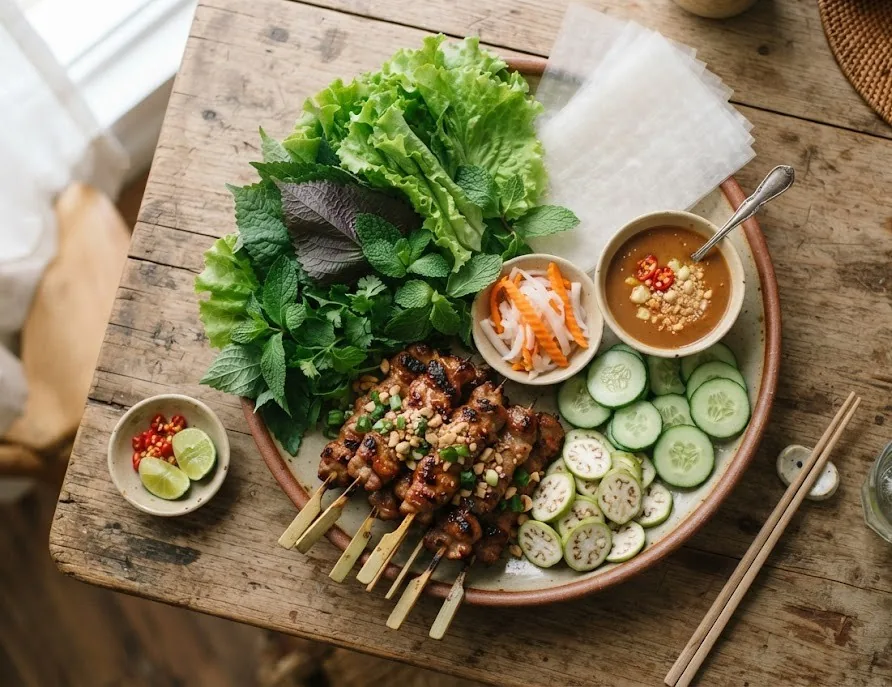
Essential Components of a Da Nang Nem Nuong Platter
A proper Da Nang nem nuong platter is not just skewers of meat — it is a carefully curated assembly of textures, temperatures, and flavors designed to be combined in each wrap. Understanding each component helps you build better rolls and appreciate why locals order the full platter every time.
The grilled pork skewers: texture, fat content, and grilling technique
The pork is the star, and its preparation follows a specific process. The meat is ground twice — once coarsely, once finely — to achieve a paste-like consistency that holds together on the skewer without being dense.
Traditional vendors use lemongrass stalks as skewers, which infuse a subtle citrus aroma into the meat as it grills. The skewers are cooked over charcoal, not gas. Charcoal gives a smoky flavor that gas cannot replicate. The griller rotates the skewers constantly, brushing them with a thin layer of the leftover marinade to keep the surface glazed and moist. The target doneness is slightly charred on the outside, juicy on the inside — about 8-10 minutes over medium-hot coals.
The fresh herb and vegetable platter: what to expect and why each element matters
The herb basket that arrives with your nem nuong platter is not decorative. Every leaf and slice serves a purpose in balancing the richness of the pork. You will typically find:
- Rau thơm (Vietnamese coriander) — peppery, slightly citrusy, cuts through the fat
- Tía tô (perilla) — minty with a hint of cinnamon, adds aromatic complexity
- Húng lủi (spearmint) — cooling, freshens each bite
- Xà lách (lettuce) — mild crunch, structural base for the wrap
- Khế chua (sour star fruit) — thin slices that add a tangy pop
- Chuối chát (green banana) — firm, slightly astringent, cleanses the palate
- Dưa leo (cucumber) — cool and hydrating
- Cà rốt và củ cải muối chua (pickled carrot and daikon) — sweet-sour crunch
Each herb and fruit is chosen to counterbalance the savory, fatty pork. The sour star fruit and bitter green banana are particularly important — they prevent the wrap from feeling heavy after the third or fourth roll.
Bánh tráng (rice paper) and bún (vermicelli): the wrapping essentials
The rice paper used in Da Nang is typically the thin, round variety, about 22 centimeters in diameter. It is briefly dipped in warm water to soften, then laid flat on a plate or banana leaf. The vermicelli noodles — bún — are thin, round rice noodles that have been boiled and rinsed in cold water to stop the cooking process. They provide a neutral, chewy base that holds the wrap together.
Some platters also include bánh tráng nướng — crispy grilled rice paper sheets that are broken into pieces and added inside the wrap for crunch. This is a Da Nang specialty that you won’t find in other regions’ versions.
The peanut dipping sauce: what makes Da Nang’s version unique
The peanut sauce in Da Nang is thicker than versions found in Saigon or Hanoi. It is made by grinding roasted peanuts into a coarse paste, then simmering with hoisin sauce, chicken liver pâté, coconut milk, and a touch of sugar. The result is a sauce that clings to the wrap without dripping everywhere. A standard serving might contain around 4 tablespoons of hoisin sauce and 3 tablespoons of peanut butter.
Some stalls add a squeeze of lime or a dash of chili oil on top. The sauce should be room temperature or slightly warm, never cold. A good test: dip a piece of rice paper in the sauce — it should coat the paper evenly without pooling excessively at the bottom.
Where to Find the Best Nem Nuong in Da Nang: Top Spots Revealed
Four locations stand out among locals for their consistent quality, traditional techniques, and loyal customer bases. These are not tourist-oriented restaurants — they are the stalls where Da Nang residents bring their families on weekend evenings.
Bà Mưa Nem Nướng: the local legend on Hoàng Hoa Thám Street
Bà Mưa is arguably the most famous nem nuong address in Da Nang. Located at 104 Hoàng Hoa Thám Street in Hải Châu, this open-air stall has been operating for over 20 years. The name translates to “Mrs. Rain,” a nickname the owner earned for always working through the weather.
The marinade here is sweeter than average, with a heavier hand on the sugar and annatto oil. The pork is ground finer than most competitors, giving the skewers a smoother, almost pâté-like texture. The peanut sauce is notably thick — almost like a dip for bread — and includes visible peanut chunks. A full platter for one person costs around 50,000-70,000 VND. Arrive before 7 PM on weekends to avoid a 30-minute wait.
Nem Nướng Cô Huệ: the family-run stall with the secret marinade
Cô Huệ’s stall at 22 Lê Duẩn Street operates on a smaller scale — about 15 plastic tables set up on the sidewalk each evening. The family has been running this spot for three generations, and the marinade recipe is passed down verbally, never written down.
The distinguishing feature here is the addition of finely minced pork skin to the meat mixture, which gives the skewers a slightly chewy texture that regular ground pork cannot achieve. The herb platter is more generous than most, with extra portions of star fruit and green banana included without asking. The peanut sauce is lighter and more savory, with less sugar than Bà Mưa’s version.
Nem Nướng Bà Năm: the beachside favorite for tourists and locals alike
Located near Mỹ Khê Beach at 218 Nguyễn Công Trứ Street, Bà Năm’s stall attracts both beachgoers and long-time residents. The skewers here are thicker than average — about 3 centimeters in diameter — and are grilled over charcoal that has been infused with coconut husks for a subtly sweet smoke.
Bà Năm’s peanut sauce includes a noticeable amount of chicken liver pâté, giving it a richer, more umami-forward flavor. The restaurant also serves a fried rice paper roll on the side — a crispy, cylindrical roll that you break apart and add to your wraps for texture contrast.
Hidden gem: the night market stalls along Sơn Trà Night Market
The Sơn Trà Night Market, located on Võ Nguyên Giáp Street near the beach, hosts several mobile nem nuong stalls that set up around 6 PM. These stalls are less consistent than the established names above, but when you find a good one, the quality can rival any restaurant.
Look for a stall with a long queue of Vietnamese customers — that is the most reliable indicator. The advantage of night market nem nuong is the price: platters start at 30,000-40,000 VND, about half the cost of sit-down stalls. The trade-off is a smaller herb platter and a thinner peanut sauce. For a quick, budget-friendly introduction to nem nuong, this is a solid starting point.
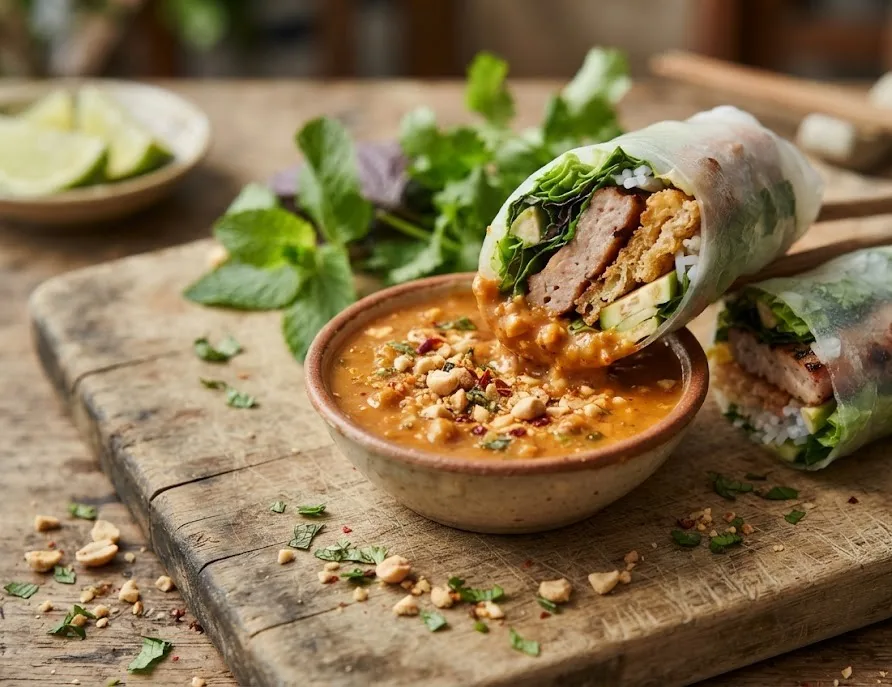
The Art of Eating Nem Nuong: A Step-by-Step Guide to the Perfect Wrap
Building a nem nuong wrap is a skill that takes a few tries to master, but the basic technique follows a consistent sequence. Locals develop their own preferences over time, but these five steps will get you a stable, flavorful roll on your first attempt.
Step 1: Preparing your rice paper wrapper — the dip and lay technique
Fill a shallow bowl with warm tap water — not hot, not cold. Take one sheet of rice paper and dip it completely for about 2-3 seconds. Lift it out and let excess water drip off for another 2 seconds. Lay the softened paper flat on a clean plate or the banana leaf provided. The paper should be pliable but not falling apart. If it tears easily, your water is too hot or you dipped too long.
Step 2: Layering the vermicelli and herbs for optimal texture
Place a small handful of vermicelli noodles — about the size of a golf ball — slightly below the center of the rice paper. Spread them into a horizontal line. Add 2-3 leaves each of rau thơm, tía tô, and húng lủi on top of the noodles. Place one slice of star fruit and one slice of green banana alongside the herbs. The goal is to distribute the fillings evenly so every bite contains all components.
Step 3: Adding the grilled pork and pickled vegetables
Slide one or two pieces of grilled pork off the lemongrass skewer using your chopsticks or fork. Place the meat on top of the herbs. Add a small pinch of pickled carrot and daikon — about one tablespoon. Add a slice of cucumber. At this point, your filling should form a compact log about 10 centimeters long and 3 centimeters wide.
Step 4: Rolling technique — tight enough to hold, loose enough to dip
Fold the bottom edge of the rice paper over the filling. Fold in the left and right sides. Roll upward firmly but gently, tucking the filling as you go. The roll should be snug enough that the filling doesn’t fall out when you pick it up, but loose enough that you can still dip it without the paper splitting. A common mistake is rolling too tight, which causes the rice paper to tear at the seam.
Step 5: The final dip — how much sauce is too much sauce?
Dip one end of the roll into the peanut sauce — about one-third of the roll submerged. Do not soak the entire roll, or the rice paper will become soggy and disintegrate. Lift the roll, let excess sauce drip off for 2 seconds, and eat it in two to three bites. The sauce should coat the exposed filling at the end of the roll, not the rice paper wrapper itself.
Common Mistakes First-Timers Make with Da Nang Nem Nuong
Even experienced food travelers make predictable errors when tackling nem nuong for the first time. These four mistakes are the most common, and avoiding them will dramatically improve your experience.
Overloading the rice paper: why less is more for your first wrap
It is tempting to pile on all the herbs, fruits, and noodles at once, but an overstuffed rice paper will tear before you finish rolling. For your first wrap, use half the amount of filling you think you need. A successful wrap should be about the thickness of two fingers. You can always make a second wrap with the remaining ingredients. After two or three wraps, you will have a better sense of how much each paper can hold.
Skipping the herbs: the most common regret among tourists
Many first-timers, especially those unfamiliar with Vietnamese herbs, skip the tía tô, star fruit, and green banana because they look unfamiliar or taste strong on their own. This is a mistake. The herbs and sour fruits are not optional garnishes — they are functional components that balance the richness of the pork. A wrap without tía tô and star fruit will taste one-dimensional and greasy after two bites. Try at least one leaf of each herb in your first wrap. If you dislike a particular herb, skip it in subsequent wraps, but do not skip the entire herb category.
Using the wrong dipping technique: double-dip vs single-dip etiquette
In Vietnam, double-dipping — dipping a bite into the sauce, taking a bite, then dipping again — is not considered rude in casual street food settings, but it does affect the sauce quality. Each time you dip, small crumbs of rice paper and herbs fall into the communal sauce bowl, clouding it and altering the flavor for everyone at the table.
The better approach: spoon a small portion of peanut sauce onto your own plate or into a small bowl. Dip your wrap into your personal portion. If you need more sauce, spoon more from the communal bowl. This keeps the main sauce clean for the entire meal.
Ordering the wrong portion size: single platter vs sharing platter guide
A single platter at most Da Nang stalls includes 6-8 skewers, one basket of herbs, one portion of noodles, one portion of rice paper, and one bowl of peanut sauce. For a person with a moderate appetite, this is sufficient for one meal. For a hungry person, order an extra portion of skewers (typically 4-6 additional skewers for 20,000-30,000 VND).
For two people, order one full platter plus one extra order of skewers and one extra herb basket. This gives each person enough ingredients for 4-5 wraps without running out of herbs or noodles. Do not order two full platters unless you are very hungry — the portion sizes are generous, and leftover nem nuong does not reheat well.
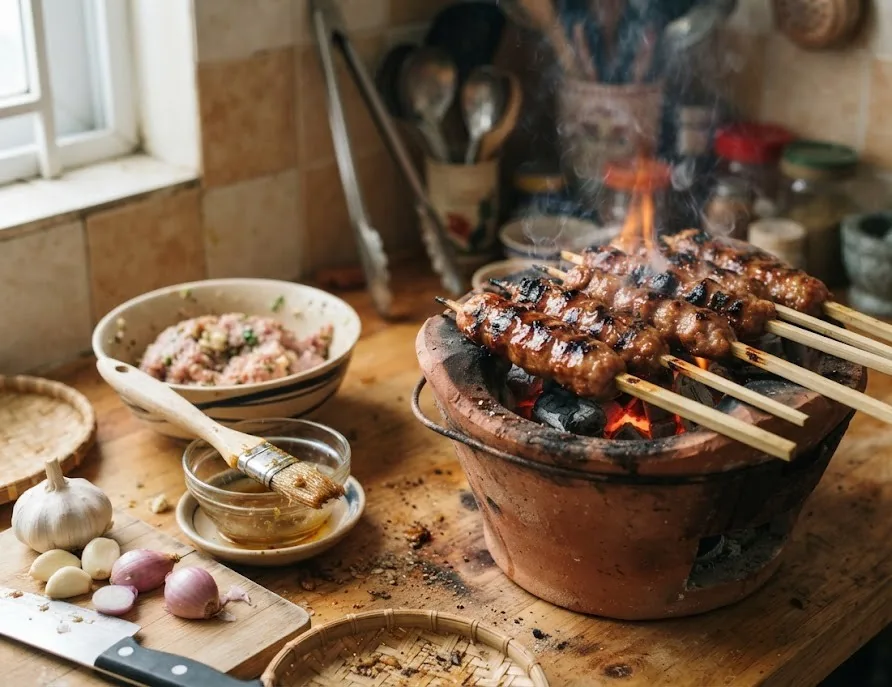
How to Make Da Nang-Style Nem Nuong at Home: Simplified Recipe
Recreating Da Nang’s nem nuong at home requires attention to the marinade balance and the grilling method. While charcoal is ideal, an oven or stovetop can produce respectable results with the right technique.
The marinade: balancing fish sauce, sugar, lemongrass, and annatto oil
For 500 grams of ground pork (minced twice, with 10% fat content), combine the following in a bowl:
- 3 tablespoons fish sauce (use a premium brand like Red Boat or Viet Huong)
- 2 tablespoons white sugar
- 1 tablespoon finely minced lemongrass (white part only)
- 2 cloves garlic, minced to paste
- 1 shallot, minced to paste
- 1 tablespoon annatto seed oil (available at Asian grocery stores or made by steeping annatto seeds in warm oil)
- 1 teaspoon black pepper
- 1 tablespoon vegetable oil
Mix the marinade ingredients together, then add the ground pork. Knead the mixture with your hands for 3-4 minutes until the meat becomes sticky and cohesive. Cover and refrigerate for at least 2 hours, ideally overnight. The longer marination allows the lemongrass and annatto to penetrate the meat fully.
The meat preparation: why minced twice pork with added fat cubes works best
Ask your butcher to grind the pork twice — once through a coarse plate, once through a fine plate. If you cannot request double grinding, pulse the ground pork in a food processor for 10-15 seconds until it reaches a paste-like consistency. Do not over-process, or the meat will become tough.
Add 50 grams of pork belly, diced into 5-millimeter cubes, to the mixture. These fat cubes will melt during grilling and keep the skewers moist. Without the added fat, lean ground pork will dry out on the grill.
Grilling methods: charcoal grill vs oven vs stovetop — which delivers authentic flavor?
Charcoal grill is the gold standard. Use lump charcoal, not briquettes, and wait until the coals are covered in white ash before grilling. Thread the meat onto lemongrass stalks or bamboo skewers (soaked in water for 30 minutes). Grill over medium heat for 8-10 minutes, turning every 2 minutes and brushing with leftover marinade.
If you do not have a charcoal grill, an oven broiler is the next best option. Place skewers on a wire rack over a baking sheet, 6 inches from the broiler element. Broil on high for 5 minutes, flip, brush with marinade, and broil for another 4-5 minutes. The surface should be charred in spots but not burnt.
Stovetop grilling is the least authentic but still functional. Use a cast-iron grill pan over medium-high heat. Cook skewers for 3-4 minutes per side, pressing gently with a spatula to ensure even contact. The lack of smoky flavor can be partially compensated by adding a pinch of smoked paprika to the marinade.
The peanut sauce recipe: recreating Da Nang’s signature dipping sauce
In a small saucepan over medium heat, combine:
- 4 tablespoons hoisin sauce
- 3 tablespoons creamy peanut butter (unsweetened, natural style)
- 2 tablespoons chicken liver pâté (available in cans at Asian grocery stores)
- 1 tablespoon coconut milk
- 1 tablespoon sugar
- 1 tablespoon water
- 1 teaspoon chili garlic paste (optional, for heat)
Whisk continuously over low heat for 5 minutes until the sauce thickens and becomes glossy. The consistency should be thick enough to coat a spoon but thin enough to dip without clumping. If too thick, add water one teaspoon at a time. If too thin, simmer for another 2-3 minutes. Serve at room temperature with crushed roasted peanuts sprinkled on top.
Related on this site
- Exploring Da Nang’s Crab Shack Experiences: Steamed, Grilled, and More 2026
- Da Nang’s Best BBQ: Grilled Meats and Seafood 2026
- Da Nang’s Best Nem Lui: Lemongrass Pork Skewers to Try 2026
Frequently Asked Questions (FAQ)
What is the difference between nem nuong and nem lui?
Nem lui, popular in Huế and Hội An, uses pork that is wrapped around a lemongrass stalk and grilled, creating a hollow center where the lemongrass infuses the meat. Nem nuong in Da Nang is ground pork formed into patties or thick pieces on a skewer, without the hollow center. The marinade and dipping sauce also differ between the two dishes.
Is Da Nang nem nuong gluten-free?
The pork skewers themselves are gluten-free, as the marinade uses fish sauce, sugar, and annatto oil. However, the peanut dipping sauce contains hoisin sauce, which is made from fermented soybeans and wheat flour. For a gluten-free meal, request a simple fish sauce dip instead of the peanut sauce.
How many skewers come in a standard platter?
A standard single platter at most Da Nang stalls includes 6-8 skewers. Sharing platters for two people typically contain 10-12 skewers. Extra skewers can be ordered individually for 5,000-8,000 VND each.
Can I find vegetarian nem nuong in Da Nang?
Traditional nem nuong is made with pork and cannot be made vegetarian without changing the dish entirely. Some restaurants in Da Nang offer mock meat versions made from mushrooms or tofu, but these are not considered authentic by local standards. For a vegetarian option, try bánh tráng cuốn — fresh rice paper rolls with herbs and tofu.
What is the best time of day to eat nem nuong in Da Nang?
Nem nuong is primarily an evening dish in Da Nang. Most stalls open around 4 PM and operate until 10 PM or later. Lunchtime options are limited — only a few dedicated restaurants serve nem nuong during the day. For the freshest experience, visit between 5 PM and 7 PM when the grills are at their peak temperature and the herbs are freshly washed.
How do I store leftover nem nuong ingredients?
Grilled pork skewers can be refrigerated for up to 2 days in an airtight container. Reheat in a dry frying pan over medium heat for 2-3 minutes per side. Fresh herbs and fruits should be stored separately in damp paper towels inside a sealed bag — they will last about 24 hours. Rice paper and vermicelli noodles should be stored in a cool, dry place and used within a week. Do not refrigerate leftover peanut sauce — it will separate and become grainy.
Why is Da Nang nem nuong pink?
The pink color comes from annatto seed oil, which is made by steeping annatto seeds in warm vegetable oil until the oil turns deep orange-red. When mixed into the pork marinade and cooked, the annatto oil gives the meat a reddish-pink hue. This is a natural coloring agent, not artificial food dye.
Part of our guide to what to eat in Da Nang.