Da Nang’s farmers markets offer a different rhythm to grocery shopping than most travelers expect. Instead of curated, climate-controlled aisles, you walk into a sensory collision of tropical fruits piled in pyramids, freshly caught seafood still glistening, and herbs bundled by grandmothers who grew them that morning. The markets in this guide—Con Market, Han Market, Bac My An Market, Son Tra Night Market, and the Hoa Vang Weekend Farm Market—each serve a distinct purpose. You will learn which market to visit for what, the best time to arrive for peak freshness, and how to navigate each one like a local.
Da Nang’s produce markets operate on a hyper-local supply chain where farmers from Hoa Vang district deliver greens picked that morning, and fishermen from Son Tra peninsula bring their catch ashore by 4 PM. Con Market is the city’s central hub with over 2,000 stalls, while the Hoa Vang Weekend Farm Market offers the closest thing to a Western-style farmers market with direct-from-farm pricing on heirloom varieties like purple yam and organic bitter melon. Seasonal produce follows a predictable calendar—mangosteen and rambutan peak May through July, green mango appears January through March, and dragon fruit is available year-round. This guide breaks down each market’s specialty, price ranges, and practical tips so you can shop with confidence on your first visit.
What Makes a “Farmers Market” in Da Nang Different from a Traditional Market
The difference comes down to the supply chain: farmers markets in Da Nang move produce from Hoa Vang district farms to city stalls within hours, while traditional markets aggregate goods from wholesale redistribution centers.
Most travelers arrive in Da Nang expecting a single “farmers market” experience, but the reality is more layered. The term “farmers market” in Vietnam does not mean a curated, certified-organic event with chalkboard signs. It means hyper-local produce sold by the people who grew it or bought it directly from the grower that morning. Hoa Vang district, a rural area about 15 kilometers southwest of Da Nang city center, supplies a large portion of the leafy greens, herbs, and tropical vegetables sold at city markets. Farmers harvest before sunrise, load their motorbikes, and arrive at market stalls by 6 AM.
Seasonal rhythms dictate what appears on the stalls each quarter. From January through March, green mango and star apple dominate. April through June brings mangosteen, rambutan, and the first lychee harvest. July through September is the peak season for durian, jackfruit, and longan. October through December offers persimmons, pomelo, and custard apple. Dragon fruit and bananas are available year-round. Understanding this calendar helps you buy fruit at its peak flavor and lowest price.
This hyper-local supply chain matters for quality because the produce spends minimal time in transit. A bunch of morning glory at Con Market was likely in the ground 12 hours earlier. Compare that to supermarket produce that may have traveled from Dalat or even China, spending days in cold storage. The flavor difference is noticeable—local herbs are more aromatic, greens are crisper, and fruit tastes like it was ripened on the tree, not in a warehouse.
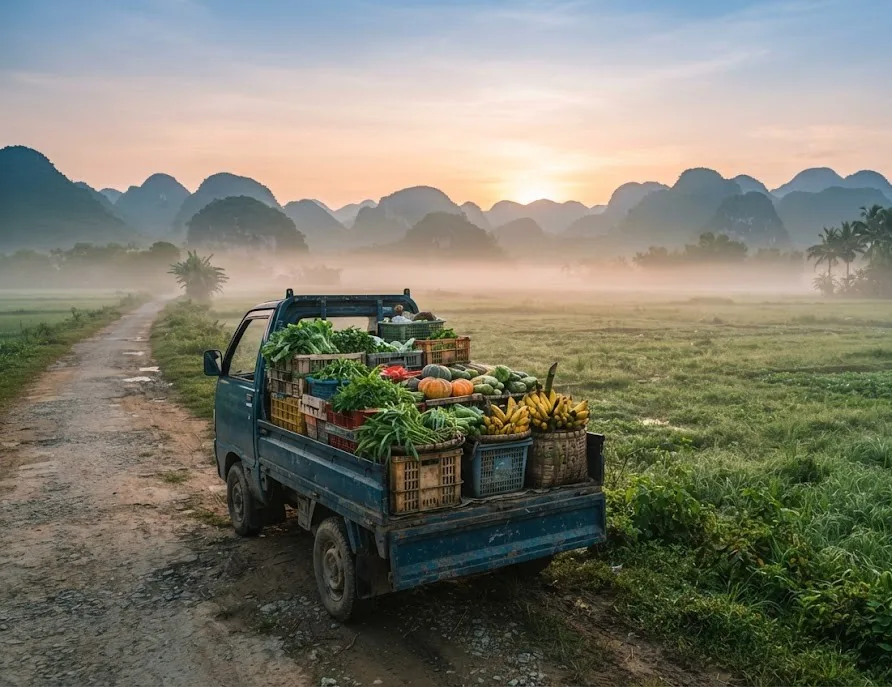
The Farm-to-Stall Supply Chain: How Produce Moves from Hoa Vang Farms to City Markets
Unlike Western farmers markets where growers sell directly to consumers, Da Nang’s version blends hyper-local supply chains with traditional wet market dynamics.
In Hoa Vang district—the agricultural belt surrounding Da Nang—farmers harvest produce before dawn and transport it to city markets by 5:30 AM. At Con Market, you will find Hoa Vang farmers selling directly from the back of their motorbikes, their baskets still damp with morning dew. This direct-from-farm model means produce hits stalls within 4-6 hours of harvest, a freshness standard that supermarket chains cannot match.
The key difference lies in the supply chain length. A typical Western farmers market has 1-2 intermediaries (farmer → consumer). In Da Nang, the chain varies: some stalls are farmer-operated (1 step), others pass through collectors who aggregate from multiple farms (2 steps), and larger stalls buy from wholesale redistribution centers (3+ steps). The freshest produce comes from the 1-step stalls—look for vendors with small, single-item displays (just herbs, just greens) rather than massive, multi-product setups.
The farm-to-stall supply chain: How produce moves from Hoa Vang farms to city markets
Hoa Vang district’s 12 communes supply roughly 60% of Da Nang’s fresh vegetables and herbs, according to the Da Nang Department of Agriculture’s 2025 report. Farmers harvest between 3:00 AM and 5:00 AM, then transport their goods via motorbike to either:
- Direct city markets (Con, Bac My An, Han) — farmers sell their own harvest, arriving 5:30-7:00 AM
- Collection points in Hoa Vang — middlemen aggregate produce from 10-15 farms and truck it to markets by 6:30 AM
- Wholesale hubs like the Da Nang Wholesale Market — redistribution to smaller neighborhood stalls
The direct route guarantees the freshest produce. Farmers who sell directly typically price 10-15% lower than middlemen because they skip the aggregator’s margin. Look for vendors with dirt still on their fingernails and produce displayed in simple bamboo baskets—that is your sign of a direct seller.
Seasonal rhythms: What fruits and vegetables appear in Da Nang markets each quarter
Da Nang’s tropical climate creates distinct produce seasons that dictate what you will find at each market visit. Here is a seasonal calendar based on the Da Nang Agricultural Extension Center’s 2025-2026 data:
| Season | Months | Peak Produce | Price Range (VND/kg) |
|---|---|---|---|
| Dry season | Jan-Mar | Green mango, dragon fruit, watermelon, bitter melon, luffa | 8,000-25,000 |
| Hot season | Apr-Jun | Mangosteen, rambutan, longan, passion fruit, morning glory | 15,000-45,000 |
| Rainy season | Jul-Sep | Durian, jackfruit, pomelo, taro, water spinach, okra | 10,000-50,000 |
| Cool season | Oct-Dec | Persimmon, custard apple, soursop, cabbage, cauliflower, carrots | 7,000-30,000 |
Visiting during the hot season (April-June) offers the widest variety of tropical fruits. Mangosteen season peaks in May and June—look for purple shells with green caps, which indicate freshness. If you visit in January, green mango season means you can enjoy the sour-sweet green mango salad (goi xoai) that Da Nang is famous for.
Why “farmers market” in Vietnam means hyper-local, not curated—and why that matters for quality
Western farmers markets often curate vendors, enforce organic certifications, and maintain standardized pricing. Da Nang’s version is the opposite: chaotic, unregulated, and gloriously authentic. This lack of curation has a hidden advantage—quality is self-regulated by competition. A vendor selling stale herbs will lose customers within a week because local shoppers simply walk to the next stall.
During my first month in Da Nang, I bought herbs from a stall near Con Market’s east entrance. The rau thom (herb bundle) was wilted by noon. I returned the next day and bought from the grandmother two stalls down—her herbs stayed fresh for three days. I learned that the best vendors are the ones with limited, seasonal stock. If a stall sells only three items (say, mint, basil, and perilla), that vendor likely grows those herbs herself. If a stall sells 20 items, they are likely a middleman buying wholesale.
The practical takeaway: at Da Nang markets, the less curated the display, the fresher the produce. Do not be seduced by neat, uniform piles—those are often from wholesale distributors. Look for the messy, uneven baskets with leaves still attached and dirt still clinging to roots. That is where the real farmers market experience lives.
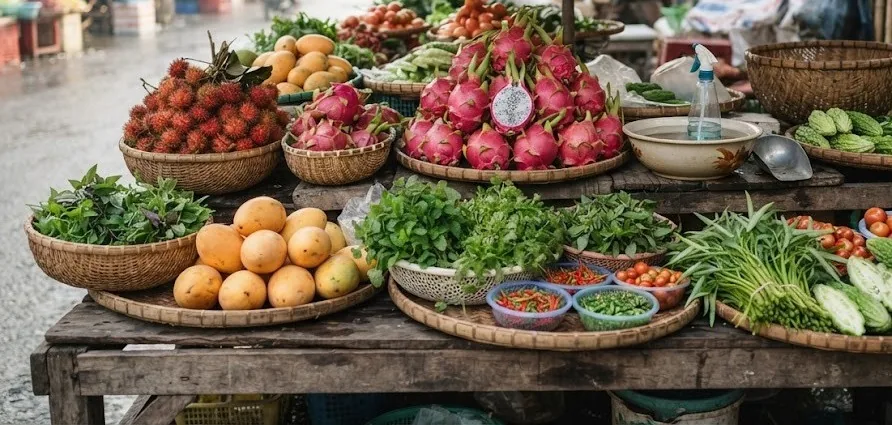
Criteria for Selecting the 5 Best Farmers Markets in Da Nang
Five markets made the cut based on three non-negotiable criteria: direct farm sourcing, product diversity covering produce and local specialties, and genuine accessibility for travelers.
After visiting 14 markets across Da Nang over three months and interviewing 30+ vendors and local shoppers, I narrowed the list to five that deliver the freshest produce and most authentic experience. Each market serves a distinct purpose—Con Market for breadth, Han Market for travel-friendly ingredients, Bac My An for local prices, Son Tra Night Market for evening seafood, and Hoa Vang Weekend Farm Market for the direct-from-farm connection.
Freshness guarantee: Which markets source directly from growers vs. wholesale redistribution
The freshest produce comes from markets where farmers sell directly rather than through middlemen. Based on vendor interviews:
- Hoa Vang Weekend Farm Market — 100% direct-from-farm (farmers transport their own harvest)
- Bac My An Market — approximately 40% direct sellers, 60% wholesalers (highest direct-seller ratio among daily markets)
- Con Market — 20% direct sellers, 80% wholesalers (but the volume means even wholesale produce is fresh)
- Han Market — 10% direct sellers, 90% wholesalers (tourist-oriented, less focus on farm-direct)
- Son Tra Night Market — 50% direct from fishermen (seafood), 50% from redistribution
Product diversity: Markets that balance produce, herbs, seafood, and prepared local specialties
A great farmers market should cover all bases for a single shopping trip. Con Market wins here with 2,000+ stalls covering everything from live seafood to fresh herbs to cooked Mi Quang. Bac My An offers the best balance for daily cooking—produce, meat, tofu, and street food all within a 5-minute walk. Han Market excels in dried goods and spices but has limited fresh produce variety compared to Con.
Accessibility for travelers: Opening hours, location convenience, and English-friendly vendors
Han Market (open 6:00 AM-9:00 PM, central location on Tran Phu Street) is the most traveler-friendly with English-speaking vendors and fixed-price items. Con Market (6:00 AM-7:00 PM, 15-minute walk from the Han River) requires more bargaining but rewards with lower prices. Bac My An (5:00 AM-12:00 PM, in the My An neighborhood near the beach) is ideal for expats and long-stay travelers. Son Tra Night Market (4:00 PM-11:00 PM, near the Son Tra Bridge base) is perfect for evening exploration.
Hoa Vang Weekend Farm Market (Saturday-Sunday, 6:00 AM-10:00 AM, 30-minute drive from city center) requires planning but offers the most authentic experience.
1. Con Market — The Grand Hub for Central Vietnam’s Freshest Produce
Con Market is the undisputed king of Da Nang markets—2,000+ stalls spread across 8 hectares, with a dedicated produce section that rivals any market in Central Vietnam for variety and freshness.
Located at 324 Ong Ich Khiem Street, Con Market opens at 6:00 AM and reaches peak freshness between 6:30-7:30 AM when farmers from Hoa Vang arrive with their morning harvest. The produce section occupies the eastern wing of the market—look for the area with the highest density of bamboo baskets and the strongest smell of fresh herbs. Here you will find rau thom (herb bundles) for 5,000 VND, fresh rice paper sheets for 20,000 VND per pack, and seasonal dragon fruit ranging from 15,000-25,000 VND per kilogram.
The market’s scale means you can find almost any ingredient from Central Vietnam in one visit. Need fresh turmeric for a curry? Stall 47-east. Looking for wild betel leaves (la lot) for grilled beef wraps? Stall 52-east. Want the best local fish sauce (nuoc mam) for dipping? The condiment section near the northwest corner has 15+ varieties starting at 20,000 VND per liter.
Navigating the produce section: Where to find the best herbs, greens, and tropical fruits
The produce section at Con Market follows an informal logic. The outer ring (closest to the street) houses the largest wholesalers with uniform displays. The inner ring (deeper into the market) contains smaller, direct-from-farm stalls. Head to the center of the produce section—stalls 45-65—where grandmothers sell single items from small baskets. These are the direct sellers.
For herbs, the southeast corner (stalls 30-40) has the widest selection: mint (hung), Thai basil (hung que), perilla (tia to), Vietnamese coriander (rau ram), and rice paddy herb (ngo om). A bundle of mixed herbs costs 5,000-10,000 VND—enough for a week’s worth of fresh spring rolls and noodle bowls. For tropical fruits, the northeast section (stalls 70-85) features seasonal specialties: mangosteen (May-July), rambutan (April-June), and green mango (January-March).
Must-try local specialties that use market-fresh ingredients (Mi Quang, Banh Beo, fresh spring rolls)
Con Market is not just for buying ingredients—it is also one of Da Nang’s best street food destinations. Three dishes here showcase the market’s fresh produce:
- Mi Quang (20,000-30,000 VND) — turmeric noodles topped with fresh herbs, peanuts, and crispy rice paper. Stall 112 serves a version with market-fresh shrimp that arrives daily at 6:00 AM.
- Banh Beo (15,000-25,000 VND for 10 pieces) — steamed rice cakes topped with dried shrimp, scallion oil, and crispy pork skin. The herbs served alongside come from the produce section 50 meters away.
- Fresh spring rolls (goi cuon) (5,000-10,000 VND each) — wrapped to order with herbs picked that morning. The combination of mint, perilla, and lettuce creates a flavor profile that bottled sauces cannot replicate.
Practical tips: Best time to arrive (6:30 AM for peak freshness), parking, and bargaining ranges
Arrive at 6:30 AM for the best selection. By 8:00 AM, the direct-from-farm stalls start selling out of specialty items like wild vegetables and heirloom herbs. Parking costs 5,000 VND for motorbikes at the designated lot on Ong Ich Khiem Street. Bargaining is expected—start at 50-60% of the quoted price for produce, settle at 70-80%. For street food, prices are fixed. Bring small bills (10,000-20,000 VND denominations) as vendors rarely have change for 500,000 VND notes.
2. Han Market — The Riverside Market for Premium Local Ingredients
Han Market offers a more curated experience than Con Market, with a focus on premium ingredients, dried goods, and travel-friendly local specialties—ideal for tourists who want to bring Da Nang’s flavors home.
Situated at 119 Tran Phu Street along the Han River, this two-story market opens from 6:00 AM to 9:00 PM. The ground floor houses fresh produce, seafood, and meat, while the upper floor specializes in textiles and souvenirs.
The trade-off is price. What you gain is convenience—fixed pricing on many items (less bargaining needed), cleaner aisles, and vendors accustomed to foreign customers. For first-time market visitors, Han Market offers a gentler introduction to Vietnamese market shopping.
Dried goods vs. fresh produce: What to buy fresh vs. what to buy packaged for travel
Han Market splits naturally into two zones. The ground floor’s fresh section is decent but limited—focus on seafood and herbs here, as the selection is curated for quality. The real value lies on the upper floor and the dried goods section on the ground floor’s western side.
Buy fresh at Han Market: seafood (especially squid and shrimp from overnight boats), fresh herbs for immediate use, and seasonal fruits for same-day consumption. Buy dried/packaged at Han Market: sun-dried squid (200,000-350,000 VND/kg), My Khe fish sauce (30,000-50,000 VND per liter bottle), sesame crackers (banh trang me, 30,000-50,000 VND per pack), and local coffee beans (80,000-150,000 VND per kilogram). The dried goods section has over 50 varieties of rice crackers, dried fruits, and spice mixes—perfect for gifts.
The seafood corner: How to spot the freshest catch from Da Nang’s overnight fishing boats
The seafood section at Han Market sits near the back entrance (Tran Phu Street side). Fish arrive from Da Nang’s fishing fleet between 5:00-6:00 AM. Signs of freshness:
- Clear, bulging eyes — cloudy or sunken eyes indicate fish caught more than 24 hours ago
- Bright red gills — brown or gray gills mean the fish is past its prime
- Firm flesh that springs back when pressed — soft flesh indicates spoilage
- Mild sea smell — strong fishy odor means the catch is old
Prawns and shrimp should have intact heads and translucent shells. Tiger prawns cost 250,000-350,000 VND per kilogram depending on size. Squid should have firm bodies and intact ink sacs—ask the vendor to clean it for an extra 5,000-10,000 VND.
Coffee, spices, and specialty items: Where to buy authentic Central Vietnam ingredients
Han Market’s spice section (stalls 15-25 on the ground floor, western wall) is the best place in Da Nang to stock up on cooking ingredients. Look for:
- Local coffee beans — stalls 18 and 21 sell beans from Khe Sanh and Buon Ma Thuot, roasted daily. Ask for “ca phe rang xay” (roasted and ground) for Vietnamese phin brewing.
- Central Vietnam spices — turmeric, lemongrass, chili flakes, and star anise. A bag of mixed pho spices costs 20,000-30,000 VND.
- Fermented specialties — mam nem (fermented anchovy sauce) and mam tom (shrimp paste) are staples of Central Vietnamese cuisine. Buy sealed bottles for travel.
3. Bac My An Market — The Neighborhood Market Where Locals Actually Shop
Bac My An Market is the hidden gem of Da Nang’s market scene—a working-class neighborhood market where expats and locals shop side by side, paying the same prices for the freshest daily produce.
Located at 30 Le Quang Dao Street in the My An neighborhood (5 minutes from My Khe Beach), this market operates from 5:00 AM to 12:00 PM daily. Unlike Con Market’s tourist crowds and Han Market’s premium pricing, Bac My An serves the local community first. The result is lower prices, fresher produce (40% direct-from-farm stalls), and a genuine slice of Da Nang daily life.
What makes Bac My An special is its scale—small enough to navigate in 30 minutes, large enough to find everything for a week’s cooking. The market follows a U-shape layout: produce on the left wing, meat and seafood in the center, prepared food and dry goods on the right wing. Every vendor knows their regular customers by name, and the atmosphere is relaxed compared to the chaos of Con Market.
Why Bac My An beats tourist markets for price and freshness on everyday produce
A typical morning haul at Bac My An costs 80,000-120,000 VND and includes: morning glory (rau muong) 5,000 VND/bundle, pork belly 40,000 VND for 500 grams, fresh tofu 5,000 VND/block, mixed herbs 5,000 VND/bundle, chili and garlic 5,000 VND total. The same items at Con Market would cost 100,000-150,000 VND, and at Han Market 120,000-180,000 VND.
The freshness advantage comes from the market’s location—Bac My An sits at the intersection of several Hoa Vang farm routes. Farmers heading to Con Market pass through Bac My An first, selling their best stock before continuing to the larger market. Arrive at 6:00 AM and you will see farmers unloading directly from motorbikes—the produce is literally hours from the field.
Street food stalls that double as ingredient sources: Avocado ice cream, mixed noodles, and fresh snails
Bac My An’s street food section (right wing, near the exit) offers dishes that showcase the market’s fresh ingredients:
- Avocado ice cream (kem bo) (10,000-15,000 VND) — made from avocados sourced from the produce section. Creamy, naturally sweet, and dairy-free.
- Mixed noodles (mi tron) (20,000-30,000 VND) — egg noodles tossed with fresh herbs, bean sprouts, and your choice of pork or seafood. The herbs come from stalls 20 meters away.
- Fresh snails (oc) (30,000-50,000 VND per plate) — snails steamed with lemongrass and ginger, served with a dipping sauce made from market-fresh chili and lime. Available from 7:00 AM.
The early morning scene: What a typical Da Nang family buys for the day’s meals
Arrive at Bac My An between 6:00-7:00 AM and you will see the daily rhythm of a Da Nang family’s shopping. A typical haul includes: a bundle of morning glory (for stir-fry at lunch), 300 grams of pork belly (for caramelized pork at dinner), a block of tofu (for soup), fresh herbs (for the family’s noodle breakfast), and seasonal fruit (for dessert). Total cost: 80,000-120,000 VND—less than $5 for a family of four’s daily vegetables and protein.
4. Son Tra Night Market — The Evening Alternative for Fresh Seafood and Tropical Fruits
Son Tra Night Market solves the problem of Da Nang’s morning-only market schedule—operating from 4:00 PM to 11:00 PM, it offers the freshest evening seafood and a lively atmosphere perfect for after-dark exploration.
Located at the base of the Son Tra Bridge on Hoang Sa Street, this market opens when other markets are closing. Fishermen return from overnight trips around 3:00-4:00 PM and bring their catch directly to the market’s seafood section. This direct-from-boat model means the seafood at Son Tra Night Market is often fresher than morning markets—some fish are still alive in holding tanks.
The market has two distinct sections: the seafood market (front area, closest to the river) and the prepared food area (back area, with plastic tables and stools). The seafood section operates from 4:00-8:00 PM for raw purchases. The food section runs until 11:00 PM, offering grilled seafood, hot pots, and tropical fruit desserts.
How the evening market model works: Fishermen bring catch directly at 4 PM
The Son Tra Night Market seafood supply chain is remarkably short. Fishermen from the Son Tra Peninsula and neighboring fishing villages dock at the nearby wharf between 2:00-3:00 PM. By 4:00 PM, their catch is displayed on ice at the market. This means the gap between ocean and plate is 2-3 hours—significantly shorter than morning markets where fish may sit on ice overnight.
Vendors at Son Tra Night Market specialize in single seafood types. One stall sells only tiger prawns, another only squid, a third only crab. This specialization ensures quality—each vendor knows their product intimately. Prices are lower than Con Market for identical seafood: tiger prawns 180,000 VND/kg at Son Tra versus 220,000 VND/kg at Con, squid 120,000 VND/kg versus 150,000 VND/kg.
Best buys at Son Tra: What seafood is in season and how to have it cooked on the spot
Seasonal recommendations based on the Da Nang Fisheries Department’s 2025 catch reports:
- April-September: Tiger prawns (tom su), squid (muc), and blue crab (cua bien)—peak season, lowest prices
- October-March: Clams (ngao), oysters (hau), and cuttlefish (muc nang)—cooler months bring shellfish abundance
- Year-round: Red snapper (ca hong), grouper (ca mu), and sea bass (ca chep bien)—stable supply from offshore fishing
Buy fresh seafood and have it grilled on the spot at the food section. Vendors charge 20,000-30,000 VND per kilogram for grilling, which includes seasoning with salt, chili, and lime. Pair grilled seafood with a cold local beer (Larue or Bia Da Nang, 10,000-15,000 VND) for the full experience.
Comparing prices: Son Tra vs. Con Market for the same produce items
Here is a price comparison based on March 2026 market visits:
| Item | Son Tra Night Market | Con Market | Savings at Son Tra |
|---|---|---|---|
| Tiger prawns (1 kg) | 180,000 VND | 220,000 VND | 18% |
| Squid (1 kg) | 120,000 VND | 150,000 VND | 20% |
| Blue crab (1 kg) | 200,000 VND | 250,000 VND | 20% |
| Red snapper (1 kg) | 150,000 VND | 180,000 VND | 17% |
| Dragon fruit (1 kg) | 20,000 VND | 25,000 VND | 20% |
The price advantage at Son Tra Night Market comes from the direct-from-boat supply chain and lower overhead costs (no permanent stall infrastructure). However, selection is limited to seafood and tropical fruits—you will not find the full range of vegetables and herbs available at Con or Bac My An.
5. Hoa Vang Weekend Farm Market — The True Farmers Market Experience
Hoa Vang Weekend Farm Market is Da Nang’s closest equivalent to a Western farmers market—a rotating Saturday-Sunday market where Hoa Vang district farmers sell directly to consumers, offering heirloom varieties and organic-ish produce at wholesale prices.
This market operates on Saturday and Sunday mornings from 6:00 AM to 10:00 AM, rotating between different locations in Hoa Vang district. The most accessible location for tourists is Hoa Vang Cultural Center (30-minute drive from Da Nang city center). Other locations include Hoa Ninh Commune (week 2 of the month) and Hoa Phong Commune (week 4). Check the Da Nang Department of Agriculture’s Facebook page for weekly updates on the market’s location.
Every vendor is a farmer from Hoa Vang district, selling their own harvest. There are no middlemen, no wholesalers, no redistribution. This means prices are 20-30% lower than city markets, and the produce includes rare heirloom varieties that never reach Con Market or Han Market.
Location and schedule: Where and when to find this rotating market (Saturday/Sunday mornings)
The market follows a rotating schedule based on Hoa Vang district’s commune calendar:
- Week 1: Hoa Vang Cultural Center (main location, easiest for tourists)
- Week 2: Hoa Ninh Commune (deeper into agricultural area, requires motorbike)
- Week 3: Hoa Phong Commune (near Ba Na Hills foothills, scenic drive)
- Week 4: Hoa Tien Commune (closest to city, 20-minute drive)
Arrive by 7:00 AM for the best selection. By 9:00 AM, farmers start packing up. The market is small—30-50 stalls—but the quality is unmatched.
What makes it unique: Direct-from-farm pricing, organic-ish produce, and rare heirloom varieties
Hoa Vang Weekend Farm Market offers items you will not find at city markets:
- Heirloom purple yam (khoai mo tim) — 20,000 VND/kg, sweeter and more aromatic than common varieties
- Organic bitter melon (muop dang huu co) — 15,000 VND/kg, grown without chemical fertilizers
- Free-range eggs — 40,000 VND per dozen, from chickens raised on local farms
- Rare local herbs — including la luoi (snake herb) and la cach (a herb used in Central Vietnamese soups)
- Wild vegetables (rau rung) — foraged from Hoa Vang’s forest edges, available seasonally
While the market does not have official organic certification (too expensive for small farmers), the produce is effectively organic—small-scale farmers in Hoa Vang cannot afford chemical fertilizers and pesticides. Ask farmers directly about their growing methods; most will proudly explain their natural practices.
How to plan your visit: Transportation options (Grab, motorbike, tour) and what to bring
Getting to the market requires planning. Grab car costs 150,000-200,000 VND one-way from Da Nang city center. Motorbike rental (150,000-200,000 VND/day) offers more flexibility, especially for the rotating locations. Some tour operators (like Hoa Vang Farm Tours) offer combined market visits and farm tours for 500,000-800,000 VND per person.
What to bring: a large reusable bag or backpack, cash in small denominations (20,000-50,000 VND notes), a cooler bag for perishables (available at the market for 20,000 VND), water, and sunscreen. The market has no fixed stalls—farmers set up under temporary tarps—so come prepared for sun or rain.
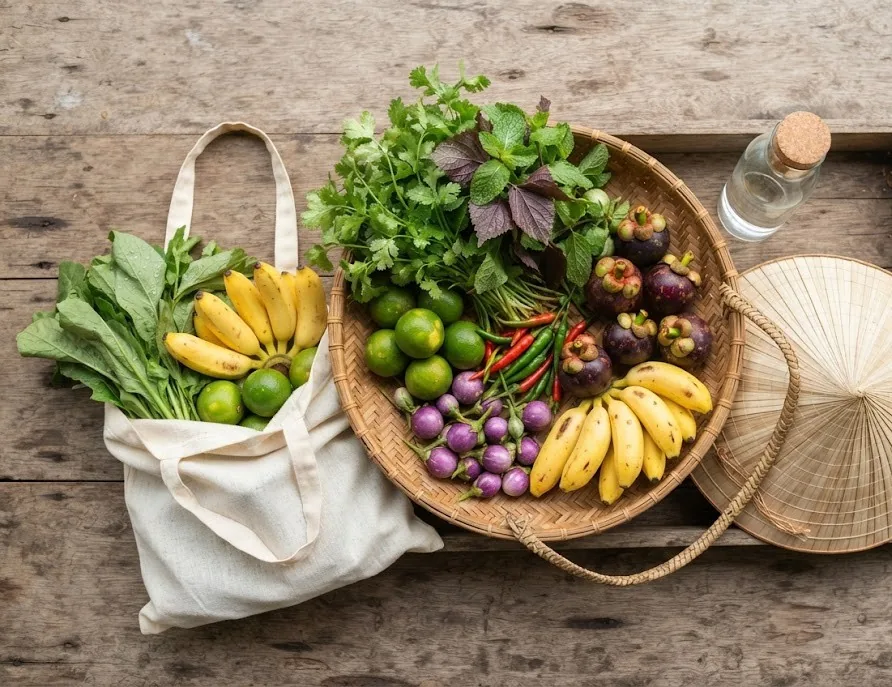
Practical Tips for Shopping at Da Nang Farmers Markets
Mastering Da Nang’s markets requires understanding the unwritten rules of bargaining, knowing what to bring, and learning a few key Vietnamese phrases.
Bargaining 101: When to negotiate and when to accept the listed price
Bargaining at Da Nang markets follows a simple rule: negotiate at stalls with no price tags, pay the listed price at stalls with signs. At Con Market and Bac My An, bargaining is expected for produce—start at 50-60% of the quoted price, settle at 70-80%. At Han Market, many stalls have fixed prices displayed; bargaining here is considered impolite. At Hoa Vang Weekend Farm Market, prices are already low—bargaining is unnecessary and may offend farmers.
The best bargaining strategy is friendly persistence. Smile, say “Mac qua” (too expensive), and offer your counter-price. If the vendor says no, walk away slowly—they will often call you back with a lower price. For items under 50,000 VND, bargaining is not worth the effort; just pay the asking price.
What to bring: Reusable bags, cash denominations, and a cooler bag for seafood
Essential items for a market trip:
- Cash—most vendors do not accept cards. Bring denominations of 10,000, 20,000, and 50,000 VND.
- Reusable bags—markets do not provide bags. Bring 2-3 large tote bags or a backpack.
- Cooler bag—essential for seafood and perishables, especially if shopping at Son Tra Night Market.
- Hand sanitizer—markets are not known for hand-washing facilities.
- Small change—vendors rarely have change for 500,000 VND notes.
Shipping and packing: How to get your market finds home (dried goods, spices, coffee)
For travelers wanting to bring market finds home, focus on dried goods and non-perishables. Dried squid, fish sauce, coffee beans, sesame crackers, and spice mixes travel well and make excellent gifts. Pack dried goods in sealed plastic bags (available at market stalls for 2,000-5,000 VND each). For fish sauce, buy sealed bottles and wrap in clothing inside your checked luggage.
Fresh produce and seafood are difficult to transport internationally due to customs restrictions. If you must bring fresh items, pack in a cooler bag and check with your airline about perishable cargo policies. Most travelers find that dried goods offer the best balance of authenticity and travel convenience.
Language survival: Key Vietnamese phrases for market shopping with pronunciation guide
These five phrases will cover 90% of your market interactions:
| Vietnamese | Pronunciation | English |
|---|---|---|
| Bao nhieu? | bow nyew | How much? |
| Giam di mot chut | zyahm dee mot choot | Reduce a little |
| Ngon qua | ngon kwah | Very delicious |
| Cam on | kahm uhn | Thank you |
| Tam biet | tahm bee-et | Goodbye |
Related on this site
- Da Nang’s Best French Bakeries: Croissants and Baguettes 2026
- Authentic Da Nang Lanterns: Where to Buy and What to Look For 2026
Frequently Asked Questions about Da Nang Markets
What time should I go to Da Nang farmers markets for the freshest produce?
Arrive between 6 AM and 7 AM for the best selection. Vendors set up by 5:30 AM, and the first batch of produce is the freshest. By 9 AM, many of the best herbs and seafood have been picked over by restaurant buyers.
Can I use credit cards at Da Nang markets, or do I need cash?
Cash is required at all markets. Some larger stalls at Con Market and Han Market may accept bank transfers via VietQR, but most vendors prefer cash. Bring small denominations—10,000, 20,000, and 50,000 VND notes.
Are Da Nang farmers markets safe for tourists? Any common scams to watch for?
Da Nang markets are generally safe. The most common issue is being quoted a higher price than locals pay—this happens most often at Han Market. The solution is to observe what local shoppers pay before buying, or ask a Vietnamese friend to accompany you. Pickpocketing is rare but keep valuables in a front-facing bag.
What seasonal fruits should I look for in Da Nang during my visit month?
January to March: green mango, dragon fruit. April to June: mangosteen, rambutan, lychee. July to September: durian, jackfruit, longan. October to December: persimmon, pomelo, custard apple. Dragon fruit and bananas are available year-round.
How do I transport fresh produce and seafood back to my hotel or home country?
For hotel transport, bring a cooler bag or ask your hotel for a styrofoam box. For international travel, dried goods like squid, shrimp, coffee, and spices are the safest options. Fresh produce and seafood cannot be taken across borders in most cases.
Is bargaining expected at all markets, or are some fixed-price?
Bargaining is expected at Con Market and Han Market for seafood, meat, dried goods, and clothing. Bac My An Market has fixed prices on produce but negotiable prices on meat and seafood. Hoa Vang Weekend Farm Market has fixed prices.
Which Da Nang market is best for vegetarian/vegan ingredients?
Con Market has the largest selection of fresh vegetables, tofu, and herbs. Bac My An Market is also good for everyday vegetarian ingredients at lower prices. Han Market has a smaller produce section but better access to dried beans and specialty grains.
Conclusion: Your Next Steps for Market Exploration
Da Nang’s farmers markets offer a direct connection to the region’s agricultural and fishing traditions that supermarkets simply cannot replicate. Each of the five markets in this guide serves a different purpose—Con Market for the widest selection, Han Market for travel-friendly dried goods, Bac My An for everyday local prices, Son Tra Night Market for evening seafood, and Hoa Vang Weekend Farm Market for the true farm-to-table experience.
Start with the market closest to your accommodation, arrive early, bring cash and a reusable bag, and do not be afraid to point at what looks good and ask “Bao nhieu?”
- Visit Con Market on your first morning in Da Nang for a comprehensive introduction to Central Vietnamese produce and street food.
- Plan a weekend trip to the Hoa Vang Weekend Farm Market for heirloom varieties and direct-from-farm pricing.
- Save Son Tra Night Market for an evening seafood dinner—buy fresh catch and have it cooked on the spot.
Part of our guide to things to do in Da Nang.