Short answer: Hoi An's Chinese assembly halls are temple-like clubhouses built by merchant communities from the 1690s on. Start with the Fujian Assembly Hall at 46 Tran Phu (built 1697, rebuilt 1757), then walk 450 m west to the Cantonese Assembly Hall at 176 Tran Phu. Go between 7:00 and 9:00, before the midday heat and tour groups.
What is an assembly hall in Hoi An?
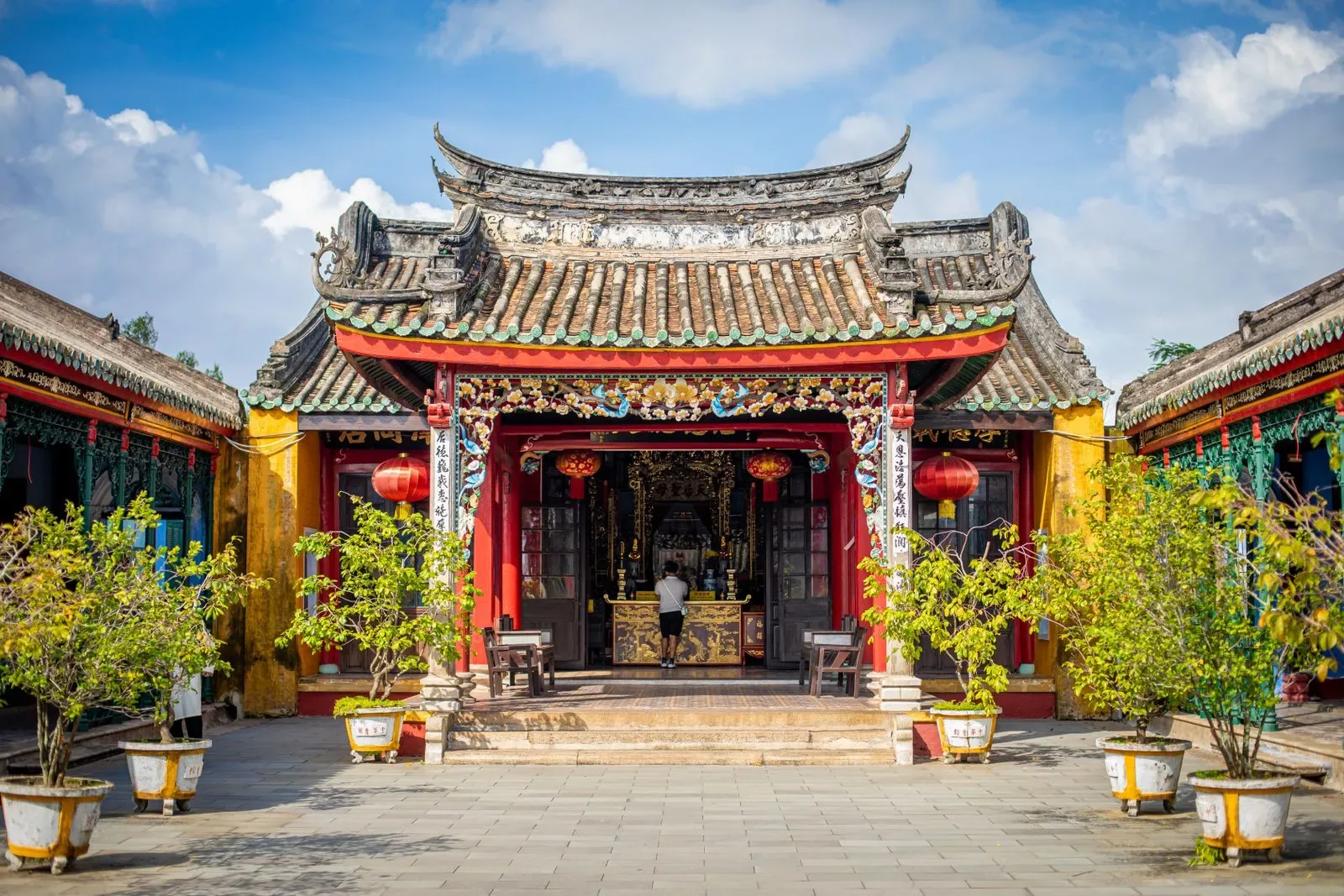
An assembly hall (hội quán) is a meeting house and shrine in one, built by Chinese traders from the same home province; Hoi An's best-known one, the Fujian hall, dates from 1697. Merchants used the halls to meet, settle business, help newcomers and worship the gods who protected their voyages.
That is why the halls look like temples. You walk through a decorated gate, cross an open courtyard with bonsai and a small pond, and reach a main hall with an altar. The side wings and rear hall hold more altars, carved beams, lacquered boards and old bronze bells. Locals still come to pray, especially on the 1st and 15th days of each lunar month, so treat the halls as working places of worship rather than museums.
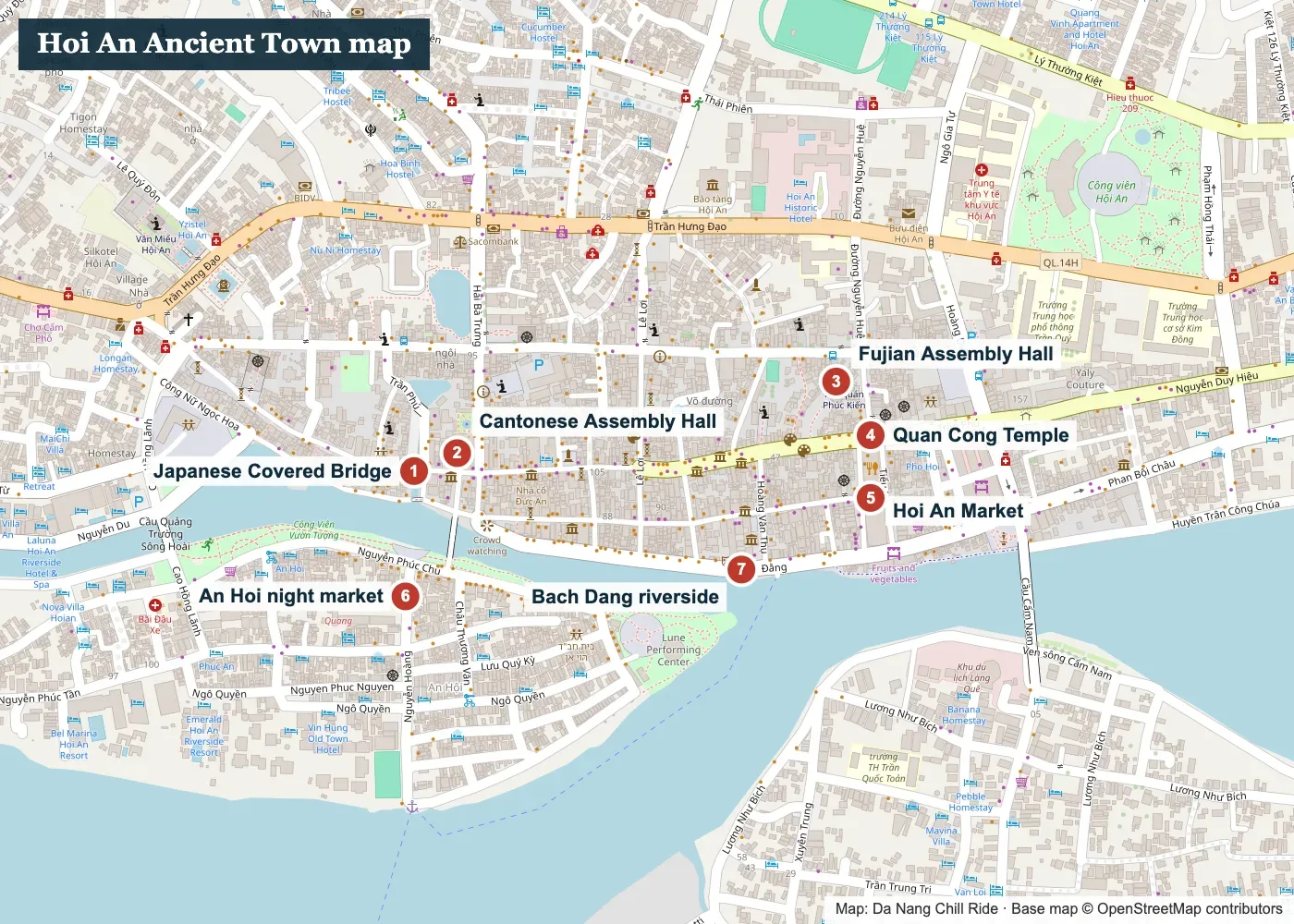
The halls sit inside the walkable old town. If you have not got your bearings yet, our Hoi An old town map shows both halls numbered next to the Japanese Covered Bridge and Hoi An Market.
Which assembly halls are worth your time?
For a first visit, two halls give the clearest picture: Fujian for its size and its incense coils, and Cantonese for its stone and wood carving, about 6 minutes apart on foot (Google Maps, November 2026). Both are on Tran Phu Street, the northern of the old town's three parallel streets.
Fujian Assembly Hall (Phuc Kien), 46 Tran Phu
According to the Da Nang city tourism portal, Fujian merchants bought an old pagoda site here in 1697 and rebuilt the hall in brick and tile in 1757. It was recognised as a national historic and cultural relic in 1990. The main hall honours Thien Hau (Mazu), the sea goddess who protects sailors and traders, with a model of a 19th-century merchant ship nearby.
Look up when you reach the main hall. Large spiral incense coils hang from the ceiling, each carrying a written wish, and a single coil can burn for up to 30 days. The rear hall has altars to the six Fujian patriarchs and to the twelve midwives, where local couples come to pray for children.
Cantonese Assembly Hall (Quang Dong), 176 Tran Phu
The official heritage record from the Hoi An heritage management centre says the hall was founded around 1885 by Cantonese merchants and now honours Quan Cong (Guan Yu), with altars to the founders and the god of wealth on either side. It is a few steps east of the Japanese Covered Bridge, so it pairs easily with the bridge.
The hall stands taller than the houses around it and mixes stone and timber, with carved panels showing court scenes. Its biggest ceremony falls on the 16th day of the first lunar month, which in 2027 is 21 February. You can read the record in Vietnamese on the Hoi An heritage centre website.
Other Chinese communities, such as the Chaozhou and Hainan groups, built smaller halls in the old town too. Check the board at the ticket booth to see which ones are open that day.

Do you need a ticket, and when are the halls open?
Yes: the assembly halls are on the old town's heritage ticket, which costs 80,000 or 120,000 VND in 2026 and can be used for up to three days. The Da Nang city tourism portal lists the Fujian hall as included and open from about 7:00 to 17:00 daily.
The two ticket types differ in how many sites you can enter, not in who you are. Keep the stub with you while you walk around.
| What | Figure | Official source (checked November 2026) |
|---|---|---|
| 80,000 VND ticket | Walk the old town + Japanese Covered Bridge or Quan Cong Temple + 2 other sites | Da Nang city tourism portal, ticket notice of March 2026 |
| 120,000 VND ticket | Bridge or Quan Cong Temple + the museum system + 3 other sites | Da Nang city tourism portal, March 2026 |
| Ticket validity | Up to 3 days; buy once and keep the stub | Da Nang city tourism portal, March 2026 |
| Fujian hall opening hours | About 7:00–17:00, daily | Da Nang city tourism portal, Fujian hall page, December 2025 |
| Fujian hall dates | Built 1697, rebuilt 1757, national relic 1990 | Da Nang city tourism portal, December 2025 |
| Cantonese hall founded | Around 1885 | Hoi An heritage management centre, relic record |
| Walk Cantonese → Fujian | 450 m, about 6 min | Google Maps walking route |
| Old town pedestrian hours | 9:00–21:00 in winter, 9:00–21:30 in summer | Da Nang city tourism portal, March 2026 |
| Folk music shows on the ticket | 10:15, 15:15 and 16:15 at 01 Cao Hong Lanh Street | Da Nang city tourism portal, March 2026 |
How we checked: we read the ticket and site pages of the Da Nang Tourism Promotion Center's city portal and the Hoi An heritage centre's relic record in November 2026, and measured the walk on Google Maps. Opening hours can change on festival days, so check the board at the hall gate.
For every other fee in the area, see our Da Nang and Hoi An entrance fees guide.
What is the best time to visit with kids or as a couple?
Early morning, between 7:00 and 9:00, is the best time for both: it is cooler, the courtyards are quiet, and you can watch locals light incense before work. Late afternoon after 15:30 is the second-best slot.
With young children: the halls are small, flat and quick to see, about 15 to 20 minutes each. The front courtyards have greenery and potted plants, and kids usually love the dragons, the giant incense coils and the ship model. The halls are temples, so if a step or door threshold is in the way, a light stroller is easy to lift or leave by the gate. Plan toilet stops at your café or at Hoi An Market, a short walk east (see our Hoi An market guide). Keep little hands away from candles and the incense burners.
As a couple: the red gates, lanterns and carved roofs make some of the best photo backdrops in town, and local couples often take pre-wedding photos here. Come early for clear shots without crowds. Then cross to the river for sunset and stay for the lanterns, or book the evening show in our Hoi An Memories show guide.

What should you wear and how should you behave inside?
Cover your shoulders and knees, keep your voice low and skip the flash near the altars; these are active shrines visited daily. The city tourism portal asks visitors to avoid very short shorts and sleeveless tops in sacred areas.
- Do not touch statues, bells or carved panels, and do not sit on altar steps.
- If you want to offer incense, light an odd number of sticks and place them neatly.
- Photos are fine in courtyards; step aside if someone is praying.
- Pack a light scarf for children and adults, which also helps in the afternoon sun.
How do you fit the halls into a day in Hoi An?
A simple half-day loop covers the Japanese Covered Bridge, the Cantonese hall, a riverside coffee and the Fujian hall in about 3 hours on foot. Start at the western end with the Japanese Covered Bridge, step into the Cantonese hall next door, then walk east along Tran Phu.
Cars cannot enter the old town during pedestrian hours, so drivers drop you at its edge. From Da Nang Airport to Hoi An, our private car costs $18 (5-seat), $23 (7-seat) or $30 (16-seat van) and takes 40–50 minutes. A day trip from Da Nang with the driver waiting up to 8 hours costs $36, $45 or $60. There is no deposit; you pay the driver at the end. Every ride comes with free child seats (tell us the child's age), a free foldable kids' stroller (ask when you book) and a welcome bag for every adult with water, a cold towel and tissues. In 5- and 7-seat cars kids also get a pack with a sick bag, alcohol-free baby wipes, a Da Nang colouring map and stickers. On the way we can stop at Non Nuoc stone carving village below the Marble Mountains for free if you ask. See the Da Nang to Hoi An route page or message us on WhatsApp +84 968 275 320.
Both halls are easy to find: here is the Fujian Assembly Hall on Google Maps and the Cantonese Assembly Hall on Google Maps.
Frequently asked questions
Can you see the assembly halls without a ticket?
You can see the gates from the street, but entry needs the heritage ticket. Buy it once at an old town booth; it lasts up to three days, so you can split the halls across two mornings.
How long do you need for the Hoi An assembly halls?
Plan 15 to 20 minutes per hall. Two halls plus the walk between them take under an hour, or about 3 hours with the Japanese Covered Bridge and a coffee stop.
Are the halls good on a rainy day?
Yes. The main halls are roofed, so they work well on wet mornings from October to December. Courtyard stones get slippery, so hold small children's hands.
When are the halls busiest?
Mid-morning, when tour groups arrive, and on festival days. The Fujian hall fills with worshippers at the Lantern Festival on the 15th day of the first lunar month (20 February 2027) and at the Thien Hau festival on the 23rd day of the third lunar month, in late April 2027.
Can we visit the halls on a day trip from Da Nang?
Easily. Leave Da Nang by 7:00, see the halls before 9:00, and you will have the rest of the day for lunch, the market and the lanterns. Our Hoi An day trip from Da Nang guide has a full plan.