Da Nang’s Hidden Food Courts: Local Lunch Spots 2026 aren’t secret basements or password-protected eateries. They are the unmarked second floors of market buildings, the alleyways behind office blocks, and the communal dining halls tucked inside residential complexes. While tourist guides focus on the neon-lit Son Tra Night Market and the beachfront seafood rows, locals are eating lunch for VND 20,000–40,000 at these indoor food courts—spaces that rarely appear on Google Maps and never have English menus.
Da Nang’s hidden food courts for local lunch in 2026 are indoor communal dining spaces where office workers, university students, and market vendors eat daily. They are defined by three markers: no English signage, cash-only payment, and peak chaos between 11:30 AM and 1:00 PM. This guide covers five specific spots—from the basement of a Hai Chau office building to the unmarked second floor of Con Market—with dish recommendations, price ranges, and navigation tips. You will learn how to find them, order without Vietnamese, and avoid the 11:45 AM rush.
What Defines a “Hidden Food Court” in Da Nang in 2026?
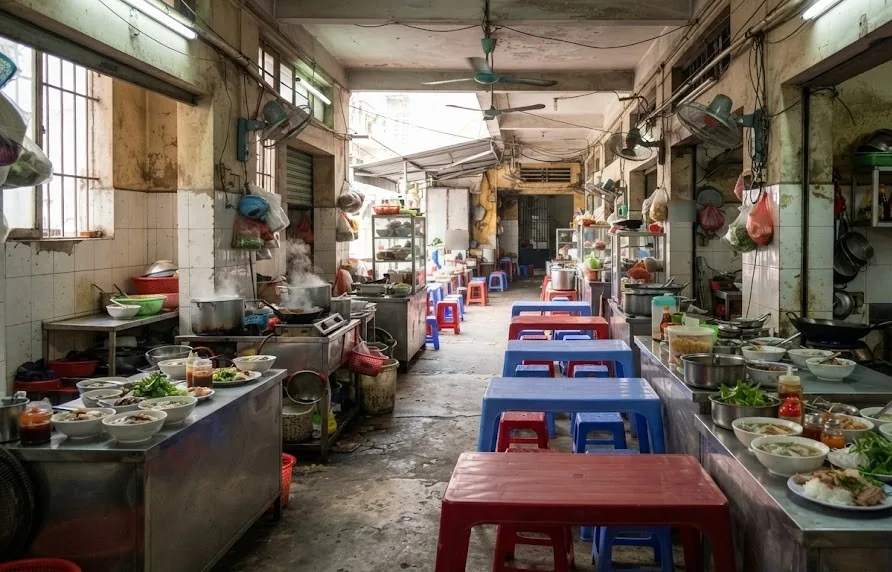
A hidden food court in Da Nang is an indoor, multi-stall dining space serving local lunches, operating without tourist-oriented marketing, and relying entirely on repeat local customers. These are not the curated food halls found in Helio Center or the open-air Son Tra Night Market. They are functional spaces built for speed, affordability, and familiarity.
Update, August 2026: Helio Center suspended Helio Play, Helio Kids and the Helio Night Market for renovation on 5 September 2025, and the Da Nang city tourism portal still lists them as suspended. The Metiz cinema at the same address stayed open. Check directly before you plan a visit.
The shift from street-side stalls to indoor communal dining spaces
Between 2022 and 2026, Da Nang’s city government tightened sidewalk regulations in Hai Chau and Thanh Khe. Street-side stalls that once operated on plastic stools along the pavement moved indoors—into the ground floors of apartment buildings, the basements of commercial blocks, and the upper floors of traditional markets. This shift created a new category of dining: the indoor food court that looks like a canteen but functions like a street-food cluster. Con Market’s second floor, for example, was once a storage area. Today it houses 12 lunch stalls serving bún chả cá and cơm gà.
How local lunch spots differ from tourist-oriented night markets
Son Tra Night Market, open from 5:00 PM to 11:00 PM, targets visitors with grilled seafood, bánh tráng nướng, and souvenir stalls. Prices there start at VND 40,000 for a small portion. A hidden food court like Khu Ẩm Thực Hải Châu serves lunch only, closes by 1:30 PM, and charges VND 20,000–30,000 for the same dish. The difference is not just price—it is purpose. Night markets are entertainment. Hidden food courts are fuel.
Key characteristics: no English menus, cash-only, peak hours 11:30 AM – 1:00 PM
Every hidden food court in Da Nang shares three operational rules. First, menus are handwritten on whiteboards or laminated A4 sheets—entirely in Vietnamese. Second, no stall accepts cards or e-wallets like MoMo. Third, the lunch window is tight: vendors open around 10:30 AM, hit peak chaos at 11:45 AM, and begin shutting down by 1:00 PM. Arrive at 12:30 PM and you will find empty pots and vendors already cleaning their counters.
Why Da Nang’s Lunch Scene Is Moving Underground and Upstairs
Rising commercial rents and stricter street vending laws are pushing Da Nang’s most affordable lunches into non-obvious spaces—basements, second floors, and alleyway cul-de-sacs. This is not a temporary trend but a structural shift in how the city’s food economy operates.
Rent pressure on prime street-front spaces in My An and Hai Chau
In My An, the neighborhood behind My Khe Beach, street-front rent for a 20-square-meter space rose from VND 8 million per month in 2026 to VND 15 million in 2026, according to local real estate listings on Facebook groups. A single bún bò Huế stall cannot sustain that cost. The solution: move to the second floor of a shared building, split the rent among 6–8 vendors, and rely on the density of office workers in the area.
Tòa Nhà 86 Nguyễn Văn Linh in Hai Chau is a textbook example—a six-story office building where floors 2 and 3 have been converted into lunch courts serving the building’s tenants and nearby workers.
The rise of “toà nhà ăn trưa” (lunch buildings) in Son Tra and Thanh Khe
Locals now use the phrase “toà nhà ăn trưa” to describe buildings where multiple food vendors operate on different floors. These are not official food courts—they are organic aggregations. A building near the Da Nang University of Economics at 71 Ngũ Hành Sơn has four lunch stalls on its ground floor and two more on the second floor. No signage advertises this. You discover it by seeing the cluster of motorbikes parked outside at 11:30 AM. The phenomenon is strongest in Son Tra district, where several new apartment blocks have dedicated lunch floors that are invisible from the street.
Social media discovery: how locals share hidden spots via Facebook groups and Zalo
Google Maps is unreliable for these spots. Many are pinned incorrectly or not at all. Instead, locals share locations through Facebook groups like “Đà Nẵng Ăn Gì” (What to Eat in Da Nang) and Zalo chat groups organized by workplace or neighborhood. A typical post reads: “Có quán bún chả cá mới ở tầng 2 số 42 Lê Duẩn, ngon, 25k, bán đến 1h.” Translation: “New bún chả cá stall on floor 2, 42 Lê Duẩn, delicious, 25k, open until 1 PM.” This word-of-mouth network is how hidden food courts maintain their customer base without any tourist-facing presence.
5 Hidden Food Courts Locals Actually Use for Lunch in 2026
These five locations are not listed on any tourist map. Each has been verified through local Facebook groups, Zalo recommendations, and in-person visits by residents. Prices and dishes are accurate as of early 2026.
1. Khu Ẩm Thực Hải Châu – The Office Worker’s Basement
Location: Basement level, 86 Nguyễn Văn Linh, Hải Châu. Look for the blue office building with a Vietcombank ATM on the ground floor. The entrance to the basement is on the left side of the building. Price range: VND 20,000–35,000. Signature dish: Bún thịt nướng (grilled pork noodle bowl) with a side of chả giò (spring rolls). Peak time: 11:40 AM–12:15 PM. Why it works: This basement houses 10 stalls serving the 2,000+ office workers in the building and surrounding offices. The stalls rotate seasonally—in summer, you will find more cold noodle options; in winter, hot bún bò Huế dominates. The space is air-conditioned, which is rare for a food court at this price point.
2. Tầng 2 Chợ Cồn – The Unmarked Floor Above the Chaos
Location: Second floor of Chợ Cồn (Con Market), Hùng Vương Street. Enter through the main market entrance, walk past the dried seafood stalls, and take the stairs near the western exit. Price range: VND 15,000–30,000. Signature dish: Bánh tráng cuốn thịt heo (rice paper rolls with boiled pork and herbs) served with fermented fish sauce. Peak time: 11:30 AM–12:30 PM. Why it works: Most visitors to Con Market stay on the ground floor buying dried squid and coffee. The second floor is where market vendors eat. Eight stalls operate here, each specializing in one dish. The bánh tráng cuốn stall has been run by the same family since 2012. Regulars do not order—they nod at the vendor and she prepares their usual portion.
3. Hẻm 42 Lê Duẩn – The Alley Food Court with 8 Stalls
Location: Alley 42 Lê Duẩn, Hải Châu. The alley entrance is between a pharmacy and a mobile phone shop. Walk 30 meters in. Price range: VND 20,000–40,000. Signature dish: Cơm gà xé (shredded chicken rice) with a bowl of ginger fish sauce. Peak time: 11:30 AM–12:30 PM. Why it works: This is not a single food court but a covered alley where eight stalls operate under a shared corrugated iron roof. Each stall has 3–4 plastic tables. The turnover is fast—most customers finish eating in 15 minutes. The cơm gà xé stall sells out by 12:30 PM daily. Arrive before noon to secure a portion.
4. Food Court 3/2 – The University-Budget Powerhouse
Location: Near the intersection of 3/2 Street and Nguyễn Tri Phương, adjacent to the Da Nang University of Economics. Look for a yellow two-story building with no visible signage. Price range: VND 15,000–25,000. Signature dish: Bún chả cá (fish cake noodle soup) with a side of bánh đa (red noodle) option. Peak time: 11:20 AM–12:00 PM. Why it works: This food court targets university students with tight budgets. A full bowl of bún chả cá with extra fish cake costs VND 25,000—half the price of the same dish at a street-front restaurant. The trade-off is speed: meals are pre-prepared, and you eat within 10 minutes. The space is basic—concrete floors, metal tables, and a loud fan—but the quality is consistent because students will not return to a stall that serves a weak broth.
5. Ngã Tư Khuê Mỹ – The Hidden Cul-de-Sac with Rotating Vendors
Location: Ngã Tư Khuê Mỹ intersection, Ngũ Hành Sơn. The food court is inside a cul-de-sac behind a gas station. Price range: VND 20,000–35,000. Signature dish: Bánh canh cá lóc (thick noodle soup with snakehead fish). Peak time: 11:30 AM–12:30 PM. Why it works: Unlike the other four spots, this food court has rotating vendors. Each day, 5–6 different stalls set up under a shared awning. Monday might feature bánh canh cá lóc; Wednesday switches to hủ tiếu Nam Vang. The rotation keeps regulars coming back daily to see what is available. The turnover is high because vendors test new dishes here before committing to a permanent space.
What to Order at Each Hidden Food Court: Dish-by-Dish Guide
Knowing what to order is more important than knowing where to sit. Each hidden food court has one or two signature dishes that define its reputation among locals. Ordering the wrong dish means eating a mediocre version of something better served elsewhere.
Mi Quang, Bún Chả Cá, and Bánh Tráng Cuốn – the non-negotiable lunch staples
Three dishes appear across almost every hidden food court in Da Nang. Mì Quảng is a turmeric-tinted noodle dish with pork, shrimp, and a small amount of broth—more of a salad with soup than a soup noodle. Look for stalls that use fresh rice noodles, not dried. Bún chả cá is a fish cake noodle soup where the quality of the broth matters most. A good stall simmers the fish bones for at least four hours. Bánh tráng cuốn thịt heo is a DIY roll-your-own dish with rice paper, boiled pork, herbs, and fermented fish sauce.
At Tầng 2 Chợ Cồn, the vendor pre-wets the rice paper for you—a sign of an experienced stall.
Seasonal specials to look for (June–October: Bún Bò Huế, November–February: Cháo Vịt)
Hidden food courts adjust their menus based on season and weather. From June to October, during the rainy season, bún bò Huế appears on more menus. This spicy beef noodle soup from nearby Huế city is a comfort food during Da Nang’s monsoon months. From November to February, cháo vịt (duck porridge) becomes common. The duck is simmered with roasted rice and topped with fresh herbs and fried shallots. At Food Court 3/2, the cháo vịt stall only operates from November to January. Ask a vendor “Có cháo vịt không?” (Do you have duck porridge?) before ordering anything else.
How to communicate your order without Vietnamese: point, gesture, and the “same as him” trick
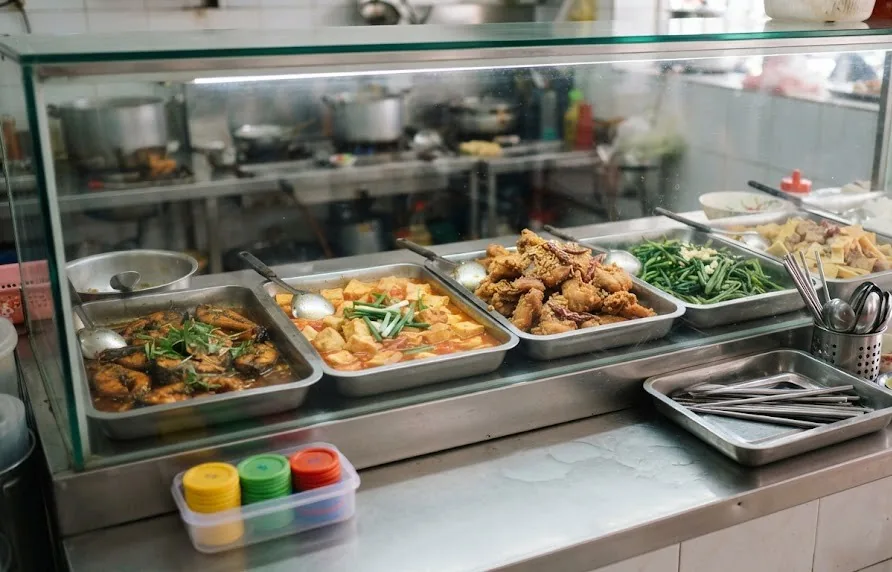
You do not need Vietnamese to eat at these food courts. Three methods work consistently. First, point at the dish on another customer’s table and say “Một phần” (one portion). Vendors understand this gesture immediately. Second, use the “same as him” trick: when you see someone eating something that looks good, point at their bowl and say “Giống vậy” (same as that). Third, carry a phone with Google Translate’s camera function. Hold it over the handwritten menu, and the app will translate the Vietnamese text into English.
The translation is not perfect, but it will identify the main ingredient and cooking method—enough to avoid ordering a bowl of organ meat if you prefer lean pork.
How to Navigate a Hidden Food Court Like a Local
The social rules of a hidden food court are different from a restaurant or a night market. Breaking them will not offend anyone, but following them will make your meal smoother and faster.
The etiquette of seat selection and shared tables
Do not sit at an empty table near the fan. That table is reserved for the stall’s regulars—the customers who eat there daily and have an unspoken arrangement with the vendor. Instead, sit at a table that already has condiment jars and napkins. If a table has a half-empty bowl of chili sauce and a stack of used napkins, it is available. At Khu Ẩm Thực Hải Châu, the tables nearest the entrance are always general seating. The tables in the back corners belong to specific stalls. When in doubt, sit at the largest table—it is almost always shared.
Payment flow: order first, eat, then pay – never the reverse
In a hidden food court, you order and eat before paying. The vendor remembers your face and your table number. After you finish, walk to the stall and say “Tính tiền” (calculate the bill). The vendor will tell you the total. Pay in exact change if possible—these stalls do not always have change for VND 500,000 notes. At the alley food court Hẻm 42 Lê Duẩn, some vendors use a mental tally system. They remember that Table 3 ordered bún bò Huế with extra chili and a fried spring roll.
Do not try to pay before eating—the vendor will wave you away and point at your seat.
Timing your visit to avoid the 11:45 AM rush and the 1:00 PM shutdown
The worst time to arrive is 11:45 AM. This is when office workers flood the food court. Every stall has a line, and seats are scarce. Arrive at 11:15 AM and you will have your pick of tables and a shorter wait. Arrive at 12:30 PM and you risk finding empty pots—especially at stalls known for a single dish. At Tầng 2 Chợ Cồn, the bánh tráng cuốn stall sells out by 12:15 PM. At Food Court 3/2, the bún chả cá stall is empty by 12:30 PM. By 1:00 PM, most stalls are washing their pots.
If you arrive after 1:00 PM, your only option is a bowl of phở from a stall that made extra broth—and even that is not guaranteed.
Key Differences Between Hidden Food Courts and Popular Tourist Markets
The gap between a hidden food court and a tourist market is not just about price. It is about language, consistency, and the relationship between vendor and customer.
| Attribute | Hidden Food Court (e.g., Tầng 2 Chợ Cồn) | Tourist Market (e.g., Son Tra Night Market) |
|---|---|---|
| Price for bún chả cá | VND 20,000–25,000 | VND 50,000–70,000 |
| Menu language | Handwritten Vietnamese only | Vietnamese + English + photos |
| Payment | Cash only | Cash, card, MoMo |
| Operating hours | 10:30 AM–1:30 PM | 5:00 PM–11:00 PM |
| Customer base | 90% local regulars | 60% tourists, 40% locals |
| Dish consistency | Same vendor, same recipe, same quality for years | Rotating vendors, variable quality |
| Seating | Shared plastic tables, no reserved seats | Assigned tables, often with table service |
At Con Market’s second floor, the bánh tráng cuốn vendor has been using the same fish sauce recipe since 2012. Her regulars return because the flavor is predictable. At Son Tra Night Market, the vendor selling bánh tráng cuốn changes every few months, and the recipe shifts with each change. This consistency gap is why locals spend VND 20,000 at a hidden food court rather than VND 60,000 at a tourist market for the same dish.
Important Practical Notes Before You Go
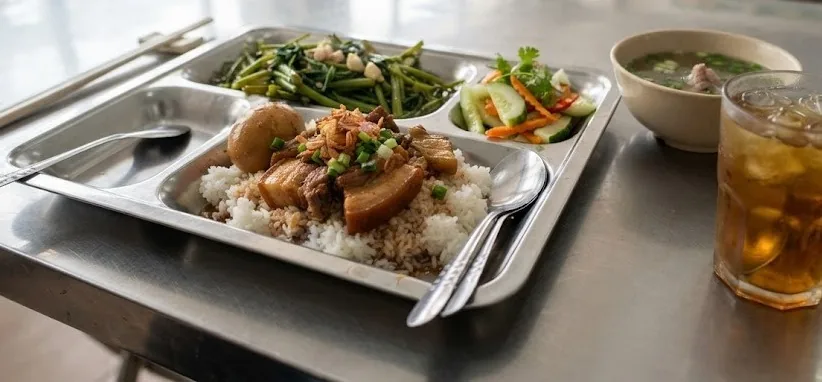
Hidden food courts require preparation. Without cash, a working phone, and the right expectations, your visit will be frustrating rather than rewarding.
Cash readiness: ATMs near each food court location
None of the five food courts listed accept cards. Bring Vietnamese đồng in small denominations—VND 10,000, 20,000, and 50,000 notes. ATMs are available near each location. For Khu Ẩm Thực Hải Châu, use the Vietcombank ATM at 86 Nguyễn Văn Linh (ground floor of the same building). For Tầng 2 Chợ Cồn, use the Agribank ATM at the market’s eastern entrance. For Hẻm 42 Lê Duẩn, the nearest ATM is a Techcombank branch at 50 Lê Duẩn, a two-minute walk. For Food Court 3/2, use the BIDV ATM at 100 3/2 Street.
For Ngã Tư Khuê Mỹ, the closest ATM is at the Petrolimex gas station at the intersection.
Google Maps accuracy issues: how to verify the spot is still open
Google Maps pins for hidden food courts are often outdated or misplaced. Before visiting, check the location on Facebook by searching the area name plus “quán” (e.g., “Khu Ẩm Thực Hải Châu quán”). If there is a recent post within the last two weeks, the spot is likely still open. Alternatively, search Google Maps for nearby landmarks—the Vietcombank ATM for Khu Ẩm Thực Hải Châu, the pharmacy at Hẻm 42 Lê Duẩn—and walk the last 50 meters. The food court will be visible by the cluster of motorbikes parked outside.
Hygiene expectations: what’s acceptable and what to avoid
Hidden food courts operate at a hygiene level appropriate for high-turnover lunch service. Plates and bowls are washed in communal sinks with hot water and detergent. Ice is delivered in sealed bags from commercial ice factories—standard practice in Da Nang. Avoid stalls where raw meat is left uncovered at room temperature for more than 30 minutes. At Khu Ẩm Thực Hải Châu, the stalls with the longest lines are the safest choices because ingredients turnover is fast. At Tầng 2 Chợ Cồn, the stalls near the open windows have better ventilation and less smoke buildup.
Trust your nose: if the fry oil smells rancid, choose another stall.
Related on this site
- Da Nang’s Best Street Food Tours: Taste the City in 2026
- Da Nang’s Affordable Eats: Budget-Friendly Meals Under $5 2026
- where to eat com tam in Da Nang
Frequently Asked Questions
Do these food courts have vegetarian options?
Most do not have dedicated vegetarian stalls, but you can request “chay” (vegetarian) at a bún chả cá or cơm gà stall. The vendor will serve the dish without meat or fish sauce. At Tầng 2 Chợ Cồn, one stall offers bún chay (vegetarian noodle soup) on Mondays and Fridays.
Can I bring children to these food courts?
Yes. The shared table setup works well for families. Children can eat from multiple dishes. The only challenge is the heat—most food courts are not air-conditioned, so bring a handheld fan for young children during summer months.
What if I have a food allergy?
Communicating allergies is difficult without Vietnamese. Write “Dị ứng [ingredient]” on your phone and show it to the vendor. Common allergies include đậu phộng (peanuts), tôm (shrimp), and sữa (dairy). Most vendors will accommodate if they understand the request.
Are these food courts open for dinner?
No. All five food courts listed operate exclusively for lunch. Some stalls at Ngã Tư Khuê Mỹ occasionally serve until 3:00 PM, but by 2:00 PM most vendors have closed for the day.
How do I find these spots without a phone?
Use the landmark method. Memorize the nearest ATM or major intersection. For Khu Ẩm Thực Hải Châu, the landmark is the Vietcombank ATM at 86 Nguyễn Văn Linh. For Tầng 2 Chợ Cồn, the landmark is the Con Market main entrance. Walk toward the cluster of motorbikes parked at lunchtime—that is where the food court is.
Is it safe to eat raw vegetables at these food courts?
Yes. Vietnamese food courts use vegetables that are washed in salted water or diluted potassium permanganate solution—standard food safety practice in Da Nang. The herbs (mint, basil, perilla) are from local farms and are generally safe. If you have a sensitive stomach, skip the raw bean sprouts.
What is the best time to take photos?
Arrive at 11:00 AM, before the rush. The light is better, the stalls are fully stocked, and you can photograph the dishes without crowds in the frame. By 11:45 AM, the food court is too crowded for good photos.
Next Steps
Da Nang’s hidden food courts offer the city’s most authentic lunch experience at a fraction of tourist-market prices. Start with Tầng 2 Chợ Cồn for bánh tráng cuốn, then try Khu Ẩm Thực Hải Châu for bún thịt nướng. Bring cash, arrive before 11:30 AM, and use the pointing method to order.
Here are three action steps for your first visit:
- Withdraw VND 200,000 in small denominations (VND 10,000 and VND 20,000 notes) from a Vietcombank or Agribank ATM the morning of your visit.
- Open Google Maps and pin the nearest landmark—the Vietcombank ATM for Khu Ẩm Thực Hải Châu or the Con Market entrance for Tầng 2 Chợ Cồn.
- Arrive at 11:15 AM, walk toward the cluster of motorbikes, find a shared table, and point at the dish someone else is eating to place your order.
Part of our guide to what to eat in Da Nang.
Image: “Food stall in the Bắc Hà Sunday market, Vietnam – 20131027-04” — CC BY-SA 3.0, via Wikimedia Commons.