Da Nang is known for its beaches and bridges, but a quieter layer of history waits behind the shutters of its colonial-era buildings. Staying in one of these properties offers a direct connection to the city’s French colonial past, a chance to sleep in rooms where governors once lived and merchants once traded. For 2026, this type of accommodation is becoming a defining travel experience in Central Vietnam.
Staying in a colonial building in Da Nang means sleeping in spaces with original terrazzo floors, high ceilings, and shuttered windows that date back to the early 1900s. Properties like La Résidence Hotel & Spa and The Memory Danang offer authentic heritage stays, not just themed decor.
What Defines a Colonial Building Stay in Da Nang — and Why 2026 Is the Year to Book One
A colonial building stay in Da Nang means occupying a space originally built between 1888 and 1954, now converted into a hotel that preserves its original architectural DNA.
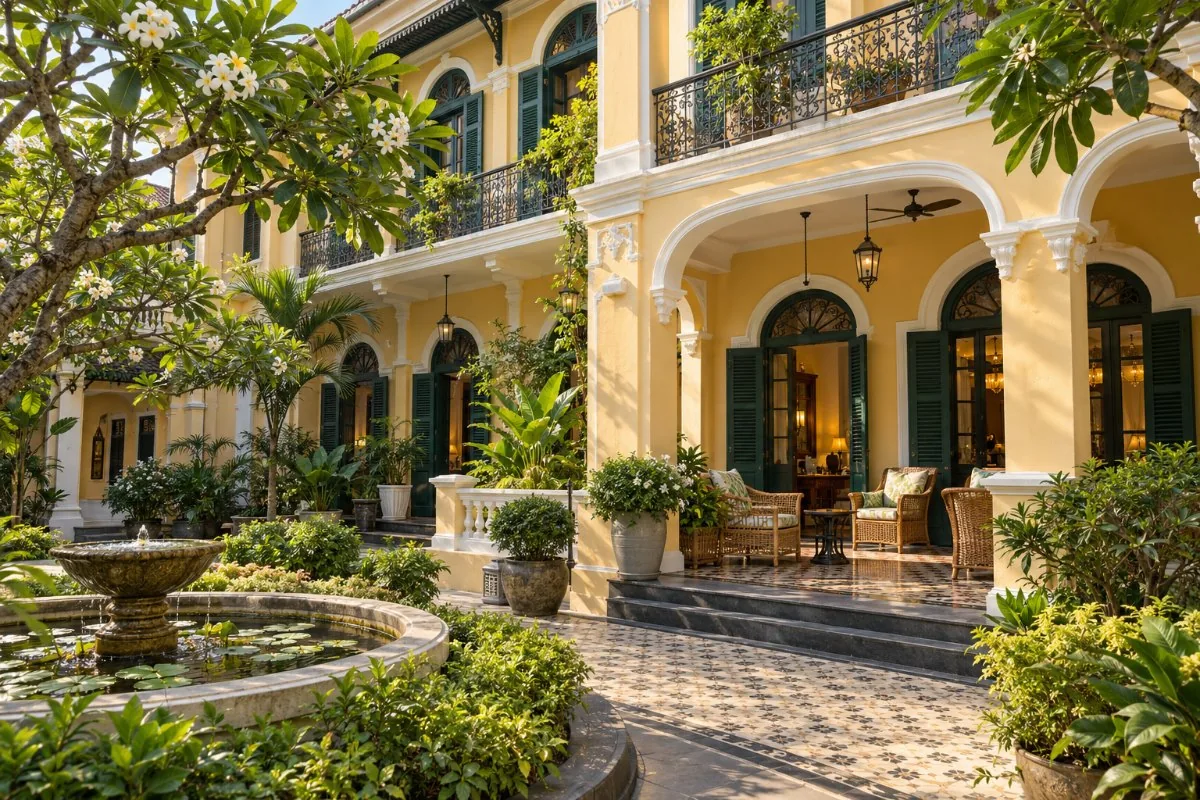
The French colonial legacy in Central Vietnam left behind a distinct architectural style. Administrative buildings, villas, and trading offices were constructed with a mix of European neoclassical forms and tropical adaptations. You see it in the shuttered windows designed to catch the breeze, the terrazzo floors that stayed cool in the heat, and the high ceilings that allowed hot air to rise away from living spaces. These features were practical solutions for the climate, not just aesthetic choices.
Adaptive reuse hotels in Da Nang have taken these original structures and added modern plumbing, air conditioning, and reliable WiFi without gutting the character. When you book a room at La Résidence, you are not staying in a replica. You are staying in a building where the original timber beams hold the roof and the original lime-washed walls still breathe. The 2026 travel market shows a measurable shift away from “same-same” international chains. Travelers are looking for stories, and a colonial building comes with one built in.
The Best Colonial-Era Stays in Da Nang City Center
La Résidence Hotel & Spa — a 1920s French governor’s mansion reborn on the Han River
La Résidence is the closest you can get to sleeping inside Da Nang’s colonial history without sacrificing a king-sized bed and rain shower.
Originally built in 1924 as the residence for the French governor of Tourane (Da Nang’s colonial name), this property sits directly on the Han River at 18 Bach Dang Street. The building retains its original U-shaped layout with a central courtyard, now converted into a pool and garden area. Only 28 rooms occupy the original structure — the rest are in a newer wing built in 2026. To get the genuine experience, book a “Heritage Room” category, which guarantees you’re in the original building with 4.2-meter ceilings, original terrazzo floors, and shuttered windows overlooking the river.
What makes La Résidence stand out is its commitment to historical accuracy. The hotel hired a heritage architect from Hue to restore the facade’s original lime-wash color — a pale yellow called “jaune Indochine” — using period-correct techniques. The lobby still has the original fireplace, now functional with a gas insert, and the staircase banister is the original wrought iron from the 1920s. Room rates start at $120/night in low season, rising to $200 in peak months (April-August). The hotel’s “Heritage Discovery Package” at $180/night includes a guided tour of the building’s history and a colonial-era afternoon tea service.
Mercure Danang French Village Bana Hills — colonial fantasy or faithful replica? What to expect
Mercure Danang French Village is a theatrical recreation of a French colonial town, not a genuine heritage building — and that matters for your expectations.
Located in the Bana Hills complex 1,400 meters above sea level, this hotel is part of Sun World’s French Village theme park. The architecture is meticulously researched — cobblestone streets, Gothic-style church, and colonial villas — but none of the buildings are original. They were constructed between 2013 and 2018, using French architectural patterns from the 1920s as design inspiration. This means you get the aesthetic of a colonial French town without the historical patina.
For travelers who value authenticity, this is a disappointment. However, the French Village offers something genuine colonial stays cannot: cool mountain air (average 18°C year-round), a cable car ride that holds the world record for longest non-stop route, and access to the Bana Hills entertainment complex. Room rates are comparable to city-center colonial stays at $100-150/night. The hotel’s “Colonial Suite” category includes a private terrace with French-style wrought iron furniture.
If you want the look of colonial architecture without the humidity, noise, or aging infrastructure of a genuine heritage building, this is a solid alternative — just don’t pretend it’s real.
The Memory Danang — how a former colonial-era trading office became a boutique stay
The Memory Danang proves that a former trading office can become a more intimate stay than a governor’s mansion.
Located at 7 Le Loi Street, a short walk from the Han River, this property was originally built in 1928 as the headquarters for a French trading company exporting silk and spices. The building’s commercial past is visible in its layout: wide corridors for moving goods, high ceilings for ventilation, and a large central hall that was once the trading floor. Today, that hall serves as the hotel’s lobby and breakfast area, with the original timber beams and a mezzanine level added for seating.
The Memory has only 12 rooms, all in the original building. Each room is slightly different in layout, reflecting the original office divisions. Room 7, for instance, was the manager’s office and has a corner balcony overlooking the street — book this room if available. The hotel’s owner, a local history enthusiast, has curated a small museum in the basement displaying original trading documents, scales, and photographs from the 1930s. Room rates are higher than La Résidence, starting at $150/night, reflecting the boutique size and curated experience.
The hotel’s “History & Heritage” package at $200 includes a private walking tour of colonial-era buildings along Bach Dang Street.
Historic Stays Near Da Nang: Hoi An’s Colonial and Merchant Houses Worth the Trip
The Old House of Tan Ky — can you stay overnight in a 200-year-old merchant home?
No — the Old House of Tan Ky is a museum, not a hotel, but its architecture sets the standard for what “heritage” means in the region.
The Old House of Tan Ky, built in 1741, is one of Hoi An’s most famous merchant houses. It combines Vietnamese, Chinese, and Japanese architectural elements with later French colonial additions like the second-floor balcony and louvered windows. The house is still owned by the same family that built it, now in its seventh generation. You can visit daily from 8:00 AM to 5:00 PM for an entrance fee of 120,000 VND ($5), but overnight stays are not permitted — the house is a UNESCO-protected structure.
For an overnight experience that captures a similar atmosphere, book the Hoi An Ancient Town Village Resort & Spa, which uses restored merchant houses as guest accommodations. The key difference: the Old House of Tan Ky gives you the original, untouched structure, while the resort offers a curated version with modern plumbing and air conditioning. Visit Tan Ky during the day to see the real thing, then sleep in a restored version at the resort. This combination gives you both authenticity and comfort.
Anantara Hoi An Resort — colonial elegance on the Thu Bon River with original French villa architecture
Anantara Hoi An offers the most polished colonial experience in the region, with original French villas converted into luxury suites.
Built in 2006, the resort’s architecture deliberately mimics French colonial style, but with a key difference: several villas were relocated from their original sites in Da Nang and Hoi An and reconstructed here. The “Heritage Villa” category, for example, uses original doors, window frames, and tiles salvaged from a 1920s French villa in Da Nang that was slated for demolition. This gives the rooms genuine historical materials within a modern resort infrastructure — arguably the best balance of authenticity and comfort.
The resort sits on the Thu Bon River, 10 minutes from Hoi An’s Ancient Town. Its colonial credentials include a main building modeled after the French governor’s residence in Hue, with a sweeping staircase and a library filled with books on Vietnamese history. Room rates start at $200/night for a Deluxe Room, rising to $400 for a Heritage Villa. The resort’s “Colonial Heritage Experience” at $350/night includes a guided tour of Hoi An’s French colonial buildings, a cooking class using French-Vietnamese fusion recipes, and a colonial-era cocktail making session.
This is the best option for travelers who want colonial atmosphere without any rough edges.
Hoi An Ancient Town Village Resort & Spa — a cluster of restored heritage villas turned into guest rooms
This resort offers the most authentic “sleeping in a heritage building” experience near Hoi An, at a lower price point than Anantara.
Located at 479 Cua Dai Street, this property consists of seven restored villas that were originally built between 1920 and 1940 as summer homes for French colonial officials and wealthy Vietnamese merchants. Each villa has been individually restored, preserving original features like terrazzo floors, timber beam ceilings, and French ceramic tiles. The resort’s grounds include a large pool, spa, and restaurant, but the villas themselves maintain their original layout and character.
Room rates start at $80/night for a Superior Room in a shared villa, rising to $150 for a private villa with a living room and garden. The resort’s “Heritage Villa” category guarantees you’re in one of the original buildings, with period-appropriate furniture (reproductions, not antiques, but faithful to the 1920s style). The downside: some villas have thin walls and original windows that let in street noise. Book a villa at the back of the property for quieter sleep. This is the best value-for-money colonial stay in the region, especially for longer stays of 3-5 nights.
How to combine a Da Nang colonial stay with a Hoi An day trip (logistics for 2026)
The optimal strategy: base yourself in Da Nang for 3 nights, then move to Hoi An for 2 nights, using the colonial stays as your anchor at each location.
The distance between Da Nang city center and Hoi An Ancient Town is 30 kilometers, roughly 45 minutes by car or taxi (Grab car costs $12-15 one way). For 2026, a new express bus service launched by the Da Nang Department of Transport runs every 30 minutes from 6:00 AM to 10:00 PM, with a fare of 50,000 VND ($2). This makes day-tripping feasible, but staying overnight in Hoi An is recommended to experience the Ancient Town after the day-trippers leave at 5:00 PM.
A suggested itinerary: spend nights 1-3 at La Résidence or The Memory in Da Nang, exploring the city’s colonial architecture, museums, and beaches. On day 3, check out and take a Grab to Hoi An. Spend nights 4-5 at Anantara or Hoi An Ancient Town Village Resort. This gives you two distinct colonial experiences — the French administrative style in Da Nang and the merchant house style in Hoi An — without backtracking. Book both hotels directly for the best heritage room guarantees.
What to Look for in a Colonial Building Stay: Authenticity vs. Theming
Original structural features: checking for genuine French tiles, timber beams, and lime-washed walls
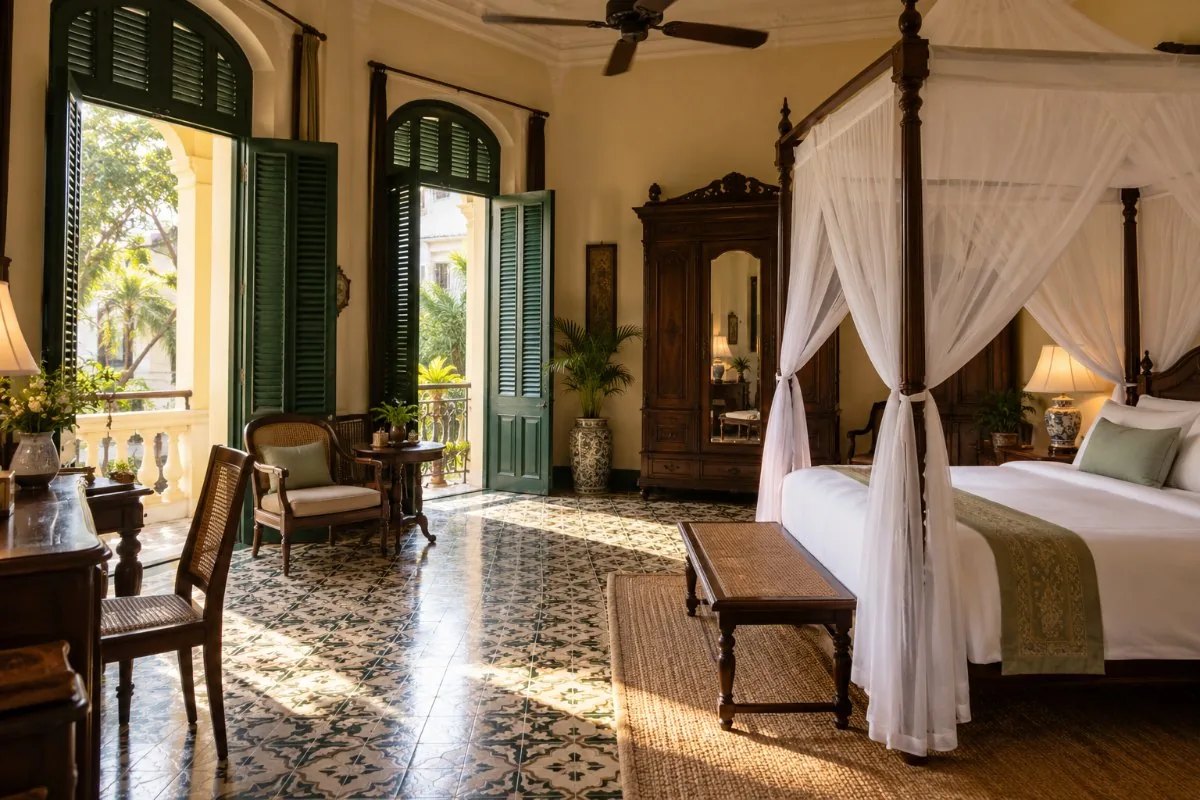
Genuine colonial buildings share three non-negotiable features: terrazzo or parquet flooring, timber beam ceilings, and lime-wash or stucco walls.
Before booking, check the hotel’s website or call to confirm these three elements are original, not reproductions. Original terrazzo floors have a distinct patina — slight unevenness, tiny cracks, and a gloss that comes from decades of polishing, not factory finishing. Timber beams should show age marks: nail holes from previous uses, slight warping, and a dark color from years of exposure. Lime-wash walls have a soft, matte texture that modern paint cannot replicate — run your hand across the wall; if it feels chalky and slightly powdery, it’s likely original.
Red flags include: perfectly uniform tiles that look fresh from a factory, beams that are still light-colored (indicating new wood), and walls with a glossy paint finish. Hotels that use “colonial style” as a marketing term often install new materials that mimic old ones — check for these tells. If the hotel’s website shows photos of rooms with modern wall paint and new tiles but calls them “colonial,” move on.
Red flags: when “colonial style” means cheap replica furniture and no heritage story
If the hotel can’t tell you the original purpose of the building or its construction date, you’re probably in a themed replica.
Genuine heritage hotels have a story to tell. La Résidence can tell you exactly which French governor lived there, when the building was renovated, and which original features remain. The Memory Danang has a museum of original trading documents. If a hotel’s “heritage” claim consists only of dark wood furniture and a vintage sign in the lobby, it’s likely a themed property. Specific red flags:
- No mention of the building’s original function or construction date on the website
- All rooms look identical (genuine heritage buildings have varied room layouts)
- Furniture is clearly new but styled to look old (check for modern drawer slides, uniform wood grain)
- No original architectural features visible in the lobby or common areas
- Staff cannot answer questions about the building’s history
Mercure Danang French Village is the clearest example of theming over authenticity — it’s a designed experience, not a historic building. That’s fine if you know what you’re getting, but don’t confuse it with a genuine colonial stay.
How to verify a property’s historical credentials before booking
Three verification methods take less than 10 minutes and can save you from booking a themed replica.
First, check the hotel’s “About Us” or “History” page for specific details: construction year, original owner or function, and which features are original. If this information is missing or vague, call the hotel directly. Second, search Google Images for “hotel name Da Nang original” or “hotel name colonial architecture” — look for photos that show the building’s exterior and interior before renovation; these often appear in architectural blogs or travel articles. Third, check TripAdvisor reviews for mentions of “original,” “genuine,” or “authentic” versus “fake,” “replica,” or “themed.”
For 2026, a new tool called “HeritageCheck” launched by the Vietnam National Administration of Tourism allows you to verify a hotel’s heritage status by entering its address. The database includes 1,200 registered heritage properties nationwide, including 47 in Da Nang and Hoi An. If your chosen hotel isn’t listed, ask why — it may not meet the criteria for genuine heritage status.
Booking in 2026: Pricing, Seasons, and How to Secure the Best Colonial Room
Peak vs. shoulder season pricing for heritage properties in Da Nang and Hoi An
Colonial stays in Da Nang follow a predictable pricing pattern: peak season (April-August) costs 40-60% more than low season (September-February, excluding Tet).
Da Nang’s high season runs from April through August, when weather is driest and temperatures average 28-34°C. During this period, La Résidence charges $200-250/night for a Heritage Room, while The Memory Danang reaches $200-250. Low season (October-February, excluding the Tet holiday in January/February) sees rates as low as $80-120 for the same rooms, but expect rain and occasional storms.
Hoi An colonial stays follow a similar pattern but with a longer shoulder season from February to May and September to November. Anantara’s Heritage Villas peak at $400-500/night in July-August, dropping to $250-300 in shoulder season. The Hoi An Ancient Town Village Resort ranges from $120-180 in peak to $70-100 in low season. For 2026, booking at least 60 days in advance is recommended for peak season, as heritage properties have limited room counts (12-28 rooms) and sell out faster than modern hotels.
Which room categories in colonial hotels offer the most authentic experience
Always book the “Heritage,” “Original,” or “Colonial” room category — these guarantee you’re in the historic building, not a modern addition.
Colonial hotels typically have two room categories: those in the original building and those in a newer wing. La Résidence’s “Heritage Room” is in the 1924 mansion; its “Deluxe Room” is in the 2018 wing with modern construction and no original features. The Memory Danang has only original building rooms, so any category works. Anantara’s “Heritage Villa” uses salvaged materials; its “Deluxe Room” is modern-built colonial-style.
When booking, call the hotel and ask: “Is this room in the original 1920s building, or a newer addition?” If the reservation agent can’t answer, ask to speak to the front desk manager. Also confirm that the room retains original features — some hotels have retained the building’s exterior but gutted the interior, replacing original floors and ceilings with modern materials. A genuine heritage room should have at least two original features (terrazzo floors, timber beams, or shuttered windows) visible in the bedroom itself.
Direct booking vs. OTA: which platform gives you heritage room guarantees
Book directly with the hotel for the best heritage room guarantee and potential upgrades.
Online travel agencies (OTAs) like Booking.com and Agoda often list colonial hotels but may not specify which rooms are in the original building. A 2025 study by HotelTechReport found that 23% of OTA listings for heritage properties in Vietnam had incorrect room category information. Direct booking solves this: you can specify “Heritage Room in original building” in the booking notes, and the hotel can confirm availability.
Direct booking also offers better cancellation policies and perks. La Résidence offers a 10% discount for direct bookings and a guaranteed Heritage Room upgrade if available at check-in. The Memory Danang includes a free heritage walking tour for direct bookers. Anantara’s direct booking rate includes breakfast and a welcome cocktail.
Important Considerations Before Booking a Colonial Stay
Noise and insulation: what to expect from old buildings with thin walls and original windows
Colonial buildings were not designed for soundproofing — expect to hear street noise, neighboring rooms, and the building’s natural creaks.
Original shuttered windows, while beautiful, provide minimal sound insulation compared to modern double-glazed windows. At La Résidence, rooms facing Bach Dang Street hear traffic noise from 6:00 AM onward. The Memory Danang’s central location on Le Loi Street means motorbike noise until late evening. Interior walls in colonial buildings are often single-brick thickness, so conversations in adjacent rooms are audible. Some hotels have addressed this: La Résidence installed secondary glazing behind the shutters, and The Memory Danang added acoustic panels in the ceiling cavities. But no colonial stay can match a modern hotel’s silence.
For light sleepers, request a room at the back of the building or on a higher floor. Bring earplugs as a backup. Alternatively, choose a property like Anantara Hoi An, which sits on a quieter riverfront location with more distance between villas. The trade-off: quieter rooms often lack the best views or original window features. Decide which matters more — silence or authenticity.
Accessibility challenges: stairs without elevators, uneven floors, no modern HVAC in some rooms
Most colonial buildings in Da Nang and Hoi An were built before accessibility standards existed — stairs are steep, floors are uneven, and some rooms lack modern air conditioning.
La Résidence has no elevator in the original building; Heritage Rooms are on the second floor accessed by the original staircase. The Memory Danang has three floors with no elevator. Hoi An Ancient Town Village Resort has single-story villas, making it the most accessible option. Original terrazzo floors, while beautiful, are often uneven — you’ll feel slight slopes and dips as you walk. Doorways are narrower than modern standards, and bathrooms in original building rooms may have step-in tubs rather than walk-in showers.
Air conditioning varies. Most colonial hotels have installed modern HVAC systems, but some original building rooms rely on ceiling fans and open windows for cooling. At La Résidence, Heritage Rooms have split-unit AC installed discreetly in the ceiling; at The Memory, AC units are wall-mounted but hidden behind decorative panels. Always confirm the cooling method before booking, especially for summer travel. If you need consistent temperature control, choose a newer wing room or a property like Anantara, which has full modern HVAC.
Mosquito management and humidity control in tropical heritage properties
Tropical humidity and mosquitoes are the two biggest comfort challenges in colonial stays — prepare accordingly.
Colonial buildings were designed for natural ventilation, which means they’re more exposed to the outdoors. Original windows lack modern seals, allowing mosquitoes entry. Most heritage hotels provide mosquito nets over beds and plug-in repellent devices, but these aren’t always sufficient. The Memory Danang provides a mosquito coil on the balcony and a spray in the room. La Résidence has a pest control service that treats rooms weekly. For 2026, bring your own DEET-based repellent and consider a portable mosquito net if you’re sensitive to bites.
Humidity is a constant challenge. Original terrazzo floors can feel damp during rainy season (October-February). Hotels run dehumidifiers in common areas, but rooms may still feel sticky. Pack quick-dry clothing and avoid storing electronics in drawers that might trap moisture. The upside: colonial buildings’ high ceilings and cross-ventilation mean they cool down faster at night than modern concrete buildings. Open windows in the evening to let the breeze through, then close them before dawn when mosquitoes are most active.
Related on this site
- Charming Boutique Stays in Da Nang You Should Try
- Explore Da Nang’s Old Town: Charming Guesthouses 2026
Frequently Asked Questions
Are colonial building stays in Da Nang expensive compared to modern hotels?
They are moderately more expensive. A Heritage Room at La Résidence costs $120-200/night, while a modern 4-star hotel in Da Nang averages $60-100. The value is in the experience, not the amenities — you’re paying for a room that cannot be replicated.
Can I find a colonial stay that is also family-friendly?
Yes, but with limitations. Hoi An Ancient Town Village Resort offers family-sized villas with separate bedrooms and a kitchenette. Anantara Hoi An has connecting rooms and a kids’ club. La Résidence and The Memory Danang are better suited for couples due to their small room counts and lack of children’s facilities. For families, choose a property with villa-style accommodations.
What is the best time of year to book a historic stay in Da Nang?
March, April, September, and October offer the best balance of good weather and lower rates. Avoid July-August for peak pricing and February for Tet holiday closures. For the most authentic experience, book in shoulder season when fewer tourists allow for quieter stays and more personal attention from hotel staff.
Do these properties offer guided historical tours of the building?
La Résidence and The Memory Danang offer guided tours included in their Heritage packages. Anantara offers a “Colonial Heritage Experience” with a guided walking tour of Hoi An’s French colonial buildings. Hoi An Ancient Town Village Resort provides a self-guided map of the property’s history. Always ask at check-in — tours may be scheduled only on certain days.
How far in advance should I book a colonial stay for 2026 travel?
For peak season (April-August), book 60-90 days in advance. For shoulder season, 30-45 days is sufficient. Heritage rooms sell out first — if you see availability for a specific room category, book immediately rather than waiting. Direct booking gives you the best chance of securing the room you want.
Next Steps
Colonial building stays in Da Nang offer a tangible connection to the city’s history that no modern hotel can replicate. The key is to book a property with genuine original features, not a themed replica, and to prepare for the quirks that come with staying in a building that is nearly a century old. Your next steps are simple:
- Choose between a Da Nang city center stay (La Résidence or The Memory Danang) or a Hoi An heritage experience (Anantara or Hoi An Ancient Town Village Resort).
- Book directly with the hotel and confirm your room is in the original building.
- Pack earplugs, a mosquito repellent, and an open mind for an experience that is more about atmosphere than luxury.
Part of our guide to where to stay in Da Nang.